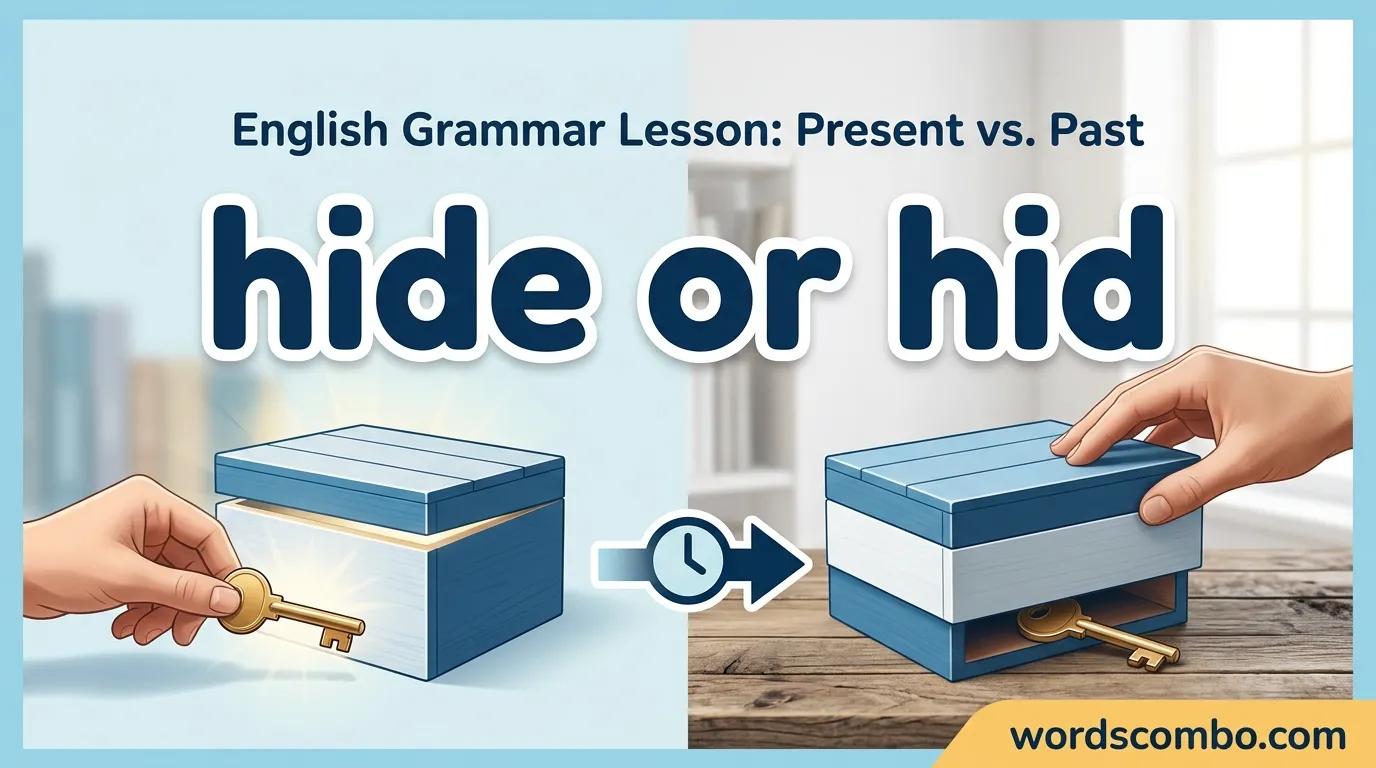
Hide is the base form of the verb, while hid is its simple past tense. Use hide for present, future, commands, and infinitives, and hid for completed past actions.
I caught this exact mistake once while editing a short email. The sentence said, “Yesterday, I hide the file in the shared folder.” It looked almost right, and that was the problem. My eyes moved past it twice before the tense finally stood out.
If you have ever stopped over a sentence like “I hide the keys” or “I hid the keys,” you are dealing with the same small grammar trap. The two words are not different spellings of the same tense. They are different forms of the same irregular verb.
The good news is that the rule is simple. Hide = present or base form. Hid = simple past. Hidden = past participle. Once you see the pattern, sentences that once felt uncertain become easy to fix.
This guide breaks down the difference with simple examples, common mistakes, real-world writing, and a quick memory trick. By the end, you should know exactly which form belongs in your sentence.
Hide or Hid: The Quick Answer
Both hide and hid are correct. The choice depends on when the action happens.
- Hide = present or base form
- Hid = simple past
- Hidden = past participle
For example:
- I hide my keys in the desk drawer.
- Yesterday, I hid my keys in the desk drawer.
The first sentence describes a present or regular action. The second describes something that already happened.
Where Hide and Hid Come From
The verb hide has very old English roots. It comes from Old English hȳdan, a verb connected with concealing or keeping something out of sight. Over time, its past form developed as hid rather than the regular hided pattern.
That makes hide an irregular verb.
Regular verbs usually form the past with -ed:
- walk → walked
- clean → cleaned
- open → opened
But irregular verbs do not follow that pattern:
- write → wrote
- drive → drove
- take → took
- hide → hid
So hided is not the normal past tense when you mean “concealed something.” The standard form is hid.
The full pattern is worth remembering:
hide → hid → hidden
Once you learn all three forms together, many tense mistakes disappear.
Hide vs. Hid: What Is the Real Difference?
The key difference is verb tense.
| Term | Meaning | When to Use | Region/Context |
| hide | Conceal or keep out of sight | Present, future, commands, infinitives | Standard English |
| hid | Concealed something in the past | Completed past action | Standard English |
| hidden | Concealed, used as a past participle | Perfect tenses and passive voice | Standard English |
| hiding | In the act of concealing | Continuous forms | Standard English |
Use hide for the present
- I hide my diary in my desk.
- They hide the gifts before the party.
- Please hide this document from public view.
You also use hide after words such as will, can, should, must, and to.
- I will hide the gift.
- She can hide the evidence.
- You should hide your password.
- He wants to hide the surprise.
Use hid for the simple past
Use hid when the action happened before now and is presented as a completed past event.
- I hid the keys yesterday.
- She hid behind the door.
- They hid the letter under the mattress.
- He hid his disappointment during the meeting.
Do not forget hidden
A common mistake is stopping at hid when the sentence needs a past participle.
Correct:
- I have hidden the file.
- She has hidden the gift.
- They had hidden the documents.
Not:
- I have hid the file.
- She has hid the gift.
- They had hid the documents.
The standard pattern is:
hide → hid → hidden
Which Form Should You Use?
The easiest way to choose is to look at the sentence around the verb.
For beginners and students
Use this simple rule:
- Now or usually: use hide
- Already happened: use hid
- With has, have, or had: use hidden
Example:
I hide my notes in this folder.
I hid my notes there yesterday.
I have hidden my notes in the folder.
For professional writers
Focus on the tense of the whole sentence.
If you are describing an action that happened at a definite point in the past, choose hid.
The employee hid the document before the meeting.
If you are describing a current practice, use hide.
Employees hide sensitive files from public access.
For perfect tenses, use hidden.
The employee had hidden the document before the meeting.
For global or neutral English
There is no special American versus British spelling rule here. Hide, hid, and hidden follow the same tense pattern in standard English varieties.
So do not choose based on location. Choose based on grammar.
Common Mistakes with Hide or Hid
1. Using “hide” for a past action
❌ Yesterday, I hide the letter.
✅ Yesterday, I hid the letter.
The word yesterday clearly places the action in the past.
2. Using “hid” for a present habit
❌ I hid my phone in my desk every day.
✅ I hide my phone in my desk every day.
The phrase every day describes a repeated present habit.
3. Using “hid” after have or has
❌ She has hid the keys.
✅ She has hidden the keys.
After has or have, you need the past participle hidden.
4. Using “hid” after had
❌ They had hid the evidence.
✅ They had hidden the evidence.
The past perfect uses had + past participle.
5. Creating “hided” by adding -ed
❌ He hided the gift.
✅ He hid the gift.
This error happens because many English verbs form their past with -ed. But hide is irregular.
Hide or Hid in Real-World Examples
Professional email
“I hid the confidential file in the restricted folder before sending the report.”
Here, hid is correct because the action happened before the email was sent.
For an instruction, use hide:
“Please hide any private information before sharing the document.”
News headline or article
Officials Say the Company Hid Key Information
The action is presented as something that happened in the past, so hid fits naturally.
Another example:
New Rules Hide Personal Data From Public View
Here, hide describes what the rules do.
Social media post
“I hid the snacks so nobody would eat them before dinner.”
The hiding already happened.
For a current action:
“I hide my notifications when I need to focus.”
Formal document or report
“The investigation found that the organization had hidden important records.”
The word had requires hidden, not hid.
Another example:
“The policy allows users to hide personal information from public view.”
Here, to hide is an infinitive, so the base form is correct.
Hide or Hid: Data, Trends & Usage
This keyword has a clear informational search intent. People usually want to know which verb form is correct, especially when writing an essay, email, assignment, story, or everyday message.
Search results around this topic also show recurring questions such as “What is the past tense of hide?”, “Is hid correct?”, and “hide vs. hidden.”
The topic matters most for:
- English learners
- Students doing grammar work
- People writing essays and reports
- Professionals checking an email before sending it
- Writers learning irregular verbs
- Anyone unsure about hid vs. hidden
There is also a useful distinction in search intent. Hide appears in many general contexts because it is a common everyday verb. Hid is more strongly tied to past events, stories, reports, and grammar questions.
The important insight is this: you do not need to memorize two unrelated words. Learn one verb family:
hide → hid → hidden
That gives you the base form, simple past, and past participle in one quick pattern.
Hide or Hid: Comparison at a Glance
| Term/Variant | Meaning | Region/Context | Best Used When |
| hide | Conceal or keep out of sight | Standard English | Present, future, commands, infinitives |
| hid | Concealed something | Standard English | Simple past |
| hidden | Concealed; past participle | Standard English | Has/have/had, passive voice |
| hiding | Currently concealing | Standard English | Continuous actions |
| hided | Not the standard past form for concealment | Nonstandard in this meaning | Do not use for ordinary past tense |
A quick memory trick is:
Hide = today. Hid = yesterday. Hidden = has/have/had.
For example:
- Today, I hide the gift.
- Yesterday, I hid the gift.
- I have hidden the gift.
FAQs About Hide or Hid
Q: Is it hide or hid?
A: Both are correct, but they have different jobs. Hide is the base form, while hid is the simple past tense.
Q: What is the past tense of hide?
A: The simple past tense of hide is hid. For example, “She hid the keys under the table.”
Q: Can I use hide for something that happened yesterday?
A: No, not when hide is the main simple past verb. Say, “Yesterday, I hid the keys,” not “Yesterday, I hide the keys.”
Q: What is the difference between hid and hidden?
A: Hid is the simple past form. Hidden is the past participle, so it is used with forms such as has, have, and had, and in passive constructions.
Q: Is “I have hid” grammatically correct?
A: In standard English, use “I have hidden.” The pattern is hide, hid, hidden, so hidden follows “have.”
Q: Is “hided” the past tense of hide?
A: Not for the normal meaning of concealing something or someone. The standard past tense is hid.
Q: Do Americans and British speakers use different forms of hide and hid?
A: No. Both major varieties use hide as the base form and hid as the simple past. This is a tense difference, not a regional spelling difference.
Q: Can “hidden” be used without has, have, or had?
A: Yes. Hidden can also work as a past participle in passive sentences or as an adjective. For example, “The documents were hidden” and “a hidden message” are both correct.
Final Thoughts on Hide or Hid
The difference between hide and hid is much easier once you stop treating them as competing spellings.
They are forms of the same irregular verb:
Hide → Hid → Hidden
Remember these three points:
- Hide is the base form and works for present actions, future actions, commands, and infinitives.
- Hid is the simple past form for an action that already happened.
- Hidden is the past participle used with has, have, had, and in passive constructions.
The biggest mistake is trying to make hide behave like a regular verb. Do not write hided when you mean the normal past tense. Say hid.
If you are unsure, look for a time clue or a helping verb. Words such as yesterday often point to hid, while has, have, or had point to hidden.
Now you know exactly how to use hide or hid. Bookmark this guide so you never have to second guess the three forms again.
Want to expand your vocabulary further? Check out Buisness or Business: The Easy Spelling Fix.

I started writing about English word differences after years of teaching students who kept making the same mistakes. My focus is on making spelling rules feel simple and easy to remember. At WordsCombo, I turn confusing word pairs into clear comparisons.








1 thought on “Hide or Hid: The Easy Grammar Guide”