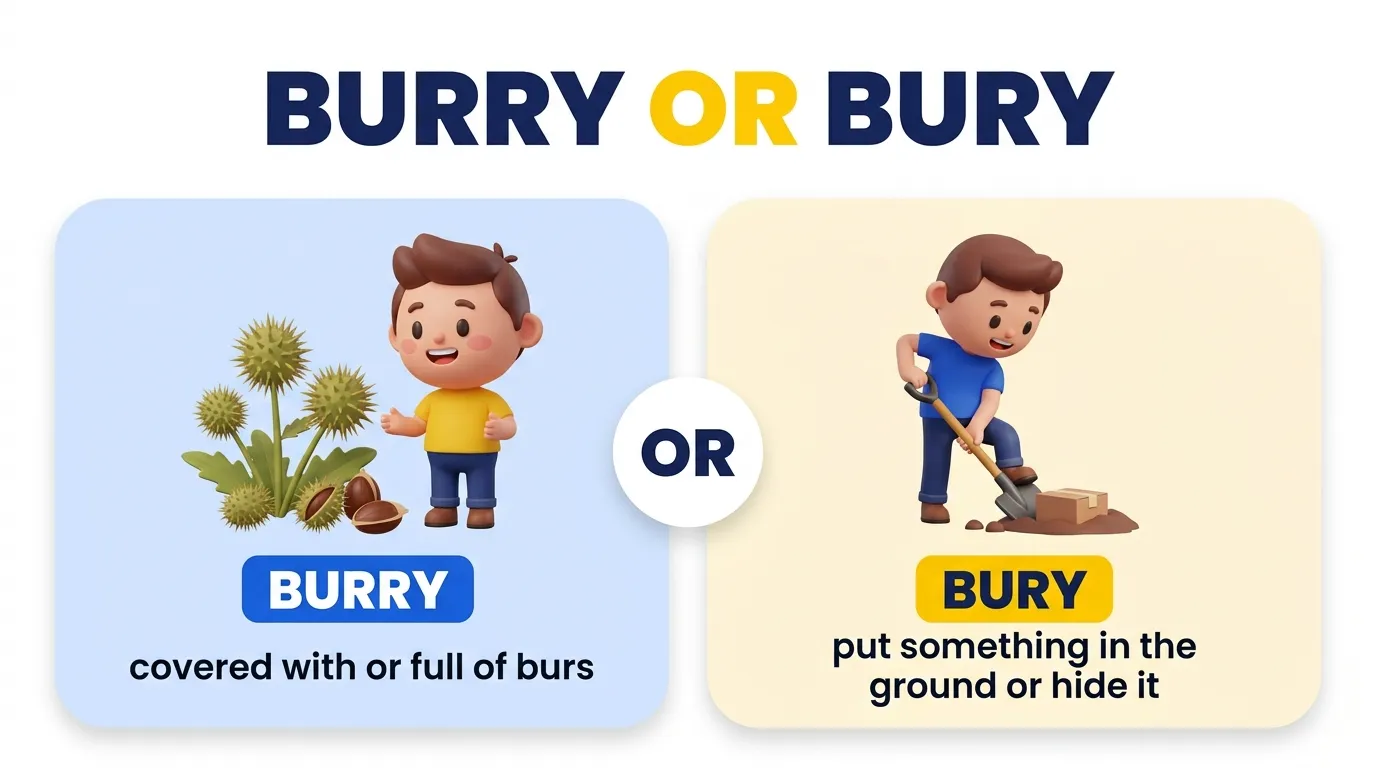
Bury means to put something in the ground, hide it, or cover it. Burry is a real but uncommon adjective for something covered with or full of burs.
Your email is ready to send, but the red spelling line stops you at one word: “burry or bury.” You may know the meaning, yet the extra r can still look tempting. The correct verb is bury when you mean putting something in the ground, hiding something, or covering it. Burry is a real but uncommon adjective linked to burs, the prickly seed cases that stick to fur and clothes.
So, if you are writing “bury the dead” or “bury the treasure,” choose bury. Keep reading for a simple way to remember the difference.
Burry or Bury: Quick Answer
The correct word for putting something underground is bury. It is a verb used for people, objects, animals, and things you want to hide or cover.
For example:
- Bury the time capsule in the garden.
- The family will bury him near his parents.
However, burry has a different job. It is an adjective that can describe something covered with burs or shaped like a bur.
For example, you might describe a prickly plant as burry. The word is uncommon, so most everyday writers rarely need it.
The Origin of Burry or Bury
The word bury has a very old history. It comes from an Old English word linked to hiding or placing something in the ground.
Over time, its spelling changed into the short form we use today. However, its basic idea stayed much the same: something goes under the ground or out of sight.
The word burry has a different path. It comes from bur, the name for a prickly seed case, plus the ending -y. So, something burry is related to burs.
This difference also explains why the two spellings should not be treated as simple alternatives. One is mainly a verb, while the other is an adjective.
Burry or Bury Explained: Key Differences
The easiest way to separate these words is to look at what each one does in a sentence.
Bury is a verb. It tells you about an action.
Burry is an adjective. It describes something with burs or a prickly quality.
| Term | Meaning | When to Use | Region/Context |
| bury | Put something in the ground, hide, or cover it | Graves, objects, animals, figurative uses | Standard English |
| burry | Covered with or full of burs | Plants, fabric, fur, or prickly things | Uncommon English |
For example, bury works in “They will bury the box.” Here, the word shows an action.
Meanwhile, burry works in a sentence such as “The field was burry.” Here, the word describes the field.
The spelling difference is small, but the meaning changes completely. So, context should guide your choice.
Bury Has Several Common Meanings
First, bury can mean placing a dead person or animal in a grave.
It can also mean putting an object under the ground. For example, a dog may bury a bone in the yard.
In addition, the word can describe hiding something. Someone may bury a letter in a drawer.
The word also works in figurative phrases. For example, you can bury yourself in work or bury your feelings.
Burry Has a Narrow Meaning
By contrast, burry describes something connected with burs.
A burry plant may have many prickly seed cases. Likewise, a piece of fabric may become burry after touching plants with burs.
Because the word is uncommon, a writer may choose a simpler phrase such as “covered with burs.” Still, burry can be correct when that is exactly what you mean.
Burry vs Bury: Comparison at a Glance
| Term/Variant | Meaning | Region/Context | Best Used When |
| bury | Put in the ground or hide | American and British English | You mean the action of putting or hiding something |
| burry | Covered with or full of burs | American and British English | You are describing something prickly or covered with burs |
| buried | Past form of bury | Standard English | The action happened in the past |
| burying | Present participle of bury | Standard English | The action is happening now |
| buries | Third-person form of bury | Standard English | The subject is he, she, or it |
Notice that bury does not become burry when you change its tense.
The correct forms are bury, buries, buried, and burying. Therefore, forms such as burried and burrying are spelling mistakes when they mean putting something underground.
Which One Should You Use?
For most writers, the answer is simple: use bury when you mean putting something in the ground or hiding it.
For students, use bury in essays when you mean putting something underground. For example, “The dog will bury the bone.”
For professionals, use bury when writing about a hidden item, a grave, or a figurative idea. The same spelling works in emails, reports, and other formal writing.
For everyday writers, choose bury when talking about graves, treasure, objects, animals, or hidden things.
For plant descriptions, burry may be correct if you mean covered with or full of burs. Still, because the word is uncommon, make sure that meaning fits the sentence.
For a general audience, bury is the safe choice when the meaning is putting something underground. That is also the spelling used in both American and British English.
Common Mistakes with Burry or Bury
Writing “burry the dead”
Mistake: The family will burry the dead.
Correction: The family will bury the dead.
This happens because the extra r feels natural when you hear the word. However, bury is the correct verb.
Writing “burrying”
Mistake: They are burrying the box.
Correction: They are burying the box.
The word keeps one r before the -ing ending. So, burying is correct.
Writing “burried”
Mistake: They burried the treasure.
Correction: They buried the treasure.
The past form changes the final y to i before -ed. As a result, the correct spelling is buried.
Treating burry as another spelling of bury
Mistake: The two words mean the same thing.
Correction: They have different meanings and word roles.
Bury is mainly a verb. Burry is an adjective linked to burs.
Avoiding burry when the meaning fits
Mistake: Assuming burry can never be correct.
Correction: Use burry when something is covered with or full of burs.
This mistake goes in the other direction. Although burry is uncommon, it is still a real English word.
Burry or Bury in Real-World Examples
Professional Email
“Please bury the old records in the archive folder after the review.”
Here, bury has a figurative meaning. It suggests putting something away where it will not be seen easily.
News Headline
“Workers bury time capsule near the new school.”
In this case, bury means placing an object underground.
Social Post
“We should bury the old argument and move forward.”
The word is figurative here. It means putting an issue behind you.
Formal Document
“The remains were buried in the family cemetery.”
The past form buried is correct because the action has already happened.
Nature Description
“The field became burry after the plants released their prickly seed cases.”
Here, burry describes the field. It does not describe an action.
Burry or Bury: Data, Trends & Usage
Searches for burry or bury mainly come from people checking spelling, meaning, or correct word choice. Many users also look for forms such as burying, buried, and phrases like bury the dead.
The main search intent is informational. People usually want a quick answer before writing an email, school assignment, message, article, or formal document.
Because bury has several meanings, the word appears in many types of writing. It can describe a grave, a hidden object, a covered item, or a figurative idea.
Meanwhile, burry attracts much less everyday attention because its meaning is narrow. It becomes useful when the topic involves plants, burs, fur, clothing, or prickly surfaces.
One useful point stands out: pronunciation can lead people toward the wrong spelling. Bury is pronounced like berry in standard American English, which makes the spelling less obvious than it looks.
So, learning the meaning and the word form together is more useful than trying to remember the extra r alone.
FAQs About Burry or Bury
Is “burry” ever a correct word?
Yes, burry can be correct. It is an adjective that describes something covered with or full of burs. However, it should not replace bury when you mean putting something underground.
Is it “burry or bury the dead”?
The correct phrase is bury the dead. Here, bury is a verb that means placing a dead person in a grave. The spelling burry does not fit this meaning.
How do you spell “bury” correctly?
The correct spelling is bury, with one r. Its main forms are bury, buries, buried, and burying.
Is “burry” acceptable in formal writing?
Yes, but only when its meaning fits the sentence. For normal writing about graves, hidden objects, or covering something, use bury instead.
Why do people spell bury as burry?
The pronunciation can cause the confusion because bury sounds like berry for many English speakers. As a result, people may guess the spelling from the sound and add an extra r.
What is the past tense of bury?
The past tense is buried. For example, “They buried the box in the garden.” The spelling is not burried.
Is it “burying” or “burrying”?
Burying is correct when you mean putting something underground. The spelling burrying is incorrect for this verb.
Final Thoughts on Burry or Bury
The main choice is easy once you focus on meaning. Use bury for putting something in the ground, hiding something, covering something, or using the word in a figurative way.
On the other hand, burry is an adjective connected with burs. It can describe a prickly plant, surface, or material, but it is much less common in everyday English.
Remember the simple rule: bury has one r when you mean the action. Then use buried for the past and burying for the ongoing action.
For clear writing, choose bury whenever you mean putting something underground. Save burry for the rare cases where something is actually covered with or full of burs. Keep exploring confusing English words so small spelling choices never slow down your writing again.
Curious about similar words? Explore Compair or Compare.

I started writing about English word differences after years of teaching students who kept making the same mistakes. My focus is on making spelling rules feel simple and easy to remember. At WordsCombo, I turn confusing word pairs into clear comparisons.