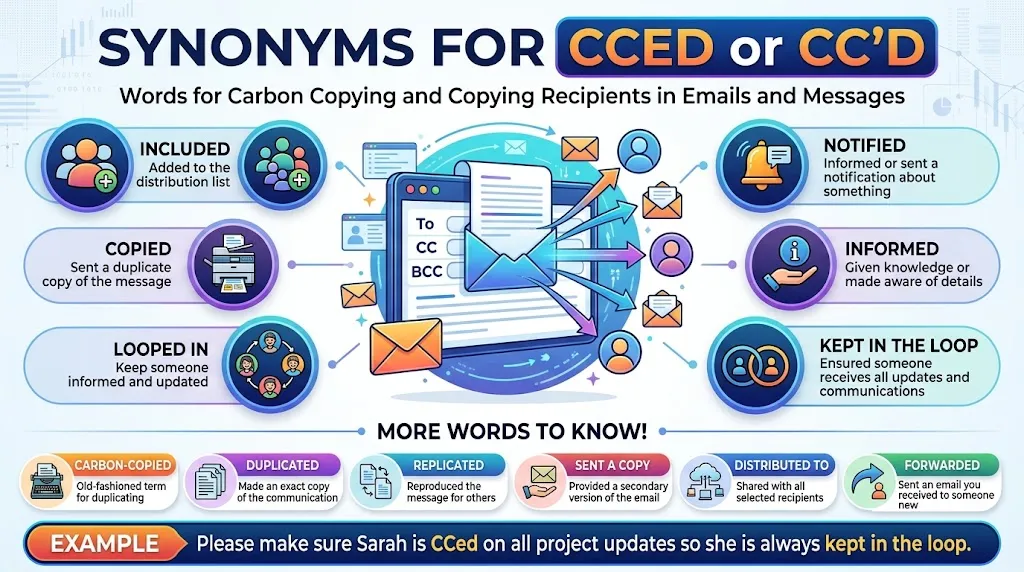
cced and CC’d both mean that someone was sent a copy of an email, but CC’d is often easier to read and is a strong choice for professional email.
I caught this one while editing a short client email on a laptop. The sentence was simple: “I have ___ you on the latest update.” I knew exactly what I meant, but the moment I typed cced, the word looked strangely crowded on the screen.
That tiny pause is why this spelling causes so much trouble. CC starts as an abbreviation, then suddenly becomes a verb. Once you need the past tense, English gives you more than one form: cced, cc’d, and even cc’ed appear in real writing.
The good news is that you do not need to guess. The key is knowing how the abbreviation works, which forms readers recognize, and when a plain word such as copied is better.
By the end of this guide, you will know which form to use in emails, reports, workplace messages, and more formal writing.
Cced or CC’d: Quick Answer
Cced and CC’d are past-tense forms of the verb CC, meaning to send someone a copy of an email or document.
For example:
- I CC’d Sarah on the email.
- I cced Sarah on the email.
Both forms communicate the same basic idea. Major dictionary evidence also records more than one past-tense form for cc, including cc’d and cced.
For most professional emails, I recommend CC’d because the apostrophe makes the abbreviation easier to spot.
The Story Behind CC and Its Past Tense
CC comes from carbon copy. Before email, carbon paper was used to make copies of typed or handwritten documents. A copy could then be sent to another person.
Email kept the idea but changed the process.
Today, when you CC someone, you send that person a copy of the message while the main recipient remains in the To field.
That created a useful new verb:
- Present: I will CC you.
- Past: I CC’d you.
- Past alternative: I cced you.
- Simple alternative: I copied you.
The unusual spelling comes from adding a normal English verb ending to an abbreviation. CCed can look awkward because the capital letters run directly into ed. That visual problem is one reason writers often prefer the apostrophe in CC’d. Usage references show that both forms have been used for years.
Cced or CC’d Explained: What Is the Difference?
There is no major difference in meaning between cced and CC’d. The main difference is style and readability.
| Term | Meaning | When to Use | Region/Context |
| CC’d | Sent a copy to someone | Clear workplace emails | Common in modern English |
| cced | Sent a copy to someone | When following a house style | Used in English writing |
| cc’ed | Sent a copy to someone | Seen as another spelling variant | Less streamlined |
| copied | Sent someone a copy | Formal or very clear writing | Broadly understood |
CC’d
CC’d is easy to recognize because the apostrophe separates CC from d.
Example:
I CC’d my manager on the report.
This is especially useful when the abbreviation is already visually unusual.
Cced
Cced treats CC more like a normal verb and adds ed directly.
Example:
I cced my manager on the report.
It is understandable, but some readers may find it less natural at first glance.
Copied
Sometimes the best solution is to avoid the spelling issue completely.
I copied my manager on the report.
This version is clear, natural, and works well when you want a polished sentence without an abbreviation.
Which Version Should You Use?
Your best choice depends on your reader and the level of formality.
- For U.S. workplace emails: Use CC’d when you want to keep the email short and natural.
- For international readers: CC’d is visually clear, but copied may be even easier.
- For students: Use CC’d in ordinary email communication, unless your teacher or institution has a different style.
- For formal reports: Prefer copied, included, or a copy was sent to when the abbreviation feels too casual.
- For company documents: Follow your organization’s style guide and stay consistent.
- For casual messages: CC’d is perfectly natural.
The biggest rule is simple: do not switch styles without a reason. If one email says CC’d, another says cced, and a third says cc’ed, your writing can look inconsistent.
Common Mistakes with Cced or CC’d
Small spelling problems often happen because writers are unsure how to turn CC into a verb.
| Mistake | Better Form | Why |
| I cceed John. | I CC’d John. | Cceed is not the usual past form. |
| I CCed John. | I CC’d John. | The apostrophe can make the form easier to read. |
| I CC-ed John. | I CC’d John. | The hyphen is unnecessary in this form. |
| I CCD John. | I CC’d John. | CCD can mean something entirely different. |
| I CC’d to John. | I CC’d John. | The verb normally takes the recipient directly. |
Mistake 1: Writing “cceed”
The extra e is unnecessary.
Wrong: I cceed the manager.
Better: I CC’d the manager.
Mistake 2: Confusing CC’d with CCD
CCD can refer to a charge-coupled device, especially in technology and photography. It is not the normal way to write the past tense of email CC.
Mistake 3: Using “CC’d to”
You normally CC someone, not “CC someone to” an email.
Better:
I CC’d David on the email.
Mistake 4: Forgetting the meaning of CC
Being CC’d usually means someone is being kept informed. It does not automatically mean that person must take action.
Cced or CC’d in Real-World Examples
Seeing the form in context makes the choice much easier.
Professional Email
I CC’d Maria on this email so she has the latest project details.
This is natural and clear for everyday workplace communication.
News Article
The agency said the legal team was CC’d on the message.
Here, CC’d works as a compact description of what happened.
Social Media Post
I CC’d the whole team so everyone has the same update.
This sounds natural in an informal workplace post or professional social update.
Formal Report
A copy of the correspondence was sent to the project manager.
For a formal report, this version may be better than either cced or CC’d. It removes the email abbreviation and states the action directly.
A Useful Email Tip
Do not confuse CC with BCC.
CC lets the other recipients see who was copied. BCC hides those additional recipients from one another.
That distinction matters more than the small spelling difference between cced and CC’d.
Cced or CC’d: Data, Trends & Usage
This keyword has a strongly informational search intent. People usually search it because they are writing an email, checking a sentence, or trying to decide whether an apostrophe belongs after CC.
Search results also show several competing forms, including cced, cc’d, and cc’ed. That variation explains why the question keeps appearing in grammar and workplace-writing searches.
For U.S. readers, the most useful distinction is not really regional grammar. It is clarity and context. In a quick email, CC’d is compact and familiar. In a formal document, copied or a copy was sent to may sound cleaner.
There is also a practical reason this topic matters now. Email remains full of abbreviations that started as labels but became verbs. Writers regularly turn terms such as email, text, Google, and CC into ordinary verbs.
So the real lesson is broader: when an abbreviation becomes a verb, readability matters as much as grammar.
Cced or CC’d: Comparison at a Glance
| Term/Variant | Meaning | Region/Context | Best Used When |
| CC’d | Sent a copy | General modern email | You want a clear, compact form |
| cced | Sent a copy | General English usage | A style guide accepts it |
| cc’ed | Sent a copy | Alternative usage | You are following an established house style |
| copied | Sent a copy | Formal and general English | You want maximum clarity |
| a copy was sent | Someone received a copy | Very formal writing | You want to avoid abbreviations |
If you are unsure, CC’d is a practical choice for ordinary professional email. If the document is formal, copied is often the safest and smoothest option.
FAQs About Cced or CC’d
Q: Is it cced or CC’d?
A: Both forms are used for the past tense of CC. CC’d is often easier to read because the apostrophe clearly separates the abbreviation from the past-tense ending.
Q: What does CC’d mean in an email?
A: CC’d means that someone was included as a recipient of a copy of the email. The person can see the message and, in normal CC use, the other recipients can see that person too.
Q: Is CC’d correct in professional emails?
A: Yes. CC’d is widely understood in professional email. If the message is highly formal, you can use copied instead for a more traditional tone.
Q: Is cced grammatically correct?
A: Cced is an established alternative past-tense form of cc. It is less visually clear to some readers, but it is not simply a meaningless spelling mistake.
Q: Should I write CCed, CC’d, or cc’d?
A: Use the capitalization style that fits your sentence and your organization’s style. CC’d is a clear choice when the abbreviation is written as CC.
Q: Is CC’d the same as BCC’d?
A: No. CC’d means someone received a visible copy of the message. BCC’d means the recipient was added through blind carbon copy, so other recipients normally cannot see that address.
Q: Can I use “copied” instead of CC’d?
A: Yes. In fact, copied is often the best choice in formal writing. For example, “I copied the director on the email” is clear and natural.
Final Thoughts on Cced or CC’d
The cced or CC’d question looks tiny, but it comes from a real problem in modern English. An abbreviation has become a verb, and writers need to decide how its past tense should look.
Here are the key points to remember:
- CC’d and cced can both mean that someone received a copy.
- CC’d is often easier to read because the apostrophe separates CC from d.
- Cced is also an established form, so it should not be treated as meaningless.
- Copied is an excellent choice when you want a more formal or universally clear sentence.
- BCC’d is different from CC’d because BCC hides recipients from the other recipients.
For everyday professional email, I would choose CC’d. When the writing is more formal, choose copied if it reads more naturally.
Now you can write that sentence with confidence instead of stopping before the Send button to wonder about three little letters.
Curious about similar email terms? Explore Ccing or CC’ing: The Easy Spelling Guide.

I have been writing about English spelling and word usage for the past five years. My goal is to give readers a clear answer without overwhelming them with complicated rules. At WordsCombo, I focus on making everyday English easier for everyone.