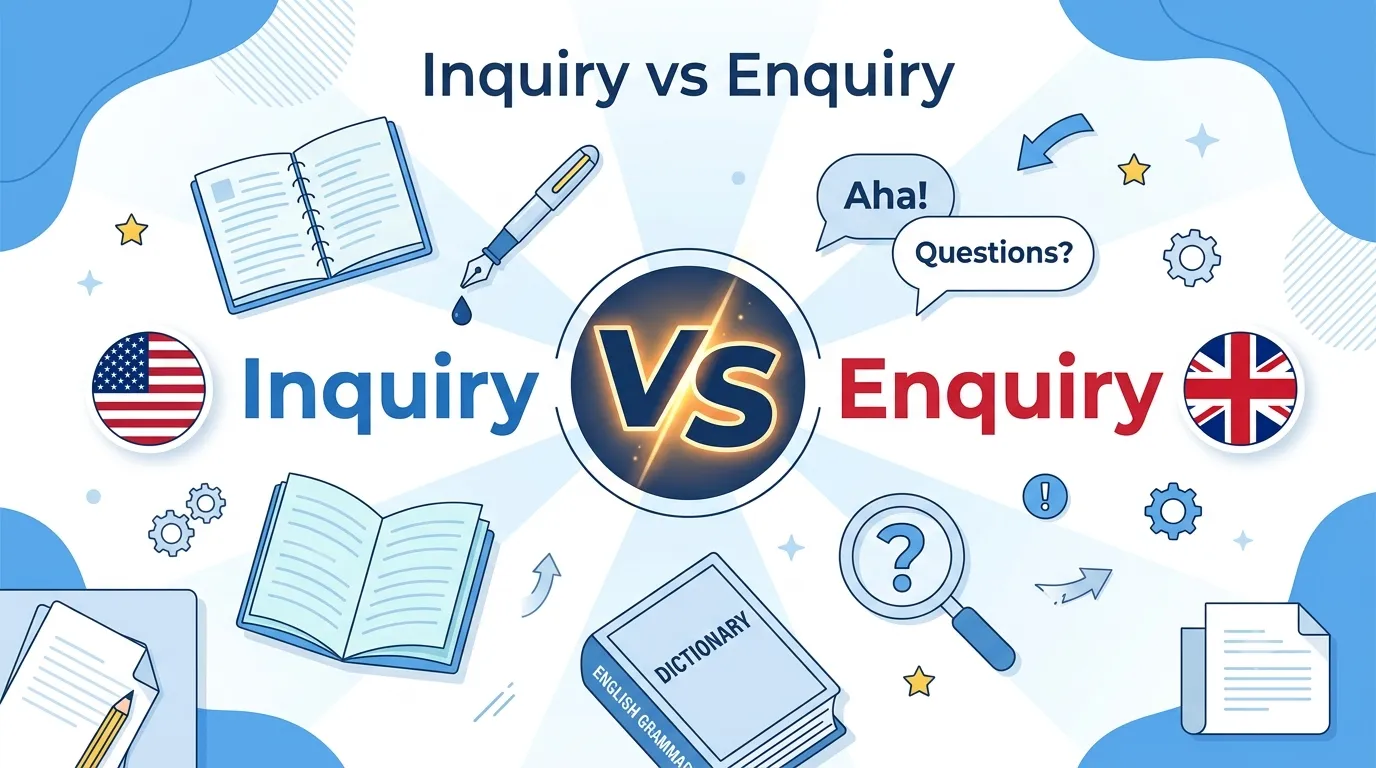
Inquiry and enquiry mean the same thing. The only real difference is spelling. Inquiry is the preferred spelling in American English, while enquiry is more common in British English for general questions.
Have you ever stopped while writing an email and wondered, Should I write “inquiry” or “enquiry”? I have. Years ago, I was preparing a message for an overseas client. I typed enquiry, then changed it to inquiry, then back again. That tiny spelling choice made me question my English more than the whole email.
Later, I discovered that both words are correct. The trick is knowing where and when to use each one.
Many students, writers, and business professionals search for this topic because dictionaries, websites, and style guides don’t always explain it in simple words. Some say the words are identical. Others claim they have different meanings. That leaves many people confused.
If you’ve ever paused before hitting “Send” because of these two spellings, you’re not alone.
By the end of this guide, you’ll know the difference between inquiry and enquiry, understand their history, learn which spelling fits your audience, and avoid common mistakes with confidence.
Inquiry or Enquiry: Quick Answer
Both inquiry and enquiry mean asking for information or seeking an answer. They describe the act of asking a question or requesting details.
The main difference is regional English.
- Inquiry is the standard spelling in American English.
- Enquiry is commonly used in British English, especially for everyday questions.
Simple Examples
- I sent an inquiry about the job opening. (American English)
- She made an enquiry about train times. (British English)
In everyday conversation, both words communicate the same idea.
The Origin and Background of Inquiry or Enquiry
The story behind these two spellings goes back hundreds of years.
Both words come from the Old French word enquerre, which means to seek or to ask. That word later became the Latin-based English verb inquire or enquire.
Over time, English developed two spelling traditions.
In Britain, both enquire and inquire continued to exist. Some publishers and organizations even gave them slightly different meanings. For example, enquiry often referred to a simple question, while inquiry could describe an official investigation.
In the United States, things became much simpler. American English gradually adopted inquiry as the standard spelling for almost every situation.
Today, the difference is mostly about location, not meaning.
Why Do People Get Confused?
Several reasons create confusion.
- Dictionaries often list both spellings.
- British style guides sometimes make small distinctions.
- American English almost always uses inquiry.
- International companies mix both styles depending on their audience.
The good news is that most readers understand both words.
Inquiry or Enquiry Explained: Key Differences
Although the meanings are almost identical, choosing the right spelling makes your writing look more natural to your readers.
| Term | Meaning | When to Use | Region/Context |
|---|---|---|---|
| Inquiry | Asking for information or conducting an investigation | Business writing, academic work, legal documents, everyday writing | American English, international English |
| Enquiry | Asking for information | Casual questions, customer service, everyday communication | British English and some Commonwealth countries |
Inquiry
Inquiry is the spelling you’ll see most often in:
- American schools
- Business emails
- Government documents
- Research papers
- News articles in the United States
Examples
- We received an inquiry about our services.
- The police launched an inquiry into the accident.
- Thank you for your inquiry regarding our products.
Notice that inquiry works well for both simple questions and formal investigations.
Enquiry
Enquiry is common in British English when someone asks for information.
You’ll often find it in:
- UK customer support
- British company websites
- Travel offices
- Public information centers
Examples
- Please send your enquiry using our online form.
- I made an enquiry about the hotel booking.
- The receptionist answered every enquiry politely.
Many British organizations still prefer this spelling because it matches traditional British English.
Is There Really a Meaning Difference?
Some older British style guides suggest this rule:
- Enquiry = a simple question.
- Inquiry = a formal investigation.
For example:
- A customer enquiry about prices.
- A government inquiry into public safety.
While this distinction still appears in some places, modern English does not require it. Many respected dictionaries treat the words as interchangeable, with regional spelling being the more important difference.
So, unless you’re following a specific style guide, your audience matters more than the old rule.
Which Version Should You Use?
The best choice depends on who will read your writing. Think about your audience before you decide.
If You Write for American Readers
Choose inquiry.
It is the standard spelling in the United States. Most American schools, companies, and websites expect this version.
Examples
- Product inquiry
- Customer inquiry
- Business inquiry
- Job inquiry
If your readers are in the US, this is almost always the safest choice.
If You Write for British Readers
Choose enquiry for everyday questions.
British readers are familiar with both spellings, but enquiry feels more natural in daily communication.
Examples
- Travel enquiry
- Booking enquiry
- Customer enquiry
- General enquiry
If You Write for an International Audience
Use inquiry.
Many global businesses, universities, and websites use inquiry because it is widely understood around the world.
If you’re unsure where your readers live, inquiry is usually the better option.
Quick Recommendation
- Students in the US → Use inquiry.
- Students in the UK → Use enquiry if your school follows British English.
- Business professionals → Match your company’s style guide.
- Website owners and bloggers → Pick one spelling and use it consistently.
- International writers → Choose inquiry for the broadest audience.
The most important rule is simple:
Don’t mix both spellings in the same document.
Common Mistakes with Inquiry or Enquiry
Many writers make the same small mistakes. Here are the most common ones.
| Mistake | Correct Version | Why It Happens |
|---|---|---|
| Mixing both spellings in one article | Pick one spelling and stay consistent | Switching between American and British English |
| Using enquiry in American business writing | Use inquiry | American English prefers inquiry |
| Thinking one spelling is wrong | Both are correct | The difference is regional |
| Believing they always have different meanings | Usually they mean the same thing | Older style guides caused confusion |
| Ignoring your audience | Match the reader’s English style | Readers expect familiar spelling |
Example 1
❌ We received your enquiry. Thank you for your inquiry.
✅ We received your inquiry. Thank you for your inquiry.
or
✅ We received your enquiry. Thank you for your enquiry.
Stay consistent.
Example 2
❌ American company: Send us your enquiry today.
✅ American company: Send us your inquiry today.
Example 3
❌ Enquiry is incorrect English.
✅ Both spellings are correct.
Only the preferred region changes.
Inquiry or Enquiry in Real World Examples
Seeing real examples makes the difference much easier to remember.
Professional Email
American English
Thank you for your inquiry. Our sales team will reply within one business day.
British English
Thank you for your enquiry. We’ll respond as soon as possible.
News Headline
American Style
City Opens Inquiry Into School Funding
British Style
Public Inquiry Begins After Safety Report
Notice that British newspapers often use inquiry when talking about an official investigation.
Social Media Post
Have a question? Send us your inquiry, and we’ll help you today.
UK Version:
Have an enquiry? Our support team is here to help.
Formal Report
The committee launched an official inquiry into the incident.
Formal reports often use inquiry, even in countries that usually prefer enquiry.
Customer Service Website
United States
Submit your inquiry using the contact form.
United Kingdom
Complete the enquiry form, and our team will contact you shortly.
Inquiry or Enquiry: Data, Trends & Usage
People search for inquiry or enquiry because they want to avoid making mistakes in professional writing.
Where Is This Topic Most Popular?
The keyword is commonly searched in countries that use English every day, including:
- United States
- United Kingdom
- Canada
- Australia
- New Zealand
- India
- Pakistan
Students, teachers, writers, bloggers, and business professionals are the biggest audience.
Search Intent
Primary search intent: Informational
People want to know:
- Which spelling is correct.
- Whether the words have different meanings.
- Which version they should use.
- How to write correctly in emails and reports.
Why Does This Matter Today?
English has become a global language.
You might write an email to someone in New York today and another to someone in London tomorrow. Knowing the preferred spelling helps your writing feel natural and professional.
Small details like this build trust with your readers.
Standalone Comparison Table
| Term/Variant | Meaning | Region/Context | Best Used When |
|---|---|---|---|
| Inquiry | Asking for information or conducting an official investigation | American English, international business, academic writing | Writing for US readers, global audiences, formal documents, research papers |
| Enquiry | Asking for information | British English, customer service, everyday communication | Writing for UK readers, local businesses, casual questions |
| Inquiry (Formal Investigation) | An official examination or investigation | Legal, government, corporate reports worldwide | Discussing investigations, hearings, or official reviews |
Frequently Asked Questions (FAQs)
Q1: What does inquiry or enquiry mean?
Inquiry and enquiry both mean asking for information or seeking an answer. They describe the act of requesting details, help, or clarification. The main difference is the preferred spelling in different regions.
Q2: How do you use inquiry or enquiry correctly?
Choose the spelling that matches your audience.
- Use inquiry if you’re writing for American readers or an international audience.
- Use enquiry if you’re writing for British readers and following British English conventions.
Whichever spelling you choose, use it consistently throughout your writing.
Q3: Inquiry vs enquiry: what’s the difference?
The biggest difference is regional spelling.
- Inquiry is the standard spelling in American English.
- Enquiry is commonly used in British English for everyday questions.
Some older British style guides also use inquiry for official investigations, but this distinction is less important today.
Q4: Is inquiry acceptable in formal writing?
Yes. Inquiry is widely accepted in formal writing.
You’ll see it in business emails, academic papers, legal documents, government reports, and professional communication. It is also the preferred choice for most international organizations.
Q5: Which version is correct: inquiry or enquiry?
Both are correct.
The right choice depends on the type of English you’re using.
- American English → Inquiry
- British English → Enquiry (for general questions)
There isn’t one universally “correct” spelling.
Q6: Where do the words inquiry and enquiry come from?
Both words come from the same historical roots. They developed from the Old French word enquerre, meaning “to ask” or “to seek.” As English evolved, both spellings remained, with different regions favoring different forms.
Q7: Can inquiry or enquiry be used in business communication?
Absolutely.
American companies almost always use inquiry, while British businesses may use enquiry on websites, forms, and customer support pages. If you’re writing for a global audience, inquiry is usually the safest choice.
Conclusion
Choosing between inquiry and enquiry doesn’t have to be confusing. Both words mean the same thing, and both are correct English. The key difference is where your audience lives.
If you’re writing for readers in the United States or for an international audience, inquiry is the best choice. If you’re writing in British English, enquiry is a natural option for everyday questions. Some British organizations still use inquiry for formal investigations, but many modern style guides focus more on regional spelling than strict meaning.
The most important rule is to stay consistent. Don’t switch between the two spellings in the same document unless you’re quoting another source or following a specific style guide.
Now that you know the difference between inquiry and enquiry, you can write with confidence. Bookmark this guide for future reference, and share it with anyone who’s ever paused over these two spellings. A small spelling choice can make your writing look polished and professional.

I studied English literature and have spent years editing content for blogs and digital platforms. I noticed most people struggle with choosing between two similar words. At WordsCombo, I make that choice simple and clear.