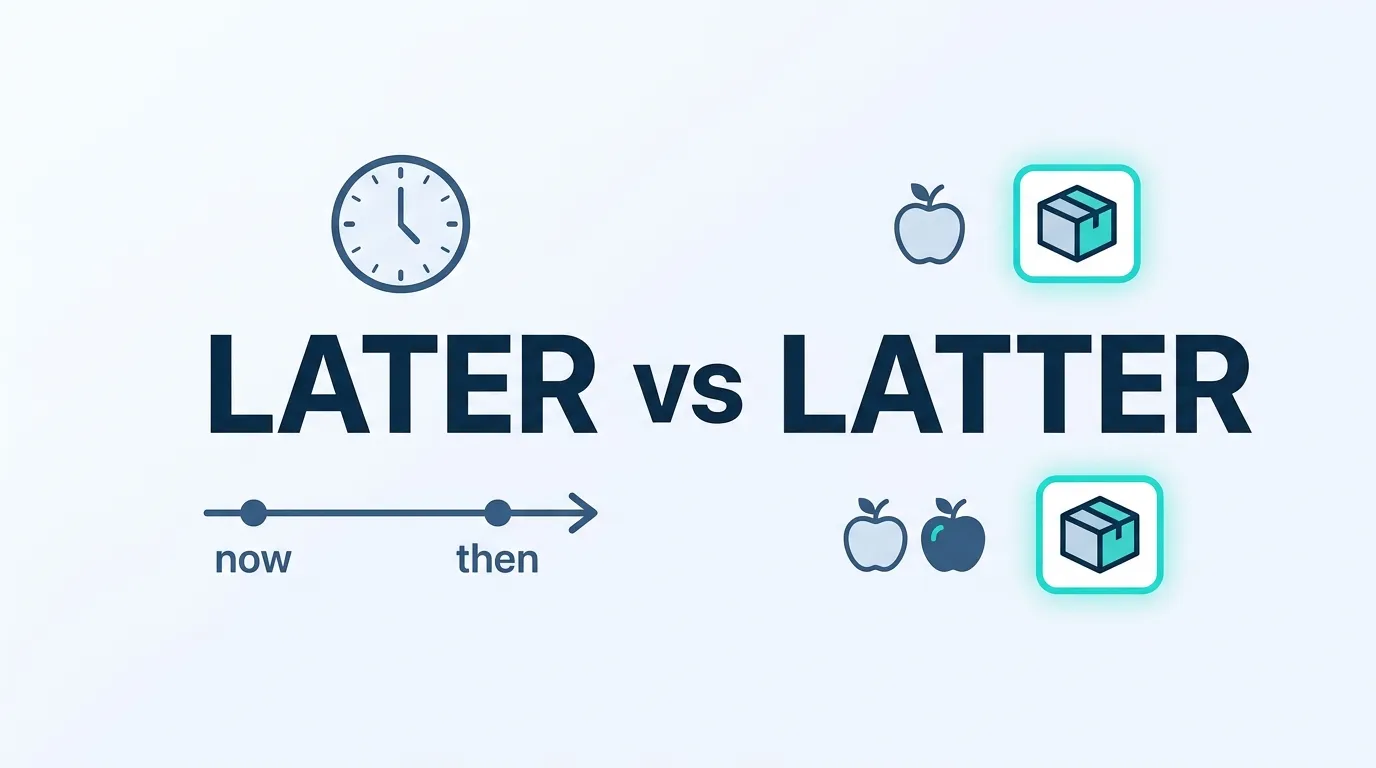
Later means “at a time after now or after another time,” while latter means the second of two people or things that were just mentioned.
Have you ever typed a sentence, stopped, and wondered, “Is it later or latter?” You are not alone. These two words look almost the same, but they do very different jobs.
A simple spelling mistake can change the meaning of a sentence. For example, “I will call you latter” is wrong if you mean “at a later time.” The correct sentence is “I will call you later.”
I often see this mix up when helping students improve their English writing. The problem is easy to understand. Both words start with “lat”, and both are linked to the idea of something coming after something else. That makes them easy to confuse.
The good news is that you do not need a long grammar rule to remember the difference.
This guide will show you what later and latter mean, where they come from, how to use them, and the common mistakes to avoid. By the end, choosing the right word should feel much easier.
Later or Latter
Later is about time. It means something happens after now or after another time.
- I will finish the work later.
- She arrived later than expected.
- We can talk later.
Latter is about choice or order. It means the second of two people or things already mentioned.
- I like tea and coffee, but I prefer the latter.
- Tom and Jack applied for the job. The latter got the position.
The easiest trick
Remember this:
Later = time
Latter = second of two
If you are talking about when, use later.
If you are talking about which one, and there are two choices, use latter.
The Origin and Background of Later and Latter
The confusion between these words has a long history.
Both later and latter are related to the word late. The word late has old roots connected with something happening after the expected or usual time.
Over time, English developed different forms to express different ideas.
Later became the comparative form of late. It means more late or at a time after another time.
For example:
- today → later today
- early → later
- now → later
Latter, meanwhile, developed as a way to refer to the second of two things.
That distinction is still used in modern English.
The similar spelling causes most of the confusion. The words look like close relatives because they are related, but their jobs in a sentence are different.
Later vs. Latter Explained
Here is the main difference at a glance:
| Term | Meaning | When to Use | Region/Context |
| Later | At a time after now or another time | Talking about time | Standard English |
| Latter | The second of two people or things mentioned | Talking about order or choice | Formal and standard English |
How to use “later”
Use later when you mean afterward or at a future time.
Examples:
- I will study later.
- We can meet later this evening.
- She called me later.
- He arrived later than expected.
You can also use later when comparing two times.
The second train arrived later than the first.
Here, later tells us when the train arrived.
How to use “latter”
Use latter when you mention two things and then refer back to the second one.
For example:
I have two options: working from home or working in an office. I prefer the latter.
The two options are:
- Working from home
- Working in an office
The latter is the second option: working in an office.
Another example:
Sarah and Maria attended the meeting. The latter spoke first.
Here, Sarah is first and Maria is second. Therefore, latter refers to Maria.
A key warning about “latter”
Use latter mainly when there are two choices or items.
If you have three or more items, latter is usually not the right word.
For example:
I bought apples, oranges, and bananas. I chose the latter.
This is unclear because there are three items.
Instead, say:
I chose the bananas.
Or:
I chose the last item.
Which Version Should You Use?
The best choice depends on what you want to say.
If you are talking about time
Use later.
- I will do it later.
- See you later.
- We will discuss it later.
- She came later.
If you are talking about the second of two things
Use latter.
- Cats and dogs are both popular pets, but I prefer the latter.
- The company offers online and in person classes. The latter are more expensive.
For beginners
Later is much more common in everyday English.
You will hear phrases such as:
- See you later.
- Talk to you later.
- I will do it later.
- Maybe later.
Latter is more common in formal, academic, business, and carefully written English.
For global or neutral English
Use later when you mean afterward or at a future time.
Use latter only when you clearly mean the second of two things.
That rule works well in American, British, Canadian, Australian, and other major forms of standard English.
Common Mistakes with Later and Latter
These mistakes are easy to make. Here are the most common ones.
1. Using “latter” to mean “later”
❌ I will call you latter.
✅ I will call you later.
Why? You are talking about time, not the second of two things.
2. Using “later” when choosing between two things
❌ I prefer the later.
✅ I prefer the latter.
Why? You are referring to the second item in a pair.
3. Using “latter” with three or more choices
❌ I chose the latter from the three options.
✅ I chose the last option from the three choices.
Why? Latter normally refers to the second of two items.
4. Confusing “later” with “latest”
These words are also different.
- Later = at a time after another time
- Latest = most recent or newest
Example:
I will arrive later.
But:
What is the latest news?
5. Forgetting what “latter” refers to
Consider this sentence:
Ali, Ahmed, and Bilal attended the event. The latter won the prize.
The reader may wonder which person you mean because there are three names.
For clarity, simply use the person’s name.
Ali, Ahmed, and Bilal attended the event. Bilal won the prize.
Clear writing is often better than forcing a formal word into a sentence.
Later or Latter in Real World Examples
Knowing the definition is useful. Seeing the words in real situations is even better.
Professional email
I am busy with another meeting right now. I will send the report later today.
Here, later refers to time.
Another example:
We can choose between email support and phone support. The latter is available during business hours.
Here, latter means phone support because it is the second option.
News headline or article
Officials said they would release more details later this week.
Later means at a future time.
Another example:
The two countries discussed trade and security, with the latter becoming the main focus.
Latter refers to security because it was mentioned second.
Social media post
Too busy right now. I will post the photos later!
This is a natural everyday use of later.
Formal report
The study compared online learning with classroom learning. The latter showed higher attendance.
The latter means classroom learning, the second of the two options.
Later or Latter: Quick Comparison Table
| Term/Variant | Meaning | Region/Context | Best Used When |
| Later | At a time after now or another time | All standard English varieties | Talking about time |
| Latter | The second of two things mentioned | Formal and standard English | Referring to the second of two items |
| Latest | Most recent or newest | All standard English varieties | Talking about the newest event or item |
| Last | Final in a sequence | All standard English varieties | Referring to the final item in a group |
A quick memory rule can make all four easier:
Later = time
Latter = second
Latest = newest
Last = final
A Simple Memory Trick
Still mixing them up?
Try this:
Later has an “e” for “event.”
An event happens at a certain time, so later deals with time.
Latter has two “t” sounds in the middle. Think “two.”
Latter = the second of two.
It is not a perfect spelling rule, but it is a useful memory aid.
Another easy test is to replace the word.
If you can replace it with “afterward,” choose later.
I will see you later.
I will see you afterward.
If you can replace it with “the second one,” choose latter.
I prefer the latter.
I prefer the second one.
Later or Latter: Data, Trends & Usage
The search intent behind “later or latter” is mainly informational. People usually search the phrase because they have to choose the correct word in a sentence.
This is especially common among:
- English learners
- Students
- Writers
- Job applicants
- Professionals
- People preparing for English tests
The confusion is understandable because both words are pronounced differently from how beginners may expect, and their spellings are very close.
There is also a practical reason to learn the difference. English writing often depends on small word choices. A single word can change the meaning of a sentence.
Later appears much more often in everyday conversation because people frequently talk about future time.
Latter has a narrower job. It is most useful when comparing or referring to two previously mentioned choices.
The key insight is simple: you do not need to memorize a long grammar lesson. You only need to identify whether you mean time or the second of two items.
FAQs About Later or Latter
Q: What does “later” mean?
A: Later means at a time after now or after another time. For example, “I will finish the work later” means you will finish it at a future time.
Q: What does “latter” mean?
A: Latter means the second of two people or things that have already been mentioned. For example, “I like tea and coffee, but I prefer the latter” means you prefer coffee.
Q: How do you use “later” correctly?
A: Use later when you are talking about time. For example, “We can talk later” and “She arrived later than me” both use the word correctly.
Q: Later vs. latter: what is the difference?
A: Later relates to time, while latter refers to the second of two things. Think later = time and latter = second.
Q: Is “latter” acceptable in formal writing?
A: Yes. Latter is correct and can be useful in formal, academic, and professional writing. However, use it only when the reader can clearly identify the second of two items.
Q: Which is correct: “I will call you later” or “I will call you latter”?
A: “I will call you later” is correct. You are talking about a future time, so you need later.
Q: Can “latter” refer to three things?
A: Usually, no. Latter normally refers to the second of two things. If you have three or more items, use a clearer phrase such as “the last one” or name the item directly.
Q: Is “later” the same as “latest”?
A: No. Later means at a time after another time. Latest means the most recent or newest. For example, “I will call later” and “What is the latest news?” have different meanings.
Q: Can I use “latter” in everyday conversation?
A: Yes, but it sounds more formal than many everyday alternatives. In casual speech, saying “the second one” is often clearer and more natural.
Conclusion
The difference between later and latter is small but important.
Later is about time. Use it when something happens after now or after another event.
I will finish it later.
Latter is about order. Use it when you mean the second of two things already mentioned.
I prefer tea and coffee, but I prefer the latter.
There is one more useful lesson here. Do not choose a word simply because it sounds more formal. Choose the word that gives your reader the clearest meaning.
When in doubt, use the quick test:
- Can you replace the word with “afterward”? Use later.
- Can you replace it with “the second one”? Use latter.
Once you learn that simple distinction, this common English problem becomes much easier.
Bookmark this guide so you never have to second guess “later or latter” again.
Related words: Frances or Francis: Which One Is Right?

I started writing about English word differences after years of teaching students who kept making the same mistakes. My focus is on making spelling rules feel simple and easy to remember. At WordsCombo, I turn confusing word pairs into clear comparisons.



1 thought on “Later or Latter: The Complete Easy Guide”