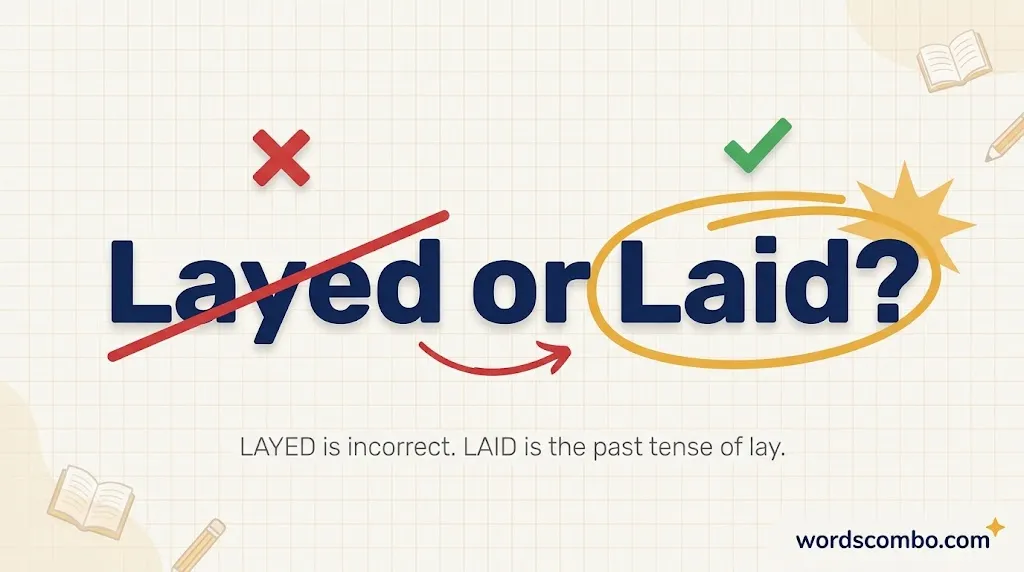
Layed or laid: laid is the correct past tense and past participle of lay. Use laid when you mean put, placed, or set something somewhere.
I once caught this mistake while checking a short email before sending it to a client. The sentence looked fine at first, but one word stopped me: “I layed the report on your desk.” It was one of those tiny errors that feels completely natural until you look at it twice.
That is exactly why layed or laid causes so much trouble. English often forms the past tense by adding -ed. We write played, walked, and cleaned, so layed seems like a perfectly logical choice.
But lay is different. Its past form is laid.
The confusion gets even deeper when lay and lie enter the picture. If you say someone lay in bed, that can be correct. But if someone laid a blanket on the bed, that is also correct. The meaning changes with the verb.
This guide clears up all of these points. You will learn the meaning of laid, the correct past tense of lay, when to use laid down, why layed looks tempting, and how to handle common phrases such as laid off and laid eggs.
Layed or Laid: The Quick Answer
Laid is the correct standard form when you mean that someone put or placed something somewhere.
- Correct: She laid the book on the table.
- Incorrect: She layed the book on the table.
The basic verb pattern is:
lay → laid → laid
For example:
I lay the documents on the desk every morning.
I laid the documents on the desk yesterday.
I have laid the documents on the desk.
Layed is not the standard past form of lay.
The word laid can also appear in common phrases such as laid down, laid off, and laid eggs. The meaning depends on the sentence.
Why Does Layed Look Correct?
The confusion comes from a very common English pattern.
Many verbs form the past tense by adding -ed:
- play → played
- clean → cleaned
- open → opened
- call → called
So it is easy to think:
lay → layed
But lay is an irregular verb. It does not use the normal -ed pattern.
Its forms are:
| Verb Form | Correct Form | Example |
| Base form | lay | I lay the book here. |
| Past tense | laid | I laid the book here yesterday. |
| Past participle | laid | I have laid the book here. |
| -ing form | laying | I am laying the book here. |
This irregular pattern is the main reason layed or laid becomes confusing.
There is another problem, too. Lie has a past form that is lay.
That gives you two different patterns:
lay → laid → laid
lie → lay → lain
Once you separate these two verbs, many confusing sentences become much easier.
Layed or Laid Meaning: What Does Laid Mean?
Laid is the past tense and past participle of lay when lay means to put, place, or set something somewhere.
For example:
She laid her phone on the table.
This means she put her phone on the table.
You can replace laid with put in many simple sentences:
He laid the keys on the counter.
He put the keys on the counter.
This is a useful memory trick. If you are talking about placing an object, laid is often the word you need.
The word also appears in other common expressions:
- laid down the rules
- laid off employees
- laid the foundation
- laid an egg
- laid the book on the desk
So when someone asks, “What is the meaning of laid?”, the answer depends on the sentence, but the core idea is often connected to putting, placing, or setting something down.
Layed or Laid in Bed: This Is Where It Gets Tricky
The phrase layed or laid in bed is a common source of confusion because it can involve two different verbs.
If you mean resting in bed, use lie in the present and lay in the past.
Today, I lie in bed.
Yesterday, I lay in bed.
I have lain in bed all morning.
You would not write:
❌ I layed in bed all morning.
But if you are placing something on the bed, use lay and laid.
I lay the blanket on the bed every morning.
I laid the blanket on the bed yesterday.
So the answer to “Is it laid or layed down in bed?” depends on what you mean.
If you mean resting, write:
I lay down in bed.
If you mean placing something, write:
I laid the blanket down on the bed.
This small difference solves one of the biggest problems with layed or laid.
Layed or Laid Down: Which One Is Correct?
When lay down means put something down, the past tense is laid down.
I laid down the book.
She laid down the rules.
They laid down the tools.
Do not write:
❌ I layed down the book.
However, when a person means rested or reclined, the past tense is lay down.
I lay down for a nap.
She lay down on the sofa.
He lay down in bed.
Here is the easiest way to remember it:
You lay something down.
You lie down.
Yesterday, that becomes:
You laid something down.
You lay down.
That distinction is much more useful than trying to memorize isolated spellings.
Layed or Laid in a Sentence
If you are looking for layed or laid in a sentence, these examples show the difference clearly.
Using Laid
She laid the letter on my desk.
The letter was placed on the desk.
He laid his jacket on the chair.
The jacket was put on the chair.
We laid the papers in order.
The papers were arranged.
Using Lay
I lay on the bed after work.
Here, lay means rested. It is the past form of lie.
She lay down for an hour.
Again, the person is resting.
Using Laid in Other Phrases
The company laid off several workers.
The hen laid two eggs.
The team laid the foundation for the project.
These examples show why the meaning of the sentence matters.
Which Version Should You Use?
For normal English writing, choose laid when you need the past tense of lay.
For students
Use laid in essays, homework, exams, and assignments.
The student laid the papers on the teacher’s desk.
This is the safe standard form.
For professional writing
Use laid in emails, reports, articles, and business documents.
The team laid out the new project plan.
It is clear and professional.
For social media
Informal writing still uses the standard spelling.
I laid everything out before the party started.
There is no need to change it to layed.
For global English
Use laid.
The standard spelling does not change between American and British English.
Common Mistakes With Layed or Laid
1. Writing Layed as the Past Tense
Wrong: She layed the phone on the desk.
Correct: She laid the phone on the desk.
The error happens because -ed feels like the natural past-tense ending.
2. Writing Layed Down
Wrong: He layed down the book.
Correct: He laid down the book.
When you put an object somewhere, use laid.
3. Using Laid for Resting
Wrong: Yesterday, I laid in bed all morning.
Correct: Yesterday, I lay in bed all morning.
Here, you are not placing an object. You are talking about resting.
4. Confusing Laid With Lain
Wrong: I have laid in bed all morning.
Correct: I have lain in bed all morning.
The pattern for resting is:
lie → lay → lain
5. Assuming Layed Is a British Spelling
Wrong idea: Americans use laid, but British speakers use layed.
Correct: Laid is the standard form in both varieties of English.
Layed or Laid Examples You Will Actually Use
Here are some everyday examples worth remembering.
Placing Something
She laid the keys beside the laptop.
Putting Something Down
He laid the book down carefully.
Arranging Something
They laid the clothes on the bed.
Resting
She lay on the sofa after dinner.
Eggs
The hen laid three eggs.
The phrase laid eggs is always written with laid, not layed.
So if you are asking, “Are eggs laid or layed?”, the answer is:
Eggs are laid.
For example:
The hen laid an egg this morning.
Employment
The company laid off 20 employees.
Here, laid off means that employees lost their jobs because their employer reduced staff or no longer needed their positions.
So the correct phrase is:
laid off
Not:
❌ layed off
Layed or Laid Off: What Does It Mean?
Laid off is a common phrase related to employment.
When a worker is laid off, the job ends because of a business decision. It is different from being fired for poor performance or misconduct.
For example:
The company laid off several employees after sales dropped.
The past form is laid, so layed off is not the standard spelling.
This is useful to know because someone searching “layed or laid off” may not be asking about lay in the sense of placing an object. They may simply want to know how to spell the employment phrase.
Layed or Laid in Real-World Writing
Professional Email
I laid the revised report on your desk for review.
This clearly describes placing the report somewhere.
News Headline
Company lays off workers as costs rise
Notice the present-tense form lays off.
In the past:
Company laid off workers after sales fell
Social Media Post
I finally laid everything out before starting the project.
This sounds natural in an informal post.
Formal Report
The committee laid the groundwork for the next phase.
Here, laid the groundwork means created a base for future work.
Everyday Conversation
She laid her phone beside the bed.
The phone was placed beside the bed, so laid is correct.
Why Do People Confuse Layed and Laid?
Layed looks logical because many English verbs form the past tense by adding -ed. But lay is an irregular verb, so its past tense is laid, not layed.
There is another reason for the confusion: lay and lie are easy to mix up, especially when talking about beds, resting, or lying down.
For example:
- I lay in bed yesterday. (I rested in bed.)
- I laid the blanket on the bed. (I placed the blanket there.)
- I lay down for an hour. (I rested.)
- I laid down the book. (I placed the book down.)
The word laid also appears in many common phrases, such as laid down, laid off, and laid eggs. This can make the spelling seem confusing at first.
A Simple Test
When you are unsure, ask what the verb means.
Are you placing something somewhere?
Use lay in the present and laid in the past.
Are you talking about resting or reclining?
Use lie in the present and lay in the past.
Remember this simple pattern:
lay → laid → laid
lie → lay → lain
Once you learn this pattern, layed or laid becomes much easier to choose correctly.
Layed or Laid: Comparison at a Glance
| Term/Variant | Meaning | Region/Context | Best Used When |
| laid | Past form of lay | Standard English | Something was placed |
| layed | Nonstandard attempted past form | Usually incorrect | Avoid in normal writing |
| lay | Put or place something | Present tense, or past of lie | Meaning depends on context |
| laying | Putting or placing | Standard English | An action is happening |
| lain | Past participle of lie | Standard English | Someone has rested or reclined |
A quick memory trick is:
Lay it today. Laid it yesterday.
Today, I lay the book on the desk.
Yesterday, I laid the book on the desk.
For resting:
Today, I lie in bed.
Yesterday, I lay in bed.
I have lain in bed.
That four-word family becomes much easier once you see the pattern.
FAQs About Layed or Laid
Is it laid or layed down in bed?
If you mean resting, the correct past form is lay down: “I lay down in bed.” If you mean placing an object down, use laid down: “I laid the blanket down on the bed.”
What is the meaning of laid?
Laid is commonly the past tense of lay, meaning put, placed, or set something somewhere. It also appears in phrases such as laid off, laid down, and laid eggs.
Is it I layed down or I laid down?
If you mean you put something down, write I laid down something. If you mean you rested, write I lay down.
Are eggs laid or layed?
Eggs are laid. The correct sentence is, “The hen laid three eggs.” Layed is not the standard spelling.
What is the past tense of lay?
The past tense of lay is laid. Its past participle is also laid, as in “I have laid the book on the desk.”
Is layed a word?
Layed is not the standard past form of lay. In ordinary modern writing, use laid instead.
What is the difference between lay and lie?
Lay means to put or place something, while lie means to rest or recline. Their forms can overlap, which is why sentences about beds and resting often cause confusion.
Is it laid off or layed off?
The correct phrase is laid off. For example, “The company laid off several employees after business slowed.”
Is it laid in bed or lay in bed?
If you mean someone rested in bed, use lay in bed for the past tense of lie. If you mean someone placed an object in bed, use laid.
Final Thoughts on Layed or Laid
When you are stuck between layed or laid, choose laid when you mean the past tense or past participle of lay.
The main pattern is:
lay → laid → laid
The tricky part is that lie has lay as its past form:
lie → lay → lain
That is why “I lay in bed” can be correct, while “I layed in bed” is not.
Remember the meaning, not just the spelling. If you place something, you can lay it today and laid it yesterday. If you rest, you lie down today and lay down yesterday.
The same rule helps with common phrases. Eggs are laid, employees are laid off, and objects are laid down.
Once you understand these patterns, layed or laid stops being a guessing game.
Use laid for the past form of lay, and you will be right in standard English.
Bookmark this guide so you never have to second-guess layed or laid again.
Take your vocabulary a step further with Unfeasible or Infeasible: The Easy Answer.

I started writing about English word differences after years of teaching students who kept making the same mistakes. My focus is on making spelling rules feel simple and easy to remember. At WordsCombo, I turn confusing word pairs into clear comparisons.











1 thought on “Layed or Laid: The Easy Way to Get It Right”