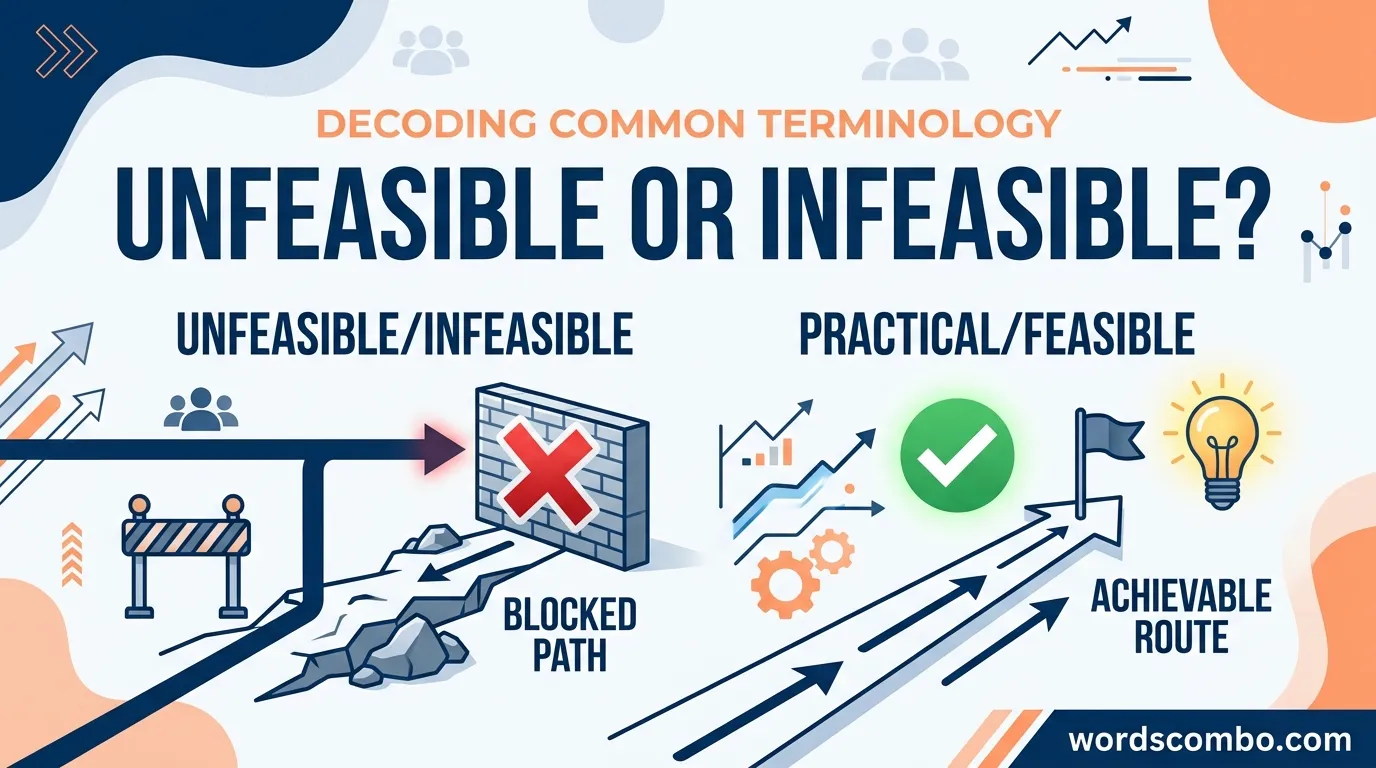
Infeasible and unfeasible both mean not feasible, possible, or practical. However, infeasible is the more common choice in modern formal and professional writing.
I remember editing a short project report where the writer had typed “unfeasible” several times. Nothing looked obviously wrong. The sentences made sense, the spelling checker accepted the word, and yet the wording felt slightly unusual. Then came the familiar second thought: should it be infeasible instead?
That small doubt is exactly why this pair causes trouble. Both forms are real English words. Both can describe a plan, task, idea, or solution that cannot realistically be carried out. The main difference is not a simple right-versus-wrong spelling rule. It is about modern usage, frequency, tone, and context.
If you are writing an email, school assignment, business report, technical document, or formal proposal, you probably want the form that sounds most natural to today’s readers. That is where infeasible has a clear advantage.
By the end of this guide, you will know what both words mean, why they exist, when to use each one, and which choice is safest when you do not want your wording to distract the reader.
Unfeasible or Infeasible: The Quick Answer
Both unfeasible and infeasible are adjectives meaning not feasible, not practical, or not possible to achieve.
The important point is that infeasible is more common in modern formal English.
For example:
- The original plan was infeasible because the budget was too small.
- Building the road in that location would be unfeasible.
Both sentences can work. The first one will usually sound more natural in professional or technical writing.
If you are unsure which one to choose, use infeasible.
Where Unfeasible and Infeasible Come From
Both words are built around the adjective feasible.
Feasible means something can be done successfully or practically.
For example:
The plan is feasible.
This means the plan can realistically work.
English can then create a negative form by adding a prefix:
- feasible = possible or practical
- infeasible = not feasible
- unfeasible = not feasible
The interesting part is that English has more than one way to create a negative adjective. The prefixes in- and un- can both express a negative idea in different words.
That does not mean you can freely put either prefix in front of every adjective. English word formation is shaped by long patterns of usage. Some combinations became standard, while others never caught on.
In this case, both infeasible and unfeasible became established words.
Their history also helps explain today’s confusion. Unfeasible was once more common, but infeasible later became the more widely used form. That shift is one reason older writing and newer writing may give you different impressions.
So if you have seen unfeasible before, you did not imagine it. It is a genuine word. It is simply less common than infeasible in much modern writing.
Unfeasible vs Infeasible: What Is the Difference?
The basic meaning is almost the same.
Both words describe something that cannot reasonably be done, achieved, completed, or put into practice.
The biggest practical difference is usage.
| Term | Meaning | When to Use | Region/Context |
| Infeasible | Not feasible, practical, or achievable | Best general choice, especially in formal writing | Common in American and British English |
| Unfeasible | Not feasible or practical | Acceptable alternative, but less common | Used in both American and British English |
| Not feasible | Cannot reasonably be done | Excellent when you want maximum clarity | Neutral and widely understood |
Consider these examples:
Infeasible:
The deadline is infeasible because the project needs another three weeks.
Unfeasible:
The original schedule became unfeasible after the supplier changed the delivery date.
Not feasible:
Completing the entire project in one day is not feasible.
All three communicate essentially the same idea.
The difference is that infeasible usually feels more established and natural in formal writing. Not feasible is even more direct and can be a good choice when you want your sentence to be instantly clear.
Does Infeasible Mean Completely Impossible?
Not always.
This is an important detail.
Infeasible can mean that something is impossible under the current conditions. It does not necessarily mean that it could never happen under any circumstances.
For example:
The project is infeasible with our current budget.
The project might become possible if the budget increases.
Likewise:
The plan is infeasible within two weeks.
That does not mean the plan can never happen. It means the two-week deadline does not work.
So infeasible often relates to practical limits such as:
- Time
- Money
- Staff
- Technology
- Equipment
- Resources
- Space
- Legal restrictions
- Physical limits
- Project requirements
Which One Should You Use?
For most readers, the simplest answer is this:
Choose “infeasible” when you need one word.
It is the stronger default for professional, academic, technical, and business writing.
For students
Use infeasible in essays, assignments, reports, and formal answers.
The proposed solution was infeasible because it required too many resources.
It sounds natural and precise.
For business writers
Infeasible works well when discussing budgets, deadlines, plans, projects, or strategies.
The proposed launch date is infeasible under the current production schedule.
It gives the sentence a clear professional tone.
For technical writers
Infeasible is especially useful when a solution cannot meet a set of technical or practical conditions.
The design is infeasible because the required materials are unavailable.
For casual writing
You can use either form, but not feasible may sound more natural and conversational.
Finishing all of that tonight is not feasible.
This is simple and easy to understand.
For global or neutral writing
If you want the safest single-word choice, use infeasible.
If you want the clearest possible wording for a broad audience, use not feasible.
Common Mistakes With Unfeasible and Infeasible
These words cause a few predictable mistakes.
1. Assuming unfeasible is always wrong
Wrong assumption:
Unfeasible is not a real English word.
Better understanding:
Unfeasible is a valid word, but it is less common than infeasible.
The issue is usually preference, not basic validity.
2. Treating infeasible as a synonym for illegal
Incorrect:
The plan is infeasible, so it must be illegal.
That conclusion does not follow.
Infeasible means something is not practical, possible, or achievable under the relevant conditions. It does not automatically mean that something breaks the law.
3. Thinking infeasible always means permanently impossible
Consider:
The project is infeasible with the current budget.
The phrase with the current budget changes the meaning. A larger budget might make the project possible.
4. Writing “infeasable”
This is a common spelling mistake.
Incorrect: infeasable
Correct: infeasible
The ending is -ible, not -able.
A useful visual reminder is:
feasible → infeasible
Keep the -ible ending.
5. Using unfeasible when a formal audience expects infeasible
This is not necessarily a grammar error.
Still, if you are writing a research paper, proposal, technical report, or formal business document, infeasible is usually the smoother choice.
Unfeasible or Infeasible in Real World Examples
Seeing these words in complete sentences makes the difference easier to remember.
Professional Email
After reviewing the revised schedule, we believe the proposed delivery date is infeasible. We recommend moving the deadline to the following week.
This sounds direct and professional.
News Headline
Infeasible Construction Plan Faces Major Delays
The word quickly tells readers that the plan cannot realistically move forward as proposed.
Social Media Post
I wanted to finish the whole project tonight, but that plan was clearly infeasible. Sometimes a realistic deadline is better than an ambitious one.
Here, the word works even in a casual setting.
Formal Report
The proposed expansion was considered infeasible because the available site could not support the required facilities.
This is a strong use of the word in formal writing.
Everyday Conversation
Getting everything done before lunch is not feasible.
In casual speech, not feasible may feel more natural than either one-word option.
Unfeasible or Infeasible: Usage, Search Intent and Trends
The search behind “unfeasible or infeasible” is mainly informational.
People who search this phrase are usually trying to answer one of these questions:
- Is infeasible correct?
- Is unfeasible a real word?
- Which spelling should I use?
- Is there a difference between the two?
- Which form sounds more professional?
- Can I use either word in formal writing?
The strongest modern usage pattern points toward infeasible as the safer default.
That matters because word choice is not only about whether a word can be found in English. It is also about whether it sounds natural to your intended reader.
A word can be valid and still be less common.
That is exactly what happens here.
Infeasible is widely useful in business, engineering, mathematics, technology, academic writing, project planning, and everyday discussions about difficult plans. Unfeasible remains understandable and acceptable, but many readers will encounter it less often.
For writers, the practical lesson is simple: do not waste time worrying that unfeasible is forbidden. Instead, use infeasible when you want the more familiar modern choice.
Unfeasible or Infeasible: Comparison at a Glance
| Term/Variant | Meaning | Region/Context | Best Used When |
| Infeasible | Not practical, possible, or achievable | Formal and general English | You want the safest modern choice |
| Unfeasible | Not practical, possible, or achievable | General English, less common usage | You have a reason to prefer the alternative |
| Not feasible | Something cannot realistically be done | Neutral, broad usage | You want maximum clarity |
The easiest rule to remember
Think of it this way:
Feasible = can work.
Infeasible = cannot realistically work.
And if you are still unsure:
Use “infeasible.”
That single choice will work well in most professional and academic situations.
FAQs About Unfeasible or Infeasible
Is infeasible a correct word?
Yes. Infeasible is a correct and widely used English adjective. It means something cannot reasonably be done, achieved, or put into practice.
Is unfeasible a correct word?
Yes. Unfeasible is also a valid English word. It has essentially the same basic meaning as infeasible, although it is less common in much modern writing.
What is the difference between infeasible and unfeasible?
There is no major difference in basic meaning. Both describe something that is not feasible, but infeasible is generally the more common and safer choice, especially in formal writing.
Which is better, unfeasible or infeasible?
Infeasible is usually the better choice. It is more familiar to many modern readers and works naturally in academic, technical, business, and professional writing.
Is infeasible formal English?
Yes. Infeasible fits formal English very well. You can use it in reports, research writing, business documents, technical discussions, and professional emails.
Can I use unfeasible in a formal sentence?
Yes. Unfeasible can appear in formal writing because it is a valid word. However, if you want the most familiar and conventional option, infeasible is usually preferable.
Is “infeasable” the correct spelling?
No. The correct spelling is infeasible. The ending is -ible, so write infeasible, not infeasable.
Does infeasible mean impossible?
It can mean impossible under the relevant conditions, but it often has a more practical sense. Something may be infeasible because of time, money, resources, technology, or other limits, even if it could become possible after those conditions change.
Can I say “not feasible” instead of infeasible?
Absolutely. Not feasible is clear, natural, and widely understood. In some situations, it is even better because it uses simple words and leaves little room for confusion.
Final Thoughts on Unfeasible or Infeasible
The unfeasible vs infeasible question looks harder than it really is.
The key point is that both words are valid. Both mean that something is not feasible, practical, or realistically achievable. You are not making a basic spelling error by using unfeasible.
Still, there is a clear practical winner.
Infeasible is the better default for most modern writing. It fits professional emails, academic assignments, technical documents, business plans, reports, and everyday explanations. If you want a simple phrase instead, not feasible is also an excellent choice.
Remember these three points:
- Feasible means possible or practical.
- Infeasible means not feasible and is the safer modern choice.
- Unfeasible is also valid, but less common.
You do not need to second-guess this word every time you write it. When your sentence calls for a one-word description of something that cannot realistically be done, infeasible is a strong, natural choice.
Bookmark this guide so you never have to second-guess “unfeasible or infeasible” again.
Looking for more word choices? See Blankey or Blankie.

I started writing about English word differences after years of teaching students who kept making the same mistakes. My focus is on making spelling rules feel simple and easy to remember. At WordsCombo, I turn confusing word pairs into clear comparisons.







1 thought on “Unfeasible or Infeasible: The Easy Answer”