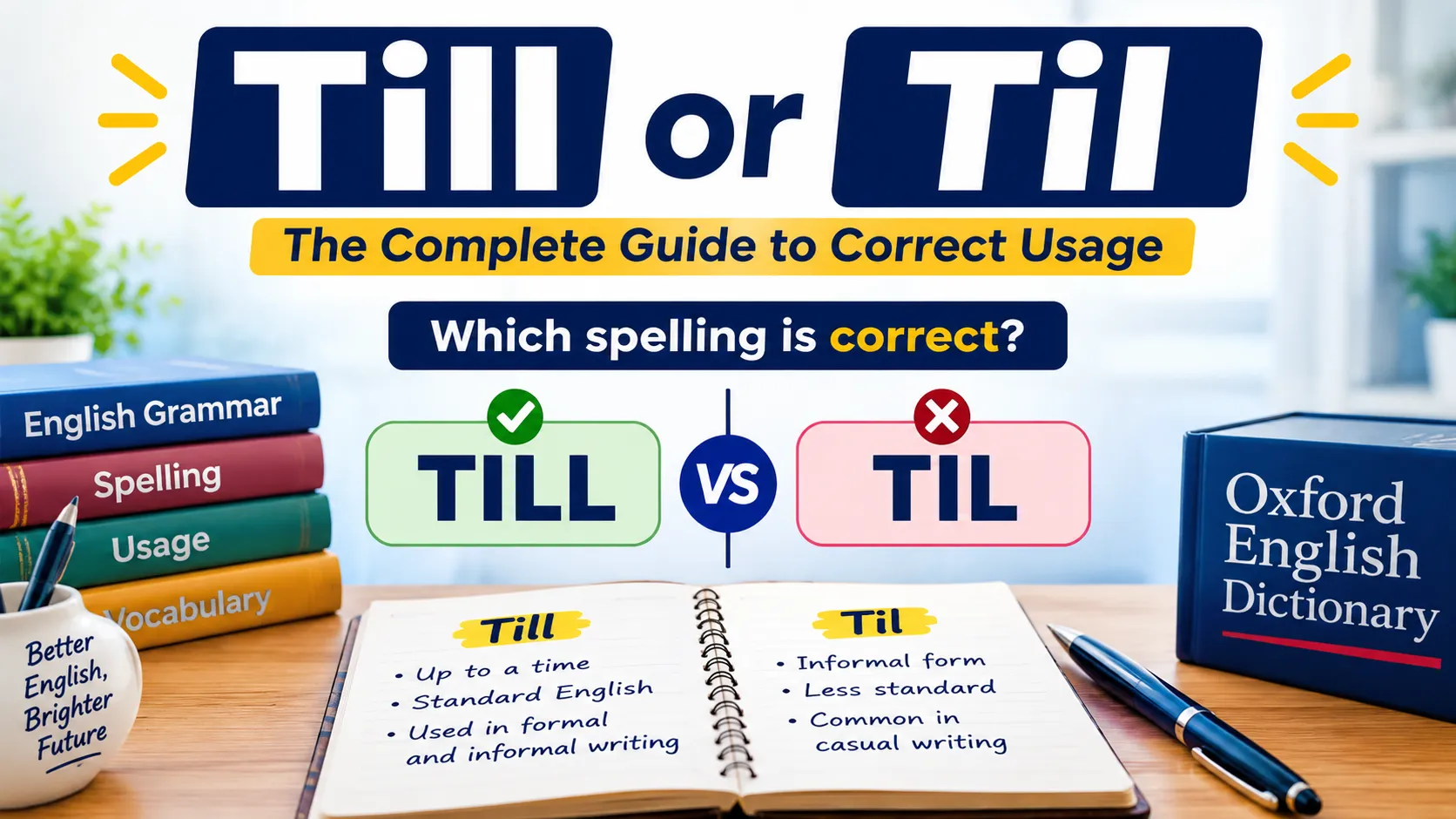
Till and til can both mean “up to a certain time.” Till is the standard form for general and formal writing, while til is mainly informal and is often used in casual writing, names, or branding.
Have you ever typed a sentence like “I will wait till 6” and then stopped to wonder, Should that be till or til?
I have seen this small spelling choice confuse English learners for years. It looks simple, but English has a habit of making simple words surprisingly tricky.
The confusion often comes from the fact that till and til look almost the same. They can also sound the same when spoken. On top of that, you may see ’til in songs, books, social media posts, and casual messages.
So, which one should you use?
The good news is that the answer is simple once you know the basic rule. Till is a standard English word. It means “up to the time that” or “until.” Til is a less standard spelling and is usually informal.
There is also a third form: ’til. This form is often used as a shortened version of “until,” especially in informal writing.
This guide explains the difference, gives you clear examples, and shows you which form is safest in school, work, and everyday English.
Till or Til
Till is the safest choice in most situations.
It means up to a particular time or point.
Examples:
- I will wait till 5 p.m.
- The shop is open till midnight.
- Stay here till I come back.
Til can appear in informal writing, but it is less widely accepted as a standard spelling.
For example:
I’ll stay here til you return.
You may see this online or in casual messages. However, if you are writing an essay, email, report, or other formal text, till or until is a better choice.
The simplest rule
If you are unsure, use till.
If you want the most formal and widely accepted option, use until.
The Origin and Background of Till
The word till is much older than many people expect.
It has been used in English for centuries. It developed from older Germanic forms and has long been used to express a point in time or a limit.
This is one reason the idea that until is always the “correct” form while till is somehow wrong is misleading.
Till is a real, standard English word.
In fact, till and until can often be used in the same sentence without changing the basic meaning.
Compare:
- I waited till noon.
- I waited until noon.
Both sentences mean that the waiting continued up to noon.
The spelling til is different. It is commonly treated as an informal shortening or alternative spelling. You may encounter it in casual online writing, advertising, song titles, and other relaxed contexts.
You may also see ’til, with an apostrophe. This usually signals that letters have been left out.
For careful writing, however, till or until is the better choice.
Till Explained: Key Differences and Variations
Here is the easiest way to understand the three common forms:
| Term | Meaning | When to Use | Region/Context |
|---|---|---|---|
| till | Up to a time or point | Standard writing and speech | Broad English use |
| until | Up to a time or point | Formal and neutral writing | Broad English use |
| til | Informal form related to “until” | Casual writing | Informal contexts |
| ’til | Informal shortened form of “until” | Casual or expressive writing | Informal contexts |
1. Till
Till is standard English.
Examples:
- Wait till tomorrow.
- The library stays open till 9 p.m.
- Don’t leave till I call you.
You can use it in everyday speech and many forms of writing.
2. Until
Until has the same basic time meaning.
Examples:
- Wait until tomorrow.
- The library stays open until 9 p.m.
- Don’t leave until I call you.
Until often sounds slightly more formal or neutral.
3. Til
Til is much less formal.
You might see it in:
- Text messages
- Social media
- Informal blogs
- Advertising
- Creative writing
- Song or slogan language
Example:
See you til tomorrow!
The meaning is clear, but til is not the best choice for formal English.
4. ’Til
The apostrophe in ’til suggests that part of the original word has been removed.
Example:
I won’t stop ’til I finish.
This spelling is common in expressive or creative writing. Still, until is safer in formal work.
Which Version Should You Use?
Your choice depends on your audience and the type of writing you are doing.
For students
Use until or till.
If you are writing an essay, exam answer, research assignment, or school project, until is the safest option.
Example:
The students remained in the classroom until the teacher arrived.
For professional writing
Use until or till.
For business emails, reports, applications, and official documents, avoid til.
For example:
The office will remain open until Friday.
This sounds clear and professional.
For casual messages
Till is still perfectly fine.
You can write:
I’ll be here till 8.
You may also see til or ’til in casual writing. These forms are easy to understand, but they are less formal.
For global or neutral English
Choose until when you want maximum clarity.
It is widely understood and works well in almost every writing situation.
Best overall rule:
Formal → until
Standard everyday English → till
Very informal → til / ’til
Common Mistakes with Till or Til
Small spelling differences can cause big doubts. Here are the most common mistakes.
| Mistake | Better Choice | Why |
|---|---|---|
| I will wait til 5. | I will wait till 5. | “Till” is the standard form. |
| Stay here ’til I return. | Stay here until I return. | “Until” is better for formal writing. |
| I stayed till until noon. | I stayed until noon. | Do not use both together. |
| Wait till after lunch. | Wait till after lunch. | This use is correct. |
| I won’t go till until Monday. | I won’t go until Monday. | Use one time connector, not both. |
Mistake 1: Thinking “till” is wrong
It isn’t.
Till is a standard English word.
You can use it naturally in sentences such as:
I worked till late.
Mistake 2: Using “til” in formal work
This is best avoided.
Instead of:
The service is available til Friday.
Write:
The service is available until Friday.
Mistake 3: Confusing “till” with “until”
They often have the same meaning.
You can usually replace one with the other:
We waited till noon.
We waited until noon.
Both are correct.
Mistake 4: Adding an unnecessary apostrophe
Some writers use ’til everywhere because they think the apostrophe is required.
It isn’t.
If you want a standard form, simply use till or until.
Till or Til in Real World Examples
Seeing the words in context makes the difference easier to remember.
1. Professional Email
Subject: Office Hours
Our customer service team will be available until 6 p.m. today. Please contact us before then if you need assistance.
Best choice: Until
It sounds clear and professional.
2. News Article
The weather service expects heavy rain until Friday morning.
Best choice: Until
News writing usually favors clear, standard language.
3. Social Media Post
Working till midnight again. Wish me luck!
Best choice: Till
This is natural and conversational.
You could also see:
Working til midnight again!
That works in a casual post, but til is less standard.
4. Formal Report
The project team will continue testing until all safety checks are complete.
Best choice: Until
Formal documents should favor standard forms.
5. Everyday Conversation
I’ll wait till you get here.
Best choice: Till
This sounds natural in everyday speech.
Till or Til: Standalone Comparison Table
| Term/Variant | Meaning | Region/Context | Best Used When |
|---|---|---|---|
| Till | Up to a time or point | Standard English | Everyday and general writing |
| Until | Up to a time or point | Standard and formal English | Formal, academic, and professional writing |
| Til | Informal form of “until” | Casual English | Texts, posts, and relaxed writing |
| ’Til | Informal shortened form of “until” | Creative and casual writing | Informal or expressive contexts |
The key point is simple: till and until are standard; til is informal.
Till or Til: Data, Trends, and Usage
When people search for “till or til,” they are usually looking for one thing: Which spelling is correct?
That makes this an informational search query.
The question is especially useful for:
- English learners
- Students
- Bloggers
- Copywriters
- Social media users
- People writing professional emails
The confusion stays alive because modern writing mixes formal and informal English. A person might see til in a text message and then see till in a dictionary.
Both may look familiar, but they do not have the same level of standard usage.
There is another reason this matters now. Online communication has made informal spellings much more visible. Social media, messaging apps, captions, and creative content often favor short forms.
That does not mean every popular spelling is ideal for formal English.
A useful habit is to ask:
“Who will read this?”
If the answer is a teacher, employer, client, or professional audience, choose until or till.
If you are writing a casual message, til may appear naturally, but till is still a safe choice.
Is Till or Until Better?
Neither word is automatically better in every sentence.
The choice is mostly about tone and context.
Till is shorter and often sounds more conversational.
I’ll stay till Monday.
Until can sound more formal or polished.
I’ll stay until Monday.
The meaning is almost the same.
If you are writing something formal and want to avoid doubt, until is the safest option.
If you want natural everyday English, till works very well.
Till vs. Until: Is There Any Meaning Difference?
In most cases, till and until mean the same thing.
Compare:
Don’t open the door till I arrive.
Don’t open the door until I arrive.
The meaning is essentially identical.
There are, however, small differences in style and common patterns. Until is more common in formal writing. Till often feels more conversational.
There is also a separate noun, till, meaning a cash register or money drawer.
For example:
The cashier put the money in the till.
This meaning has nothing to do with time.
That is one reason context matters when reading the word till.
FAQs About Till or Til
Q: What does “till” mean?
A: Till means “up to a particular time or point.” For example, “I will wait till 6” means the waiting will continue up to 6 o’clock.
Q: Is “til” correct English?
A: Til is used in informal English, but it is not the safest standard spelling. For formal writing, use till or until.
Q: Which is correct: till or til?
A: Till is the standard form. Til is mainly informal. If you are unsure, choose till.
Q: Is “till” acceptable in formal writing?
A: Yes. Till is a standard English word. However, until is often the more natural choice for formal, academic, or professional writing.
Q: Is “’til” correct?
A: ’Til is an informal shortened form associated with “until.” It is common in creative and casual writing, but until is better for formal work.
Q: Where does “till” come from?
A: Till is an old English word with Germanic roots. It has been used for a very long time to express a limit in time or place.
Q: Can I use “till” in an email?
A: Yes. For example, “I’ll be available till 5 p.m.” is correct. In a more formal email, “until” may sound slightly more polished.
Q: Can I use “til” in a text message?
A: Yes, especially in very casual writing. Still, till is also short and standard, so it is usually the better all purpose choice.
Q: Does “till” mean the same as “until”?
A: In most time expressions, yes. “Wait till noon” and “wait until noon” have the same basic meaning.
Conclusion
The till or til correct spelling is easier than it first appears.
Till is a standard English word. It means “up to a certain time or point.” You can use it in everyday speech and general writing.
Until has the same basic meaning and is often the best choice for formal, academic, and professional writing.
Til is the informal option. You may see it in texts, social media, creative writing, and casual content. It is understandable, but it is not the safest choice when you need polished standard English.
The simplest rule is this:
- Use “until” for formal writing.
- Use “till” for standard everyday English.
- Use “til” mainly in casual contexts.
- When in doubt, choose “until” or “till.”
You do not need to overthink this tiny spelling choice. Once you know the context, the answer is usually clear.
Bookmark this guide so you never second guess “till or til” again and use the right form in your next piece of writing.
Read more: Caddy or Caddie: The Complete Guide to the Correct Spelling

I started writing about English word differences after years of teaching students who kept making the same mistakes. My focus is on making spelling rules feel simple and easy to remember. At WordsCombo, I turn confusing word pairs into clear comparisons.