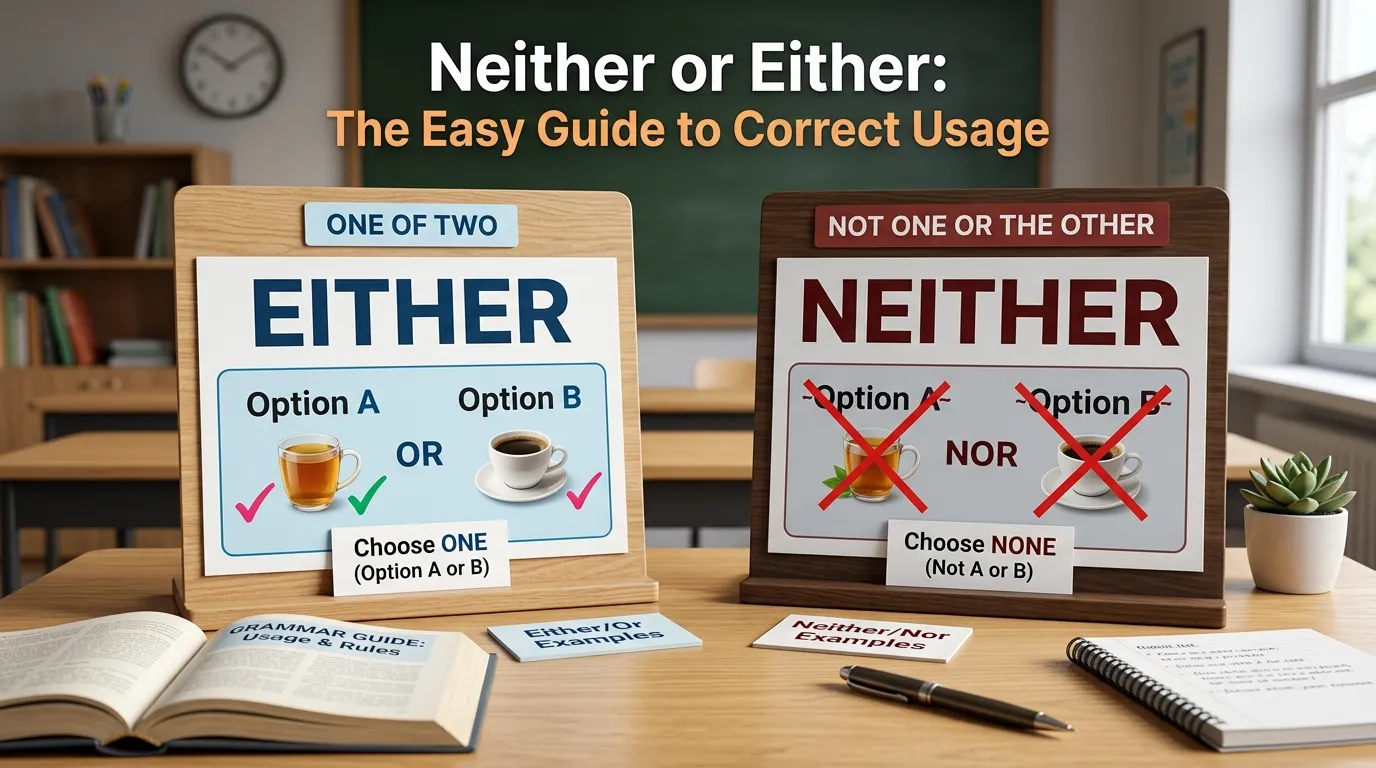
Either means one of two choices, while neither means not one and not the other. Use either…or for choices and neither…nor for two negative choices.
Have you ever written a sentence like “I don’t want neither” and then stopped to wonder if it sounded right?
You are not alone. Neither and either look simple, but they can cause real trouble when you try to use them in a sentence. The confusion often gets worse because both words can talk about two people or things.
I have seen this problem many times while helping students improve their English writing. A student may know what both words mean but still choose the wrong one in a sentence. The good news is that the basic rule is much easier than it first seems.
Think of either as a word of choice. Think of neither as a word of rejection.
For example, if you have two cakes and you can choose one, you can say, “Either cake is fine.” If you do not want either cake, you can say, “Neither cake is good.”
Once you understand that simple difference, most of the confusing rules fall into place.
Neither or Either : Quick Answer
Either refers to one of two options. It is often used when both choices are possible.
- Either answer is correct.
- You can choose either tea or coffee.
Neither means not one and not the other. It rejects both choices.
- Neither answer is correct.
- Neither tea nor coffee is available.
A useful memory trick is:
Either = one of the two
Neither = not one and not the other
Cambridge also explains that either can refer to a choice between two possibilities, while neither means “not either of two.”
The easiest pattern
Positive choice:
Either Ali or Ahmed can help.
Negative choice:
Neither Ali nor Ahmed can help.
That is the main difference.
The Origin and Background of Neither and Either
Both words have a long history in English.
Either comes from Old English æġðer, which had the sense of “each of two” or “both.” Over time, its meaning developed into the modern idea of one or the other of two.
Neither developed from Old English nāhwæther, meaning roughly “not of two.” Its modern meaning still carries that basic idea: not one and not the other.
This history helps explain why the two words feel closely connected.
You can almost think of them as opposites:
- Either → one of two
- Neither → not one of two
The pair neither…nor also became established in English as a way to connect negative alternatives.
So this is not a new grammar rule. English speakers have been making this distinction for centuries.
Neither or Either Explained: Key Differences
The easiest way to understand these words is to compare them side by side.
| Term | Meaning | When to Use | Region/Context |
|---|---|---|---|
| Either | One of two | When you have a choice | Standard English |
| Neither | Not one and not the other | When both choices are rejected | Standard English |
| Either…or | One choice or the other | To show two alternatives | Formal and informal |
| Neither…nor | Not one and not the other | To show two negative alternatives | Formal and informal |
| not…either | Also not | After a negative statement | Common in speech and writing |
1. Either means one of two
Use either when one of two choices is acceptable.
You can sit on either side.
This means both sides are possible. You can choose one.
Another example:
Either answer will work.
The speaker does not care which of the two answers you choose.
2. Neither means not one and not the other
Use neither when both choices are rejected.
Neither answer is correct.
This means answer A is wrong, and answer B is wrong.
Another example:
Neither student passed the test.
There are two students being discussed, and both failed.
3. Either…or shows a choice
The common structure is:
either + option A + or + option B
Examples:
We can either walk or take the bus.
You can either call me or send an email.
Either Sara or Maria will attend.
Cambridge describes either…or as a structure used to connect two choices or possibilities.
4. Neither…nor makes both options negative
The opposite structure is:
neither + option A + nor + option B
Examples:
Neither John nor Peter came.
She speaks neither French nor German.
Neither answer is correct.
Cambridge identifies neither…nor as the negative counterpart of either…or.
5. Either can also appear after a negative verb
This is one of the most useful rules to learn.
I don’t like coffee either.
Here, either means also not.
Compare:
I don’t like coffee either.
I don’t like tea either.
The word does not mean “one of two” in these sentences. It adds another negative fact.
Which One Should You Use?
The choice becomes simple when you ask yourself one question:
Am I choosing between two things, or rejecting both?
If you are choosing, use either
Use either when one of the two options can work.
You can choose either dress.
Either road will take you there.
We can either leave now or wait.
If you reject both, use neither
Use neither when both options are unwanted, false, unavailable, or incorrect.
Neither dress fits me.
Neither road is safe.
We can neither leave nor stay.
For students and beginners
Learn these two patterns first:
Either…or = choice
Neither…nor = two negative choices
That simple rule will solve most everyday grammar problems.
For formal writing
Both either and neither are fully acceptable in formal English. You do not need to avoid either word.
Use the form that matches your meaning.
For global English
The safest approach is to use clear structures:
Either A or B.
Neither A nor B.
These patterns are widely understood in both British and American English.
Common Mistakes With Neither or Either
Mistake 1: Using double negatives
❌ I don’t want neither option.
✅ I want neither option.
Or:
✅ I don’t want either option.
Why?
Neither already carries a negative meaning. Adding don’t can create an unwanted double negative in standard English.
Mistake 2: Mixing either with nor
❌ Either John nor Sarah came.
✅ Either John or Sarah came.
The normal pair is:
either…or
Not:
either…nor
Mistake 3: Mixing neither with or
❌ Neither John or Sarah came.
✅ Neither John nor Sarah came.
Remember:
neither…nor
Mistake 4: Using a plural noun after either
❌ Either options is fine.
✅ Either option is fine.
When either directly determines a noun, the noun is normally singular because either refers to one of two choices.
Cambridge gives the same rule: either before a singular countable noun refers to one of two choices.
Mistake 5: Confusing “either” with “both”
Sometimes either can have a special meaning.
Consider:
There are shops on either side of the street.
Here, either side can mean both sides.
But:
You can choose either side.
Here, it means one side or the other.
The meaning depends on the context. Cambridge notes this less common use of either meaning both sides of a pair.
Neither or Either in Real-World Examples
Knowing the rule is useful. Seeing the words in everyday writing makes the difference much easier to remember.
Professional email
Either option works for our team. Please let me know which one you prefer.
Negative version:
Neither option meets the project’s current needs.
Both sound natural in professional communication.
News headline or article
Neither Team A nor Team B Has Confirmed the Deal
The writer uses neither…nor because both teams have not confirmed it.
A choice-based headline might say:
Either Plan Could Change the City’s Future
Here, either points to two possible plans.
Social media post
I can meet either Friday or Saturday. What works better for you?
Negative example:
I tried both restaurants, but I liked neither.
Short sentences like these are common in everyday online communication.
Formal report
Neither method produced reliable results.
Or:
The company may adopt either method after further testing.
The words work perfectly well in formal reports.
Neither or Either : Data, Trends & Usage
The search intent behind “neither or either” is mainly informational. People searching this phrase are usually trying to solve a grammar problem, check a sentence, or understand the difference between the two words.
The confusion makes sense because the words are closely related. Both deal with two people, things, choices, or possibilities.
Modern English grammar references also treat both as common, standard words. Cambridge lists either as a determiner, pronoun, adverb, and conjunction. It gives neither the same broad range of grammatical roles.
Another useful point is pronunciation. Both either and neither have more than one accepted pronunciation. For example, either may be pronounced with an “ee” sound or an “eye” sound, and neither has similar variation.
That means you may hear:
EE-ther or EYE-ther
and:
NEE-ther or NYE-ther
Both pronunciation patterns are accepted.
For learners, the key lesson is simple: focus on meaning and sentence structure, not pronunciation alone.
Neither or Either: Standalone Comparison Table
| Term/Variant | Meaning | Region/Context | Best Used When |
|---|---|---|---|
| Either | One of two | Standard English | You are giving a choice |
| Neither | Not one or the other | Standard English | You reject both |
| Either…or | One option or another | Standard English | You present two alternatives |
| Neither…nor | Not one and not the other | Standard English | You present two negative alternatives |
| Not…either | Also not | Everyday and formal English | You add another negative point |
| Me neither | I also do not | Informal conversation | You agree with a negative statement |
A Simple Trick to Remember the Difference
If these words still feel confusing, use this mental picture.
Imagine two doors.
Either means:
🚪 A or 🚪 B
You can choose one.
Neither means:
🚪 A and 🚪 B are rejected.
You choose none.
Now add their common partners:
Either → or
Neither → nor
This gives you a quick four-word memory rule:
Either = choice = or
Neither = rejection = nor
It is not a perfect rule for every possible use, but it works extremely well for everyday English.
FAQ: Neither or Either
Q: What does either mean?
A: Either usually means one of two choices or possibilities. For example, “Either answer is acceptable” means one of the two answers can be accepted.
Q: What does neither mean?
A: Neither means not one and not the other of two people or things. For example, “Neither answer is correct” means both answers are wrong.
Q: What is the difference between either and neither?
A: Either allows one of two choices, while neither rejects both. Think of either as “one or the other” and neither as “not one or the other.”
Q: Should I use either…or or neither…nor?
A: Use either…or for two alternatives or choices. Use neither…nor when neither alternative is true, wanted, or available.
Q: Is “I don’t like either” correct?
A: Yes. It means you do not like either of the two options. You can also say, “I like neither,” which has the same basic meaning but uses a different structure.
Q: Is “I don’t like neither” correct?
A: In standard English, avoid this form because it creates a double negative. Say “I don’t like either” or “I like neither.”
Q: Can either mean both?
A: Yes, in some contexts. For example, “There were trees on either side of the road” can mean there were trees on both sides. Context tells you which meaning is intended.
Q: Can neither be used in formal writing?
A: Yes. Neither is completely standard in formal English. It is common in reports, essays, business writing, and academic work.
Q: Can I say “me neither”?
A: Yes. “Me neither” is common in informal conversation when you agree with a negative statement. In more formal writing, “Neither do I” may be a better choice.
Conclusion
The difference between neither and either becomes much easier once you stop treating them as confusing vocabulary pairs.
Remember the core idea:
- Either means one of two.
- Neither means not one and not the other.
- Either…or presents two choices.
- Neither…nor rejects both choices.
- Not…either can mean also not.
For example:
Either tea or coffee is fine.
But:
Neither tea nor coffee is available.
And:
I don’t want tea either.
These three patterns cover a large part of everyday usage.
Both either and neither are correct, useful words. Neither is “better” than the other. The right choice depends on what you want to say.
When you are unsure, ask yourself one simple question: Am I choosing one of two, or rejecting both?
If you are choosing, use either. If you are rejecting both, use neither.
Bookmark this guide so you never have to second-guess either or neither again.
Related Words: Lead or Leed: The Complete Easy Guide

I started writing about English word differences after years of teaching students who kept making the same mistakes. My focus is on making spelling rules feel simple and easy to remember. At WordsCombo, I turn confusing word pairs into clear comparisons.




1 thought on “Neither or Either: The Easy Guide to Correct Usage”