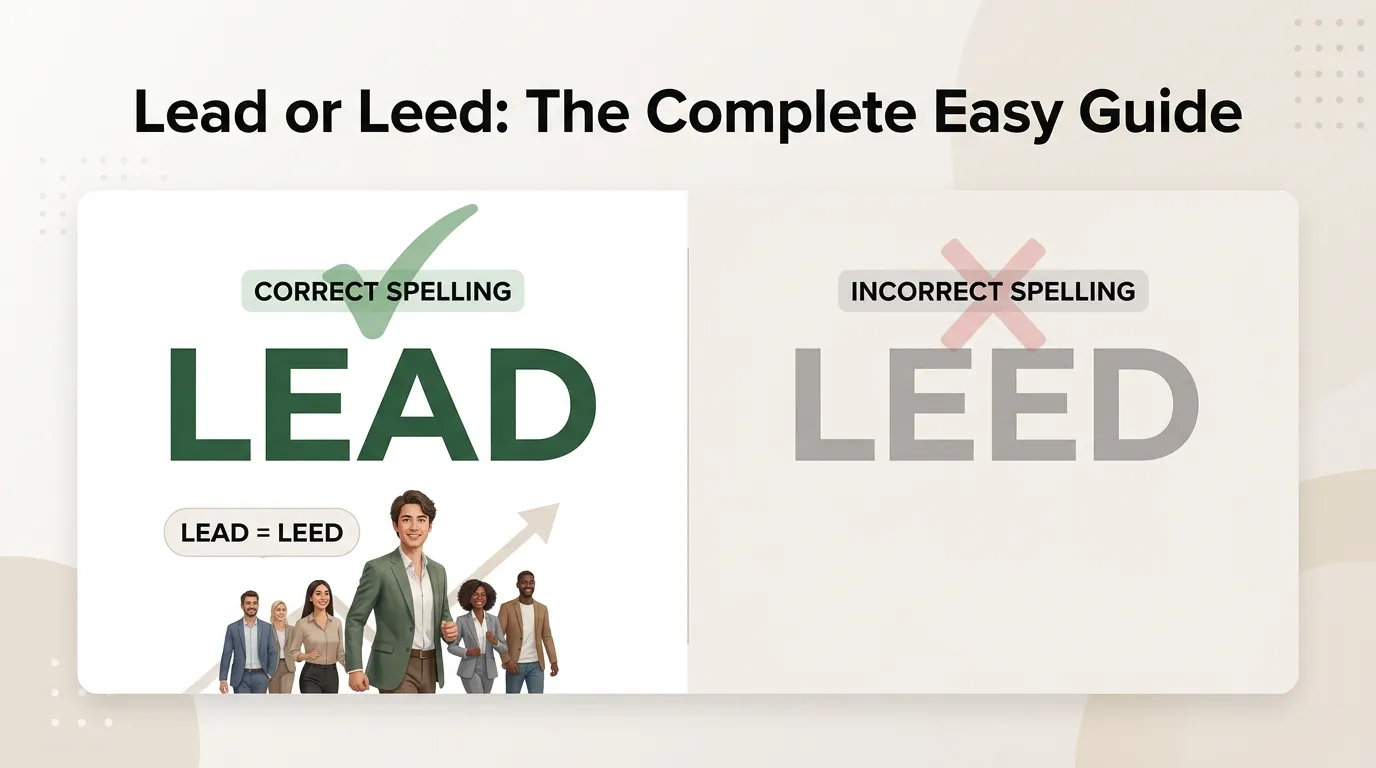
Lead is the correct spelling. It can mean to guide, be ahead, or refer to a soft metal. Leed is not the standard spelling for these meanings.
Have you ever typed a word that sounded right, only to stop and wonder, “Wait, is that actually how it is spelled?”
Lead or leed is a perfect example.
The confusion comes from sound. When lead means “to guide,” it is pronounced like leed. For example, “She will lead the team” sounds exactly like “leed.” That makes it easy to assume that leed might also be the correct spelling.
But English has a few surprises like this.
The word lead has more than one pronunciation and more than one meaning. The spelling stays the same in some cases, while the sound changes. That can be confusing for students, writers, and even fluent English speakers.
The good news is that the rule is simple once you see the pattern.
In this guide, you will learn the difference between lead and leed, how to pronounce lead, where the word comes from, common mistakes to avoid, and how to use it naturally in everyday and formal writing.
Lead or Leed: Quick Answer
Lead is the standard and correct spelling when you mean to guide, direct, or go first.
For example:
- The coach will lead the team.
- She will lead the meeting tomorrow.
- He decided to lead the group.
- Good teachers lead by example.
In all these examples, lead is pronounced “leed.”
The spelling leed is not normally used as a standard English spelling for the verb lead.
So, if you are writing a sentence such as:
I will lead the project.
Do not write:
I will leed the project.
The correct form is lead.
There is one important twist, though. Lead can also be a noun meaning the metal. In that case, it is pronounced “led.”
For example:
The old pipes contained lead.
So the same spelling can have different sounds and meanings.
The Origin and Background of Lead
The word lead has a long history in English.
The verb lead, meaning to guide or direct, comes from Old English lædan. It has been used for centuries to describe the act of showing someone where to go or helping a person or group move toward a goal.
The noun lead, meaning the metal, has a different history. It comes from an old Germanic word related to the metal known today as lead.
This is one reason English can feel strange at times. Words can have the same spelling but come from different historical roots.
The spelling leed does not replace the standard spelling lead.
Instead, leed is mainly useful as a way to show pronunciation in informal explanations. It may also appear as a name or in some regional or historical uses, but it is not the normal spelling of the verb lead.
That small difference between spelling and pronunciation causes most of the confusion.
Lead Explained: Meaning and Pronunciation
The word lead has several common uses.
1. Lead as a verb
When lead is a verb, it usually means to guide someone or something.
Example:
Sarah will lead the discussion.
Here, Sarah is guiding the discussion.
Another example:
The captain led the players onto the field.
Notice something important here.
The present form is lead, pronounced “leed.”
The past tense is led, pronounced “led.”
That gives us:
| Form | Spelling | Pronunciation | Example |
|---|---|---|---|
| Present | lead | leed | I lead the team. |
| Past | led | led | I led the team yesterday. |
| Past participle | led | led | She has led the team well. |
This is one of the most common areas of confusion.
2. Lead as a noun
Lead can also mean being in front or having an advantage.
Example:
Our team has a ten-point lead.
It can also describe the main role or position of leadership.
She took the lead in the project.
In these examples, lead is pronounced leed.
3. Lead as a metal
There is another lead.
This word refers to the chemical element and metal.
Example:
The paint contained lead.
Here, lead is pronounced “led.”
So you need to look at the meaning and context to know the pronunciation.
Lead vs. Leed: Key Differences
The easiest way to understand the issue is to compare the two spellings.
| Term | Meaning | When to Use | Region/Context |
|---|---|---|---|
| lead | Guide or direct | When someone guides people or a process | Standard English |
| lead | Be ahead | When someone has an advantage | Standard English |
| lead | A metal | When referring to the chemical element | Standard English |
| leed | Usually not the standard spelling of lead | Avoid it when writing the verb | Nonstandard for this meaning |
The key point is simple:
Lead is the spelling you want in normal English writing.
You may hear “leed” when someone says the word aloud, but that does not mean it should be spelled leed.
English pronunciation does not always tell you the spelling.
Which Version Should You Use?
If you are unsure whether to write lead or leed, choose lead.
Here is a practical guide.
For students
Use lead in school assignments, essays, exams, and homework.
The teacher will lead the students through the activity.
For professional writing
Use lead in emails, reports, presentations, business documents, and workplace communication.
Maria will lead the new project.
For formal writing
Lead is also the correct standard spelling in formal English.
The organization will lead an international campaign.
For global English
Use lead.
It is widely recognized in both American and British English.
The pronunciation can change based on meaning, but the spelling remains lead.
Common Mistakes with Lead or Leed
The sound of lead often causes spelling mistakes. Here are some of the most common ones.
Mistake 1: Writing leed instead of lead
Incorrect:
She will leed the team.
Correct:
She will lead the team.
Why does this happen?
Because lead sounds like “leed” when it means to guide.
Mistake 2: Using lead for the past tense
Incorrect:
Yesterday, she lead the meeting.
Correct:
Yesterday, she led the meeting.
The past tense of lead is led, not lead.
Mistake 3: Confusing the metal with the verb
Consider this sentence:
The workers found lead in the old paint.
Here, lead means the metal and is pronounced “led.”
But:
The manager will lead the team.
Here, lead means guide and is pronounced “leed.”
The spelling is the same, but the pronunciation and meaning are different.
Mistake 4: Assuming every sound has one spelling
English contains many words that sound different from how beginners expect them to look.
That is why spelling based only on pronunciation can cause errors.
If you hear “leed,” the standard written form for the verb is lead.
Lead or Leed in Real-World Examples
Seeing the word in different situations can make the rule easier to remember.
Professional Email
Subject: Project Update
James will lead the meeting on Friday. Please send your questions before the meeting.
Here, lead means guide or manage.
News Headline
Local Team Leads Championship Race
Here, leads means the team is ahead.
Social Media Post
Proud to lead such a talented group of people!
Again, lead means guide or manage.
Formal Report
The research findings led to several important changes.
Notice the spelling here.
The verb is led because the sentence talks about something that already happened.
Everyday Conversation
Can you lead the way?
This means:
Can you go first and show us where to go?
Lead or Leed: Data, Trends and Usage
The search for lead or leed is mainly informational.
People usually search this phrase because they have heard the word spoken and are unsure about its spelling. This is especially common when the word appears in conversation, classrooms, workplace discussions, or online content.
The confusion is also caused by the unusual pronunciation of lead.
Many common English words have spellings that cannot be guessed perfectly from their sounds. Lead is especially tricky because it has two common pronunciations.
The most useful lesson is this:
Do not spell the word based only on how it sounds.
When you mean “guide,” “direct,” or “be in front,” write lead.
When you mean the metal, write lead too, but pronounce it “led.”
When talking about something that happened in the past, use led.
This distinction matters in school writing, professional communication, and search-based content because a small spelling mistake can change the meaning or make your writing look careless.
Lead vs. Leed: Standalone Comparison
| Term/Variant | Meaning | Region/Context | Best Used When |
|---|---|---|---|
| lead | To guide or direct | Standard English | Talking about present actions |
| lead | To be ahead | Standard English | Talking about a position or advantage |
| lead | A soft, heavy metal | Standard English | Talking about the chemical element |
| led | Past tense of lead | Standard English | Talking about a completed action |
| leed | Usually a pronunciation-based spelling | Nonstandard in ordinary English | Generally avoid it |
The most important pair is lead vs. led, not lead vs. leed.
If your sentence means “guide,” the spelling is lead.
If your sentence describes that action in the past, the spelling is led.
Easy Ways to Remember Lead
A simple memory trick can save you from the mistake.
Think:
I lead today. I led yesterday.
For example:
- Today, I lead the team.
- Yesterday, I led the team.
Now remember:
Leed sounds right, but lead is spelled right.
That short rule is useful when writing quickly.
You can also remember that lead and led are different forms of the same verb.
FAQ: Lead or Leed
Q: What does lead mean?
A: Lead can mean to guide, direct, or be in front. It can also refer to the metal called lead. The pronunciation depends on the meaning.
Q: Is leed a correct spelling of lead?
A: Leed is not the standard spelling of the verb lead. If you mean “guide” or “direct,” use lead.
Q: How do you pronounce lead?
A: When lead means “guide,” it is pronounced like leed. When lead refers to the metal, it is pronounced like led.
Q: What is the difference between lead and led?
A: Lead is the present form of the verb and is pronounced “leed.” Led is the past tense and is pronounced “led.”
Q: Is lead acceptable in formal writing?
A: Yes. Lead is the standard spelling in formal and informal English. Use it in essays, reports, emails, business writing, and academic work when the meaning is correct.
Q: Where does the word lead come from?
A: The verb lead comes from Old English lædan, meaning to guide or bring. The metal noun has a separate Germanic history.
Q: Can I write leed when showing pronunciation?
A: You may see leed used informally to explain how lead sounds, but it is not the normal spelling of the word. In standard writing, use lead.
Conclusion
The lead or leed question looks harder than it really is.
The main rule is easy: lead is the standard spelling when you mean to guide, direct, or be ahead. It is pronounced “leed” in these uses.
Leed is not the normal spelling for this meaning.
There is another form worth remembering. The past tense of lead is led. So you can say, “I lead the team today,” but “I led the team yesterday.”
There is also the noun lead, meaning the metal. That word is pronounced “led,” even though it has the same spelling.
Once you connect the spelling to the meaning, the confusion disappears.
So the next time you hear “leed,” do not automatically type leed. Ask what the speaker means. If the meaning is “guide” or “direct,” write lead.
Bookmark this guide so you never second-guess lead or leed again.
Related Words: Families or Family’s: The Complete Easy Guide

I started writing about English word differences after years of teaching students who kept making the same mistakes. My focus is on making spelling rules feel simple and easy to remember. At WordsCombo, I turn confusing word pairs into clear comparisons.








1 thought on “Lead or Leed: The Complete Easy Guide”