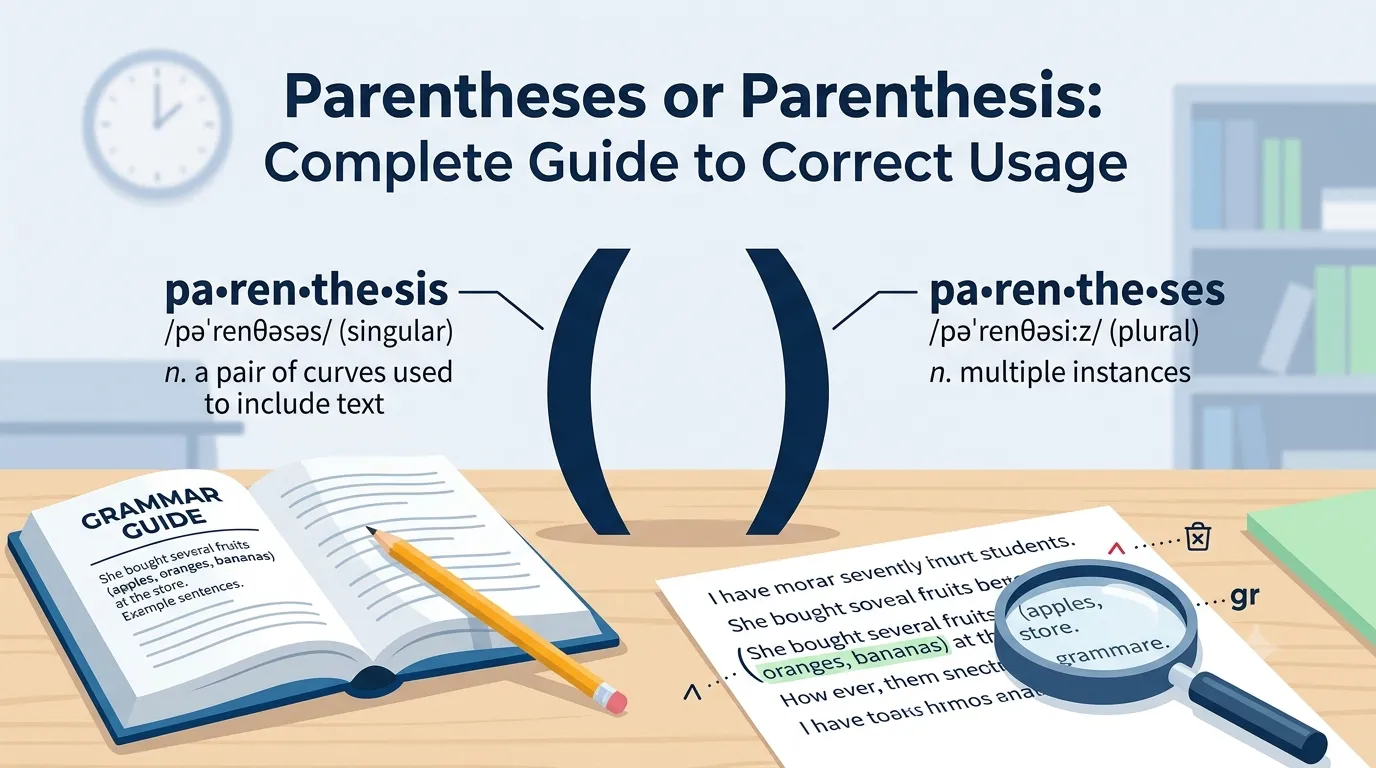
Parenthesis is the singular form, meaning one curved punctuation mark or one piece of extra information. Parentheses is the plural form and refers to the pair of curved punctuation marks ( ) used together in writing.
I still remember proofreading one of my first blog posts. Everything looked perfect until I noticed I’d written, “Put the sentence inside a parenthesis.” It seemed right at the time. Later, an editor pointed out that I actually meant parentheses because the sentence was enclosed by two punctuation marks, not one.
That small correction stuck with me. Since then, I’ve seen this mistake everywhere—from student essays to business emails and even published articles. Many people know what ( ) look like, but they aren’t sure whether to call them parenthesis or parentheses.
The confusion makes sense. The words look similar, sound alike, and both relate to the same punctuation marks. Yet they don’t mean the same thing.
If you’ve ever paused while writing and wondered which word is correct, you’re in the right place. By the end of this guide, you’ll know the difference, understand when to use each one, and avoid one of the most common grammar mistakes in English.
Parentheses or Parenthesis: Quick Answer
The difference is simple.
- Parenthesis = singular
- Parentheses = plural
In everyday writing, you almost always use parentheses because punctuation marks come as a pair.
Examples
✅ Please put the note inside parentheses.
✅ The sentence includes parentheses around the extra information.
✅ A parenthesis can separate additional information from the main sentence.
Although parenthesis is correct, it appears much less often because writers usually refer to both punctuation marks together.
The Origin and Background of Parentheses or Parenthesis
Understanding where these words came from makes them much easier to remember.
The word parenthesis comes from the ancient Greek word parentithenai, which means “to place beside” or “to insert.”
That meaning still fits modern English.
When you use parentheses, you’re inserting extra information into a sentence without changing its main meaning.
For example:
The meeting (which started late) ended at noon.
The words inside the parentheses add useful detail, but the sentence still makes sense without them.
Why Are People Confused?
There are several reasons.
- The singular and plural forms look very similar.
- Most punctuation names don’t change this way.
- Writers usually talk about the pair instead of one mark.
- Grammar books often focus on using the punctuation rather than naming it.
As a result, many people assume parenthesis and parentheses are interchangeable.
They aren’t.
Why the Plural Sounds Different
English borrowed these words from Greek.
Many Greek words ending in -is become -eses in the plural.
Examples include:
| Singular | Plural |
|---|---|
| Analysis | Analyses |
| Thesis | Theses |
| Crisis | Crises |
| Parenthesis | Parentheses |
Once you notice the pattern, it’s much easier to remember.
Parentheses or Parenthesis Explained: Key Differences
Although these words are closely related, they serve different purposes.
Here’s the easiest way to think about them.
What Is a Parenthesis?
A parenthesis is a single punctuation mark.
It can also refer to one inserted word, phrase, or clause that adds extra information.
Example:
The opening parenthesis appears before the added information.
Notice we’re talking about only one punctuation mark.
What Are Parentheses?
Parentheses are the two curved punctuation marks used together.
They surround information that isn’t essential to the sentence.
Example:
Sarah (our new manager) joined the meeting.
The phrase inside the parentheses gives extra information.
The sentence still works without it.
Parenthetical Information
Sometimes the word parenthesis refers to the inserted information itself rather than the punctuation.
Example:
The phrase “our new manager” is a parenthesis because it interrupts the sentence with extra detail.
This use is more common in grammar books than in everyday writing.
Comparison Table
| Term | Meaning | When to Use | Region/Context |
|---|---|---|---|
| Parenthesis | One punctuation mark or one inserted expression | Grammar discussions, linguistic writing, talking about a single mark | Standard English worldwide |
| Parentheses | The pair of curved punctuation marks ( ) | Everyday writing, editing, blogging, business writing, academic work | Standard English worldwide |
Examples Side by Side
Correct
- Add the explanation inside parentheses.
- Please remove the parentheses from this sentence.
- The opening parenthesis is missing.
- The closing parenthesis should come after the final word.
Incorrect
❌ Add the explanation inside parenthesis.
✔ Add the explanation inside parentheses.
A Simple Memory Trick
Here’s the trick I teach new writers.
Think about what you see on the page.
( )
There are two punctuation marks.
Two marks mean parentheses.
If you’re talking about only one curved mark, use parenthesis.
You can also compare it with these words:
- One analysis → many analyses
- One thesis → many theses
- One parenthesis → two parentheses
The pattern becomes much easier to remember once you’ve seen it a few times.
Which Version Should You Use?
Now that you know the difference, the next question is simple.
Which word should you actually use?
For most people, the answer is parentheses.
Why? Because you almost always write with both punctuation marks.
For Students
Use parentheses when writing:
- Essays
- Homework
- Research papers
- Reports
Example:
The Nile River (the longest river in Africa) flows north.
You are talking about the pair of punctuation marks, so parentheses is correct.
For Bloggers and Content Writers
Choose parentheses in articles, blog posts, and web content.
Example:
Our sale ends Friday (unless we sell out sooner).
This follows standard English grammar and looks natural to readers.
For Business Professionals
Business emails and reports also use parentheses.
Example:
The meeting starts at 10:00 a.m. (please arrive 15 minutes early).
Professional writing almost never requires the singular word.
For Editors and Teachers
You may use parenthesis when discussing grammar itself.
Example:
The opening parenthesis should come before the quotation.
Editors often refer to each punctuation mark separately.
For Everyday Writing
If you’re unsure, ask yourself one question:
Am I talking about one mark or both?
- One mark → parenthesis
- Both marks ( ) → parentheses
Since most writing uses both symbols together, parentheses is usually the right choice.
Common Mistakes with Parentheses or Parenthesis
Many writers make the same errors. The good news is they’re easy to fix once you know the rule.
| Mistake | Correct Version | Why It Happens |
|---|---|---|
| Put the sentence inside parenthesis. | Put the sentence inside parentheses. | People forget there are two punctuation marks. |
| Remove the parenthesis around the phrase. | Remove the parentheses around the phrase. | The writer means the pair, not one mark. |
| Add an opening parentheses. | Add an opening parenthesis. | Only one punctuation mark is being discussed. |
| The parentheses is missing. | The parenthesis is missing. | Singular noun needs singular form. |
| Every sentence needs parenthesis. | Some sentences use parentheses. | Confusing singular and plural forms. |
Mistake 1: Using the Singular for the Pair
❌ Please place the note inside parenthesis.
✅ Please place the note inside parentheses.
The note sits between two punctuation marks.
Mistake 2: Using the Plural for One Mark
❌ The closing parentheses is missing.
✅ The closing parenthesis is missing.
Here you’re talking about one punctuation mark.
Mistake 3: Thinking Both Words Mean the Same Thing
They don’t.
Remember:
- Parenthesis = singular
- Parentheses = plural
That’s the only difference.
Mistake 4: Mixing Them in Formal Writing
In professional documents, incorrect grammar can distract readers.
A small mistake may make your writing look less polished.
Using the correct form shows attention to detail.
Parentheses or Parenthesis in Real World Examples
Seeing these words in context makes the rule much easier to remember.
Professional Email
Please review the updated schedule (attached below) before tomorrow’s meeting.
Notice how parentheses surround extra information.
News Headline
City Council Approves New Budget (After Weeks of Debate)
The words inside the parentheses add context without changing the main headline.
Social Media Post
We finally reached 10,000 followers (thank you all!) 🎉
The extra comment feels friendly and natural.
Business Report
Revenue increased by 18% (compared with last year).
The information inside the parentheses gives useful detail without interrupting the main statement.
Academic Writing
Shakespeare (1564–1616) wrote many famous plays.
The dates provide extra information but are not essential to understanding the sentence.
Everyday Conversation
I’ll call you tomorrow (if I finish work early).
Again, the sentence still makes sense without the words inside the parentheses.
Parentheses in Different Types of Writing
Different writing styles use parentheses in different ways.
Academic Writing
Used for:
- Citations
- Dates
- Definitions
- Clarifications
Example:
Climate change affects many species (IPCC, 2023).
Business Writing
Used for:
- Short explanations
- Extra instructions
- Helpful reminders
Example:
Submit your expense report (including receipts) by Friday.
Creative Writing
Authors use parentheses to show:
- Personal thoughts
- Quiet comments
- Funny side notes
Example:
I almost forgot my keys (again).
Digital Content
Bloggers often use parentheses to:
- Add quick tips
- Improve readability
- Explain unfamiliar terms
Example:
Install the update (it only takes two minutes).
Parentheses or Parenthesis: Data, Trends & Usage
Understanding how people search for this topic helps explain why the confusion continues.
| Topic | Insight |
|---|---|
| Primary search intent | Informational |
| Who searches most? | Students, teachers, bloggers, editors, writers, and English learners |
| Common search queries | parenthesis or parentheses, parentheses meaning, how to use parentheses, parenthesis vs parentheses |
| Popular regions | United States, United Kingdom, Canada, Australia, India, and other English-speaking countries |
| Difficulty level | Beginner grammar |
| Why it matters today | More people publish online, making clear and correct grammar more important than ever. |
Why Is This Topic So Popular?
Millions of people write every day.
They send emails.
They publish blog posts.
They complete school assignments.
They post on social media.
One small grammar question can affect all of those.
Because parenthesis and parentheses look almost identical, many writers search for the difference before publishing their work.
Learning the correct form helps your writing look more professional and builds confidence every time you type.
Standalone Comparison Table
| Term/Variant | Meaning | Region/Context | Best Used When |
|---|---|---|---|
| Parenthesis | A single curved punctuation mark or one inserted expression | Grammar lessons, editing, linguistics | Referring to one opening or closing punctuation mark |
| Parentheses | A pair of curved punctuation marks ( ) | Everyday English, business, education, publishing | Referring to the punctuation used around extra information |
| Parenthetical | An adjective describing information inside parentheses | Formal and informal writing | Describing words, phrases, or clauses enclosed by parentheses |
Frequently Asked Questions (FAQs)
Q: What does parenthesis mean?
A parenthesis is the singular form of the word. It refers to one curved punctuation mark or, in grammar, one inserted word, phrase, or clause that adds extra information to a sentence.
Q: What does parentheses mean?
Parentheses is the plural form. It refers to the pair of curved punctuation marks ( ) used to include extra information that is helpful but not essential.
Example:
The conference (held in June) attracted thousands of visitors.
Q: How do you use parentheses correctly?
Use parentheses to enclose extra details that the reader can skip without changing the main meaning of the sentence.
For example:
The package (ordered last week) arrived today.
If you remove the words inside the parentheses, the sentence still makes sense.
Q: Parentheses vs. brackets: what’s the difference?
Although they look similar, they have different purposes.
| Punctuation | Looks Like | Main Use |
|---|---|---|
| Parentheses | ( ) | Add extra information or explanations |
| Brackets | [ ] | Add editorial notes, corrections, or explanations inside quoted text |
Example with parentheses:
The meeting (scheduled for Monday) has been postponed.
Example with brackets:
“She [the manager] approved the proposal.”
Q: Is it correct to say “inside parenthesis”?
Usually, no.
If you mean the pair of punctuation marks, the correct phrase is:
✅ inside parentheses
You would only use parenthesis if you’re talking about one punctuation mark.
Q: Which version is correct: parenthesis or parentheses?
Both are correct, but they are used in different situations.
- Use parenthesis for one punctuation mark.
- Use parentheses for the pair of punctuation marks.
Since writing almost always uses both marks together, parentheses is the word you’ll use most often.
Q: Where does the word parenthesis come from?
The word comes from the ancient Greek parentithenai, meaning “to place beside” or “to insert.”
That origin reflects its modern purpose: adding extra information to a sentence without changing its main meaning.
Q: Can parentheses be used in formal writing?
Yes. Parentheses are widely accepted in formal writing when used carefully.
They are common in:
- Academic papers
- Business reports
- Legal documents
- Research articles
- Technical manuals
Avoid overusing them, though. Too many parentheses can make your writing harder to read.
Conclusion
At first glance, parenthesis and parentheses seem almost identical. That is exactly why so many writers mix them up. The good news is that the rule is simple once you know it.
Remember these key points:
- Parenthesis is singular and refers to one punctuation mark or one inserted expression.
- Parentheses is plural and refers to the familiar pair of curved punctuation marks ( ).
- In everyday writing, emails, articles, reports, and essays, you’ll almost always use parentheses because the punctuation works as a pair.
- If you’re discussing grammar or referring to one opening or closing mark, parenthesis is the correct choice.
Keeping this distinction in mind will make your writing clearer and more professional. It’s a small detail, but strong writing is built on small details done well.
Now you know exactly when to use parenthesis and parentheses. The next time you write an email, blog post, or school assignment, you’ll choose the correct word with confidence.
Bookmark this guide so you never second guess parenthesis or parentheses again. If you found it helpful, share it with a friend or classmate who has been confused by these words.

I have a background in academic writing and spent several years as a proofreader for digital publications. Spotting differences between easily confused words became second nature to me. At WordsCombo, I share that knowledge so readers can write with confidence.