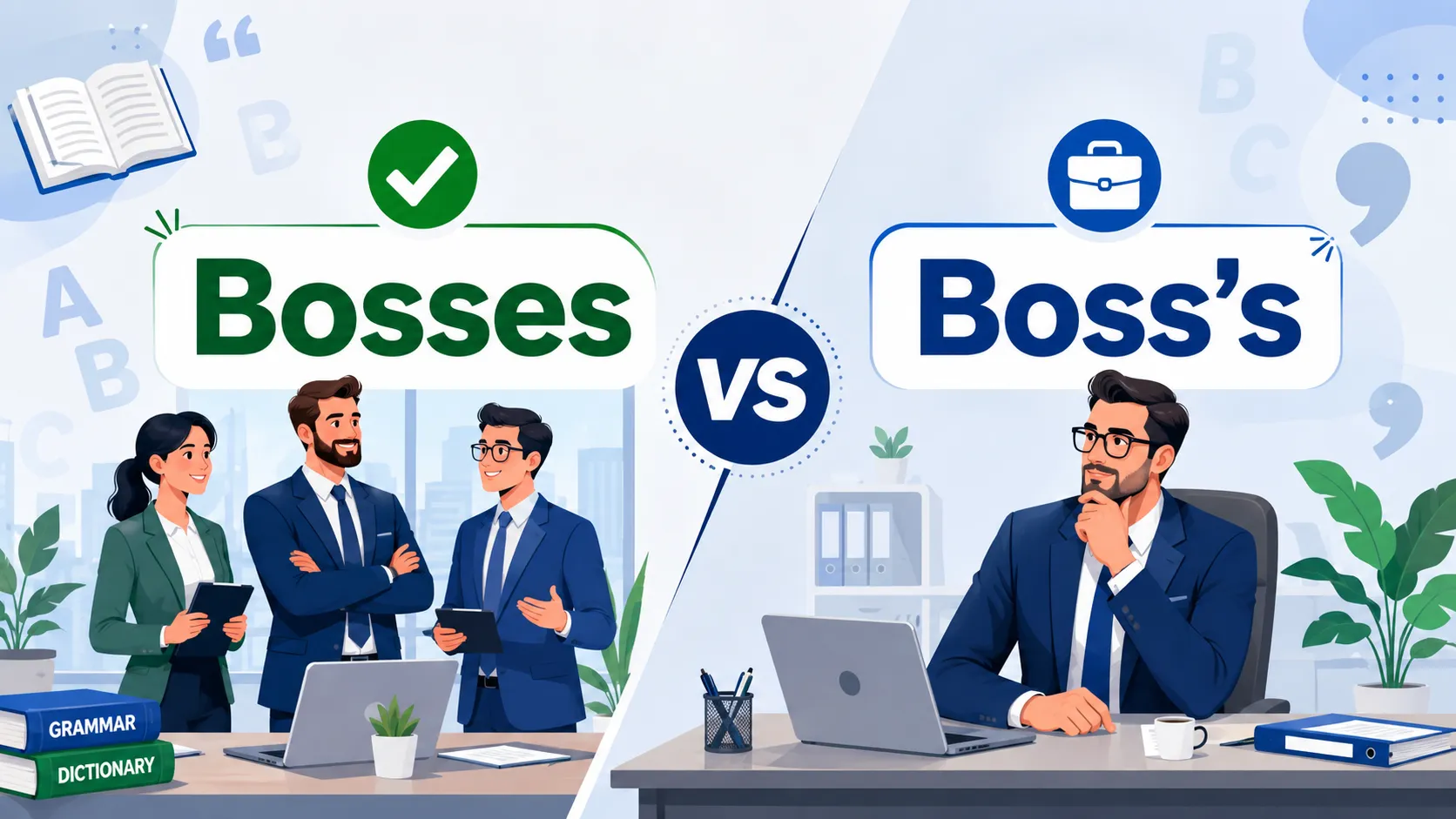
Bosses is the correct plural form of boss, meaning more than one boss. Boss’s is the singular possessive form, meaning something belongs to one boss.
A few years ago, I was editing a business report for a client. Everything looked perfect until I reached one sentence:
“All the boss’s attended the meeting.”
It was a small mistake, but it changed the meaning of the sentence. The writer wanted to talk about several managers. Instead, the sentence suggested that something belonged to one manager. I have seen this confusion many times over the years, even from experienced writers.
If you have ever paused before typing bosses or boss’s, you are not alone. English punctuation can be tricky. Plurals and possessives often look similar, but they have very different jobs.
This guide will make the difference simple. You will learn what each word means, when to use it, and how to avoid common mistakes. By the end, you will never have to guess again.
Bosses or Boss’s: Quick Answer
Use bosses when you mean more than one boss.
Use boss’s when you mean something belongs to one boss.
Examples
- Several bosses attended the conference.
- My boss’s office is on the third floor.
- The bosses agreed on the new policy.
- The boss’s decision surprised everyone.
The apostrophe makes all the difference.
The Origin Background of Bosses or Boss’s
The word boss came into English from the Dutch word baas, which means master or supervisor. English speakers adopted it during the 1600s.
As English grammar developed, writers followed two simple rules:
- Add -es to make most words ending in -ss plural.
- Add ‘s to show ownership.
That is why we have:
- boss → bosses (plural)
- boss → boss’s (singular possessive)
People often confuse them because both words end with -es or -‘s, and they sound almost the same when spoken.
Bosses Explained: Key Differences or Variations
Although these words look alike, they have different meanings.
| Term | Meaning | When to Use | Region/Context |
|---|---|---|---|
| Bosses | More than one boss | Talking about multiple managers | Worldwide |
| Boss’s | Belonging to one boss | Showing ownership | Standard English |
| Bosses’ | Belonging to multiple bosses | Ownership by several bosses | Formal writing |
Examples
Bosses
- The bosses held a meeting.
- Our bosses approved the budget.
Boss’s
- My boss’s laptop stopped working.
- The boss’s speech inspired everyone.
Bosses’
- The bosses’ decision changed company policy.
- The bosses’ offices are upstairs.
Which Version Should You Use?
Choosing the right form is easy once you know your goal.
For students
Use bosses when writing about several employers or managers.
For office workers
Use boss’s when talking about something owned by your manager.
For business writing
Use bosses’ if something belongs to multiple managers.
For global English
These rules work in both American and British English.
Quick tip
Ask yourself one question:
Am I talking about more than one boss, or about something that belongs to a boss?
The answer tells you which form to use.
Common Mistakes with Bosses or Boss’s
Many writers make the same errors.
| Mistake | Correct |
|---|---|
| The boss’s are meeting today. | The bosses are meeting today. |
| Three boss attended. | Three bosses attended. |
| My bosses office. | My boss’s office. |
| The boss’s decision of all managers. | The bosses’ decision. |
| Every bosses opinion matters. | Every boss’s opinion matters. |
Why these mistakes happen
- People confuse plurals with possessives.
- Apostrophes are often added by habit.
- Spoken English does not clearly show the difference.
A simple grammar check can prevent these mistakes.
Bosses in Real World Examples
Professional Email
Dear Team,
Our bosses have approved the project timeline. Please review the attached schedule before Friday.
News Headline
Company Bosses Announce Major Expansion Across Europe
Social Media Post
Big thanks to our amazing bosses for supporting the whole team this year!
Formal Report
The boss’s approval is required before any financial changes are made.
Bosses: Data, Trends & Usage
The keyword bosses or boss’s is searched mainly by people who want grammar help.
Search intent
Informational
Users want to know which spelling is correct.
Popular audiences
- Students
- Office workers
- Job seekers
- Business writers
- English learners
Regions with strong interest
- United States
- United Kingdom
- Canada
- Australia
- India
Why this matters now
Remote work, email, and online communication have made written English more important than ever. Small grammar mistakes can affect professionalism and credibility.
Comparison Table
| Term/Variant | Meaning | Region/Context | Best Used When |
|---|---|---|---|
| Bosses | More than one boss | Global English | Talking about several managers |
| Boss’s | Belonging to one boss | Global English | Showing singular ownership |
| Bosses’ | Belonging to several bosses | Global English | Showing plural ownership |
Frequently Asked Questions
Q: What does bosses mean?
A: Bosses is the plural of boss. It refers to two or more managers, supervisors, or employers.
Q: How do you use boss’s correctly?
A: Use boss’s when something belongs to one boss. For example, My boss’s desk is near the window.
Q: Bosses vs boss’s: what’s the difference?
A: Bosses means multiple bosses. Boss’s shows ownership by one boss. They have different meanings even though they look similar.
Q: Is boss’s acceptable in formal writing?
A: Yes. Boss’s is the standard singular possessive form and is accepted in formal business, academic, and professional writing.
Q: Which version is correct bosses or boss’s?
A: Both are correct. The right choice depends on your sentence. Use bosses for the plural and boss’s for singular possession.
Q: Where does the word boss come from?
A: The word comes from the Dutch word baas, meaning master or supervisor. English adopted it several centuries ago.
Q: Can bosses be used in business writing?
A: Absolutely. Bosses is common in reports, emails, articles, workplace policies, and professional communication whenever more than one manager is involved.
Conclusion
The difference between bosses and boss’s is simple once you know the rule. Bosses refers to more than one boss. Boss’s shows that something belongs to one boss. If something belongs to several bosses, use bosses’.
Remember three quick checks:
- Bosses = plural.
- Boss’s = singular possessive.
- Bosses’ = plural possessive.
These small grammar choices make your writing clearer and more professional. Whether you are writing an email, preparing a report, or completing schoolwork, using the correct form helps your message look polished and trustworthy.
Now you know exactly how to use bosses and boss’s. Bookmark this guide so you never second-guess these words again, and share it with anyone who has ever wondered which version is correct.
Read more: Sees or See’s: The Complete Guide to Correct Usage

I have a background in academic writing and spent several years as a proofreader for digital publications. Spotting differences between easily confused words became second nature to me. At WordsCombo, I share that knowledge so readers can write with confidence.