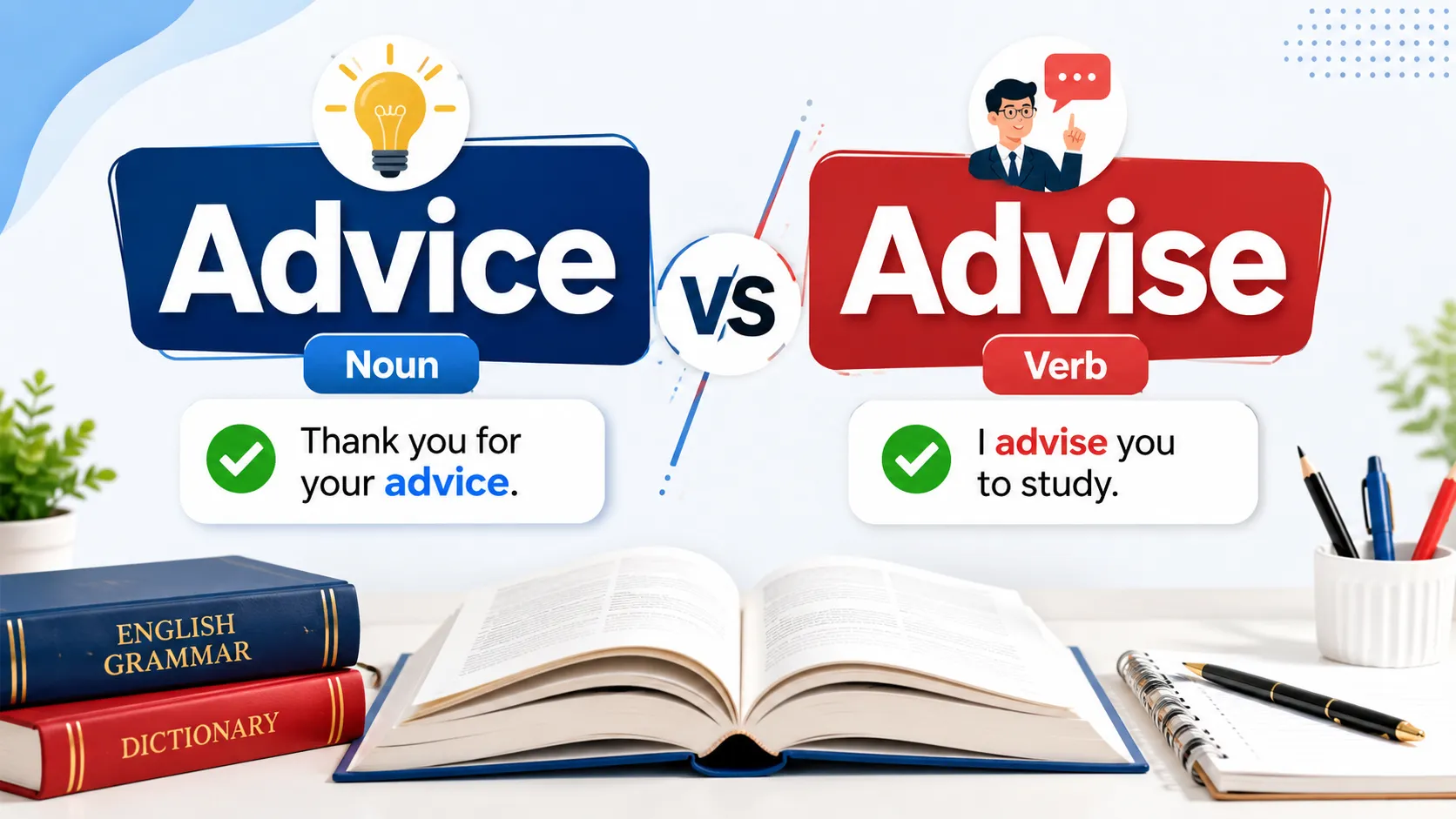
💬 Advice is a noun (a suggestion), while advise is a verb (to give a suggestion). 💡 Easy trick: Advice = thing, advise = action.
A few years ago, I edited an article written by a talented student. The ideas were great, but one mistake appeared over and over. They wrote, “Thank you for your advise.” I smiled because I had made the same mistake when I first started teaching English.
Many people mix up advice and advise. The words look almost the same. They sound similar too. That is why millions of English learners search for the difference every year.
The good news is that the rule is simple. Once you learn it, you will probably never confuse these words again.
In this guide, you will discover what advice and advise mean, when to use each one, common mistakes to avoid, and easy examples from real life. By the end, you will feel confident every time you write or speak.
Advice or Advise
The difference is easy.
- Advice is a noun. It is the guidance itself.
- Advise is a verb. It is the action of giving guidance.
Examples
- She gave me good advice.
- My teacher advised me to study every day.
A simple trick:
Advice = Thing
Advise = Action
The Origin and Background of Advice or Advise
Both words come from the Old French word aviser, which meant “to consider” or “to think carefully.”
Later, English created two forms.
- Advice became the noun.
- Advise became the verb.
The spelling changed slightly, but their meanings stayed closely connected.
Many learners become confused because English has other word pairs like:
- Practice / Practise (British English)
- Device / Devise
The pronunciation also causes problems.
- Advice ends with the /s/ sound.
- Advise ends with the /z/ sound.
That tiny sound makes a big difference.
Advice or Advise Explained: Key Differences
The easiest way to remember them is by their job in a sentence.
| Term | Meaning | When to Use | Region/Context |
|---|---|---|---|
| Advice | Guidance or recommendation | As a noun | American & British English |
| Advise | To give guidance | As a verb | American & British English |
Examples with Advice
- Can I have your advice?
- Her advice helped me.
- Thank you for the helpful advice.
Examples with Advise
- I advise you to save money.
- Doctors advise patients to exercise.
- My lawyer advised me to wait.
Notice something?
You can usually put words like good, helpful, or useful before advice.
You cannot do that with advise because it is a verb.
Which Version Should You Use?
The answer depends on your sentence.
For English learners
Use advice when you mean the idea or suggestion.
Example:
“I need your advice.”
For students
Use advise when someone is doing the action.
Example:
“The teacher advised us to revise.”
For professionals
Business writing often uses both.
Example:
“Our consultant gave useful advice.”
“We advise all customers to read the policy.”
For global communication
These rules work in both American and British English.
There is no regional difference.
Common Mistakes with Advice or Advise
Many people make the same errors.
| Mistake | Correct |
|---|---|
| Please advice me. | Please advise me. |
| Thanks for your advise. | Thanks for your advice. |
| He gave me many advises. | He gave me lots of advice. |
| She advice me daily. | She advises me daily. |
| I need an advice. | I need some advice. |
Why these mistakes happen
- The words sound alike.
- Learners forget which one is the noun.
- Advice is an uncountable noun. You normally do not say “an advice.”
Instead say:
- some advice
- a piece of advice
- lots of advice
Advice or Advise in Real World Examples
Professional Email
Thank you for your advice regarding the project. I appreciate your support.
News Headline
Health experts advise people to stay hydrated during the heatwave.
Social Media Post
My grandmother’s best advice still helps me every day.
Formal Report
We advise management to review the current safety procedures before approval.
Advice or Advise: Data, Trends & Usage
Search behavior shows that “advice or advise” is an informational keyword.
People usually search it because they:
- write emails
- complete homework
- prepare for exams
- improve business English
- avoid grammar mistakes
The topic is especially popular among:
- English learners
- Students
- Job seekers
- Professional writers
- Content creators
Why this matters today
People write more emails, messages, blogs, and social posts than ever before. One small spelling mistake can make writing look less professional. Learning this simple rule helps you communicate with confidence.
Comparison Table
| Term/Variant | Meaning | Region/Context | Best Used When |
|---|---|---|---|
| Advice | A suggestion or recommendation | Worldwide | Talking about guidance |
| Advise | To give guidance | Worldwide | Giving recommendations |
| Suggestion | One possible idea | General English | Offering an option |
| Recommendation | Strong suggestion | Professional writing | Formal advice |
Easy Memory Tricks
Here are simple ways to remember the difference.
Trick 1
Advice = Noun
You can receive it.
Trick 2
Advise = Verb
You can do it.
Trick 3
Think:
- I give advice.
- I advise people.
Practice Sentences
Choose the correct word.
- My teacher gave great ________.
- I ________ you to arrive early.
- Thank you for your helpful ________.
- Doctors ________ patients to stop smoking.
- She asked for career ________.
Answers:
- advice
- advise
- advice
- advise
- advice
Frequently Asked Questions
Q: What does advice mean?
A: Advice is guidance or a recommendation. It is a noun and refers to the information someone gives to help another person.
Q: How do you use advise correctly?
A: Use advise when someone gives guidance. It is always a verb. Example: “I advise you to check your work.”
Q: Advice vs advise: what is the difference?
A: Advice is the thing you receive. Advise is the action of giving it. One is a noun, while the other is a verb.
Q: Is advice acceptable in formal writing?
A: Yes. Advice is common in business emails, reports, academic writing, and professional communication.
Q: Which version is correct advice or advise?
A: Both are correct when used properly. Choose advice for the noun and advise for the verb.
Q: Where does advice come from?
A: The word comes from Old French and later Middle English. It originally meant careful consideration before becoming the modern word for guidance.
Q: Can advice be used in business emails?
A: Yes. It is very common. Example: “Thank you for your valuable advice regarding the proposal.”
Conclusion
The difference between advice and advise is much easier than many people think. Remember these three key points. First, advice is a noun. Second, advise is a verb. Third, advice is usually uncountable, so you normally say some advice or a piece of advice, not an advice.
Whenever you write an email, assignment, report, or social media post, pause for a moment. Ask yourself one simple question: Am I talking about the guidance, or am I talking about giving the guidance? The answer will tell you which word to use.
With a little practice, this choice will become automatic. You will write more clearly and sound more confident in both everyday and professional English.
Now you know exactly how to use advice and advise, try using both correctly in your next email or conversation. Better yet, bookmark this guide and share it with someone who still mixes them up.
Read more: Farther or Further: The Complete Guide to Using Them Correctly

I have a background in academic writing and spent several years as a proofreader for digital publications. Spotting differences between easily confused words became second nature to me. At WordsCombo, I share that knowledge so readers can write with confidence.