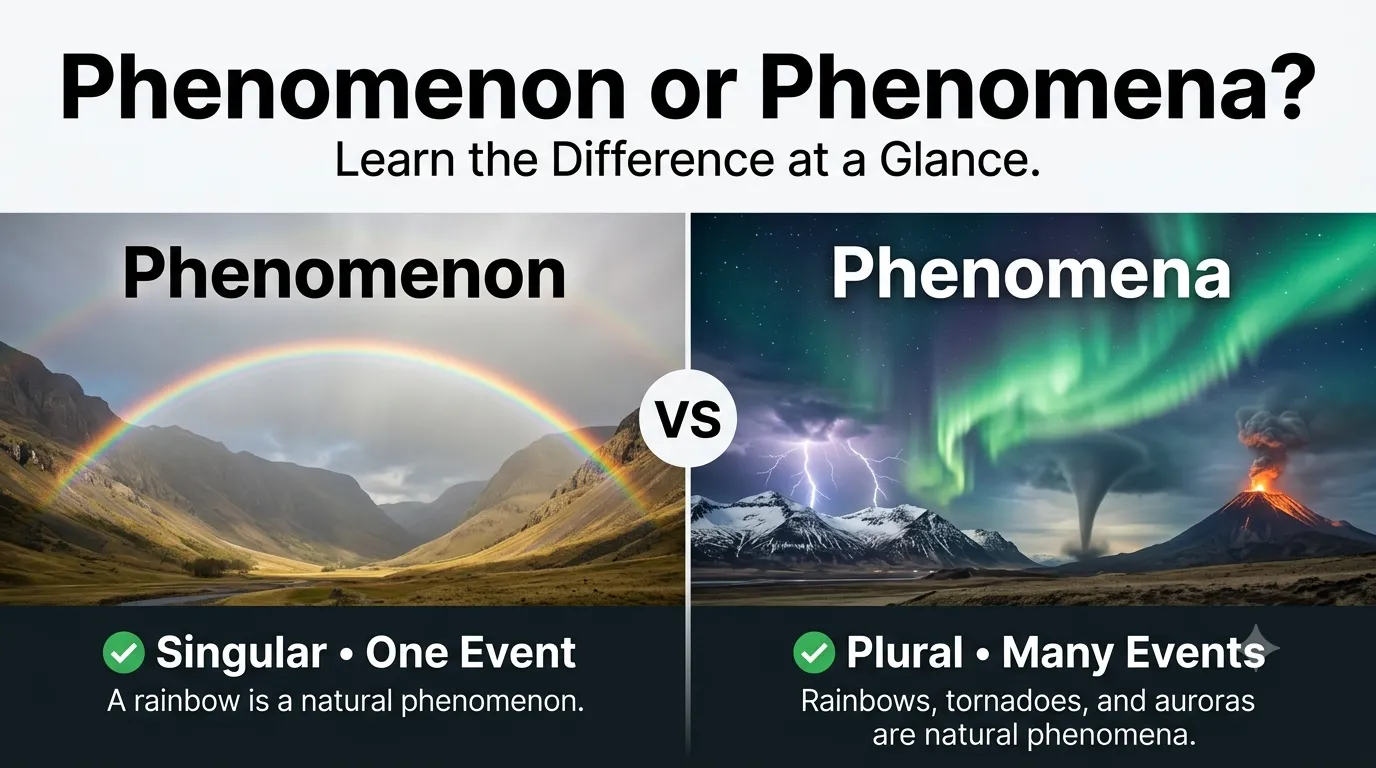
Phenomenon is the singular form, meaning one event, fact, or occurrence. Phenomena is the plural form, meaning two or more events or occurrences.
A few years ago, I was proofreading an article for a student who wrote, “This natural phenomenon are amazing.” At first glance, it looked almost right. But one small word changed the whole sentence. The writer used phenomenon when they actually needed phenomena.
It is a mistake I see again and again.
Many people know these words sound smart. They often appear in science books, news reports, and everyday conversations. Yet even confident English speakers stop and wonder, “Which one should I use?”
The confusion is easy to understand. Both words come from Greek rather than modern English, so they follow a grammar rule that feels unusual today. Unlike words such as cat and cats, these two change completely between singular and plural.
If you’ve ever paused before typing phenomenon or phenomena, you’re not alone.
By the end of this guide, you’ll know exactly what each word means, when to use it, common mistakes to avoid, and a simple trick that helps you remember the difference forever.
Let’s clear up the confusion once and for all.
Phenomenon or Phenomena: Quick Answer
Phenomena or phenomenon: The correct choice depends on the number of events you are describing. Use phenomenon for one event or occurrence, and use phenomena for multiple events or occurrences.
Phenomenon meaning: A phenomenon is a single event, fact, or occurrence that can be observed or studied.
Phenomena meaning: Phenomena means multiple events, occurrences, or observable facts. It is the plural form of phenomenon.
The difference is simple.
- Phenomenon = one event, fact, or occurrence.
- Phenomena = more than one event, fact, or occurrence.
Examples
✅ The Northern Lights are a beautiful phenomenon.
✅ Many weather phenomena happen during hurricane season.
Another way to think about it:
- One rainbow = a phenomenon
- Many rainbows or unusual weather events = phenomena
Whenever you’re talking about one thing, choose phenomenon.
Whenever you’re talking about multiple things, choose phenomena.
That single rule solves almost every question.
The Origin of “Phenomenon” and “Phenomena”
Knowing where these words came from makes them much easier to remember.
Both words come from the ancient Greek word phainomenon, which means “something that appears” or “something that can be observed.”
Later, the word entered Latin before becoming part of English.
Unlike many English nouns, this word kept its original Greek plural.
| Form | Language | Meaning |
|---|---|---|
| Phenomenon | Greek singular | One observable event |
| Phenomena | Greek plural | Multiple observable events |
That is why English doesn’t simply add -s.
Instead of:
❌ Phenomenons
English uses:
✅ Phenomena
Many English words borrowed from Greek and Latin follow the same pattern.
For example:
| Singular | Plural |
|---|---|
| Criterion | Criteria |
| Datum | Data |
| Analysis | Analyses |
| Thesis | Theses |
| Phenomenon | Phenomena |
Once you recognize this pattern, phenomenon and phenomena stop feeling strange.
Why Do People Confuse Them?
There are several reasons.
1. They Look Almost Identical
Only the last few letters change.
- Phenomenon
- Phenomena
Because the spelling is so similar, many people assume they can be used interchangeably.
They cannot.
2. English Usually Adds “-s”
Most English nouns become plural by adding -s.
Examples:
- Book → Books
- Car → Cars
- Student → Students
So many learners naturally expect:
- Phenomenon → Phenomenons
But English keeps the original Greek plural instead.
3. They Often Appear in Academic Writing
You’ll usually see these words in:
- Science articles
- Psychology books
- Business reports
- News stories
- Research papers
Because they aren’t everyday vocabulary for many people, writers sometimes guess instead of checking.
4. Similar Words Cause More Confusion
Many people mix phenomenon, phenomena, and phenomenal.
These are different words.
- Phenomenon = one event
- Phenomena = several events
- Phenomenal = extraordinary or amazing
Example:
✅ Auroras are natural phenomena.
✅ The light show was phenomenal.
Notice that phenomenal is an adjective, not a noun.
Phenomenon vs Phenomena Explained
Phenomenon vs phenomena meaning: The difference is based on number. A phenomenon refers to one observable event, while phenomena refers to multiple events or occurrences.
The easiest way to understand these words is by comparing them directly.
| Term | Meaning | When to Use | Context |
|---|---|---|---|
| Phenomenon | One event, occurrence, or observable fact | When referring to a single thing | Everyday English, science, research, education |
| Phenomena | More than one event or occurrence | When referring to multiple things | Science, journalism, education, formal writing |
Think of them exactly like this:
- Child → Children
- Person → People
- Criterion → Criteria
- Phenomenon → Phenomena
The form changes because the word comes from Greek.
When to Use Phenomenon
Use phenomenon whenever you’re talking about one event, observation, or unusual occurrence.
Examples
✅ Climate change is a complex phenomenon.
✅ The eclipse was a rare natural phenomenon.
✅ This social phenomenon interests researchers.
✅ Scientists studied the unusual phenomenon for years.
Each sentence discusses one thing.
When to Use Phenomena
Use phenomena whenever you’re discussing multiple events or observations.
Examples
✅ Scientists study many natural phenomena.
✅ These weather phenomena affect millions of people.
✅ Researchers observed several unusual phenomena.
✅ Ocean currents and earthquakes are fascinating natural phenomena.
Every example refers to more than one occurrence.
Side-by-Side Examples
| Correct Usage | Why It Is Correct |
|---|---|
| The eclipse is a rare phenomenon. | One eclipse |
| Auroras are beautiful phenomena. | Many auroras |
| This social phenomenon spread quickly. | One trend |
| Online trends are modern phenomena. | Multiple trends |
| Gravity is a natural phenomenon. | One scientific concept |
| Earthquakes and volcanoes are natural phenomena. | More than one event |
A Simple Memory Trick
Here’s the easiest way to remember the difference.
Phenomenon ends with “ON.”
Think:
ONE ends with ON.
So:
- PhenomenON = ONE
Now look at phenomena.
The ending -A can remind you of A lot.
So:
- PhenomenA = A lot
Another quick trick is this:
- If you can replace the word with one event, use phenomenon.
- If you can replace it with many events, use phenomena.
This tiny memory trick helps you choose the correct word in seconds.
Which Version Should You Use?
Now that you know the difference, the next question is simple:
Which word should you choose in your writing?
The answer depends on how many events or occurrences you’re talking about, not where you live or what type of English you use.
Unlike words such as color/colour or organize/organise, phenomenon and phenomena are not regional spelling variations. They are different grammatical forms of the same noun.
Here is practical advice for different audiences.
For Students
Use phenomenon when writing about one event.
Use phenomena when describing two or more events.
Example
✅ Photosynthesis is a biological phenomenon.
✅ Many natural phenomena are explained in science class.
For Researchers and Academics
Academic writing often discusses multiple observations, so phenomena appears more frequently.
Examples include:
- Social phenomena
- Economic phenomena
- Physical phenomena
- Psychological phenomena
However, if your research focuses on one specific event, phenomenon is still correct.
For Business Professionals
Business reports often describe market behavior, customer trends, or economic events.
Examples:
✅ The rapid increase in online shopping is a global phenomenon.
✅ Several market phenomena influenced consumer spending.
For Journalists and Content Writers
Choose the word that matches your subject.
One event
The mysterious light was a rare phenomenon.
Several events
Scientists recorded unusual weather phenomena across the region.
For Everyday Conversation
Native speakers usually follow the same rule.
You’ll hear sentences like:
- “That’s a strange phenomenon.”
- “Scientists study weather phenomena.”
Even in casual speech, the singular and plural forms stay the same.
Quick Recommendation
| Audience | Best Choice |
|---|---|
| Students | Follow singular vs. plural carefully |
| Academic writers | Use the correct grammatical form |
| Professionals | Match the number of events |
| Bloggers | Keep it simple and accurate |
| Global audience | Use phenomenon for one, phenomena for many |
The rule never changes:
- One = phenomenon
- More than one = phenomena
Common Mistakes with Phenomenon and Phenomena
Even experienced writers sometimes mix these words.
Here are the mistakes you should avoid.
Mistake 1: Using Phenomena for One Event
❌ The eclipse was an amazing phenomena.
✅ The eclipse was an amazing phenomenon.
Why?
An eclipse is one event.
Mistake 2: Using Phenomenon for Multiple Events
❌ Scientists studied several weather phenomenon.
✅ Scientists studied several weather phenomena.
Why?
“Several” tells us the noun must be plural.
Mistake 3: Writing “Phenomenons”
❌ Scientists discovered many phenomenons.
✅ Scientists discovered many phenomena.
Why?
The plural is phenomena, not phenomenons.
Mistake 4: Mixing Singular Subjects with Plural Verbs
❌ This phenomenon are difficult to explain.
✅ This phenomenon is difficult to explain.
Mistake 5: Mixing Plural Subjects with Singular Verbs
❌ These phenomena is unusual.
✅ These phenomena are unusual.
Quick Correction Guide
| Incorrect | Correct |
|---|---|
| A strange phenomena | A strange phenomenon |
| Many phenomenon | Many phenomena |
| Phenomenons | Phenomena |
| This phenomenon are | This phenomenon is |
| These phenomena is | These phenomena are |
Phenomenon and Phenomena in Real World Examples
Seeing these words in context makes them much easier to remember.
Professional Email
Our research identified a new phenomenon affecting customer behavior. We will continue monitoring similar phenomena over the next quarter.
News Headline
Scientists Discover Rare Ocean Phenomenon Near Pacific Coast
Another headline:
Climate Phenomena Increase Across Several Continents
Social Media Post
Have you ever seen this incredible sky phenomenon? 🌈
Another example:
Nature is full of amazing phenomena we still don’t fully understand.
Formal Report
The study examined one economic phenomenon in detail before comparing similar phenomena from previous years.
Classroom Example
Teacher:
Gravity is a natural phenomenon.
Student:
Volcanoes, earthquakes, and tornadoes are natural phenomena.
Everyday Conversation
Person A: Have you ever seen the Northern Lights?
Person B: Yes! They’re one of the most beautiful natural phenomena on Earth.
Science Writing
Photosynthesis is a biological phenomenon.
Weather patterns are complex natural phenomena.
Phenomenon or Phenomena: Data, Trends & Usage
These words may seem academic, but they are searched online thousands of times every month.
Many users search because they are unsure which form is grammatically correct.
Search Intent
The primary search intent is:
Informational
People want to know:
- Which word is correct?
- Is phenomena singular or plural?
- How do I use phenomenon in a sentence?
- What is the difference?
- Can I say phenomenons?
Who Searches for These Words?
The topic is especially popular among:
- Students
- English learners
- Teachers
- Researchers
- Bloggers
- Journalists
- Business professionals
- Academic writers
Where Is It Most Common?
Interest is strongest in countries where English is widely used for education, including:
- United States
- United Kingdom
- Canada
- Australia
- India
- Pakistan
- Philippines
Universities and research institutions also use these words frequently because they appear in science, psychology, economics, sociology, and medicine.
Why Does This Topic Matter Today?
Clear communication matters more than ever.
Whether you’re writing a university assignment, publishing a blog post, creating business content, or posting on social media, using phenomenon and phenomena correctly makes your writing look more polished and professional.
Because these words appear in scientific discoveries, technology news, climate reports, and academic papers, understanding them is a valuable skill for students and professionals alike.
Standalone Comparison Table
| Term/Variant | Meaning | Region/Context | Best Used When |
|---|---|---|---|
| Phenomenon | A single observable event, fact, or occurrence | Standard English worldwide | Referring to one event or observation |
| Phenomena | Multiple observable events, facts, or occurrences | Standard English worldwide | Referring to two or more events or observations |
| Phenomenal | Extraordinary, remarkable, or impressive (adjective) | Standard English worldwide | Describing something amazing, not naming an event |
Frequently Asked Questions (FAQs)
Q: What is the difference between phenomenon and phenomena?
A: Phenomenon is the singular form and refers to one observable event, fact, or occurrence. Phenomena is the plural form and refers to two or more events or occurrences. The only difference is the number of things being discussed.
Q: What is phenomena?
A: Phenomena are multiple events, occurrences, or observable facts. The word phenomena is the plural form of phenomenon and is used when talking about two or more events.
Q: Is “phenomena” singular or plural?
A: Phenomena is always plural. It should be used when referring to multiple events, observations, or facts. For a single event, use phenomenon instead.
Examples:
- ✅ The eclipse is a rare phenomenon.
- ✅ Eclipses and auroras are fascinating natural phenomena.
Q: Is “phenomenons” a correct word?
A: No. Phenomenons is not the standard plural form in English. The correct plural of phenomenon is phenomena, following its original Greek grammar. In formal and everyday English, always use phenomena for more than one occurrence.
Q: How do you use phenomenon and phenomena correctly in a sentence?
A: Use phenomenon for a single event and phenomena for multiple events.
Examples:
- ✅ Climate change is a global phenomenon.
- ✅ Scientists study many weather phenomena each year.
A simple trick is to ask yourself whether you’re talking about one thing or many.
Q: Can I use phenomenon and phenomena in formal writing?
A: Yes. Both words are widely accepted in formal writing, including academic papers, research reports, business documents, journalism, and scientific publications. Using the correct singular or plural form makes your writing more accurate and professional.
Q: Where do the words phenomenon and phenomena come from?
A: Both words come from the ancient Greek word phainomenon, meaning “something that appears” or “something observed.” English kept the original Greek plural, which is why the plural is phenomena instead of phenomenons.
Q: What is the easiest way to remember phenomenon vs. phenomena?
A: Think of phenomenON = ONE because both end with “ON.” If you’re talking about one event, choose phenomenon. If you’re talking about several events, use phenomena. This simple memory trick helps you choose the correct word quickly and confidently.
Conclusion
Understanding the difference between phenomenon and phenomena is much easier than it first appears. The key rule is simple: phenomenon refers to one event, fact, or occurrence, while phenomena refers to two or more. Once you remember that singular versus plural distinction, you’ll rarely make the mistake again.
These words appear in science, education, business, journalism, and everyday conversations, so using them correctly helps your writing sound more polished and professional. A quick memory trick can also help: PhenomenON = ONE, making it easy to choose the right form whenever you’re unsure.
Before you use either word, pause for a second and ask yourself, “Am I talking about one event or several?” The answer will tell you which form is correct every time.
Now that you know exactly how to use phenomenon and phenomena, you can write with greater confidence and avoid one of the most common grammar mistakes in English. Bookmark this guide for future reference, and share it with classmates, colleagues, or friends who have ever been confused by these two words. The next time you see phenomenon or phenomena, you’ll know instantly which one belongs.
Read more: Scarves or Scarfs: Which Plural Is Correct?

I started writing about English word differences after years of teaching students who kept making the same mistakes. My focus is on making spelling rules feel simple and easy to remember. At WordsCombo, I turn confusing word pairs into clear comparisons.