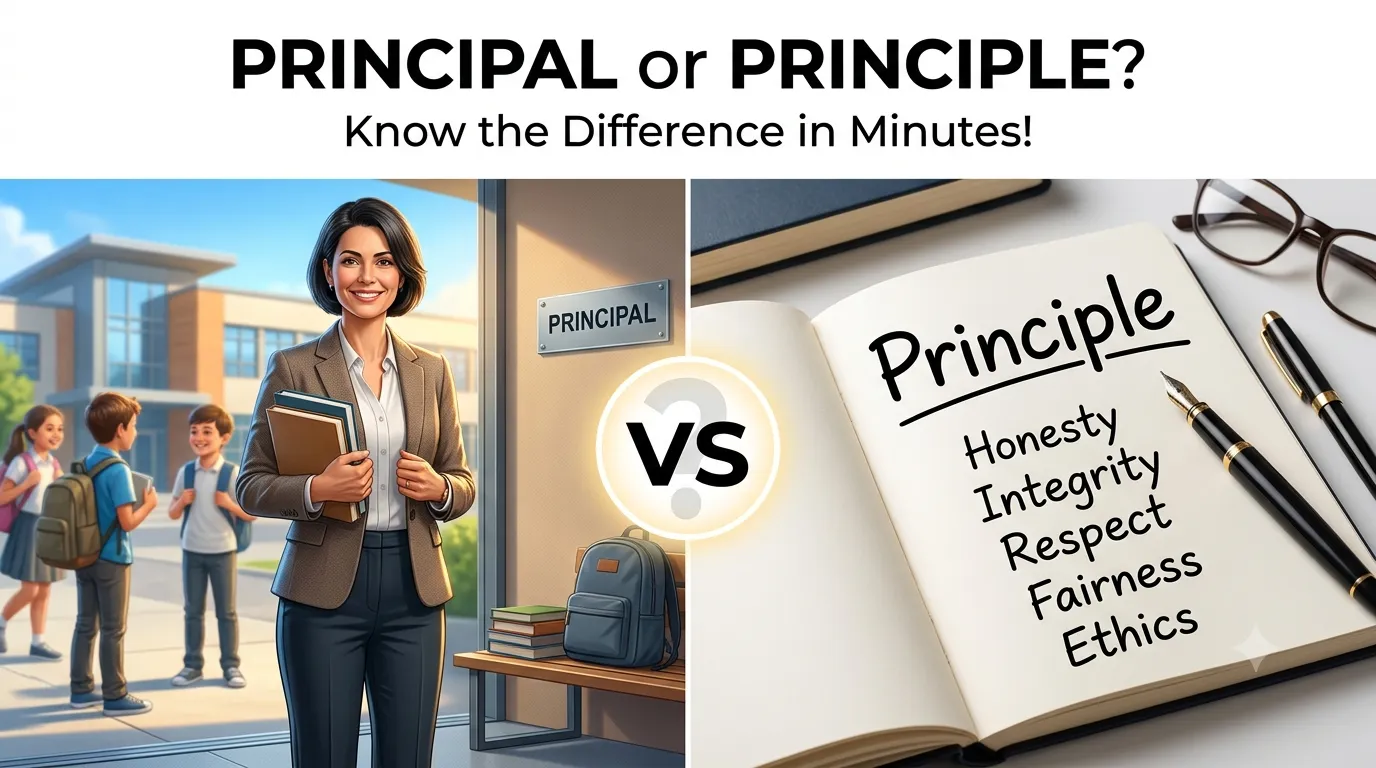
Principal usually means the most important person or thing, or the head of a school. Principle means a rule, belief, or basic truth. They sound alike, but they have very different meanings.
A few years ago, I was proofreading an email from one of my students. He had written:
“I always follow my principal.”
At first glance, the sentence looked fine. But after reading the rest of the email, I realized he meant he always followed his moral values, not his school principal.
That tiny spelling mistake completely changed the meaning.
I’ve seen this confusion hundreds of times. Students make it. Professionals make it. Even experienced writers sometimes pause before choosing between principal and principle.
The reason is simple. These words sound exactly alike. They differ by only one letter, yet they have completely different meanings.
If you’ve ever stopped mid-sentence wondering which one to use, you’re not alone.
By the end of this guide, you’ll know exactly what each word means, when to use it, how to remember the difference forever, and how to avoid one of the most common English writing mistakes.
Let’s clear up the confusion once and for all.
Principal or Principle: Quick Answer
Although principal and principle sound the same, they are never interchangeable.
- Principal = a person, something most important, or a sum of money.
- Principle = a rule, law, belief, or moral standard.
Simple Examples
✅ The principal welcomed new students.
✅ Honesty is an important principle.
✅ The principal amount of the loan must be repaid.
These examples show that choosing the wrong word changes the entire meaning of the sentence.
The Origin of Principal and Principle
Understanding where these words came from makes them much easier to remember.
Both words come from the Latin word principalis, which means first or chief.
Over time, English gave each word a different purpose.
Principal
The word principal developed the meaning of:
- first
- chief
- main
- leader
That’s why we use it for:
- the head of a school
- the main reason
- the primary amount of money in finance
Examples:
- The principal reason for the delay was bad weather.
- She spoke with the school principal.
Principle
The word principle evolved to describe:
- rules
- beliefs
- moral values
- fundamental truths
Examples:
- Respect is an important principle.
- Freedom is a basic democratic principle.
Why Do People Confuse Them?
There are several reasons.
- They sound exactly alike.
- Only one letter is different.
- Both come from the same Latin root.
- Spell check doesn’t always catch the mistake because both are real words.
This makes them one of English’s most commonly confused word pairs.
Principal or Principle Explained
The easiest way to understand them is by comparing their meanings.
| Word | Meaning | When to Use | Context |
|---|---|---|---|
| Principal | Chief, main, school leader, loan amount | Talking about people, importance, or finance | Education, business, banking |
| Principle | Rule, belief, moral value | Talking about ethics, ideas, or laws | Writing, philosophy, everyday English |
What Does Principal Mean?
The word principal has several meanings.
1. The Head of a School
This is the meaning most people know.
Example:
- The principal announced a new school policy.
2. Most Important
Example:
- Safety is our principal concern.
Here, principal means main or primary.
3. Money in Finance
Banks use principal to describe the original amount borrowed before interest.
Example:
- She paid off the loan’s principal early.
What Does Principle Mean?
A principle is something you believe in or a rule you follow.
Examples include:
- honesty
- fairness
- responsibility
- respect
Example:
- One of my guiding principles is always telling the truth.
Principle Can Also Mean a Scientific Rule
Example:
- Gravity is a scientific principle.
Or a legal principle.
Example:
- Everyone is equal before the law. That is a legal principle.
Side-by-Side Examples
| Correct Sentence | Why It Is Correct |
|---|---|
| The principal greeted parents. | School leader |
| Honesty is a core principle. | Moral belief |
| The principal amount is $5,000. | Loan amount |
| Fairness is an important principle in sports. | Guiding rule |
| Her principal responsibility is customer service. | Main responsibility |
Easy Memory Trick
This trick has helped many of my students.
Principal = PAL
The word principal ends with pal.
Think:
The principal is your pal.
Since a principal is a person, this trick works perfectly.
Principle = Rule
The ending -ple reminds many learners of principles and values.
Whenever you’re talking about:
- honesty
- respect
- fairness
- ethics
- beliefs
choose principle.
A Quick Test
Which sentence is correct?
- Our school principle greeted everyone.
- Our school principal greeted everyone.
✅ Correct answer:
Our school principal greeted everyone.
Now try this one.
- Honesty is my strongest principal.
- Honesty is my strongest principle.
✅ Correct answer:
Honesty is my strongest principle.
Which Version Should You Use?
The right choice depends on what you’re talking about, not where you live. Unlike British vs. American spelling differences, principal and principle have the same meanings in all English-speaking countries.
Use this quick guide whenever you’re unsure.
For Students
Use principal when referring to the head of a school.
Example:
- I spoke with the principal about my schedule.
Use principle when talking about values or rules.
Example:
- Respect is an important principle in our classroom.
For Teachers
Use principal for the school administrator.
Use principle when discussing teaching methods or educational values.
Examples:
- The principal approved the new science lab.
- Every lesson should follow the principle of active learning.
For Business Professionals
Choose principal for:
- Main responsibility
- Principal investor
- Principal amount
- Principal office
Choose principle for:
- Business ethics
- Company values
- Leadership principles
Examples:
- Our principal objective is customer satisfaction.
- Integrity is one of our company’s guiding principles.
For Financial Writing
Always use principal when discussing loans or investments.
Example:
- Pay the principal before the interest grows.
Never write:
❌ Pay the principle of the loan.
For Academic Writing
If you’re writing about:
- ethics
- philosophy
- science
- law
- psychology
You’ll usually need principle.
Examples:
- The principle of supply and demand.
- The principle of equality.
- The principle of natural selection.
For General Everyday Writing
Ask yourself one simple question:
Am I talking about a person, something main, or money?
→ Use principal.
Am I talking about a rule, belief, or value?
→ Use principle.
This simple question solves almost every case.
Common Mistakes with Principal or Principle
Even fluent English speakers mix these words up because they sound exactly alike. Here are the mistakes I see most often.
| ❌ Mistake | ✅ Correct | Why |
|---|---|---|
| The school principle welcomed us. | The school principal welcomed us. | A school leader is a person. |
| Honesty is my strongest principal. | Honesty is my strongest principle. | Honesty is a value, not a person. |
| Please repay the loan principle. | Please repay the loan principal. | Finance uses principal. |
| Our company follows strong principals. | Our company follows strong principles. | Company values are principles. |
| The principle reason was traffic. | The principal reason was traffic. | Principal can mean main or primary. |
Why These Mistakes Happen
Most errors happen because:
- The words are pronounced the same.
- Only one letter changes.
- Both spellings are valid English words.
- Spell check often won’t flag the mistake.
That means you must choose the correct word based on meaning.
How to Avoid the Confusion Forever
Try these memory tricks.
Trick #1: The Principal Is Your PAL
Principal contains pal.
Think:
The principal is your pal.
Since a principal is a person, this trick is easy to remember.
Trick #2: Principles Are Beliefs
Whenever you hear words like:
- honesty
- fairness
- justice
- kindness
- ethics
- values
Use principle.
Trick #3: Main = Principal
Replace the word with main.
If the sentence still makes sense, use principal.
Example:
The principal reason for leaving was the weather.
↓
The main reason for leaving was the weather.
It works.
Quick Practice
Choose the correct word.
- The school ______ met with parents.
- Honesty is an important ______.
- The bank reduced the loan ______.
- Respect is a guiding ______.
- Our ______ goal is better customer service.
Answers
- principal
- principle
- principal
- principle
- principal
If you got all five right, you’ve mastered the difference.
Principal or Principle in Real-World Examples
Seeing these words in context makes them much easier to remember.
In a Professional Email
Dear Team,
Our principal objective this quarter is improving customer support. Please continue following our core principles of honesty, teamwork, and accountability.
Notice that principal describes the main objective, while principles refer to company values.
In a News Headline
School Principal Receives National Leadership Award
Here, principal refers to the head of a school.
Another example:
Government Announces New Environmental Principles
In this headline, principles means guiding policies or values.
In a Social Media Post
Huge thanks to our school principal for making graduation unforgettable!
Another example:
Always stay true to your principles, even when no one is watching.
In a Formal Report
The principal cause of production delays was equipment failure.
Here, principal means main.
Another example:
The organization follows the principles outlined in its code of ethics.
In Everyday Conversation
Correct
- The principal called my parents.
- She lives by strong principles.
- Our principal concern is safety.
- I paid off the loan principal.
- Respect is an important principle.
Each sentence uses the correct word naturally.
Principal or Principle: Data, Trends & Usage
Many people search for principal or principle because they’re unsure which spelling fits their sentence. The confusion appears in schools, workplaces, exams, and professional writing.
Search Intent
The primary search intent is informational.
People usually want to know:
- Which spelling is correct?
- What does each word mean?
- How can I remember the difference?
- Which one should I use in my sentence?
Who Searches This Topic Most?
This word pair is especially popular among:
- Students preparing for exams
- English learners
- Teachers
- Bloggers and writers
- Business professionals
- Job seekers
- Editors and proofreaders
Where Is the Confusion Most Common?
The confusion appears across all major English-speaking regions, including:
- United States
- United Kingdom
- Canada
- Australia
- New Zealand
Because both words are standard English, the challenge is meaning, not regional spelling.
Why It Matters Today
Clear communication matters more than ever. Emails, resumes, academic papers, and online content all rely on accurate word choice.
Using principal when you mean principle can confuse readers and make your writing seem less polished. Choosing the correct word shows attention to detail and strengthens your credibility.
Principal vs. Principle: Complete Comparison Table
| Term/Variant | Meaning | Region/Context | Best Used When |
|---|---|---|---|
| Principal | School leader | Worldwide | Referring to the head of a school |
| Principal | Main or primary | Worldwide | Describing the most important reason, goal, or concern |
| Principal | Original loan amount | Finance | Discussing loans, mortgages, or investments |
| Principle | Moral value | Worldwide | Talking about honesty, fairness, or ethics |
| Principle | Rule or guideline | Education, law, science | Referring to a basic rule or fundamental idea |
| Principle | Core belief | Everyday English | Describing personal or professional values |
The simplest way to remember the difference is this:
- Principal = person, primary, or money
- Principle = rule, belief, or value
These three keywords will help you choose the correct spelling almost every time.
Frequently Asked Questions (FAQs)
Q1: What is the difference between principal and principle?
The main difference is their meaning. Principal refers to a person, something most important, or the original amount of money in a loan. Principle refers to a rule, belief, moral value, or fundamental truth.
Q2: How do I use principal and principle correctly?
Use principal when talking about:
- A school leader
- The main or primary thing
- The original loan amount
Use principle when talking about:
- Values
- Ethics
- Rules
- Beliefs
- Scientific or legal concepts
A simple way to remember is:
Principal = Person, Primary, Principal amount
Principle = Principles and Values
Q3: Is it school principal or school principle?
The correct phrase is school principal.
A principal is the head of a school.
Correct:
- The school principal welcomed the students.
Incorrect:
- The school principle welcomed the students.
Q4: Is honesty a principal or a principle?
The correct word is principle.
Honesty is a moral value or belief.
Correct:
- Honesty is one of my strongest principles.
Q5: Can principal mean “main” or “most important”?
Yes.
Besides referring to a school leader, principal also means main, chief, or most important.
Examples:
- Our principal goal is customer satisfaction.
- The principal reason for the delay was heavy rain.
Q6: Is principle acceptable in formal writing?
Absolutely.
Principle is widely used in formal writing, including:
- Academic papers
- Business documents
- Legal writing
- Government reports
- Scientific publications
Whenever you’re discussing rules, ethics, or fundamental ideas, principle is the correct and professional choice.
Q7: What is the easiest way to remember principal vs. principle?
The easiest memory trick is:
The principal is your PAL.
Since principal contains pal, it’s easy to remember that it refers to a person.
For principle, think of principles and values. If the sentence is about beliefs, morals, or rules, choose principle.
Conclusion
Choosing between principal and principle doesn’t have to be confusing. Once you understand what each word represents, the right choice becomes much easier.
Remember these three key takeaways:
- Principal refers to a person, the main or primary thing, or the original amount of a loan.
- Principle refers to a rule, belief, moral value, or fundamental truth.
- A quick memory trick can save you every time: “The principal is your pal.” If you’re talking about values or ethics, think principles instead.
Whether you’re writing an email, preparing for an exam, creating professional content, or simply improving your English, using the correct word helps your writing sound clear, accurate, and confident.
The next time you pause over principal or principle, you’ll know exactly which one fits your sentence.
Bookmark this guide for quick reference, and share it with friends, classmates, or colleagues who still mix up these commonly confused words. A simple reminder today can prevent writing mistakes for years to come.
Read more: Adapt or Adopt: The Complete Easy Guide

I have been working with English language content for over six years. I specialize in word comparisons and spelling differences that most people overlook. At WordsCombo, I help readers choose the right word every time.