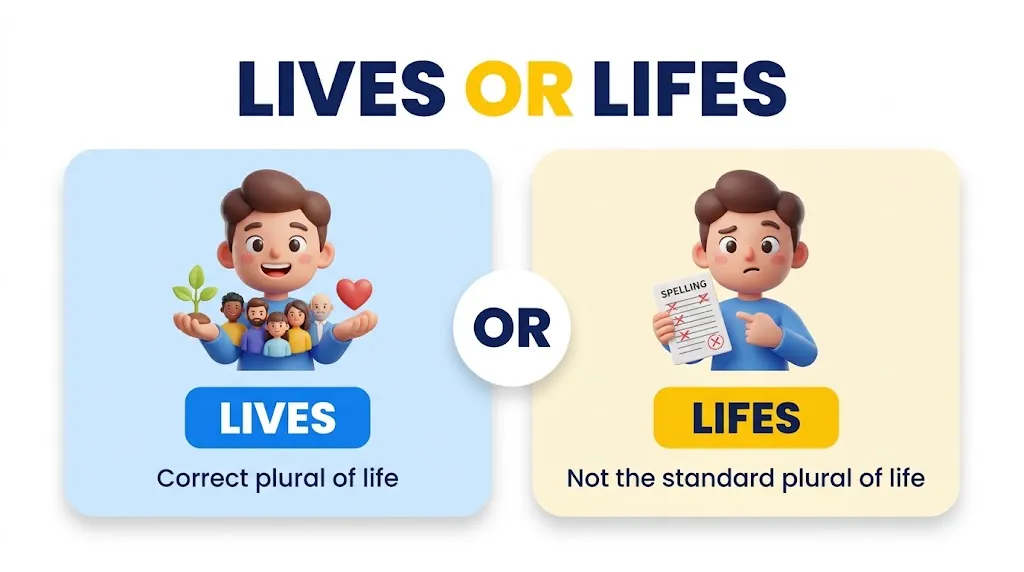
Lives is the correct plural of life. Lifes is not the standard plural spelling.
A client message is ready to send, and you stop at the line, “The changes affected many lifes.” That red spellcheck line makes you pause. The correct spelling is lives, not lifes, when you mean more than one life. However, lives can also mean “exists” or “stays alive,” which adds another layer to the confusion.
Lives or Lifes: Quick Answer
Lives is the correct plural of life. For example, “The rescue saved many lives” and “Their lives changed after the move.”
Lifes is not the normal plural form of life. So, in school work, emails, reports, and other standard writing, choose lives.
The Origin of Lives or Lifes
The word life has been part of English for many centuries. Its plural did not follow the simple pattern used by words such as book and books.
Instead, life developed the plural form lives. The spelling changed from f to v before the plural ending. Similar changes appear in wife and wives, knife and knives, and leaf and leaves.
However, English does not change every word ending in f or fe this way. For example, roof normally becomes roofs. Because of that, you cannot use one simple rule for every word.
The main reason for the mistake is easy to understand. Most English nouns form a plural by adding s. So, a learner may naturally write life + s as lifes. That guess looks logical, but the standard form is lives.
Lives or Lifes Explained: Key Differences
The biggest difference is simple: lives is correct, while lifes is not the standard plural of life. Still, lives has another job as a verb.
As a plural noun, lives means more than one life. As a verb, lives is the third-person singular form of live.
For example, “The doctor saved three lives” uses lives as a noun. In contrast, “She lives near the park” uses lives as a verb.
| Term | Meaning | When to Use | Region/Context |
| life | One existence or period of living | One life | Standard English |
| lives | More than one life | Two or more lives | Standard English |
| lives | The verb form of live | He, she, or it lives | Standard English |
| lifes | Not the standard plural of life | Do not use for normal plural meaning | Standard English error |
| life’s | Possessive form or short form of life is | When showing ownership or meaning “life is” | Standard English |
The sound can also help you tell the two uses of lives apart. When lives means plural life, it has the long i sound, like “life.” When lives is the verb form of live, it has the short i sound, like “give.”
For example, “Many lives were changed” uses the noun form. Meanwhile, “He lives in Texas” uses the verb form.
Lives or Lifes: Comparison at a Glance
| Term/Variant | Meaning | Region/Context | Best Used When |
| life | One life or existence | All standard English | Talking about one life |
| lives | More than one life | All standard English | Talking about several lives |
| lives | Third-person form of live | All standard English | Saying that someone lives somewhere or in a certain way |
| lifes | Incorrect plural spelling | Standard English | Avoid it |
| life’s | Possession or “life is” | All standard English | Showing ownership or shortening “life is” |
Which One Should You Use?
For students, use lives when you mean more than one life because it is the standard plural form. For example, write “The accident affected many lives.”
For business writers, use lives in emails, reports, and formal documents when the meaning is plural. So, “The new service can improve customers’ lives” is correct.
For social media writers, choose lives when talking about several people or several periods of life. A caption such as “Our busy lives keep us moving” uses the word correctly.
For anyone writing about one person, use life when the meaning is singular. If you are showing that a person exists somewhere or spends time in a certain way, use lives as a verb. For example, “My brother lives in Chicago.”
Common Mistakes with Lives or Lifes
1. Writing “lifes” for the plural
Mistake: “Many lifes were changed by the event.”
Correction: “Many lives were changed by the event.”
This happens because adding s is the usual plural pattern. However, life is one of the words that changes its spelling in the plural.
2. Using “lives” when you need “life”
Mistake: “She has a happy lives.”
Correction: “She has a happy life.”
Here, the writer is talking about one life. Therefore, the singular form is needed.
3. Mixing up noun and verb lives
Mistake: “She lives a very happy lives.”
Correction: “She lives a very happy life.”
The first lives is a verb. The second word should be the singular noun life because the sentence describes one life.
4. Confusing lives with life’s
Mistake: “Her lifes goal is to travel.”
Correction: “Her life’s goal is to travel.”
The apostrophe matters here. Life’s can show possession, or it can shorten “life is.”
5. Writing lifes in a phrase with a number
Mistake: “The game gives players three lifes.”
Correction: “The game gives players three lives.”
Even when a number comes before the word, the plural stays lives. So, one life becomes two lives, three lives, or many lives.
Lives or Lifes in Real-World Examples
Professional Email
“Your work has improved the lives of many customers.”
Here, lives is a plural noun. The email talks about more than one person’s life.
News Headline
“New safety plan could save lives.”
In this headline, lives means more than one life. News writing often uses this short form because the meaning is clear.
Social Post
“Busy lives can make us forget to slow down.”
The word lives refers to the different lives of many people. So, the plural form is needed.
Formal Document
“The program aims to protect the lives of workers.”
This sentence uses lives as a plural noun. Because the document refers to many workers, lives is the correct form.
Everyday Conversation
“Her family lives nearby.”
Here, lives is not a plural noun. Instead, it is the verb live used with her family as the subject.
Lives or Lifes: Data, Trends & Usage
The search intent behind lives or lifes is mainly spelling and grammar help. People usually look up the phrase when they are unsure about the plural of life or when a spelling checker flags lifes.
Students may search it while doing homework or checking an assignment. Writers may also search it while editing an email, article, report, caption, or other text.
The phrase also has a second useful search intent. Some readers want to know why lives can be both a noun and a verb. That question matters because the spelling looks the same, but the meaning and pronunciation can change.
Another useful point is that online writing creates more chances for this mistake. Short messages, captions, and fast typing often lead people to add s to life without checking the plural form.
Still, the rule is easy to remember: one life becomes two lives. Once that pattern is familiar, the spelling becomes much easier.
FAQs About Lives or Lifes
Is lives the plural of life?
Yes, lives is the standard plural of life. For example, “One life” becomes “two lives.”
Is lifes ever correct?
No, not when you mean the normal plural of life. In standard English, use lives instead.
Why does life become lives?
Life has an irregular plural form. The f changes to v before the plural ending, giving us lives.
Can lives be a verb?
Yes, lives can be the third-person singular form of live. For example, “She lives in New York” uses lives as a verb.
Is life’s the same as lives?
No, these forms have different jobs. Life’s can show possession, as in “life’s purpose,” or shorten “life is,” while lives is the plural of life or a verb form.
Should I write “many lifes” or “many lives”?
Write “many lives.” The word lifes is not the standard plural spelling.
Is “still lifes” correct?
Yes, in the fixed phrase still life, the plural is commonly written still lifes. This is a special compound noun use, so it should not be used as a reason to write lifes for the ordinary plural of life.
Final Thoughts on Lives or Lifes
The correct plural of life is lives. Lifes is not the standard spelling when you mean more than one life. Also, remember that lives can be a noun or a verb, so context tells you which meaning is intended.
For school work and formal writing, choose lives when you mean several lives. Use life for one life, and use life’s for possession or the short form of “life is.” Still, watch the sentence because lives can have two meanings.
A simple memory trick works well: one life, two lives. Keep that pair in mind whenever you write about people or animals. Then, before you send your next message, replace lifes with lives if you mean more than one life.
Curious about similar words? Explore Burry or Bury

I started writing about English word differences after years of teaching students who kept making the same mistakes. My focus is on making spelling rules feel simple and easy to remember. At WordsCombo, I turn confusing word pairs into clear comparisons.