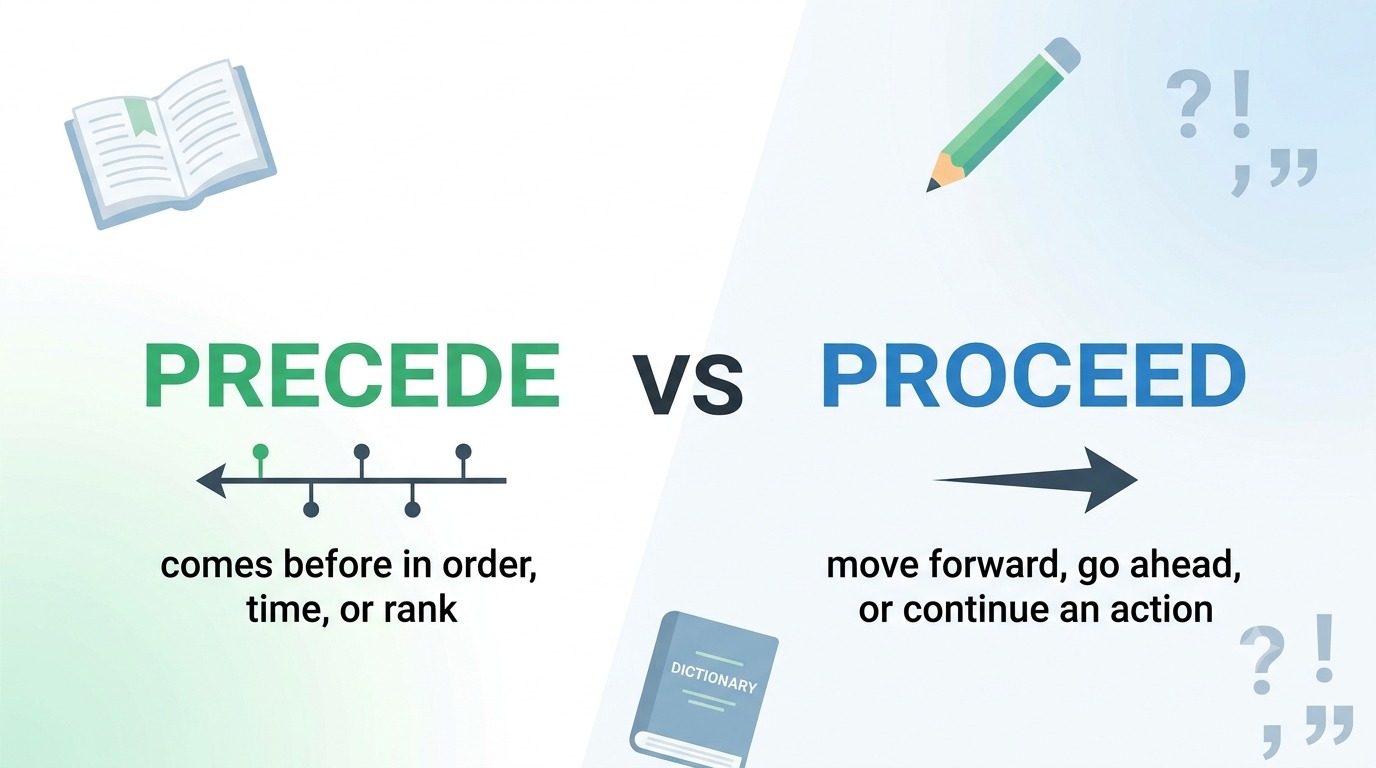
Precede means to come before, while proceed means to move forward or continue. Remember: precede = before, proceed = continue.
Have you ever stopped while writing and wondered, Should I use precede or proceed? I have. Early in my writing career, I mixed them up in an important email. I thought they sounded almost the same, so they must mean nearly the same thing. I was wrong.
That small mistake taught me a lesson. English has many words that look alike but mean very different things. Precede and proceed are among the most confusing. Even skilled writers pause to check which one fits the sentence.
The good news is that the difference is simple once you understand it. You do not need to memorize long grammar rules. You only need to remember what each word does and when it belongs.
In this guide, I will explain both words in plain English. You will learn their meanings, origins, common mistakes, and real life uses. By the end, you will know exactly which word to choose every time.
Precede or Proceed
Although precede and proceed differ by only one letter, they describe completely different actions.
- Precede means to come before someone or something.
- Proceed means to continue or move forward.
Think of it this way:
- If something happens first, it precedes something else.
- If something continues, it proceeds.
Example 1
The opening speech preceded the award ceremony.
The speech happened before the ceremony.
Example 2
After everyone was seated, the meeting proceeded as planned.
The meeting continued.
A Simple Memory Trick
Remember the first three letters.
- Pre in precede reminds you of before or previous.
- Pro in proceed reminds you of progress or move forward.
This small trick helps many learners remember the correct word instantly.
The Origin of Precede and Proceed
Knowing where words come from makes them easier to remember.
The Origin of Precede
The word precede comes from the Latin word praecedere.
It combines two parts:
- prae = before
- cedere = to go
Together, they mean to go before.
That original meaning has stayed almost the same for hundreds of years.
Examples:
- Spring precedes summer.
- A title precedes the main text.
- Preparation precedes success.
In every example, one thing comes before another.
The Origin of Proceed
The word proceed also comes from Latin.
It comes from procedere.
This word combines:
- pro = forward
- cedere = to go
So it literally means to go forward.
That meaning still fits today.
Examples:
- Please proceed to the next room.
- The project will proceed on Monday.
- The judge allowed the lawyer to proceed.
Every example shows movement or continuation.
Why People Confuse These Words
There are several reasons.
They Look Similar
Only one letter changes.
- precede
- proceed
At first glance, they almost seem identical.
They Sound Similar
Their pronunciation is close enough that many people confuse them while speaking or writing.
They Share the Same Latin Root
Both words come from cedere, meaning to go.
Their prefixes change the direction.
- prae → before
- pro → forward
Understanding the prefixes makes remembering them much easier.
Precede vs Proceed Explained
Now let’s compare both words side by side.
| Word | Meaning | When to Use | Example |
|---|---|---|---|
| Precede | To come before | When something happens earlier or appears first | Breakfast precedes work. |
| Proceed | To continue or move forward | When an action continues after something else | We can proceed with the meeting. |
What Does Precede Mean?
Use precede when talking about order, time, or position.
It answers questions like:
- Which happened first?
- Which comes before?
- Which appears earlier?
Examples
The warning preceded the storm.
Her introduction preceded the presentation.
The letter A precedes B in the alphabet.
Dinner usually precedes dessert.
Each sentence shows something happening or appearing first.
What Does Proceed Mean?
Use proceed when something keeps going.
It often means:
- continue
- move ahead
- carry on
- begin the next step
Examples
Please proceed carefully.
The workers proceeded with construction.
After lunch, the class proceeded normally.
The doctor told the nurse to proceed with the examination.
Here, nothing comes before anything else. Instead, the action continues.
Pronunciation
Although the words look alike, their sounds are slightly different.
- Precede → pri SEED
- Proceed → pro SEED
Notice the first syllable.
- pre
- pro
Listening carefully helps reduce confusion.
Grammar
Both words are verbs.
That means they describe an action.
Examples:
✔ The ceremony preceded dinner.
✔ We will proceed after lunch.
Neither word is commonly used as a noun or adjective in everyday English.
A Quick Memory Trick
This is the easiest way to remember them.
Remember “PRE”
Think of words like:
- preview
- prehistory
- preschool
- prepaid
All of them mean before.
So precede also means before.
Remember “PRO”
Think of:
- progress
- promote
- proceed
These words suggest moving ahead.
So proceed means continue or move forward.
Real Life Comparison
Imagine you are attending a wedding.
First, guests arrive.
Then the music begins.
Next, the bride walks down the aisle.
Finally, the ceremony starts.
The music precedes the ceremony because it happens first.
After the ceremony begins, everyone proceeds with the planned events.
This simple story shows both words working together naturally.
Key Takeaways
Before moving on, remember these simple rules:
- Precede = comes before.
- Proceed = continue forward.
- Pre = before.
- Pro = progress.
- Both are verbs, but they describe different actions.
- Choosing the right word makes your writing clearer and more professional.
In the next section, you’ll learn which word you should use in different situations, the most common mistakes writers make, and practical examples from emails, reports, news articles, and everyday conversations.
Which Version Should You Use?
Choosing between precede and proceed becomes easy when you think about what you want to say.
Ask yourself one simple question:
Is something happening before another thing, or is something continuing?
If it happens before, use precede.
If it continues, use proceed.
For Students
Use precede when writing about events in order.
Examples:
- The introduction precedes the conclusion.
- Chapter 2 precedes Chapter 3.
Use proceed when describing the next step.
Examples:
- Please proceed to the next question.
- After reading the passage, proceed with the exercise.
For Professional Writers
Clear writing matters.
Use precede when explaining sequence.
Example:
The executive summary precedes the main report.
Use proceed when giving instructions.
Example:
Once approved, the team can proceed with production.
For Business Communication
Business emails often use proceed because they focus on action.
Examples:
- We will proceed with the agreement.
- Please proceed with payment.
- The project will proceed as scheduled.
Use precede when discussing timelines.
Example:
A safety inspection must precede construction.
For Everyday Conversations
Most people use proceed more often.
Examples:
- Please proceed.
- You may proceed inside.
- Let’s proceed with dinner.
Use precede when talking about order.
Example:
Practice should precede performance.
For Academic Writing
Academic writing often discusses order and process.
Examples:
The literature review precedes the methodology section.
Researchers may proceed with data collection after receiving approval.
My Recommendation
Use this simple rule every time.
✅ Precede = Before
✅ Proceed = Continue
If you remember only these two ideas, you’ll rarely make a mistake.
Common Mistakes with Precede and Proceed
These words confuse many English learners because they look and sound similar.
Here are the mistakes people make most often.
| Mistake | Correct Version | Why It Is Wrong |
|---|---|---|
| Please precede to the next page. | Please proceed to the next page. | The action is continuing, not coming before. |
| Dessert proceeded dinner. | Dessert followed dinner. Dinner preceded dessert. | Dessert comes after dinner. |
| We will precede with the meeting. | We will proceed with the meeting. | The meeting is continuing. |
| Safety checks proceeded construction. | Safety checks preceded construction. | The checks happened first. |
| Can we precede now? | Can we proceed now? | The speaker means “continue.” |
Why These Mistakes Happen
Most mistakes happen because:
- The spellings are very similar.
- The pronunciation is close.
- Both words come from Latin.
- People remember the sound but forget the meaning.
A quick pause before writing can prevent these errors.
Precede or Proceed in Real World Examples
Seeing the words in context makes them much easier to remember.
Professional Email
Before we proceed with the contract, our legal team must review the final draft. This review should precede your signature.
Here, proceed means continue, while precede means happen first.
News Headline
Heavy Rain to Precede Weekend Storm Across the Coast
The rain arrives before the larger storm.
Business Report
Quality testing must precede mass production to reduce defects. Once testing is complete, the company can proceed with manufacturing.
Both words appear naturally because the report discusses sequence and action.
Social Media Post
We’re excited to proceed with our new project next week! 🎉
Short, simple, and correct.
School Essay
The Industrial Revolution preceded many modern technological advances.
The word explains historical order.
Meeting Instructions
Please proceed to Conference Room B after registration.
Registration happens first.
The meeting continues afterward.
Precede vs Proceed at a Glance
Sometimes a quick comparison is all you need.
| Feature | Precede | Proceed |
|---|---|---|
| Main Meaning | Come before | Continue or move forward |
| Part of Speech | Verb | Verb |
| Talks About | Order | Action |
| Memory Trick | Pre = Before | Pro = Progress |
| Common Context | History, sequence, timelines | Meetings, instructions, projects |
| Example | Spring precedes summer. | We can proceed now. |
Keep this table handy whenever you’re unsure.
Precede or Proceed: Data, Trends & Usage
Many people search for precede or proceed because these words are among the most commonly confused verbs in English.
Where Is This Topic Popular?
The keyword is often searched by:
- Students
- English learners
- Teachers
- Bloggers
- Business professionals
- Job seekers
- Academic writers
Countries with many English learners often generate high interest because mastering confusing word pairs improves writing confidence.
Search Intent
Primary Search Intent: Informational
People usually want to know:
- Which word is correct?
- What does each word mean?
- How do I remember the difference?
- Which word fits my sentence?
- Is my writing grammatically correct?
This means readers want a quick answer first, followed by practical examples.
Why This Matters Today
Good communication is more important than ever. Emails, reports, resumes, essays, and social media posts all reflect your writing skills.
Using precede when you mean proceed, or the other way around, can confuse readers and weaken your message. A small word choice can make a big difference in how professional and clear your writing appears.
Learning the distinction helps you write with confidence in school, at work, and in everyday life.
Standalone Comparison Table
| Term/Variant | Meaning | Region/Context | Best Used When |
|---|---|---|---|
| Precede | To come before | Standard English worldwide | Describing order, time, or sequence |
| Proceed | To continue or move forward | Standard English worldwide | Giving instructions or describing ongoing actions |
| Follow | To come after | Everyday English | Showing what happens next |
| Continue | To keep going | General English | When you don’t need the formal word proceed |
Quick Recap
Before moving to the FAQs, remember these simple points:
- Precede always relates to what comes first.
- Proceed always relates to what happens next.
- Think “Pre = Before.”
- Think “Pro = Progress.”
- Read your sentence once more before you write. A five second check can save an embarrassing mistake.
Frequently Asked Questions (FAQs)
Q1: What does “precede” mean?
Precede means to come before something in time, order, or position. It is used when one event, object, or action happens first.
Example:
The welcome speech preceded the award ceremony.
Q2: What does “proceed” mean?
Proceed means to continue, move forward, or carry on with an action or process. It often appears in instructions, meetings, and business communication.
Example:
After checking your ticket, you may proceed to the boarding gate.
Q3: What is the difference between “precede” and “proceed”?
The difference is simple:
- Precede = comes before
- Proceed = continues or moves forward
Think about the sentence. If you’re talking about order, use precede. If you’re talking about continuing, use proceed.
Q4: Which word is correct: precede or proceed?
Both words are correct. The right choice depends on your meaning.
- Use precede when something happens first.
- Use proceed when something continues or moves ahead.
Choosing the correct word makes your writing clearer and more accurate.
Q5: Is “precede” acceptable in formal writing?
Yes. Precede is widely used in formal writing, academic papers, business reports, legal documents, and professional communication. It is the correct word when describing sequence or order.
Example:
The executive summary should precede the main report.
Q6: Where do “precede” and “proceed” come from?
Both words come from Latin and share the root cedere, meaning “to go.”
- Precede comes from praecedere, meaning “to go before.”
- Proceed comes from procedere, meaning “to go forward.”
Their prefixes explain their meanings:
- Pre = before
- Pro = forward
Remembering the prefixes is one of the easiest ways to tell the words apart.
Q7: Can “precede” and “proceed” be used in business writing?
Absolutely.
Both words are common in professional communication, but they serve different purposes.
Use precede when discussing timelines or the order of tasks.
Example:
Management approval must precede production.
Use proceed when giving permission or describing the next step.
Example:
Once payment is confirmed, we will proceed with your order.
Using the correct word makes business writing more precise and professional.
Conclusion
At first glance, precede and proceed seem almost identical. They share similar spelling, pronunciation, and even the same Latin root. That is why many English learners, and even experienced writers, mix them up.
The good news is that the difference is easy to remember once you focus on their meanings. Precede always refers to something that comes before. Proceed means to continue or move forward. Keeping this simple rule in mind will help you avoid one of the most common word choice mistakes in English.
Whether you’re writing an email, preparing a report, completing a school assignment, or posting online, choosing the correct word makes your message clearer and more professional. Small improvements like this build confidence and strengthen your communication skills over time.
The next time you pause and wonder which word to use, remember: Pre = Before and Pro = Progress. That quick memory trick can save you from confusion in just a second.
Now you know exactly how to use precede and proceed. Bookmark this guide so you never second guess these words again, and share it with someone who has struggled with this common grammar question.
Read more: Flaunt or Flout: Easy Guide to Correct Usage

I have been working with English language content for over six years. I specialize in word comparisons and spelling differences that most people overlook. At WordsCombo, I help readers choose the right word every time.