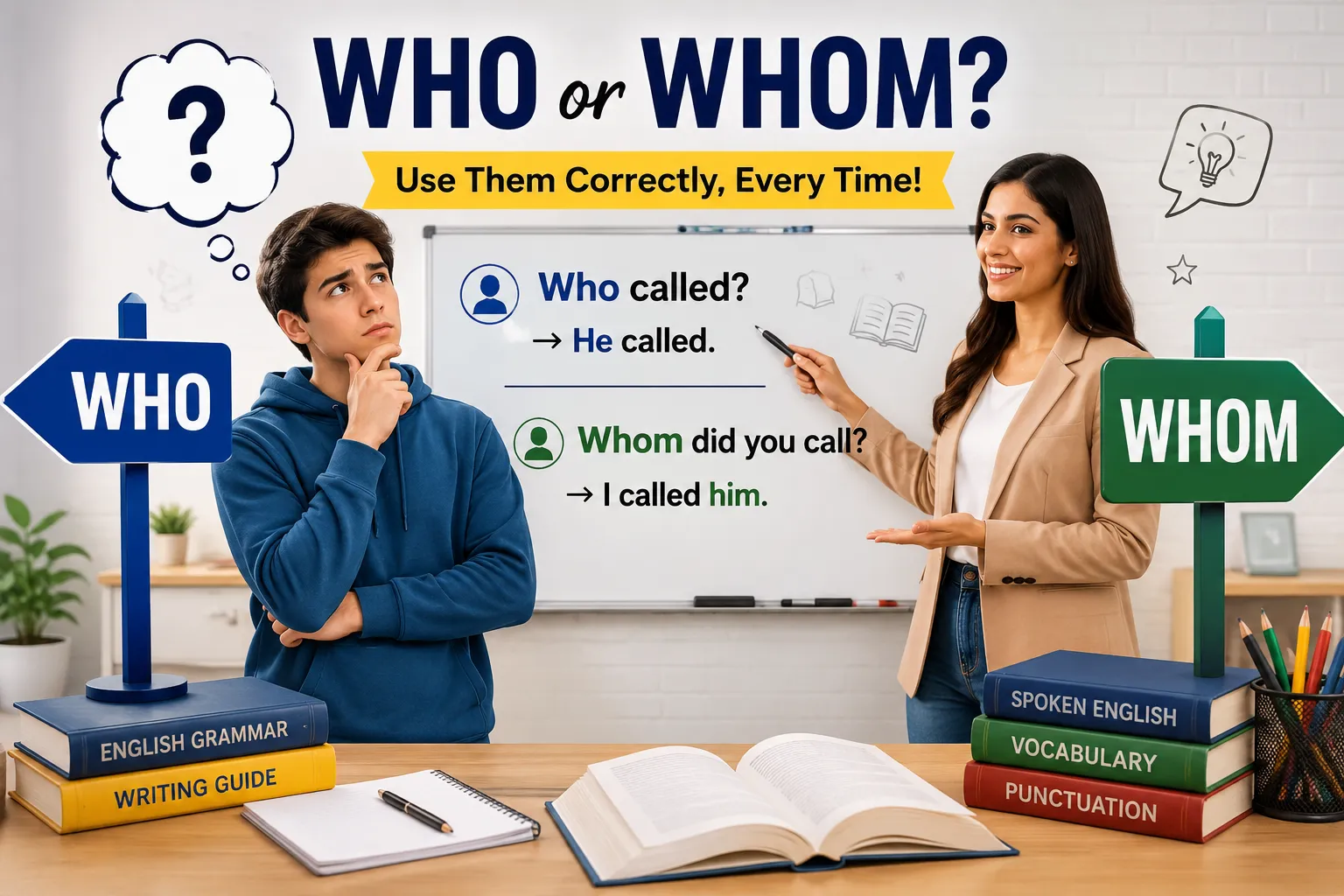
Who is used for the subject of a sentence, and whom is used for the object. A simple trick: if he fits, use who; if him fits, use whom.
A few years ago, I was editing an article for a client when I spotted this sentence:
“To whom do you think should receive the award?”
It looked formal. It even sounded smart. But it was wrong.
That moment reminded me how confusing who and whom can be. Even experienced writers, students, and professionals hesitate before using them. Many people avoid whom altogether because they worry about making a mistake. Others use it everywhere because they think it sounds more educated.
The truth is much simpler.
Once you understand the job each word does in a sentence, choosing the correct one becomes easy. You don’t need to memorize dozens of grammar rules. You only need one simple trick and a little practice.
Who or Whom
The difference comes down to one simple question:
- Who performs the action.
- Whom receives the action.
Think of it like this:
✅ Who called you?
Here, who is doing the calling.
✅ Whom did you call?
Here, whom is receiving the action.
A simple memory trick
Replace the word with one of these:
- He or she → use who
- Him or her → use whom
Examples:
- Who wants pizza?
- He wants pizza.
- ✔ Correct
- Whom did you invite?
- I invited him.
- ✔ Correct
This quick test works in almost every situation.
The Origin and Background of Who or Whom
Who and whom come from Old English. Although modern English has become simpler, whom is still preferred in formal writing, while who is common in everyday speech.
For example:
| Subject | Object |
|---|---|
| I | Me |
| He | Him |
| She | Her |
| They | Them |
| Who | Whom |
Because modern English no longer changes most words, many speakers naturally replace whom with who.
Today, you’ll often hear:
Who did you see?
instead of
Whom did you see?
In everyday conversation, this is widely accepted. However, formal writing, academic papers, legal documents, and professional communication still prefer whom when grammar requires it.
That is why many learners wonder which form is correct.
Who or Whom Explained: Key Differences
Although the two words look similar, they have different jobs.
Use Who when it is the subject.
The subject performs the action.
Examples:
- Who baked the cake?
- Who wrote this email?
- Who is waiting outside?
In every sentence above, who is doing something.
Use Whom when it is the object.
The object receives the action.
Examples:
- Whom did you meet yesterday?
- Whom should I contact?
- To whom was the letter addressed?
Here, another person performs the action, while whom receives it.
Comparison Table
| Term | Meaning | When to Use | Region/Context |
|---|---|---|---|
| Who | Subject pronoun | Performs the action | Formal and informal English worldwide |
| Whom | Object pronoun | Receives the action | Mostly formal writing, academic English, legal documents |
| Who (informal object) | Object in casual speech | Common in conversation | Everyday spoken English |
Compare these examples
| Correct Sentence | Why It Works |
|---|---|
| Who opened the door? | Subject performs the action. |
| Whom did you invite? | Object receives the action. |
| To whom should I send this email? | Object follows a preposition. |
| Who is speaking? | Subject of the verb. |
Notice that whom often appears after prepositions like:
- to
- for
- with
- by
- from
- about
Examples:
- With whom are you traveling?
- About whom were they talking?
- For whom is this gift?
In casual conversation, many native speakers simply say:
- Who are you traveling with?
- Who were they talking about?
Both sound natural, although the second version is less formal.
Which Version Should You Use?
The answer depends on your audience.
For students
Use the grammatically correct form whenever possible.
Teachers and examiners often expect you to know the difference.
Example:
- Whom did the teacher choose?
For professionals
In reports, business letters, research papers, and official emails, use whom whenever it is the object.
Examples:
- To whom it may concern
- Whom should we contact regarding this project?
Correct grammar helps your writing appear polished and professional.
For everyday conversations
Most native English speakers simply use who in almost every situation.
Examples:
- Who did you meet?
- Who are you talking to?
These sentences sound natural and are widely accepted in casual speech.
For formal writing
Choose who as the subject and whom as the object.
This follows traditional English grammar and remains the preferred style in:
- Academic writing
- Business communication
- Government documents
- Legal writing
- Formal speeches
My recommendation
If you’re unsure, ask yourself one question:
Is this word doing the action or receiving it?
If it does the action, choose who.
If it receives the action, choose whom.
And whenever you’re stuck, use the simple replacement test:
- He/She = Who
- Him/Her = Whom
This tiny trick can solve most who vs whom questions in seconds.
Common Mistakes with Who or Whom
Even native English speakers mix up who and whom. The good news is that the same mistakes happen again and again. Once you know them, they are easy to avoid.
Mistake 1: Using whom as the subject
❌ Whom is coming to dinner?
✅ Who is coming to dinner?
Why?
The person is performing the action of coming. That makes the word the subject, so who is correct.
Mistake 2: Using who after a preposition in formal writing
❌ To who should I send the report?
✅ To whom should I send the report?
Why?
The word follows the preposition to. In formal English, use whom after prepositions.
Mistake 3: Choosing whom because it sounds smarter
Some people believe whom always sounds more educated.
Example:
❌ Whom wants another slice of cake?
✅ Who wants another slice of cake?
Why?
Grammar matters more than sounding formal. Use who whenever it is the subject.
Mistake 4: Ignoring the he/him test
Many writers guess instead of testing.
Sentence:
“_____ did the manager promote?”
Replace it:
“I promoted him.”
Since him fits, the correct word is:
✅ Whom did the manager promote?
Mistake 5: Overthinking casual conversations
In everyday speech, people often say:
- Who did you invite?
- Who are you talking to?
- Who did you see?
These are common and natural.
If you’re chatting with friends or posting online, who is usually acceptable, even when traditional grammar suggests whom.
Common Mistakes at a Glance
| Mistake | Correct Form | Why? |
|---|---|---|
| Whom is calling? | Who is calling? | Subject performs the action. |
| To who should I write? | To whom should I write? | Object after a preposition. |
| Whom wants coffee? | Who wants coffee? | Subject of the sentence. |
| Who did you invite? (formal writing) | Whom did you invite? | Object of the verb. |
| Whom is responsible? | Who is responsible? | Subject before the verb. |
Who or Whom in Real World Examples
Seeing the words in real situations makes the rule much easier to remember.
Professional Email
Dear Sarah,
Could you please tell me whom I should contact regarding the new project?
Thank you for your help.
Here, whom is correct because it is the object of contact.
News Headline
Who Won the National Science Award This Year?
The winner performs the action of winning, so who is correct.
Social Media Post
Who is ready for the weekend?
This sounds friendly and natural.
Another example:
Guess who I met today!
Even though some grammar books prefer whom, almost everyone says who in casual conversation.
Formal Report
The committee interviewed several candidates, one of whom was selected for the position.
This is formal writing, so whom is the correct object.
Business Meeting
Manager:
Who will lead the presentation tomorrow?
Employee:
Whom should we invite from the marketing team?
Both words are correct because they have different grammatical roles.
Everyday Conversation
Friend A:
Who called you?
Friend B:
My cousin.
Friend A:
Who did you call back?
Although traditional grammar allows whom, most people naturally use who while speaking.
Who or Whom: Data, Trends & Usage
The debate between who and whom has changed over the years.
Modern English is becoming simpler. Many native speakers use who in places where older grammar books recommended whom.
Here are some important trends.
Where is whom still common?
- Academic writing
- Legal documents
- Government publications
- Professional reports
- Formal business letters
- Research papers
These settings still value traditional grammar.
Where is who more common?
- Everyday conversations
- Social media
- Blogs
- Podcasts
- TV interviews
- Casual emails
- Text messages
Most people choose the simpler option because it sounds natural.
Search Intent
People searching for “who or whom” usually have an informational search intent.
They want answers like:
- Which one is correct?
- What is the difference?
- How do I remember the rule?
- Is whom still used?
- Can I just use who?
They are looking for a quick explanation with practical examples rather than a detailed grammar lesson.
Why This Matters Today
English keeps changing.
Many grammar rules have become more flexible, but employers, teachers, and editors still notice mistakes in formal writing.
Knowing when to use who and whom helps you:
- Write with confidence.
- Make a professional impression.
- Avoid embarrassing grammar mistakes.
- Pass school and language exams.
- Communicate more clearly.
A small grammar choice can make your writing look much more polished.
Frequently Asked Questions (FAQs)
Q: What does “who or whom” mean?
A: Who and whom are pronouns used to refer to people. Who is the subject of a sentence, while whom is the object of a verb or preposition. Knowing the difference helps you write more clearly and correctly.
Q: How do you use “who” and “whom” correctly?
A: A simple trick is to replace the word with he/she or him/her. If he or she fits, use who. If him or her fits, use whom.
Example:
- Who called you? → He called you.
- Whom did you call? → I called him.
Q: Who vs. whom: what’s the difference?A: The difference is based on grammar.
- Who performs the action.
- Whom receives the action.
Think of who like he and whom like him. This simple comparison works in most sentences.
Q: Is “whom” still acceptable in formal writing?
A: Yes. Whom is still the preferred choice in many formal situations, including academic papers, legal documents, official reports, and business letters. While everyday speech often favors who, formal writing still values the correct use of whom.
Q: Which version is correct who or whom?
A: Neither word is always correct. The right choice depends on its role in the sentence. Use who as the subject and whom as the object. When in doubt, use the he/him test to check.
Q: Where does the word “whom” come from?
A: Whom comes from Old English, when the language had more grammatical cases than it does today. Although modern English has become simpler, whom has remained in formal grammar and written English.
Q: Can “whom” be used in everyday conversation?
A: It can, but it is less common. Most native English speakers simply use who in casual conversations. Using whom is grammatically correct, but it may sound formal or old-fashioned in everyday speech.
Conclusion
The difference between who and whom may seem confusing at first, but it becomes much easier once you understand their roles. Remember these key points:
- Who is the subject and performs the action.
- Whom is the object and receives the action.
- The he/him test is the fastest way to choose the correct word.
- In casual conversations, who is often accepted, even where traditional grammar once required whom.
- In formal writing, using who and whom correctly makes your work look polished and professional.
The more examples you read and write, the more natural the choice will become.
The next time you write an email, prepare a report, or answer an exam question, you’ll know exactly which word to use. That small change can make your writing clearer and more confident.
Now you know exactly how to use who and whom, try the he/him test in your next piece of writing. If you found this guide helpful, bookmark it and share it with someone who has ever been confused by these two words.
Read More: Lay or Lie: The Easy Guide to Using Them Correctly

I have a background in academic writing and spent several years as a proofreader for digital publications. Spotting differences between easily confused words became second nature to me. At WordsCombo, I share that knowledge so readers can write with confidence.