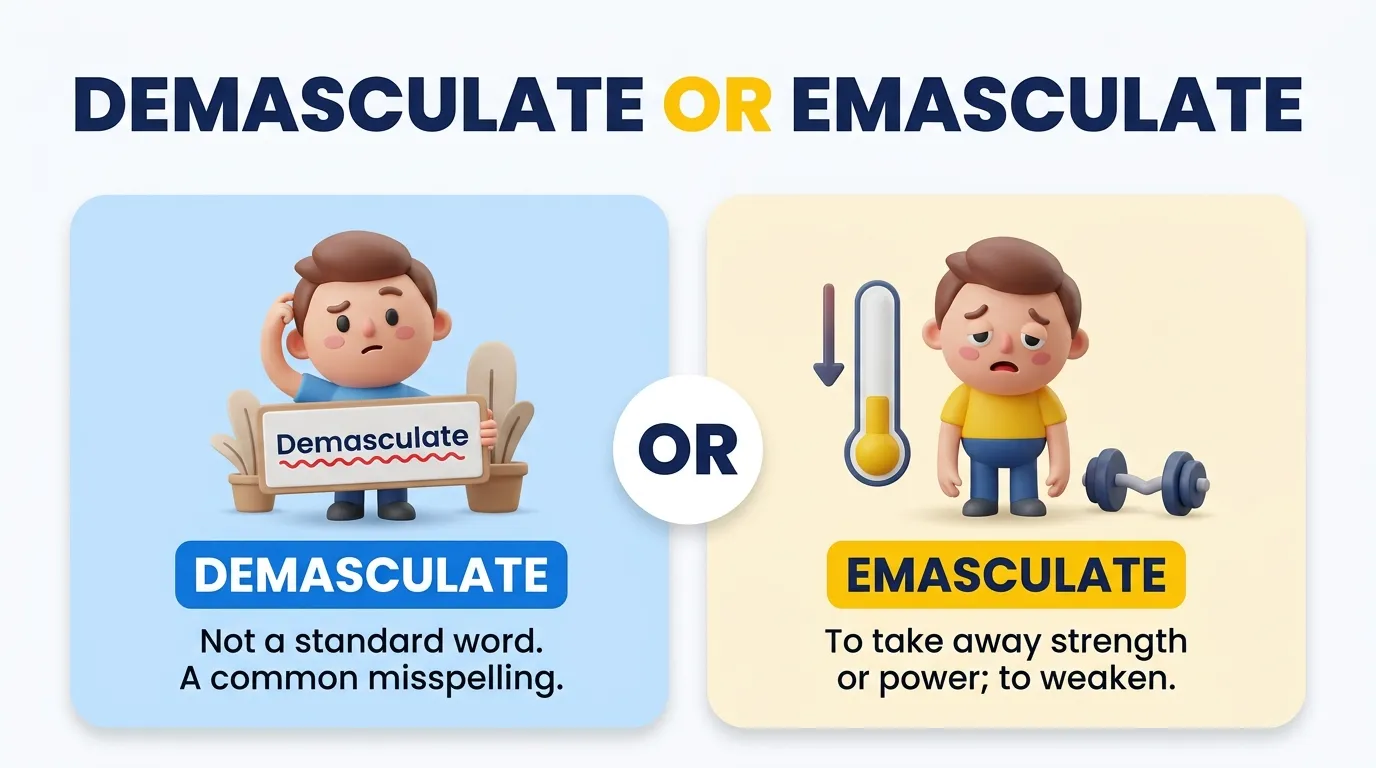
Use “Emasculate.” “Demasculate” is not a standard English word, so most editors and spell checkers treat it as a mistake.
You are typing a comment under a movie review: “That scene tried to demasculate him.” Then a red line pops up under the word. So which is right, demasculate or emasculate? The answer is emasculate, and the fix takes one second. This guide shows what the word means, why the mix-up happens, and how to get it right every time.
Meaning and Definition
Emasculate
Emasculate is a verb with two common meanings. First, it means to take away a man’s strength, power, or sense of manhood. Second, it means to make something weaker or less effective, such as a law, a plan, or an argument. In both cases, something important gets removed.
The word has clear forms too: emasculates, emasculated, and emasculating.
Example: “The constant public criticism made him feel emasculated at work.”
Demasculate
“Demasculate” is not listed as a standard word in major English dictionaries. Most people type it by accident when they mean emasculate. The mix-up makes sense because the prefix de- often means “undo” or “remove,” as in defrost or decode. Still, English never adopted it here.
A real but rare cousin is demasculinize, which means to remove masculine traits in a neutral way.
Example of the slip: “The boss tried to demasculate him in front of the team.”
Correct version: “The boss tried to emasculate him in front of the team.”
Origin of Emasculate
The word comes from the Latin emasculare, which meant to castrate. It joins e- (out) with masculus (male), so the idea is “to take the male out.” English borrowed it in the early 1600s, and the figurative sense of weakening a person or a thing grew from there. Demasculate has no such history, which is a clue that it is a modern slip.
Key Differences Between Demasculate and Emasculate
- Status: Emasculate is standard English, while demasculate is not.
- Meaning: Only emasculate has a clear, accepted meaning.
- Word forms: Emasculated and emasculating are correct, but demasculated and demasculating are not.
- Range: Emasculate works for people, laws, plans, and speeches.
- Editing: Spell checkers and editors flag demasculate, but they accept emasculate.
- Real look-alike: Demasculinize is the only true “de-” word in this family, and it is rare.
Emasculate vs Demasculate: Status, Meaning, and Safe Use
| Feature | Emasculate | Demasculate |
| Standard English? | Yes | No |
| Main meaning | To take away strength or power, or to weaken | No meaning of its own; used by mistake for emasculate |
| Word forms | emasculates, emasculated, emasculating | Not accepted |
| Safe in formal writing? | Yes | No |
| Best move | Use it | Replace it with emasculate |
Examples: Right and Wrong
Correct sentences
- ✅ The harsh joke was meant to emasculate him in front of his friends.
- ✅ Critics warned that the changes would emasculate the original bill.
- ✅ He felt emasculated when his coworkers laughed at his idea.
- ✅ The editor emasculated the report by cutting every bold claim.
- ✅ The new policy emasculates the safety team by slashing its budget.
Incorrect sentences
- ❌ The comment was meant to demasculate him. → Use emasculate.
- ❌ She felt demasculated by the review. → Use emasculated.
- ❌ The new law will demasculate the agency. → Use emasculate.
Common Emasculate Mistakes and Quick Fixes
| Mistake | Why it happens | Correct form |
| demasculate | The prefix de- feels like “remove” | emasculate |
| demasculated | The same pattern in past tense | emasculated |
| demasculating | The same pattern in the -ing form | emasculating |
| emaculate | A missing letter makes it look like “immaculate” | emasculate |
| emasculine | Masculine and emasculate get blended | emasculate |
Tips and Mnemonics
- Drop the D. Take the “d” off demasculate and you get emasculate. If you catch yourself typing “de,” just delete that first letter.
- E means out. The “e” at the start comes from a Latin prefix that means “out.” Something is taken out of the person or thing, so no extra prefix is needed.
- Erase strength. Both start with E, so think “Erase strength.” That picture matches the meaning well.
When to Use Each
In every setting below, emasculate is the only safe choice. Demasculate has no context where it is accepted.
- Email: Write “The changes would emasculate the proposal.” Because emails reflect on you, a red-underlined word looks careless.
- Formal writing: Reports, essays, and articles should always use emasculate. In addition, editors will correct the other form anyway.
- Exams: Spell it emasculate to avoid losing marks. Graders expect standard spelling, so a made-up form can cost you points.
- Resumes: You will rarely need this word here. If you do, spell it emasculate and keep the tone professional.
- Casual speech: People say “demasculate” out loud sometimes, and few notice. Even so, using emasculate keeps you correct if the words are later typed or quoted.
FAQs
Is demasculate a real word?
Not in standard English. Some people use it in casual writing, but dictionaries and editors do not accept it. As a result, emasculate is the safe choice.
What does emasculate mean?
It means to take away strength, power, or manhood, or to make something weaker. For example, you can emasculate a person’s confidence or emasculate a law by removing its key parts.
What is the past tense of emasculate?
The past tense is emasculated. In the same way, the -ing form is emasculating. Neither form ever takes the “de-” start.
Can emasculate describe things that are not men?
Yes, it can. The first meaning links to manhood, but the second meaning works for anything, such as a policy, a team, or a speech.
Is emasculate an offensive word?
It is a strong word, but it is not a slur. Still, it often describes shame or loss of power, so use it with care on sensitive topics.
What is the difference between emasculate and demasculinize?
Demasculinize is a real but rare word. It simply means to remove masculine traits, often in a neutral or scientific tone. Emasculate, on the other hand, carries the idea of weakening or shaming, so the two are not always swappable.
How do you pronounce emasculate?
It sounds like ih-MAS-kyuh-layt, with the stress on the second syllable. The last part rhymes with “late.”
What are good synonyms for emasculate?
Weaken, undermine, unman, and disempower fit most cases. For a law or plan, “water down” is also a natural choice.
Conclusion
In the choice between demasculate or emasculate, the winner is clear. Emasculate is the real word, and demasculate is a slip that editors will fix. Use it for anything that loses strength or power, whether that is a person, a law, or a speech. One practical tip: if you type “de” at the start, just drop the “d” and you are done.
Read more: Dyeing or Dying: Easy Guide to the Difference

I have been working with English language content for over six years. I specialize in word comparisons and spelling differences that most people overlook. At WordsCombo, I help readers choose the right word every time.