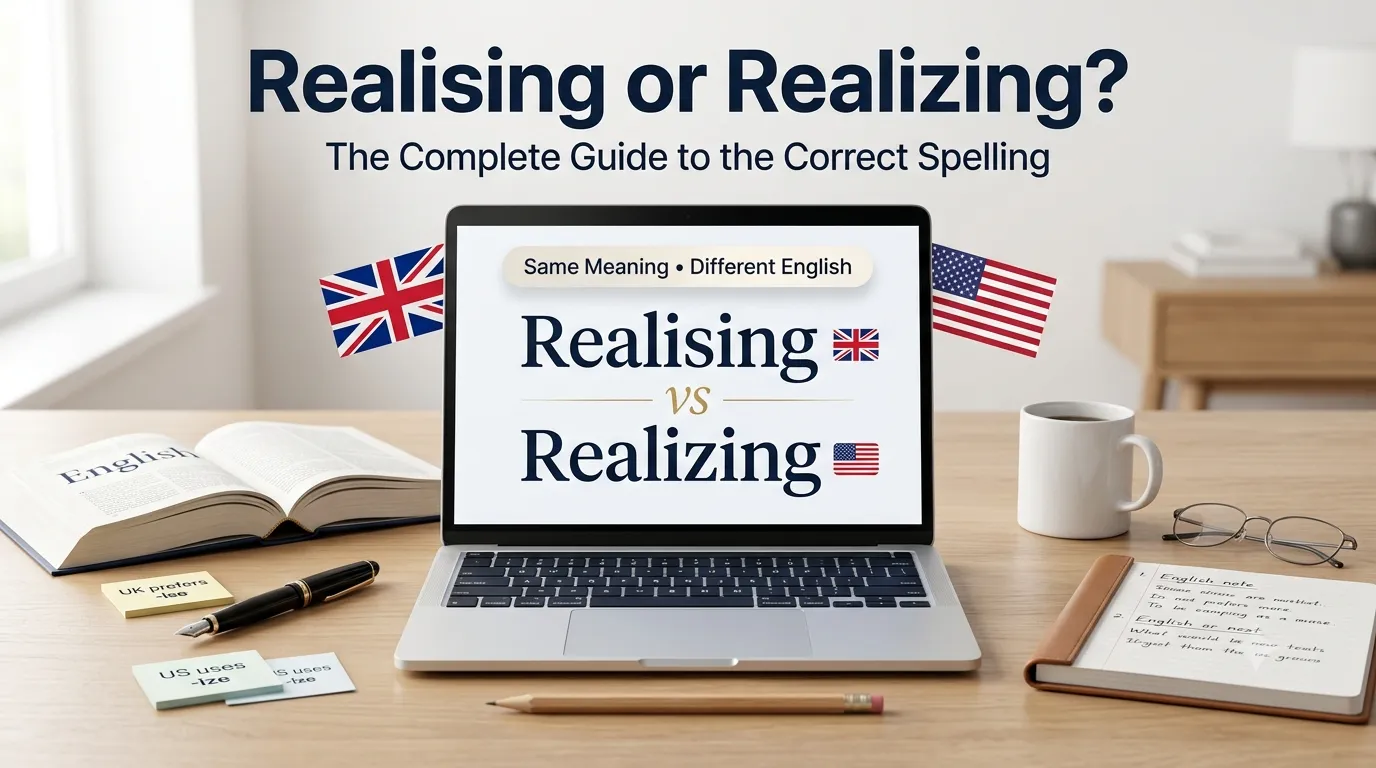
“Realising and realizing mean the same thing, only the spelling differs. Realising is British English; realizing is American English.”
Have you ever paused while writing because you weren’t sure whether to type realising or realizing? I have. Years ago, while editing an article for two international clients on the same day, one asked me to change every “realizing” to “realising,” while the other wanted the exact opposite. That simple task reminded me that even experienced writers can get caught by regional spelling differences.
If you are asking “is it realising or realizing?”, the answer is simple: both spellings are correct.The good news is that both are correct. The right choice depends on your audience, not on grammar.
Many online guides give a quick answer but stop there. They rarely explain why these spellings exist, when you should use each one, or how to stay consistent in your writing. That’s where this guide helps. By the end, you’ll know the difference, avoid common mistakes, and feel confident every time you write the word.
Let’s start with the simple answer.
Realising or Realizing: Quick Answer
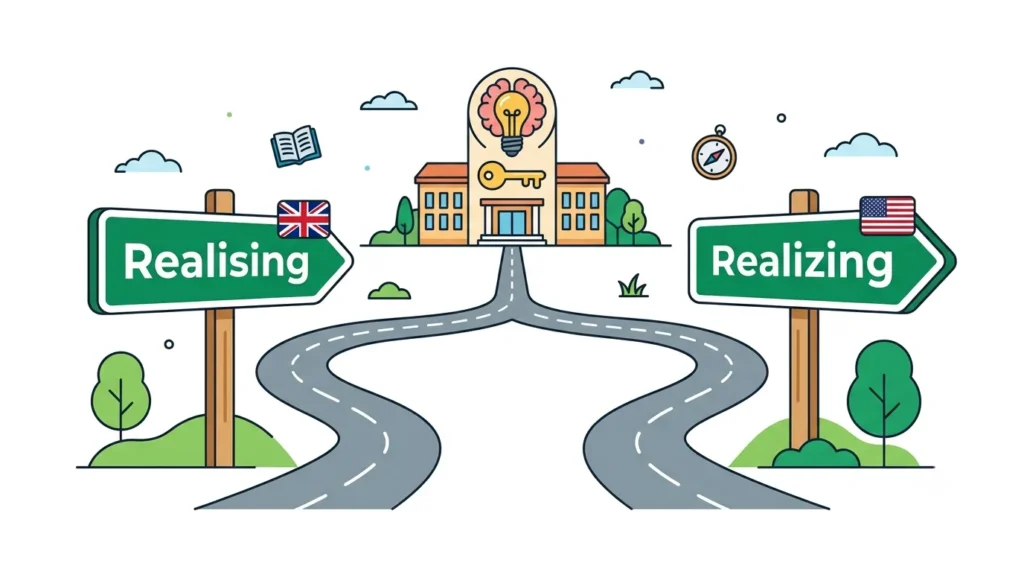
Both realising and realizing are correct spellings of the same verb, which means to become aware of something, to understand something clearly, or to make something happen.
The only difference is the variety of English you use.
- Realising → British English
- Realizing → American English
Simple examples
- She was realising that she had forgotten her keys. (British English)
- He was realizing how important the meeting was. (American English)
The meaning stays exactly the same.
What Does “Realizing” Mean?
Realizing meaning is becoming aware of something, understanding something clearly, or making something happen. Realizing (or realising) is the present participle / gerund form of the verb realize (or realise). It has two main meanings:
- Becoming aware of something
“I’m realizing that I left my phone at home.” - Achieving or making something happen
“The company is realizing its goals faster than expected.”
As a Verb
Realizing functions as a verb form used in continuous tenses:
- Present continuous: I am realizing…
- Past continuous: She was realizing…
- Present perfect continuous: They have been realizing…
As an Adjective (less common)
In some contexts, realizing can describe a moment of understanding, as in
“a realizing moment”. though this usage is rare compared to its verb form.
The Origin and Background of Realising or Realizing
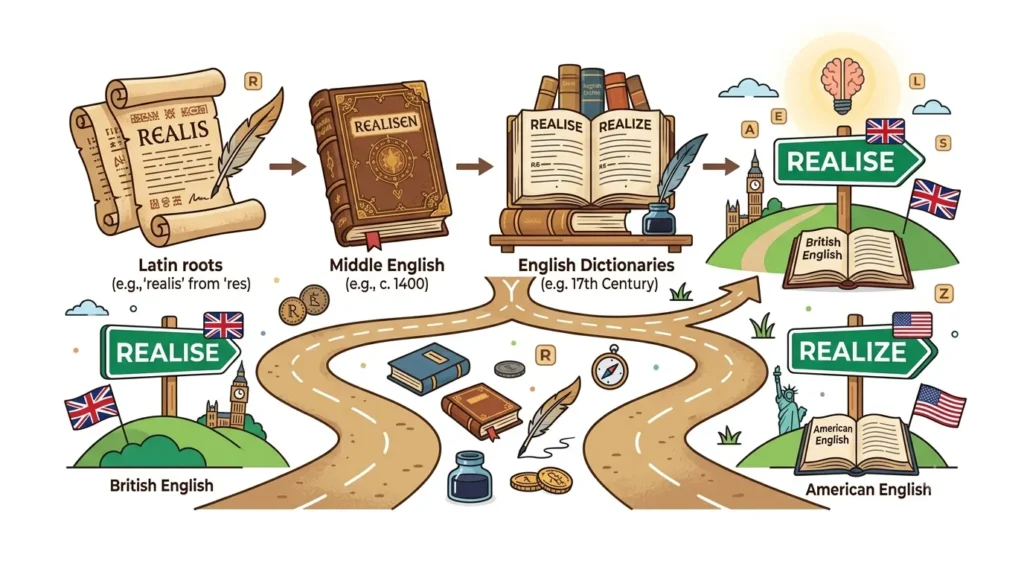
The word realize comes from the word real, which has roots in the Latin word realis, meaning “actual” or “true.”
Over time, English developed different spelling styles in different parts of the world.
In the United States, spelling became more standardized during the 1800s. Many words were simplified to create a consistent writing style. As a result, spellings ending in -ize became common.
In the United Kingdom, many publishers and schools continued using -ise spellings. Today, realising appears in most British schools, newspapers, and everyday writing.
There is one interesting detail.
Many people believe -ize is only American. That is not completely true.
Some British publishers, universities, and dictionaries also accept -ize as a correct British spelling because it follows the word’s Greek origin. However, -ise remains much more common in everyday British English.
This is why you may sometimes see both spellings in British publications.
Realising or Realizing Explained: Key Differences
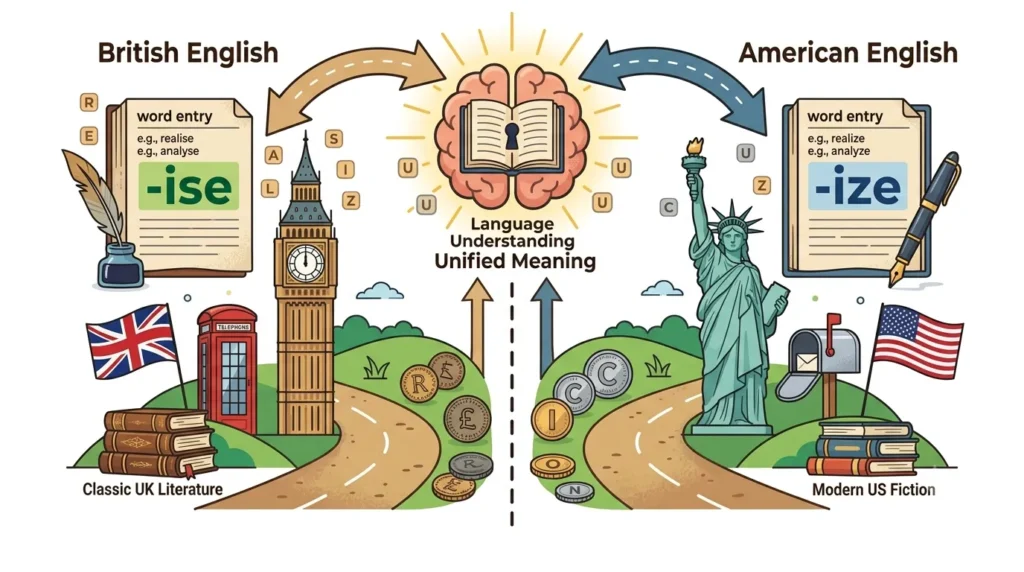
The biggest difference is not the meaning. It is the audience.
The same spelling difference appears in the noun forms realisation or realization. If you’re comparing realisation vs realization, realisation is commonly used in British English, while realization is standard in American English. Both have the same meaning.
If your readers are in the United States, they expect realizing.
If your readers are in the United Kingdom, Australia, New Zealand, or many Commonwealth countries, they usually expect realising.
Comparison Table
| Term | Meaning | When to Use | Region/Context |
| Realising | Becoming aware or understanding | British writing | UK, Australia, New Zealand, many Commonwealth countries |
| Realizing | Becoming aware or understanding | American writing | United States |
| Realize | Base verb | American English | USA |
| Realise | Base verb | British English | UK and Commonwealth |
Example 1
British English
“I am realising that practice makes a big difference.”
Example 2
American English
“I am realizing that practice makes a big difference.”
Notice that the meaning does not change.
Only the spelling changes.
Why does this confuse people?
Many English learners study from websites, videos, and books from different countries.
For example:
- Your grammar book may use realising.
- Your favorite YouTube teacher may write realizing.
- Microsoft Word may suggest one spelling.
- Your phone keyboard may suggest another.
Seeing both versions makes many people think one must be wrong.
In reality, both are accepted. You simply need to stay consistent.
Which Version Should You Use?
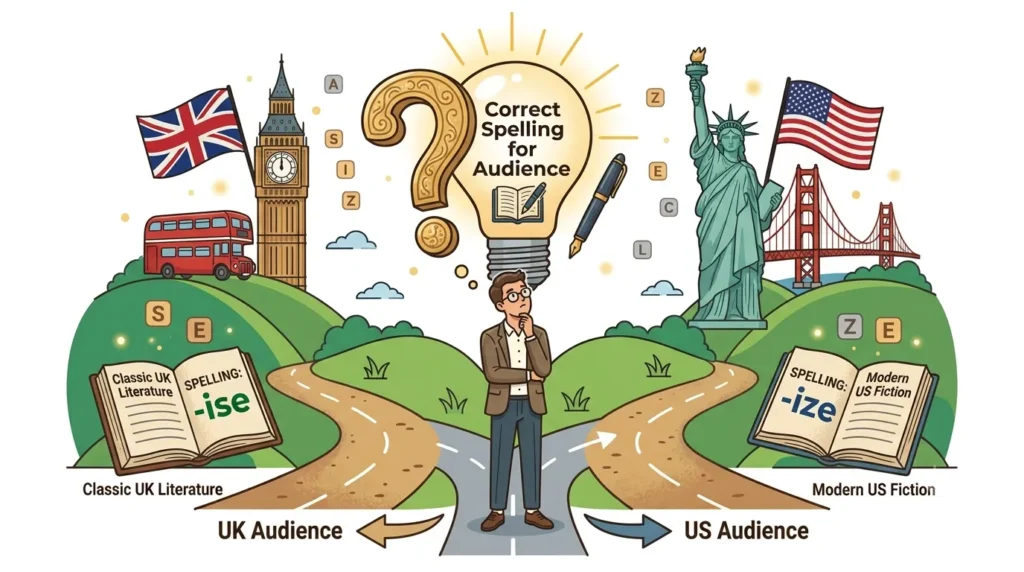
The best spelling depends on who will read your writing.
For students in the United States
Use realizing.
Schools, colleges, exams, and American textbooks almost always prefer the -ize spelling.
For students in the United Kingdom
Use realising.
British schools and many exam boards expect the -ise spelling.
For business professionals
Match your client’s style.
If you’re writing for an American company, use realizing.
If you’re writing for a British company, use realising.
Consistency makes your writing look polished and professional.
For bloggers and website owners
Think about your audience before publishing.
If most of your visitors come from the United States, use realizing throughout your article.
If your audience is mainly British, Australian, or from other Commonwealth countries, choose realising.
Changing between both spellings on the same page can look careless and may confuse readers.
For international writing
Either spelling is acceptable.
However, choose one version and use it from beginning to end.
Readers care more about consistency than about which regional spelling you choose.
Quick recommendation
- American audience → Realizing
- British audience → Realising
- Global audience → Choose one style and stay consistent.
That simple rule will solve almost every spelling question about this word.
Common Mistakes with Realising or Realizing
Even though both spellings are correct, writers often make a few simple mistakes. Here are the most common ones.
One common spelling mistake is realsing, which is incorrect. The correct spelling is realising in British English or realizing in American English.
| Mistake | Correct Form | Why It Happens |
| Mixing realising and realizing in one article | Choose one spelling and use it throughout | Writers switch between British and American English without noticing. |
| Using realising for an American school assignment | Use realizing | American English prefers -ize spellings. |
| Using realizing in writing that follows British style guidelines | Use realising if required | Many British schools and publishers prefer -ise. |
| Thinking one spelling is wrong | Both are correct | The difference is regional, not grammatical. |
| Letting spell check change your chosen style | Set your language preference first | Your writing software follows its selected language. |
Tips to avoid mistakes
- Pick British or American English before you start writing.
- Check your document settings.
- Keep the same spelling from beginning to end.
- Follow your teacher’s, editor’s, or client’s style guide.
Synonyms for Realizing / Realising
If you want alternative words with a similar meaning, consider:
- Recognizing / Recognising
- Understanding
- Grasping
- Becoming aware of
- Comprehending
- Discovering
Example: “She was realizing (recognizing) the mistake too late.”
Realising or Realizing in Real World Examples
Seeing the word in context makes it easier to remember.
Professional email
“After realizing the deadline had changed, I updated the project schedule immediately.”
(American English)
News headline
“Scientists Are Realising the Importance of Ocean Conservation.”
(British English)
Social media post
“I’m finally realizing how much daily reading improves my writing!”
(American English)
Formal report
“The company is realising significant improvements in customer satisfaction after introducing the new support system.”
(British English)
These examples show that the spelling changes, but the meaning stays the same.
Realising or Realizing: Data, Trends & Usage
The keyword realising or realizing is searched mostly by:
- English learners
- Students
- Teachers
- Content writers
- Bloggers
- Editors
- Business professionals
Search intent
Primary intent: Informational
People want to know:
- Which spelling is correct.
- Whether one version is wrong.
- Which spelling they should use.
- How the word is used in real writing.
Regional interest
Generally:
- Realizing is searched more often in the United States.
- Realising receives more searches in the United Kingdom, Australia, New Zealand, and other Commonwealth countries.
Why this matters today
More people write for international audiences than ever before.
A blog may be read in London, New York, Sydney, and Toronto on the same day. Understanding regional spelling helps writers appear more professional and build trust with readers.
Realising or Realizing: Comparison Table
| Term/Variant | Meaning | Region/Context | Best Used When |
| Realising | Becoming aware or understanding something | British English | Writing for UK or Commonwealth readers |
| Realizing | Becoming aware or understanding something | American English | Writing for US readers |
| Realise | Base verb | British English | British spelling style |
| Realize | Base verb | American English | American spelling style |
Frequently Asked Questions
Q: What does realising or realizing mean?
A: Both words mean becoming aware of something, understanding something clearly, or making something happen. The meaning never changes. Only the spelling differs by region.
Q: What is the spelling of realising?
A: The correct spelling is realising in British English. American English usually uses realizing with a “z”. Both spellings are correct and have the same meaning.
Q: How do you spell realizing?
A: The correct spelling is realizing in American English. It is spelled with a “z” before the ending “-ing”.
Q: How do you use realising or realizing correctly?
A: Use realising if you are writing in British English. Use realizing if you are writing in American English. Stay consistent throughout your document.
Q: Realising vs. realizing: what’s the difference?
A: There is no difference in meaning or grammar. The only difference is regional spelling. British English usually prefers realising, while American English uses realizing.
Q: Is realization or realisation the correct spelling?
A: Both realization or realisation are correct spellings. Realization is the standard spelling in American English, while realisation is commonly used in British English. The meaning is the same; only the regional spelling differs.
Q: What is the difference between realizing or realising?
A: Realizing or realising have the same meaning and are both correct spellings. Realizing is standard in American English, while realising is commonly used in British English. The choice depends on which variety of English you are following.
Q: Is realising or realizing acceptable in formal writing?
A: Yes. Both spellings are correct in formal writing. Choose the version that matches your organization’s, school’s, or publisher’s preferred style.
Q: Which version is correct: realising or realizing?
A: Both are correct. The right choice depends on your audience and the variety of English you are using.
Q: Where does the word come from?
A: The word comes from real, which traces back to the Latin word realis, meaning “actual” or “true.” Over time, British and American English developed different spelling preferences.
Q: Can I use realising or realizing in business writing?
A: Absolutely. Match the spelling to your audience. Use realizing for American clients and realising for British or Commonwealth clients.
Conclusion
Choosing between realising and realizing is much easier once you know the rule. Both spellings are correct. Neither is better than the other. The difference comes down to the type of English you are using.
Remember these key points:
- Realising is the preferred spelling in British English.
- Realizing is the standard spelling in American English.
- The meaning stays exactly the same.
- Consistency is more important than the spelling you choose.
Whether you’re writing an essay, an email, a blog post, or a business report, matching your spelling to your audience helps your writing look polished and professional.
Now you know exactly how to use realising or realizing with confidence. Bookmark this guide so you never second-guess the spelling again, and share it with someone who has been confused by these two versions.
Read more: Authorised or Authorized? UK vs. US

I studied English literature and have spent years editing content for blogs and digital platforms. I noticed most people struggle with choosing between two similar words. At WordsCombo, I make that choice simple and clear.







1 thought on “Realising or Realizing: Which Is Correct?”