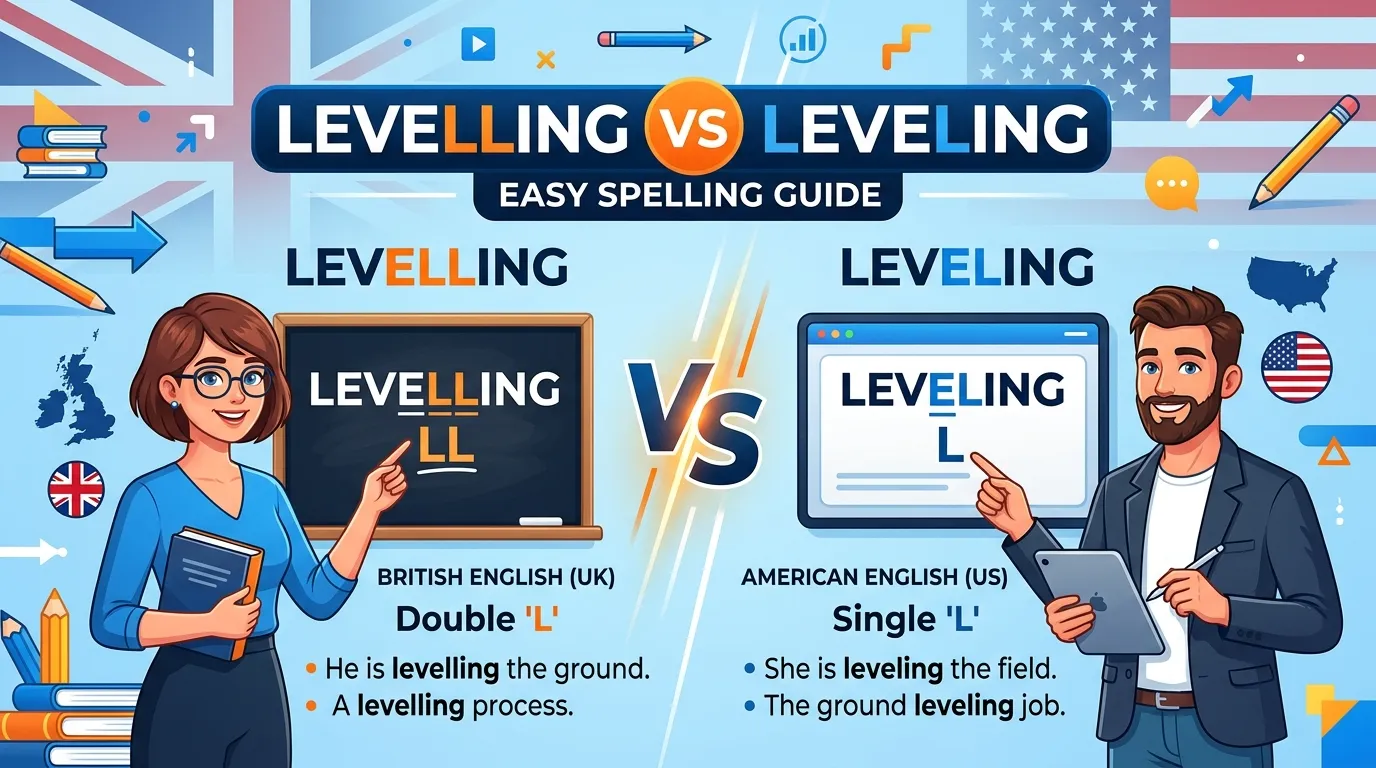
Levelling and leveling mean the exact same thing: making something flat or equal. Levelling is the British spelling, while leveling is the American spelling.
I still remember my first job as a editor ten years ago. I spent twenty minutes fixing the word levelling in a document. My manager looked at my edits and laughed. She told me both spellings were right. I felt silly, but I learned a big lesson that day.
Spelling differences across the ocean confuse millions of writers every single day. You see two words that look almost identical. You wonder if one is wrong. You worry about making a typo in a big email.
This guide will end your confusion forever. You will learn which spelling fits your writing. You will see real examples you can use right away.
Levelling or Leveling : Quick Answer
Both words come from the base word level. They mean making something flat, smooth, or equal. The only real difference is where you live or who you write for.
- Levelling (with two Ls) is the preferred spelling in British English.
- Leveling (with one L) is the preferred spelling in American English.
Here are two quick examples:
- UK: The workers are levelling the ground for the new park.
- US: The workers are leveling the ground for the new park.
The Origin and History of Leveling
The word level comes from the Old French word level, which came from Latin. It meant a balance scale. People used it to check if surfaces were flat.
So why do we have two spellings today? We can thank Noah Webster for this split. In the early 1800s, Webster wanted American English to be simpler. He decided to drop extra letters from many words.
He made a simple rule for American writers. If the stress is not on the last syllable, do not double the consonant. In the word level, the stress is on the first part (LEV-el). So, Americans dropped the second L.
British English kept the older style. They kept the double L when adding suffixes like -ing or -ed. That is why the UK still uses levelling today.
Levelling vs Leveling Explained : Key Differences
The meaning never changes when you swap these words. The context and audience determine the right choice.
Here is how the two spellings compare side by side:
| Term | Meaning | When to Use | Region/Context |
|---|---|---|---|
| Levelling | Making flat or equal | Writing for British or global readers | UK, Australia, Canada, New Zealand |
| Leveling | Making flat or equal | Writing for American readers | United States |
Let us look at a few clear examples:
- Gaming: He is leveling up his character. (US style is common in video games)
- Construction: They are levelling the concrete floor today. (UK style)
- Video Editing: I am leveling the audio tracks now. (US style)
Which Version Should You Use?
Choosing the right word depends on your target audience. You want your text to look natural to your readers.
- For American Audiences: Use leveling. American readers expect a single L. Using two Ls might look like a typo to them.
- For British and Commonwealth Audiences: Use levelling. Readers in the UK, Australia, and New Zealand expect two Ls.
- For Canadian Audiences: Canada often accepts both styles. However, levelling with two Ls is more common in formal writing.
- For Global Audiences: Pick one style and stick with it. Consistency is the most important rule in professional writing.
Common Mistakes with Levelling and Leveling
Writers often make small errors when using these terms. Here are four common mistakes and how to fix them.
1. Mixing Styles in the Same Document
- Mistake: We are leveling the field and levelling the building.
- Correction: We are leveling the field and leveling the building.
- Why it happens: People switch between American and British spellings without noticing.
2. Thinking One Version Is Grammatically Wrong
- Mistake: Saying that levelling is incorrect English.
- Correction: Both spellings are 100% correct in their own regions.
- Why it happens: Spellcheck tools set to US English flag British words as errors.
3. Adding Wrong Double Letters in Other Forms
- Mistake: The ground is levelled (in American style).
- Correction: The ground is leveled (US) or levelled (UK).
- Why it happens: People apply UK rules to past tense words while using US rules for present tense words.
4. Forgetting Style Guide Rules
- Mistake: Using levelling when your company follows AP Style.
- Correction: AP Style follows American rules, so use leveling.
- Why it happens: Writers forget to check their official style manual.
Real-World Examples
Seeing these words in action helps you pick the right one. Here is how both forms appear in everyday writing.
Professional Email (US Style)
Hi Team,
We are leveling the workload across all departments this week. Please send your task lists by 3 PM.
Thanks,
Sarah
News Headline (UK Style)
The Guardian: Council Begins Levelling Site for New Community Centre
Social Media Post (Gaming – US Style)
Spent four hours leveling my mage in the new update! What level are you all at now? #gaming
Formal Report (UK Style)
This policy aims at levelling the playing field for small businesses across the region.
Data, Trends, and Usage
Search data shows that people look up this topic thousands of times every month. Most searches come from students, writers, and non-native English speakers.
- Search Intent: Informational. Readers want a fast answer so they can get back to writing.
- Top Regions for “Leveling”: United States, Philippines, and South Korea.
- Top Regions for “Levelling”: United Kingdom, Australia, India, and New Zealand.
The gaming industry made leveling popular across the world. Video game menus almost always use the single L spelling. Because of this, younger readers around the world see the American spelling more often.
| Term/Variant | Meaning | Region/Context | Best Used When |
|---|---|---|---|
| Leveling | To flatten; to make equal; to advance | United States | Writing US blogs, tech docs, or gaming content |
| Levelling | To flatten; to make equal; to advance | UK and Commonwealth | Writing UK articles, academic papers, or books |
| Leveled | Past tense of level | United States | Describing past actions for American readers |
| Levelled | Past tense of level | UK and Commonwealth | Describing past actions for British readers |
Frequently Asked Questions
Q: What does leveling mean?
A: It means making a surface flat or bringing things to an equal level. It can also mean moving up stages in a video game.
Q: How do you spell leveling correctly?
A: Both leveling and levelling are correct. Use one L for American English and two Ls for British English.
Q: Is it leveling up or levelling up?
A: Both are correct. Gamer culture usually uses leveling up because most major game studios use American English.
Q: Is levelling acceptable in formal writing?
A: Yes, levelling is completely acceptable in formal writing. Just make sure your audience uses British English.
Q: Which version is correct in Canada: levelling or leveling?
A: Canada accepts both forms. However, Canadian style guides generally prefer levelling with two Ls.
Q: Why does my spellcheck mark levelling as wrong?
A: Your software language is likely set to English (United States). Change your dictionary setting to English (UK) to fix it.
Q: Can you use leveling for audio and video editing?
A: Yes, balancing sound volume or video colors is often called leveling the tracks.
Master Your Spelling Choice
Spelling rules do not need to be hard or scary. You now know that levelling and leveling share the exact same meaning. The only real difference comes down to regional style.
Remember the main rule for your writing. Use leveling with one L for US readers. Use levelling with two Ls for UK and global readers. Most importantly, stay consistent throughout your entire piece.
Now you know exactly how to use these words without guessing. Bookmark this guide so you never second-guess your spelling choice again.
Related words: Instill or Instil: The Complete Guide to the Correct Spelling

I studied English literature and have spent years editing content for blogs and digital platforms. I noticed most people struggle with choosing between two similar words. At WordsCombo, I make that choice simple and clear.