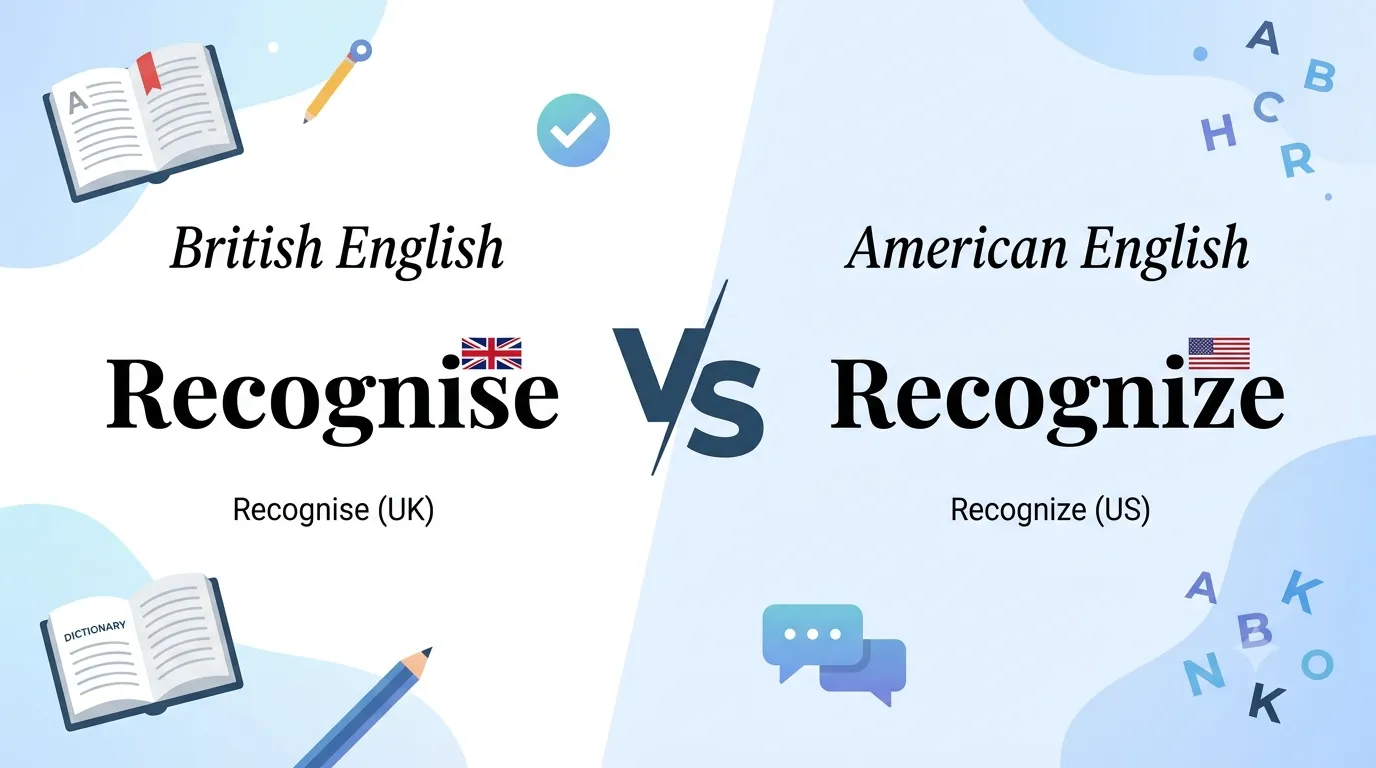
Recognise and recognize mean exactly the same thing. The only difference is spelling. Recognize is the standard form in American English, while recognise is commonly used in British English and many other English-speaking countries.
A few years ago, I was editing an article for an international client. Everything looked perfect until they left one simple comment: “Please change all instances of ‘recognise’ to ‘recognize.'” At first, I thought I had made a spelling mistake. Then I realized the issue wasn’t correctness—it was regional spelling.
If you’ve ever paused while writing because you weren’t sure whether to use recognise or recognize, you’re not alone. Students, writers, bloggers, business professionals, and even native English speakers ask this question every day.
The confusion comes from the fact that both spellings are correct. The right choice depends on the type of English you’re using and who your audience is.
In this guide, you’ll learn the difference between recognise and recognize, where each spelling comes from, when to use each one, common mistakes to avoid, and plenty of real-world examples. By the end, you’ll never have to second-guess this word again.
Recognise or Recognize: Quick Answer
The words recognise and recognize have the same meaning.
They both mean:
- To identify someone or something.
- To accept or acknowledge something as true.
- To officially approve or acknowledge someone or something.
The only difference is regional spelling.
Examples
- I recognize her from school. (American English)
- I recognise her from school. (British English)
Both sentences are completely correct.
The Origin and Background of Recognise or Recognize
The word comes from the Latin word recognoscere, meaning “to know again.”
It later entered English through Old French before becoming part of modern English.
Here’s where the spelling difference began.
For centuries, many English words ending in -ize were also written with -ise.
Later:
- American English largely kept the -ize ending.
- British English accepted both forms, although -ise became more common in everyday British publishing.
Interestingly, the famous Oxford University Press still prefers recognize with -ize, even in British English. This surprises many people because they assume -ize is only American.
That means:
- Recognize is correct in American English.
- Recognize is also acceptable in British English.
- Recognise is mainly preferred by British publishers, schools, newspapers, and government organizations.
Recognise or Recognize Explained
Although the spelling changes, the meaning never changes.
| Term | Meaning | When to Use | Region/Context |
|---|---|---|---|
| Recognize | Identify or acknowledge | American writing, international business, Oxford style | United States, international audiences |
| Recognise | Identify or acknowledge | British writing and publications | UK, Australia, New Zealand, South Africa |
Example 1
American English:
I recognize your hard work.
British English:
I recognise your hard work.
Example 2
American:
The software can recognize faces.
British:
The software can recognise faces.
Nothing changes except the spelling.
Which Version Should You Use?
The best spelling depends on your audience.
If you’re writing for American readers
Use recognize.
Examples include:
- US universities
- American companies
- Most US websites
- American newspapers
If you’re writing for British readers
Use recognise unless your style guide recommends -ize.
Examples include:
- UK schools
- British newspapers
- Government documents
- Local businesses
If you’re writing for an international audience
Choose recognize.
Why?
Many international organizations and dictionaries accept recognize, and it often reaches the widest audience.
The most important rule is simple:
Stay consistent.
Don’t switch between recognise and recognize in the same document.
Common Mistakes with Recognise or Recognize
Here are mistakes people often make.
| Mistake | Correct Version | Why It Happens |
|---|---|---|
| Mixing recognise and recognize in one article | Pick one spelling | Lack of consistency |
| Thinking recognise is wrong | It is correct in British English | Regional confusion |
| Thinking recognize is only American | It’s also accepted by Oxford | Misunderstanding British usage |
| Changing spellings halfway through editing | Keep one style throughout | Multiple editors |
| Using different spellings for SEO randomly | Match your target audience | Keyword confusion |
Remember
Choose one spelling.
Use it consistently.
Your writing will look much more professional.
Recognise or Recognize in Real-World Examples
Professional Email
We would like to recognise your outstanding contribution to the project.
American version:
We would like to recognize your outstanding contribution to the project.
News Headline
Scientists recognize a new species in the Amazon.
British newspaper:
Scientists recognise a new species in the Amazon.
Social Media Post
We recognize every volunteer who helped today.
British version:
We recognise every volunteer who helped today.
Formal Report
The committee recognizes the need for additional funding.
British report:
The committee recognises the need for additional funding.
Recognise or Recognize: Data, Trends & Usage
The search term “recognise or recognize” is popular because millions of English learners write for audiences in different countries.
Most interested audiences
- Students
- Bloggers
- Copywriters
- SEO professionals
- Business writers
- Academic researchers
Regions where the question is common
- United Kingdom
- United States
- Australia
- Canada
- India
- Pakistan
- New Zealand
Search Intent
Informational
People simply want to know which spelling is correct.
Why it matters today
More businesses now publish content for global audiences. Choosing the right spelling helps build trust, improves consistency, and meets the expectations of readers in different regions.
Quick Comparison Table
| Term/Variant | Meaning | Region/Context | Best Used When |
|---|---|---|---|
| Recognize | Identify or acknowledge | American English, Oxford style | Writing for US or global audiences |
| Recognise | Identify or acknowledge | British English | Writing for UK, Australia, or similar regions |
Tips to Remember the Difference
Use these simple tricks.
- Z = United States.
- S = Britain and many Commonwealth countries.
- Both words mean exactly the same thing.
- Never mix them in one document.
- Follow your company’s style guide if one exists.
Similar Words with the Same Difference
Recognise and recognize are not the only words with this spelling pattern.
| British | American |
|---|---|
| organise | organize |
| realise | realize |
| apologise | apologize |
| emphasise | emphasize |
| summarise | summarize |
The same regional rule applies.
FAQs
Q: What does recognise or recognize mean?
Both words mean to identify, acknowledge, or officially accept someone or something. The meaning is identical.
Q: How do you use recognize correctly?
Use recognize when writing in American English or when following a style guide that prefers -ize spellings.
Q: How do you use recognise correctly?
Use recognise when writing for British audiences or publications that prefer -ise spellings.
Q: Recognise vs recognize: what’s the difference?
Only the spelling differs. The pronunciation and meaning stay exactly the same.
Q: Is recognize acceptable in formal writing?
Yes. It is completely acceptable in formal writing, academic work, business communication, and professional publications.
Q: Which version is correct: recognise or recognize?
Both are correct. The best choice depends on whether you’re using British English or American English.
Q: Can I use recognize in the UK?
Yes. Many British publishers, especially Oxford University Press, use recognize, although recognise is more common in everyday British writing.
Conclusion
The debate over recognise or recognize isn’t really about right versus wrong. It’s about choosing the spelling that matches your audience.
Here are the key points to remember:
- Recognize is the standard American spelling.
- Recognise is the common British spelling.
- Both words have the same meaning and pronunciation.
- Consistency matters more than the spelling you choose.
- Always follow the style guide of your school, employer, client, or publication.
Once you understand this simple regional difference, you’ll write with greater confidence and avoid one of the most common English spelling questions.
Now you know exactly how to use recognise or recognize. Bookmark this guide so you never second-guess the spelling again, and share it with anyone who still wonders which version is correct.

I studied English literature and have spent years editing content for blogs and digital platforms. I noticed most people struggle with choosing between two similar words. At WordsCombo, I make that choice simple and clear.