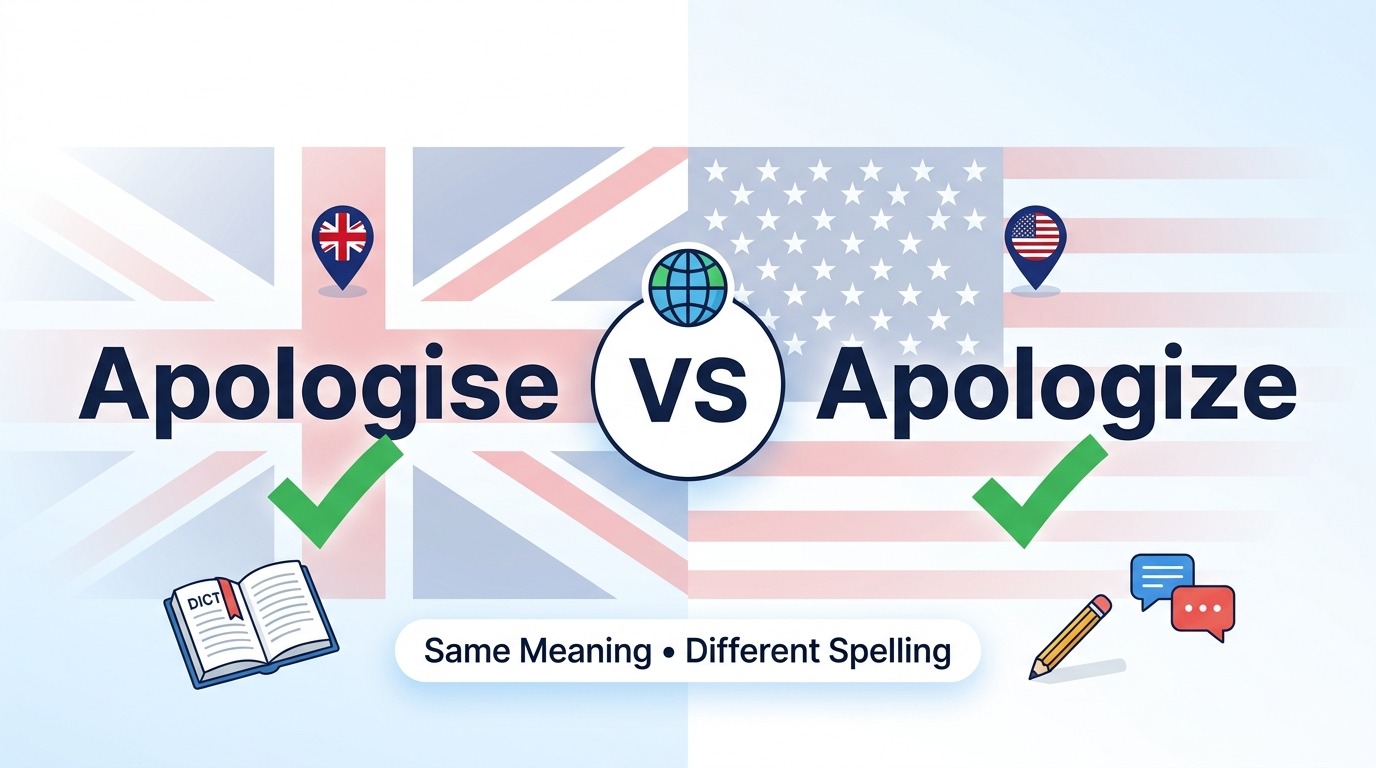
Apologise and apologize mean exactly the same thing. The only difference is spelling. Apologise is the standard spelling in British English, while apologize is the standard spelling in American English.
I still remember editing one of my first blog posts for an international client. I had carefully checked every sentence, but the editor left one simple comment: “Please change apologise to apologize throughout the article.” At first, I thought I had made a spelling mistake. After a little research, I discovered something surprising. Both spellings were correct. The only difference was the type of English the client used.
That small lesson has stayed with me ever since. Today, I see the same question asked by students, writers, bloggers, and professionals. Should you write apologise or apologize? Which one is correct? Will one make your writing look wrong?
The good news is that the answer is much simpler than most people expect. Once you understand why these two spellings exist, you’ll never second-guess yourself again.
In this guide, you’ll learn the difference between apologise and apologize, where each spelling is used, their history, and how to choose the right one for your audience.
Apologise or Apologize: Quick Answer
Both apologise and apologize are correct spellings of the same verb. They both mean to say sorry for something you did or said.
The only difference is the regional spelling.
- Apologise → British English
- Apologize → American English
Examples
✅ I want to apologise for being late. (British English)
✅ I want to apologize for being late. (American English)
The meaning never changes. Only the spelling does.
The Origin and Background of Apologise or Apologize
The word comes from the Greek word apologia, meaning a speech made in defense. Over time, its meaning changed from defending yourself to expressing regret for a mistake.
Later, the word entered Latin and then French before becoming part of English.
Many English words developed two accepted spellings because British and American English evolved differently.
In the late 1700s and early 1800s, American dictionary writer Noah Webster promoted simpler and more consistent spellings. His dictionaries encouraged many -ize spellings.
Meanwhile, British English kept many traditional spellings, including -ise forms.
That is why today you see:
- organise / organize
- realise / realize
- recognise / recognize
- apologise / apologize
Interestingly, many people believe -ize is only American English. That is not completely true.
Some respected British publishers, including Oxford University Press, also prefer -ize spellings. However, most British schools, newspapers, and businesses still use -ise.
This is one reason the topic often causes confusion.
Apologise or Apologize Explained: Key Differences
There is no difference in meaning, pronunciation, or grammar.
The only real difference is where each spelling is preferred.
| Term | Meaning | When to Use | Region/Context |
|---|---|---|---|
| Apologise | To say sorry | British writing | UK, Australia, New Zealand, South Africa |
| Apologize | To say sorry | American writing | United States, most American publications |
Pronunciation
Both words are pronounced exactly the same:
uh-POL-uh-jize
Notice that even apologise ends with a “z” sound when spoken.
Example 1
British English:
I would like to apologise for the misunderstanding.
American English:
I would like to apologize for the misunderstanding.
Example 2
British:
She apologised after the meeting.
American:
She apologized after the meeting.
Again, only the spelling changes.
Which Version Should You Use?
Choosing the correct spelling depends entirely on who will read your writing.
If you write for a British audience
Use apologise.
This includes:
- UK schools
- British newspapers
- UK businesses
- Australian readers
- New Zealand readers
Example:
We sincerely apologise for the delay.
If you write for an American audience
Use apologize.
This includes:
- American universities
- US companies
- American blogs
- US newspapers
Example:
We sincerely apologize for the delay.
If you’re writing for an international audience
Either spelling is acceptable.
The most important rule is consistency.
Don’t write:
❌ We apologise for the delay. We also apologize for the inconvenience.
Choose one spelling and use it throughout your document.
Quick recommendations
- Students in the UK → Use apologise
- Students in the US → Use apologize
- SEO writers → Match your target country’s spelling
- Businesses → Follow your company style guide
- Global brands → Stay consistent with one version
Common Mistakes with Apologise or Apologize
Even though the spelling difference is simple, people still make a few common mistakes. Here are the ones you should avoid.
| Mistake | Correct Version | Why It Happens |
|---|---|---|
| I apologise to my American teacher. | I apologize to my American teacher. | The audience uses American English. |
| We apologize for the delay. (British company website) | We apologise for the delay. | The spelling should match British English. |
| Mixing apologise and apologize in one document. | Choose one spelling and stay consistent. | Writers switch between English styles. |
| Apology and apologise are interchangeable. | Apology is a noun. Apologise/Apologize is a verb. | People confuse word forms. |
| Using sorry in formal writing instead of apologise/apologize. | Use apologise/apologize for professional communication. | “Sorry” can sound too casual. |
Tips to Avoid These Mistakes
- Know your audience before you start writing.
- Pick one English style and use it throughout.
- Proofread for consistency before publishing.
- Follow your organization’s style guide if one exists.
Apologise or Apologize in Real-World Examples
Seeing the words in context makes the difference much easier to remember.
Professional Email
British English
We sincerely apologise for the delay in processing your request. We appreciate your patience.
American English
We sincerely apologize for the delay in processing your request. Thank you for your understanding.
News Headline
British Publication
Airline Apologises After Flight Delay
American Publication
Airline Apologizes for Major Flight Delay
Social Media Post
British:
We apologise for today’s service interruption. Everything is back to normal now.
American:
We apologize for today’s outage. Thanks for sticking with us.
Formal Report
British:
The company wishes to apologise for any inconvenience caused during maintenance.
American:
The company wishes to apologize for any inconvenience caused during scheduled maintenance.
Customer Service
British:
We apologise for the inconvenience and are working to resolve the issue quickly.
American:
We apologize for the inconvenience and appreciate your patience.
Apologise or Apologize: Data, Trends & Usage
The confusion around these spellings continues because English is used worldwide.
Where is each spelling most common?
- Apologise
- United Kingdom
- Australia
- New Zealand
- South Africa
- Ireland
- Apologize
- United States
- American businesses
- US universities
- Most American media outlets
Who searches this topic?
People searching “apologise or apologize” are often:
- Students
- English learners
- Bloggers
- Copywriters
- Editors
- Business professionals
- Content marketers
Search Intent
The search intent is mainly informational.
Readers want to know:
- Which spelling is correct.
- Whether one is wrong.
- Which version they should use.
- Whether the spellings have different meanings.
Why This Matters Today
More people write for international audiences than ever before. A blog may be read in London, New York, Sydney, and Toronto on the same day. Choosing the right spelling helps your writing feel natural and professional to your readers.
Standalone Comparison Table
| Term/Variant | Meaning | Region/Context | Best Used When |
|---|---|---|---|
| Apologise | To express regret or say sorry | British English | Writing for UK, Australia, New Zealand, and other British English audiences |
| Apologize | To express regret or say sorry | American English | Writing for the United States or American readers |
| Apology | A statement expressing regret | All English varieties | Referring to the noun rather than the action |
| Sorry | Informal expression of regret | Everyday speech | Casual conversations and personal messages |
Frequently Asked Questions
Q: What does “apologise or apologize” mean?
A: Both words mean to say sorry or express regret for something you have done. The meaning is identical. Only the spelling changes based on the variety of English you use.
Q: How do you use apologise or apologize correctly?
A: Choose the spelling that matches your audience. Use apologise for British English and apologize for American English. Stay consistent throughout your writing.
Q: Apologise vs. apologize: what’s the difference?
A: There is no difference in meaning, pronunciation, or grammar. The only difference is regional spelling. British English usually prefers apologise, while American English prefers apologize.
Q: Is apologise or apologize acceptable in formal writing?
A: Yes. Both spellings are fully acceptable in formal writing. The important thing is to match the English style expected by your audience or organization.
Q: Which version is correct: apologise or apologize?
A: Both are correct. Apologise is standard in British English, and apologize is standard in American English. Neither spelling is more correct than the other.
Q: Where does the word come from?
A: The word comes from the Greek apologia, which originally meant a speech in defense. Over time, its meaning shifted to expressing regret or asking forgiveness.
Q: Can apologise or apologize be used in business communication?
A: Absolutely. Both spellings are common in professional emails, customer support messages, reports, and official announcements. Just use the version that matches your audience.
Conclusion
The debate over apologise or apologize is much simpler than it first appears. Both spellings are correct. Both mean to express regret or say sorry. The only real difference is the variety of English you choose to write.
Remember these key points:
- Apologise is the preferred spelling in British English.
- Apologize is the preferred spelling in American English.
- The meaning and pronunciation are exactly the same.
- The most important rule is consistency. Pick one style and use it throughout your writing.
Whether you’re writing a school essay, a business email, a blog post, or a social media update, matching your spelling to your audience makes your writing look polished and professional.
Now you know exactly when to use apologise and apologize. Bookmark this guide so you never second-guess the spelling again, and share it with anyone who has ever wondered which version is correct.

I studied English literature and have spent years editing content for blogs and digital platforms. I noticed most people struggle with choosing between two similar words. At WordsCombo, I make that choice simple and clear.