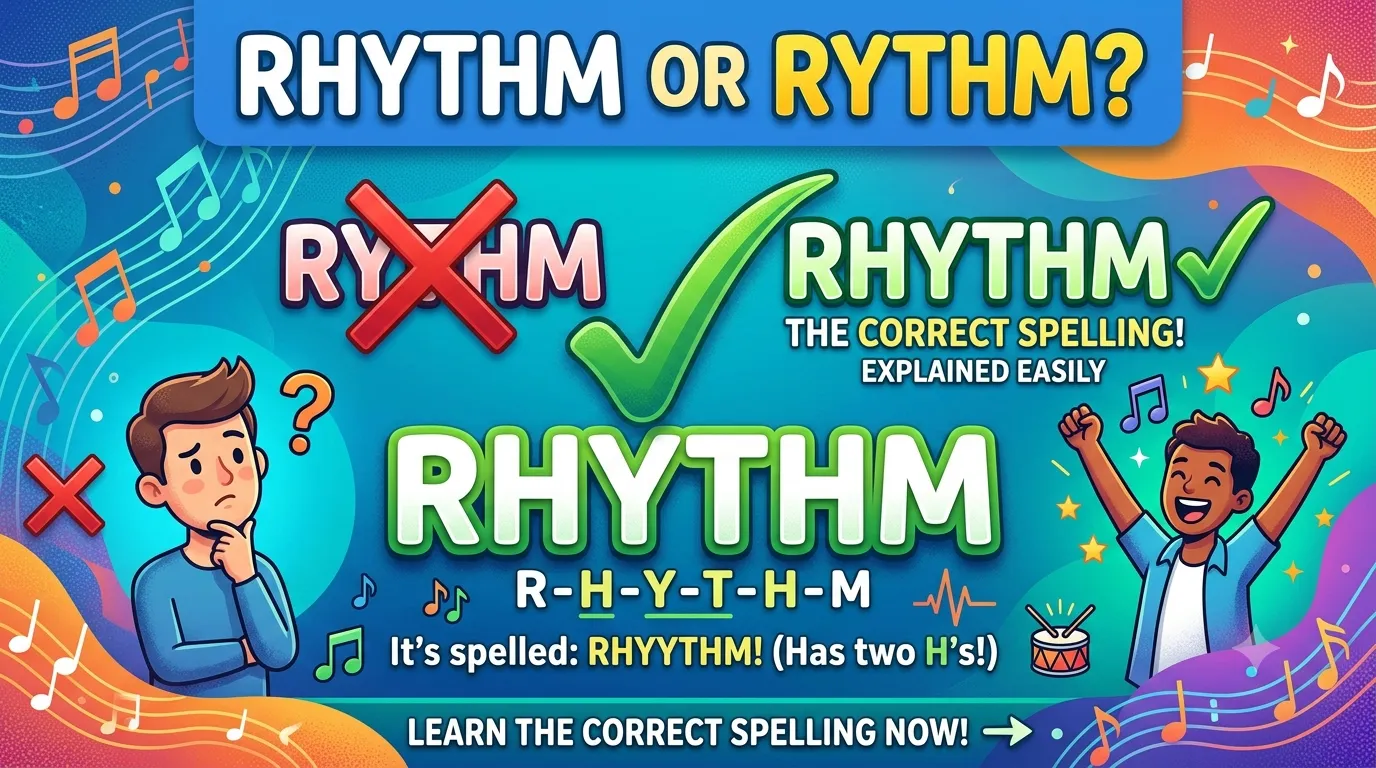
Rhythm is the correct spelling. It means a repeated pattern of beats, sounds, movements, or events. Rythm is a common spelling mistake and is not accepted in standard English.
Have you ever written a word, looked at it twice, and wondered if something feels wrong? Rhythm is one of those English words that makes many people stop and think. The letters do not follow the usual spelling patterns, and many learners accidentally write “rythm” instead.
I remember helping a student prepare a music assignment where the word appeared several times. The student understood the meaning perfectly but kept removing the second “h” because the spelling looked unusual. This small mistake is common because English has many words that do not sound the way they are written.
The confusion around rhythm or rythm comes from pronunciation, spelling habits, and the silent letters inside the word. Many people search for the correct spelling because they want their writing, essays, emails, or creative work to look professional.
This guide will explain the difference between rhythm and rythm, where the word came from, how to use it correctly, common mistakes, and real examples you can remember easily.
Let’s discover why one tiny letter changes everything.
Rhythm or Rythm : Quick Answer
The correct spelling is rhythm.
Rhythm describes a pattern of beats, sounds, movements, or repeated events. It is commonly used in music, poetry, dance, sports, and everyday life.
Examples:
- “The drummer kept a steady rhythm during the song.”
- “Everyone has their own daily rhythm.”
The spelling rythm is a common mistake. It is not accepted in standard English dictionaries.
The Origin and Background of Rhythm
The word rhythm comes from the Greek word rhythmos, which means “movement” or “measured flow.”
The word entered English through Latin and French before becoming part of modern English vocabulary.
The unusual spelling comes from its Greek roots. Unlike many English words, rhythm keeps letters that are not easy to guess from pronunciation.
The word contains:
- Two h letters
- No traditional vowel letters like “a,” “e,” “i,” “o,” or “u”
This makes rhythm famous as one of the longest English words without a traditional vowel.
The confusion with rythm happens because people often spell words based on sound. When we pronounce rhythm, the second “h” is silent, so writers may forget it.
English has many examples of silent letters:
- Knife
- Honest
- Write
- Rhythm
Learning the spelling history helps you remember that the second h belongs there.
Rhythm Explained : Key Differences and Variations
When comparing rhythm or rythm, the difference is simple:
| Term | Meaning | When to Use | Region/Context |
|---|---|---|---|
| Rhythm | A pattern of beats, sounds, movements, or events | Always use this spelling | English worldwide |
| Rythm | Incorrect spelling | Do not use | Not accepted in standard English |
Different meanings of rhythm
The word rhythm can be used in several areas.
1. Music
In music, rhythm means the pattern of beats and timing.
Example:
- “The song has a fast rhythm.”
A musician uses rhythm to create movement and structure.
2. Poetry
In poetry, rhythm means the pattern of stressed and unstressed sounds.
Example:
- “The poem has a smooth rhythm.”
Writers use rhythm to make words flow naturally.
3. Daily life
Rhythm can describe repeated habits or routines.
Example:
- “She found a healthy rhythm after changing her schedule.”
4. Movement and nature
Rhythm can describe repeated actions.
Examples:
- The rhythm of ocean waves
- The rhythm of walking
- The rhythm of breathing
Which Version Should You Use?
The answer is clear: always choose rhythm.
For students
Use rhythm in:
- Essays
- Homework
- Exams
- Presentations
Using rythm may be marked as a spelling error.
For writers and content creators
Use rhythm because correct spelling builds trust with readers.
Examples:
- “The rhythm of storytelling keeps readers engaged.”
- “Good writing has a natural rhythm.”
For global or professional communication
Choose rhythm every time.
It is the only accepted spelling in:
- Business documents
- Reports
- Articles
- Academic writing
Common Mistakes with Rhythm
Many learners make similar spelling errors.
| Mistake | Correction | Why It Happens |
|---|---|---|
| Rythm | Rhythm | The silent “h” is easy to miss |
| Rhythym | Rhythm | Writers add extra letters because the word feels unusual |
| Rithm | Rhythm | People write based on sound |
| Rhythum | Rhythm | Writers add a vowel to make pronunciation easier |
Why do these mistakes happen?
The main reason is that rhythm does not follow normal spelling patterns.
Most English words use vowels to create sound. Rhythm is different. This makes people rely on memory instead of spelling rules.
A helpful trick:
Rhythm Helps Your Two Hips Move
The first letters create:
- R
- H
- Y
- T
- H
- M
This sentence helps many learners remember the unusual spelling.
Rhythm in Real-World Examples
Professional email
Example:
“Thank you for your feedback. We will adjust the project rhythm to improve team productivity.”
Here, rhythm describes the flow or pace of work.
News headline or article
Example:
“Scientists Study the Natural Rhythm of Human Sleep Patterns”
The word describes repeated biological cycles.
Social media post
Example:
“Finding my rhythm again after a busy week. Small steps, steady progress.”
Here, rhythm describes personal balance and routine.
Formal document or report
Example:
“The research examines the rhythm of economic changes over several years.”
The word describes a repeated pattern.
Rhythm : Data, Trends, and Usage
Searches for rhythm or rythm mainly come from people checking spelling and meaning.
The topic has strong informational search intent because users usually want to know:
- Which spelling is correct?
- Why is rhythm spelled this way?
- How can I remember it?
- How do I use rhythm in a sentence?
People searching for this term often include:
- Students learning English
- Writers and editors
- Musicians
- Language learners
- Teachers
The word is especially important because rhythm appears across many fields. It connects language, music, science, and everyday communication.
Today, clear spelling matters more than ever. A small spelling mistake can affect how professional your writing appears online.
Standalone Comparison Table: Rhythm vs Rythm
| Term/Variant | Meaning | Region/Context | Best Used When |
|---|---|---|---|
| Rhythm | A pattern of beats, sounds, movements, or events | Worldwide English | All writing and speaking situations |
| Rythm | Incorrect spelling | Not accepted in standard English | Never use |
Frequently Asked Questions
Q: What does rhythm mean?
A: Rhythm means a repeated pattern of beats, sounds, movements, or events. It is often used in music, poetry, routines, and natural processes.
Q: How do you spell rhythm correctly?
A: The correct spelling is rhythm. Remember that it has two “h” letters and no normal vowel letters.
Q: Rhythm vs rythm : what is the difference?
A: Rhythm is the correct spelling. Rythm is a common spelling mistake and is not accepted in standard English.
Q: Is rhythm acceptable in formal writing?
A: Yes. Rhythm is completely acceptable in formal writing, including academic papers, reports, articles, and professional documents.
Q: Which version is correct : rhythm or rythm?
A: Rhythm is the only correct version. Always include the second “h.”
Q: Where does the word rhythm come from?
A: Rhythm comes from the Greek word rhythmos, meaning movement or measured flow.
Q: Can rhythm be used outside music?
A: Yes. Rhythm can describe habits, nature, work patterns, poetry, breathing, and many other repeated actions.
Conclusion
The choice between rhythm or rythm is simple once you remember the rule: rhythm is correct, and rythm is a spelling mistake.
The word may look strange, but its meaning is easy to understand. Rhythm describes patterns that create flow and order. You can find it in music, writing, movement, nature, and daily routines.
Keep these points in mind:
- Rhythm is the correct spelling.
- The word contains two silent “h” letters.
- Rythm should never be used in professional or academic writing.
Learning unusual words improves your confidence and makes your writing stronger. When you remember the spelling pattern, you will never need to guess again.
Now you know exactly how to use rhythm, try using it in your next piece of writing and share this guide with someone who often forgets the spelling.
Read more: Girlie or Girly: Complete Guide to Meaning and Correct Usage

I started writing about English word differences after years of teaching students who kept making the same mistakes. My focus is on making spelling rules feel simple and easy to remember. At WordsCombo, I turn confusing word pairs into clear comparisons.