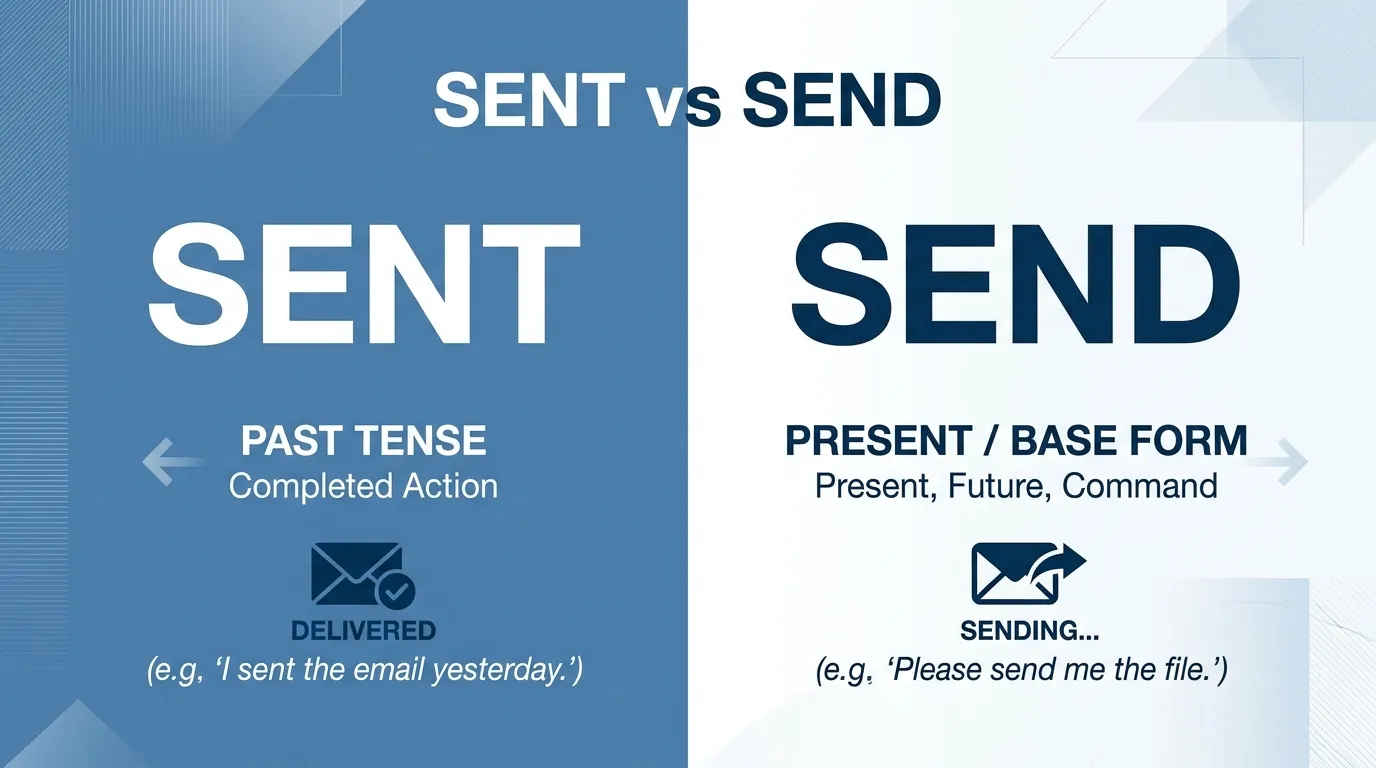
Send is the present form of the verb, while sent is the past and past participle form. Use send for actions happening now or later, and sent for actions that already happened.
Have you ever typed a quick message and stopped at one word: “Should I write send or sent?”
I have seen this mistake many times when helping students improve their English. It often happens in simple sentences. You know exactly what you want to say, but the tense makes you pause.
For example:
- “I send the email yesterday.”
- “I sent the email yesterday.”
Only one letter changes. Yet one sentence is correct, and the other is not.
The good news is that sent and send are not difficult to understand. The key is to look at the time of the action.
Send is the base and present form. Sent is the past form. You also use sent after words such as have, has, and had.
In this guide, you will learn the difference in plain English. You will see real examples, common mistakes, tense patterns, and simple tricks that make the choice much easier.
By the end, you should never need to guess between sent or send again.
Sent or Send: Quick Answer
The easiest rule is this:
Send = present or future action.
Sent = past action or past participle.
Examples with send
- I send emails every morning.
- Please send me the file.
- I will send the report tonight.
Examples with sent
- I sent the email yesterday.
- She sent me a message last night.
- They have sent the documents already.
Notice the time clues.
Words such as yesterday, last night, last week, and earlier often point to sent.
Words such as every day, now, tomorrow, and later can point to send, depending on the sentence structure.
The Origin and Background of Send
Send is an old English verb. It has been part of the language for many centuries.
The modern word comes from Old English sendan, which meant to cause someone or something to go somewhere.
Its basic idea has stayed surprisingly stable.
When you send something, you cause it to go from one place or person to another.
You can send:
- A message
- An email
- A letter
- A package
- A file
- An invitation
- A person somewhere
Over time, the verb developed several forms.
The most important ones for everyday English are:
- send: base and present form
- sent: past form
- sent: past participle
This is why learners sometimes find send confusing.
It does not follow the common -ed pattern.
For regular verbs, you might say:
- walk → walked
- call → called
- open → opened
But send changes completely:
- send → sent
This makes send an irregular verb.
Sent vs Send Explained: The Key Difference
The main difference is tense and sentence structure.
| Term | Meaning | When to Use | Region/Context |
| Send | To cause something to go | Present, commands, or after modal/future structures | All English |
| Sent | Past form of send | Completed past actions | All English |
| Sent | Past participle of send | With have, has, or had | All English |
1. Send as a present-tense verb
Use send when the action happens regularly or is generally true.
Examples:
I send my manager a report every Monday.
We send invoices to customers each month.
The action happens repeatedly. So send is correct.
2. Send for commands
You can also use send when giving an instruction.
Please send me the document.
Send the address to me.
Send your application before Friday.
You are asking someone to perform the action. The base form send is correct.
3. Send after “will”
After will, use the base verb.
I will send the file tonight.
Not:
I will sent the file tonight. ❌
The same rule works with other modal verbs:
- can send
- should send
- must send
- may send
- might send
For example:
I can send it now.
She should send the email.
4. Sent for completed past actions
Use sent when the action happened in the past.
I sent the email yesterday.
He sent the package last Friday.
She sent me a message two hours ago.
The action is finished.
5. Sent after have, has, or had
This is another major use of sent.
I have sent the report.
She has sent the invitation.
They had sent the documents before the meeting.
Here, sent is the past participle.
This is one of the easiest patterns to remember:
have/has/had + sent
Which Version Should You Use?
Your choice depends on when the action happens and what comes before the verb.
For present actions → use send
If you are talking about a routine or current habit, use send.
I send emails every day.
For past actions → use sent
If the action is finished and happened before now, use sent.
I sent the email yesterday.
For future actions → usually use send
After will, use send.
I will send the payment tomorrow.
For perfect tenses → use sent
After have, has, or had, use sent.
We have sent your order.
For instructions → use send
When telling someone what to do, use send.
Please send your application today.
A simple formula can help:
Now / routine → SEND
Past → SENT
Will → SEND
Have/has/had → SENT
Common Mistakes With Sent or Send
Even fluent speakers can make quick typing mistakes. Here are some of the most common ones.
Mistake 1: Using “sent” after will
❌ I will sent you the details.
✅ I will send you the details.
Why?
After will, always use the base form of the verb.
Mistake 2: Using “send” for a finished past action
❌ I send the email yesterday.
✅ I sent the email yesterday.
Why?
“Yesterday” clearly places the action in the past.
Mistake 3: Using “send” after have
❌ I have send the documents.
✅ I have sent the documents.
Why?
After have or has, you need the past participle.
Mistake 4: Adding “-ed” to sent
❌ I sented the message.
✅ I sent the message.
Why?
Send is irregular. Its past form is sent, not “sended” or “sented.”
Mistake 5: Confusing a request with a past action
Compare these:
Please send me the file.
You sent me the file yesterday.
The first is a request. The second describes something that already happened.
Sent or Send in Real-World Examples
The best way to learn these words is to see how people use them in everyday writing.
1. Professional email
Subject: Updated Report
Hi Sarah,
I have sent the updated report for your review. Please let me know if you need any changes.
Here, sent works because the report has already been delivered.
For a future action:
I will send the final version tomorrow.
2. News headline or article
A news report might say:
Officials sent emergency teams to the area after the storm.
The action happened in response to an event, so sent is appropriate.
A general statement might say:
The agency sends teams to areas affected by major storms.
Here, sends describes a regular practice.
3. Social media post
Just sent my application! Fingers crossed. 🤞
The person has already completed the action.
For a future action:
I’ll send you the link when I get home.
4. Formal document
The company sent written notice to all employees.
This describes a completed action.
A policy might instead say:
The company will send written notice to affected employees.
That describes a future requirement.
Sent or Send: Data, Trends & Usage
People usually search “sent or send” when they are unsure about grammar, tense, or sentence structure. The search is strongly informational, not commercial.
The confusion is easy to understand. Both words come from the same verb, and sent is used for both the simple past and past participle.
Modern communication makes this even more relevant.
People send:
- Emails
- Text messages
- WhatsApp messages
- Social media posts
- Digital files
- Online forms
- Work documents
Because send appears so often in digital communication, learners encounter both forms frequently.
The most useful insight is that you should not try to memorize hundreds of separate sentences.
Instead, learn the verb pattern.
Ask yourself:
Did it happen already?
If yes, sent is likely correct.
Is it happening regularly, being requested, or planned with “will”?
Then send is usually the right choice.
That simple question can solve most sent or send problems.
Sent or Send: Standalone Comparison Table
| Term/Variant | Meaning | Region/Context | Best Used When |
| Send | Base form of the verb | All English | Giving commands or talking about present actions |
| Sends | Present form for he/she/it | All English | A person or thing regularly sends something |
| Sent | Simple past form | All English | An action happened in the past |
| Sent | Past participle | All English | Used with have, has, or had |
| Sending | Present participle/gerund | All English | Talking about an action in progress |
Quick examples
- I send emails every day.
- She sends emails every day.
- I sent the email yesterday.
- I have sent the email.
- I am sending the email now.
Once you see the full pattern, the difference becomes much easier.
A Simple Trick to Remember Sent or Send
Here is a quick test.
Look for a past-time clue
If you see:
- yesterday
- last night
- last week
- two days ago
- earlier
- this morning, when the action is finished
You will often need sent.
I sent the email yesterday.
Look for “will”
If you see will, use send.
I will send the email later.
Look for “have,” “has,” or “had”
Use sent.
She has sent the email.
They had sent the package.
This three-part check catches most mistakes.
Frequently Asked Questions About Sent or Send
Q: What is the difference between sent and send?
A: Send is the base and present form of the verb. Sent is the past and past participle form. For example, “I send emails daily” is present, while “I sent an email yesterday” is past.
Q: Is “sent” the past tense of send?
A: Yes. Sent is the simple past form of send. It is also the past participle, so you can say “I sent it” and “I have sent it.”
Q: Should I say “I sent” or “I send”?
A: It depends on the time. Use I sent for something that already happened. Use I send for a present habit or repeated action.
Q: Is “I will sent” correct?
A: No. The correct sentence is “I will send.” After will, use the base form of the verb.
Q: Is “I have send” correct?
A: No. Say “I have sent.” After have or has, use the past participle sent.
Q: Can I say “sended” instead of sent?
A: No. Sended is not the standard past form in modern English. The correct past form is sent.
Q: Is sent acceptable in formal writing?
A: Yes. Sent is completely standard and appropriate in formal writing. You can use it in emails, reports, academic writing, business documents, and professional communication.
Q: What is the difference between “sent” and “sending”?
A: Sent normally describes a completed action or works as a past participle. Sending describes an action in progress or can act as a noun. For example, “I sent the file” and “I am sending the file.”
Final Takeaway: Sent or Send?
The difference between sent and send is simple once you focus on tense.
Send is the base form. Use it for present actions, routines, commands, and after words such as will, can, should, and must.
Sent is the past form. Use it when an action already happened. It is also the past participle used after have, has, and had.
Remember these four examples:
I send emails every day.
I sent an email yesterday.
I will send the email tonight.
I have sent the email already.
Those four patterns cover most everyday situations.
You do not need to overthink the choice. Check the tense, look for helping verbs, and ask whether the action is finished.
Once you make that habit, sent or send becomes an easy choice rather than a frustrating one.
Bookmark this guide so you never second-guess “sent” and “send” again.
Learn more: Stuffie or Stuffy: The Easy Way to Get It Right

I started writing about English word differences after years of teaching students who kept making the same mistakes. My focus is on making spelling rules feel simple and easy to remember. At WordsCombo, I turn confusing word pairs into clear comparisons.








1 thought on “Sent or Send: The Easy Guide to Get It Right”