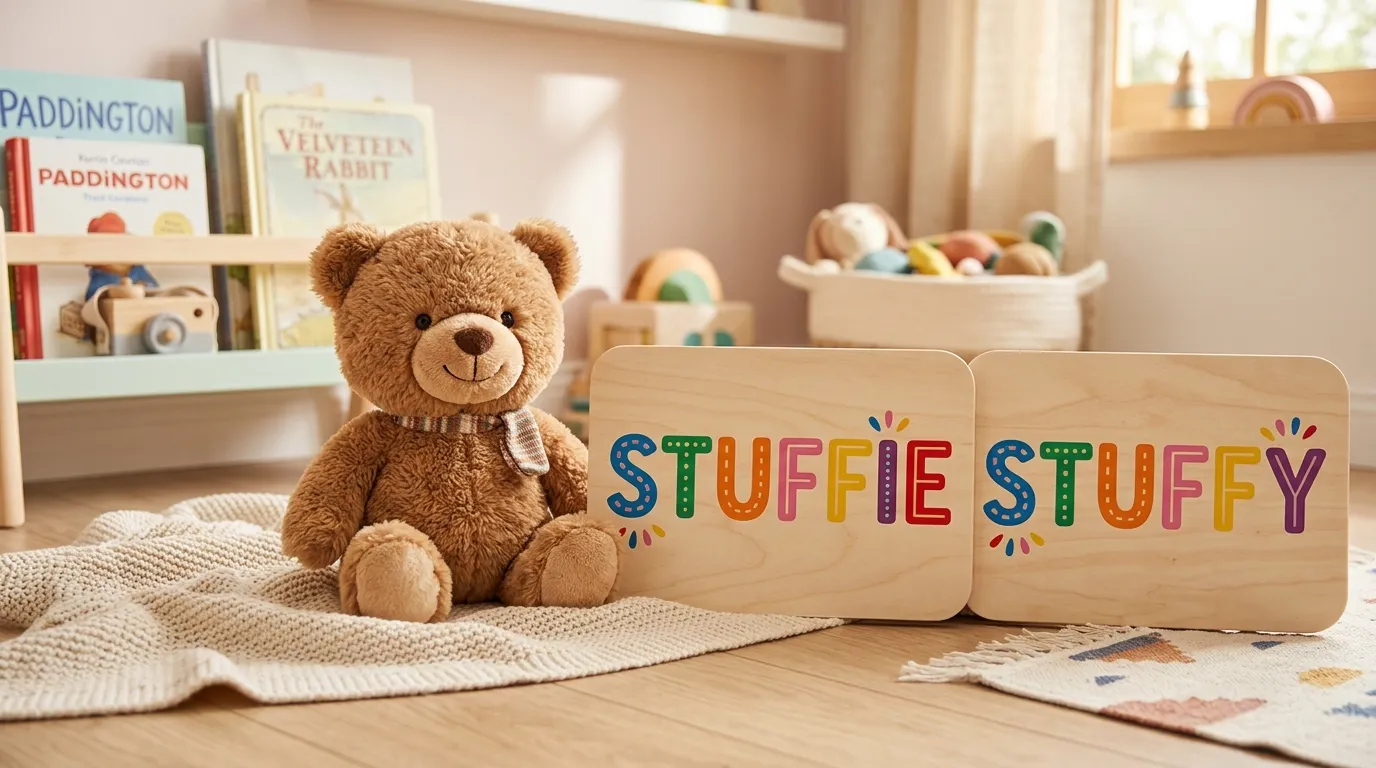
Stuffie is the informal word for a stuffed toy, while stuffy usually means lacking fresh air, overly formal, or uncomfortable. If you mean a cuddly toy, stuffie is the right choice.
Have you ever typed a cute message about a child’s favorite toy and stopped at one small question: “Is it stuffie or stuffy?”
I have seen this mistake many times when helping people with everyday English. It looks like a tiny spelling difference, but that extra “ie” changes the word and its meaning.
Imagine a child holding a soft teddy bear and saying, “This is my favorite stuffie.” That sounds natural. Now change it to “This is my favorite stuffy.” The meaning becomes less clear because stuffy is normally an adjective, not the usual name for a stuffed toy.
This is why the two words cause trouble. They look almost the same. They sound close. Both are linked to the word stuff. Yet they have different jobs in a sentence.
The good news is that the rule is simple. Once you understand the difference, you will rarely mix them up again.
Let’s break it down with simple meanings, examples, common mistakes, and a quick comparison.
Stuffie or Stuffy: Quick Answer
Stuffie is an informal noun that means a stuffed toy, such as a teddy bear, plush animal, or soft toy.
Stuffy is mainly an adjective. It can describe a room with poor air, a person who seems too formal, or an atmosphere that feels dull and old-fashioned.
Examples
- My daughter sleeps with her favorite stuffie.
- The puppy keeps carrying his stuffie around the house.
- This room feels stuffy.
- The office was hot and stuffy.
- The meeting felt too stuffy and formal.
So, if you are talking about a cuddly toy, choose stuffie.
If you are describing a room, person, style, or atmosphere, stuffy may be the word you need.
The Origin and Background of Stuffie and Stuffy
Both words are related to the word stuff, which has been part of English for centuries.
Stuff can mean material, things, or something used to fill an object. A stuffed toy is called that because it is filled with soft material.
From this idea, informal words such as stuffie developed as friendly names for stuffed toys.
The ending -ie often makes an English word sound smaller, softer, or more affectionate. Think about words such as:
- doggie
- kitty
- birdie
- blankie
- sweetie
Stuffie fits this same friendly pattern.
It is especially common in casual speech, parenting discussions, children’s language, social media, and online communities.
What about stuffy?
Stuffy has a different history of use.
It comes from stuff plus the adjective ending -y. The word can describe something filled or crowded. Over time, it developed common meanings related to poor air circulation and an overly formal or conservative manner.
For example:
The bedroom feels stuffy.
Here, stuffy means the air feels warm, closed, or unpleasant.
It can also describe a person or environment:
The old club had a very stuffy atmosphere.
Here, stuffy means overly formal or old-fashioned.
That is quite different from a cute stuffed animal.
Stuffie vs. Stuffy: Key Differences
The easiest way to remember the difference is to focus on the part of speech and meaning.
| Term | Meaning | When to Use | Region/Context |
| Stuffie | A stuffed or plush toy | When talking about a cuddly toy | Informal, casual, online, family use |
| Stuffy | Lacking fresh air | When describing a room or space | Standard English |
| Stuffy | Too formal or old-fashioned | When describing a person, style, or setting | Standard English |
| Stuffed toy | A soft toy filled with material | Formal or neutral writing | Widely understood |
Example 1: A stuffed toy
Emma took her stuffie on the trip.
Here, stuffie means a soft toy.
Example 2: A warm room
The bedroom was stuffy after the windows were closed all day.
Here, stuffy describes the air.
Example 3: A formal setting
The restaurant felt a little stuffy.
Here, stuffy suggests that the place felt too formal or serious.
The meaning changes completely depending on the word you choose.
Which Version Should You Use?
Your choice depends on what you are trying to say.
If you mean a cuddly toy
Use stuffie in casual writing.
My son brought his favorite stuffie to school.
This is friendly and natural.
For formal writing, however, stuffed toy, stuffed animal, or plush toy may be better.
The child was given a stuffed animal.
That sounds more neutral and professional.
If you are describing a room
Use stuffy.
The classroom became stuffy after the windows were closed.
Do not use stuffie here.
If you are describing a formal person or place
Use stuffy.
He thought the old-fashioned dress code was too stuffy.
Again, stuffie would be incorrect.
For global or neutral writing
If your readers may not know the informal word stuffie, choose stuffed toy or stuffed animal.
That removes any possible confusion.
Common Mistakes with Stuffie and Stuffy
These two words are easy to mix up. Here are some of the most common mistakes.
1. Using stuffy for a stuffed toy
Wrong:
I bought my niece a cute stuffy.
Better:
I bought my niece a cute stuffie.
You can also say:
I bought my niece a cute stuffed toy.
Why does this happen?
The word “stuffed” naturally makes people think of stuffy. But the informal noun for the toy is usually stuffie.
2. Using stuffie for a room
Wrong:
The office is really stuffie today.
Correct:
The office is really stuffy today.
The adjective stuffy describes uncomfortable air.
3. Using stuffie in formal writing
Casual:
My little sister loves her stuffie.
More formal:
My little sister loves her stuffed animal.
Stuffie is perfectly useful in casual language. However, it can sound too informal in academic, business, or official writing.
4. Assuming the words are interchangeable
They are not.
She hugged her stuffie.
This talks about a toy.
She opened the window because the room was stuffy.
This talks about air.
Changing one word can change the whole meaning.
5. Forgetting that stuffy has another meaning
Stuffy does not only describe air.
It can also describe someone or something that feels too formal, serious, or old-fashioned.
The ceremony was a little stuffy.
This does not mean the ceremony lacked fresh air. It means it felt overly formal or rigid.
Stuffie in Real-World Examples
Seeing the word in context makes the difference much easier to remember.
Professional Email
Because stuffie is informal, it may appear in a casual workplace email rather than a formal business message.
Subject: Lost Stuffie
Hi Sarah,
Liam may have left his favorite stuffie in the meeting room after the children’s event. Could you please check if it is still there?
Thanks!
For a more formal message, stuffed toy would be safer.
News Article or Feature
A news or lifestyle article might use stuffie when discussing children, pets, toys, or popular culture.
The child refused to leave home without her favorite stuffie.
For a formal news report, stuffed toy may be preferred if the writer wants a neutral tone.
Social Media Post
Stuffie is very natural on social media.
My cat has officially adopted this stuffie. 😂
Or:
First night away from home, but my stuffie came with me! 🧸
The informal tone fits perfectly.
Formal Report
A report would usually avoid stuffie.
Instead of:
The child was allowed to bring one stuffie.
Use:
The child was allowed to bring one stuffed toy.
The second version sounds more professional.
Stuffie vs. Stuffy: Data, Trends & Usage
The two words attract different types of searches because people are usually looking for different meanings.
Searches for “stuffie or stuffy” often come from people who have seen the informal word stuffie and want to know whether it is spelled correctly.
This is especially likely when people encounter the term in:
- Parenting content
- Social media
- Children’s books
- Toy discussions
- Pet communities
- Online shopping
- Casual conversations
Stuffy, on the other hand, is a standard English adjective. People may search for it when they want to understand its meaning, spelling, or use in a sentence.
There is also an important modern language trend here: informal words spread quickly online.
A word such as stuffie may look unusual in a dictionary-style sentence, but it can feel completely normal in a casual message.
That does not mean it is suitable for every type of writing.
The key is to match the word to your audience.
Stuffie or Stuffy: Side-by-Side Comparison
| Term/Variant | Meaning | Region/Context | Best Used When |
| Stuffie | A stuffed or plush toy | Informal English | Talking casually about a cuddly toy |
| Stuffy | Lacking fresh air | Standard English | Describing a room or space |
| Stuffy | Too formal or old-fashioned | Standard English | Describing a person, style, or setting |
| Stuffed toy | A toy filled with soft material | Neutral English | Formal and general writing |
| Stuffed animal | A soft toy shaped like an animal | Common English | Talking about plush animal toys |
A useful memory trick is simple:
Stuffie = a thing you can hug.
Stuffy = a feeling or quality you can describe.
Think of a teddy bear when you see stuffie.
Think of a closed room when you see stuffy.
How to Remember the Difference
Here is a quick trick that works well.
IE = cute thing
The -ie ending often makes a word sound cute or affectionate.
So:
Stuff + ie = stuffie
Think:
🧸 Stuffie = stuffed toy
Y = describing something
The ending -y often forms an adjective.
So:
Stuff + y = stuffy
Think:
🌬️ Stuffy = describing air, a place, or a style
This simple connection can help you choose the right word quickly.
Is “Stuffie” a Correct Word?
Yes. Stuffie is an established informal word for a stuffed toy.
However, “correct” does not always mean “best for every situation.”
If you are writing a text to a friend, a social media caption, or a casual parenting post, stuffie works well.
If you are writing a school paper, formal report, academic assignment, or professional document, stuffed toy or stuffed animal is usually a better choice.
The important point is not to confuse stuffie with stuffy.
They are different words with different meanings.
Frequently Asked Questions
Q: What does stuffie mean?
A: Stuffie is an informal word for a stuffed or plush toy. It can mean a teddy bear, plush animal, or another soft toy that people cuddle.
Q: Is stuffie the same as stuffed animal?
A: In casual use, yes, they can refer to the same type of toy. However, stuffie is more informal, while stuffed animal is more neutral and widely understood.
Q: Is stuffy the correct spelling for a stuffed toy?
A: Usually, no. If you mean a stuffed toy, stuffie is the informal term. Stuffy normally describes poor air circulation or something that feels too formal or old-fashioned.
Q: Is stuffie acceptable in formal writing?
A: It can be understood, but it is usually too casual for formal writing. Use stuffed toy, stuffed animal, or plush toy when you want a more neutral style.
Q: What is the difference between stuffie and stuffy?
A: Stuffie is a noun meaning a stuffed toy. Stuffy is mainly an adjective meaning lacking fresh air or overly formal.
Q: Where does the word stuffie come from?
A: Stuffie is an informal formation based on stuff and the friendly -ie ending. It follows the pattern of casual words such as “doggie” and “birdie.”
Q: Can I use stuffie for a pet’s toy?
A: Yes. In casual speech, you can call a pet’s soft stuffed toy a stuffie. For example, “My dog carries his stuffie everywhere.”
Q: Is stuffie a noun or an adjective?
A: Stuffie is normally used as a noun. Stuffy is normally an adjective. This is one of the easiest ways to tell them apart.
Q: Is stuffie used in British and American English?
A: Stuffie is an informal term that can be understood in different varieties of English, especially online. Usage may vary, so stuffed toy is the safest neutral choice for a broad audience.
Final Verdict: Stuffie or Stuffy?
The difference between stuffie and stuffy is small in spelling but big in meaning.
Use stuffie when you mean a stuffed toy, plush toy, or cuddly toy. It is friendly, casual, and common in informal conversations.
Use stuffy when you describe poor air circulation, such as a warm room with little fresh air. You can also use it for something that feels too formal, serious, or old-fashioned.
For formal writing, remember one more useful option: stuffed toy. It is clear, neutral, and easy for almost every reader to understand.
So the rule is easy:
🧸 Stuffie = a stuffed toy
🌬️ Stuffy = uncomfortable air or an overly formal feeling
Once you connect stuffie with a toy and stuffy with a description, the confusion disappears.
Bookmark this guide so you never second-guess “stuffie” or “stuffy” again, and share it with someone who keeps mixing them up.
Find out more: Patients or Patience: The Complete Easy Guide

I started writing about English word differences after years of teaching students who kept making the same mistakes. My focus is on making spelling rules feel simple and easy to remember. At WordsCombo, I turn confusing word pairs into clear comparisons.


1 thought on “Stuffie or Stuffy: The Easy Way to Get It Right”