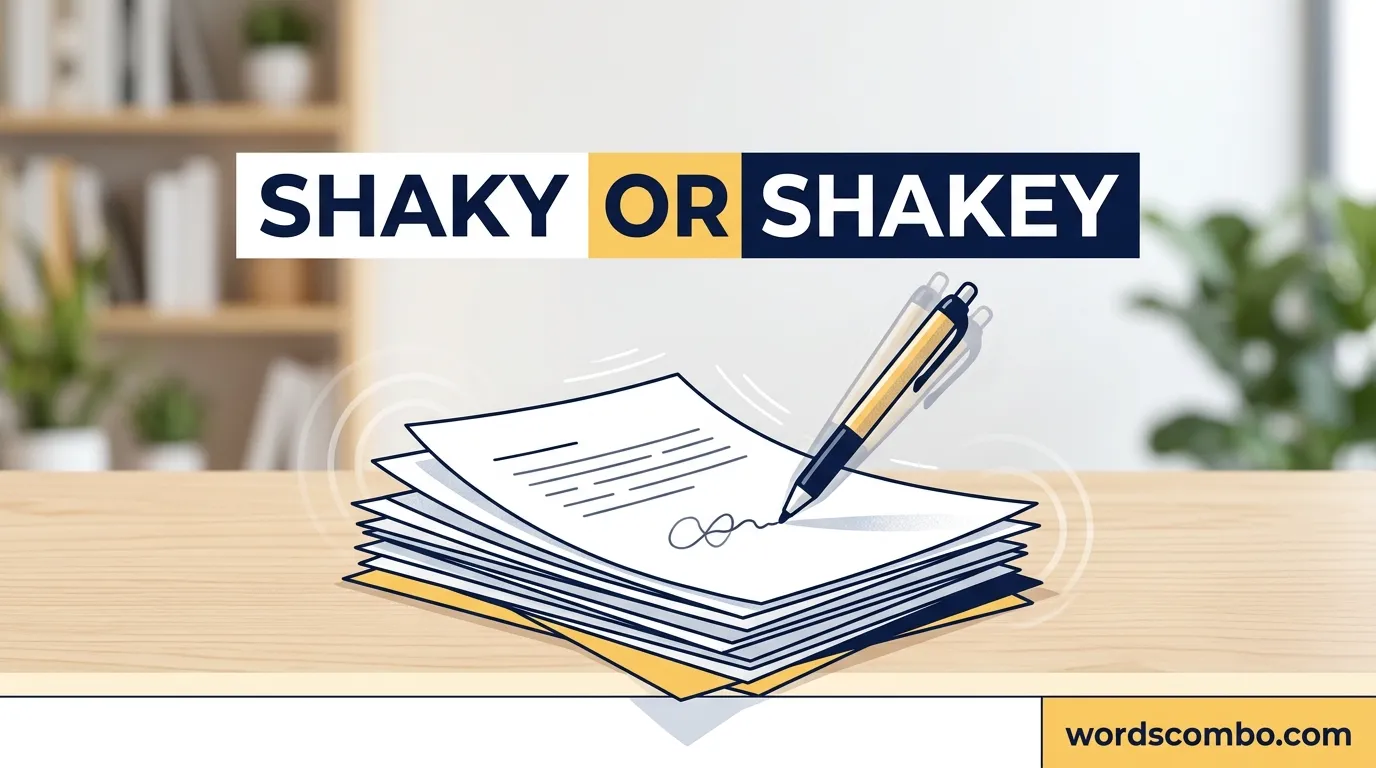
Shaky is the standard spelling for something that is trembling, unstable, weak, or uncertain. Shakey is usually a misspelling, although it can appear as a name or intentional brand spelling.
I caught this one while editing a short client email late at night. The sentence was simple: “The plan still looks ___.” My first instinct was to type shakey. Then I stopped. That extra e looked natural because the word comes from shake, but it was not the spelling I wanted in a professional message.
That tiny pause is exactly why shaky or shakey causes so much trouble. Both forms look believable. They also sound the same when spoken. If you type mostly by sound, the extra e can slip in before you notice it.
The good news is that the answer is simple. For standard English, use shaky. It can describe trembling hands, an unstable chair, weak evidence, an uncertain plan, or even a poor start. The spelling shakey has a much narrower role.
Let’s make the difference easy to remember so you can stop second-guessing this word.
Shaky or Shakey: Quick Answer
Shaky is the correct standard spelling when you mean trembling, unstable, weak, or uncertain.
Examples:
- Correct: My hands were shaky before the interview.
- Correct: The old table looks shaky.
Shakey is not the spelling you should use for the normal adjective in school, business, or everyday writing.
The Origin and Background of Shaky
The word shaky comes from shake with the suffix -y. The word has been used in English for centuries, with its recorded history reaching back to the early 1700s.
The meaning grew naturally from the idea of shaking. Something that shakes can be described as shaky.
Over time, the word gained broader meanings. It can now describe more than physical movement.
For example:
- Shaky hands means hands that tremble.
- A shaky chair is not steady.
- Shaky evidence is weak or unreliable.
- A shaky plan may not work.
- A shaky voice may show fear or emotion.
This wider meaning is one reason the word appears often in both casual and professional English.
Why Does “Shakey” Look Right?
The confusion is easy to understand.
You see shake and naturally want to keep the e:
shake + y = shakey
But standard spelling gives us:
shake → shaky
English has many spelling patterns that do not behave exactly as learners expect. The sound does not tell you whether an e belongs in the written word.
That is why shakey can look right even when it is not the standard adjective.
Shaky Explained: What Does It Really Mean?
Shaky is an adjective with several closely related meanings.
1. Trembling or Unsteady
Use shaky when something moves in an uncontrolled or trembling way.
Her hands were shaky during the presentation.
He wrote the note with a shaky hand.
This meaning is common when talking about hands, legs, voices, writing, or movement.
2. Not Stable
Shaky can describe something that is physically weak or unsafe.
That ladder looks shaky.
The old chair felt shaky.
Here, the word suggests that something may wobble, move, or fail.
3. Weak or Uncertain
The word also works in a figurative sense.
The argument was based on shaky evidence.
Their agreement is still shaky.
In these examples, nothing is physically shaking. The idea, evidence, or agreement is simply weak or uncertain.
Shaky vs. Shakey at a Glance
| Term | Meaning | When to Use | Region/Context |
| shaky | Trembling, unstable, weak, or uncertain | Standard adjective | American and British English |
| shakey | Usually a misspelling of shaky | Avoid for the normal adjective | Nonstandard writing |
| Shakey | Can be an intentional name or stylized spelling | Only when it is the actual name | Proper names, brands, nicknames |
The key point is simple: use shaky when you mean the ordinary English adjective.
Which Version Should You Use?
For almost every normal writing situation, choose shaky.
For Students
Use shaky in:
- Essays
- Homework
- Exams
- Research papers
- Class assignments
It is the standard spelling.
For Professionals
Use shaky in:
- Emails
- Reports
- Business documents
- Presentations
- Client messages
- Articles
A spelling error can distract readers from your main point.
For Social Media
Use shaky when you are using the ordinary adjective.
“My hands were shaky after that workout.”
Casual writing does not change the standard spelling.
For Global Readers
Choose shaky. It is the standard spelling in both American and British English.
What About “Shakey”?
There is one useful exception.
Shakey can be part of a proper name, nickname, username, fictional name, or brand. A name may use a spelling that is different from the normal dictionary word.
So do not automatically change Shakey when it is someone’s actual name.
But if your sentence means trembling, unstable, weak, or uncertain, write shaky.
Common Mistakes with Shaky
1. Writing “Shakey” Instead of “Shaky”
❌ The camera was shakey.
✅ The camera was shaky.
The extra e is the problem.
2. Keeping the Full Word “Shake”
❌ His hands were shake-y.
✅ His hands were shaky.
You do not need a hyphen.
3. Using Shaky as a Verb
❌ He shaky during the speech.
✅ He looked shaky during the speech.
Shaky is an adjective. It describes a person, thing, condition, or situation.
4. Using Shaky When You Mean Shakily
❌ She walked shaky across the room.
✅ She walked shakily across the room.
Use shaky to describe a noun:
She had shaky legs.
Use shakily to describe how an action happens:
She walked shakily.
5. Treating Shakey as a Standard Alternative
❌ The bridge looks shakey.
✅ The bridge looks shaky.
Do not treat the two spellings as equal alternatives in standard English.
Shaky in Real World Examples
The best way to understand a word is to see it doing real work.
Professional Email
“The connection has been shaky since this morning, so I may need a few extra minutes for the call.”
Here, shaky means unstable or unreliable.
News Headline or Article
Markets Face a Shaky Start After New Economic Data
Here, shaky means weak or uncertain.
Social Media Post
“My hands were so shaky before the interview, but I got through it!”
Here, shaky describes nervous trembling.
Formal Report
“The available evidence provides a shaky basis for the proposed conclusion.”
Here, shaky means weak or questionable.
Notice how one word works in physical, emotional, business, and academic contexts. That flexibility makes shaky a useful adjective.
Shaky: Data, Trends & Usage
The search intent behind shaky or shakey is mainly informational. People usually want a quick spelling answer, the meaning of the word, or examples showing how to use it.
Current search results also show several recurring questions around the pair, including whether shakey is a word, why shaky is spelled without the extra e, and whether the word works in American and British English.
The strongest usage areas are easy to understand:
- Health and feelings: shaky hands, shaky legs, feeling shaky
- Physical objects: shaky chair, shaky ladder, shaky bridge
- Business: shaky economy, shaky finances
- Arguments and evidence: shaky evidence, shaky argument
- Relationships and plans: shaky agreement, shaky relationship
- Performance: shaky start, shaky performance
This matters because shaky is not only a spelling question. It is a high-use adjective with both literal and figurative meanings. Once you learn the spelling, you also gain a useful word for describing uncertainty and instability.
Shaky or Shakey: Comparison at a Glance
| Term/Variant | Meaning | Region/Context | Best Used When |
| shaky | Trembling, unstable, weak, uncertain | Standard English | Almost all normal writing |
| shakey | Usually a spelling error | Nonstandard usage | Best avoided |
| Shakey | Possible proper name or stylized spelling | Names, brands, usernames | When the official name uses it |
For standard English, there is no real contest: shaky is the form to choose.
FAQs About Shaky or Shakey
Q: Is it shaky or shakey?
A: Shaky is the standard spelling. Use it when you mean trembling, unstable, weak, or uncertain.
Q: How do you spell shaky correctly?
A: Spell it S-H-A-K-Y. The word does not have an e between the k and y.
Q: What does shaky mean?
A: Shaky can mean trembling or unsteady. It can also mean weak, unreliable, or uncertain, depending on the context.
Q: Is “shakey” a real word?
A: Shakey can appear as a proper name or intentional spelling. But when you mean the ordinary adjective, shaky is the standard form.
Q: Why is shaky spelled without an e?
A: The standard adjective is shaky, not shakey. The spelling developed from shake plus -y, and the final e is not retained in the standard form.
Q: Is shaky correct in American English?
A: Yes. Shaky is the standard American English spelling. It is also standard in British English.
Q: Can I use shaky in formal writing?
A: Yes. Shaky is completely acceptable in formal writing when its meaning fits. For example, you can write about shaky evidence, a shaky foundation, or a shaky argument.
Q: What is the opposite of shaky?
A: The best opposite depends on the meaning. Common choices include stable, steady, firm, secure, reliable, and certain.
Final Thoughts on Shaky or Shakey
The spelling question is much easier once you remove that extra e.
Shaky is the standard English adjective. It can describe something that trembles, something that is physically unstable, or something that is weak or uncertain. You can use it for hands, voices, ladders, arguments, evidence, plans, finances, and many other things.
Shakey is generally not the spelling you want in ordinary English. If you see Shakey as part of a name or brand, keep it when that is the official spelling.
For everyday writing, remember one simple pattern:
shake → shaky
No extra e.
Now you know exactly which spelling to use. Choose shaky with confidence, and bookmark this guide if you often second guess tricky English spellings.
Curious about similar spelling traps? Explore Shyer or Shier: The Easy Spelling Guide.

I started writing about English word differences after years of teaching students who kept making the same mistakes. My focus is on making spelling rules feel simple and easy to remember. At WordsCombo, I turn confusing word pairs into clear comparisons.






2 thoughts on “Shaky or Shakey: The Easy Spelling Guide”