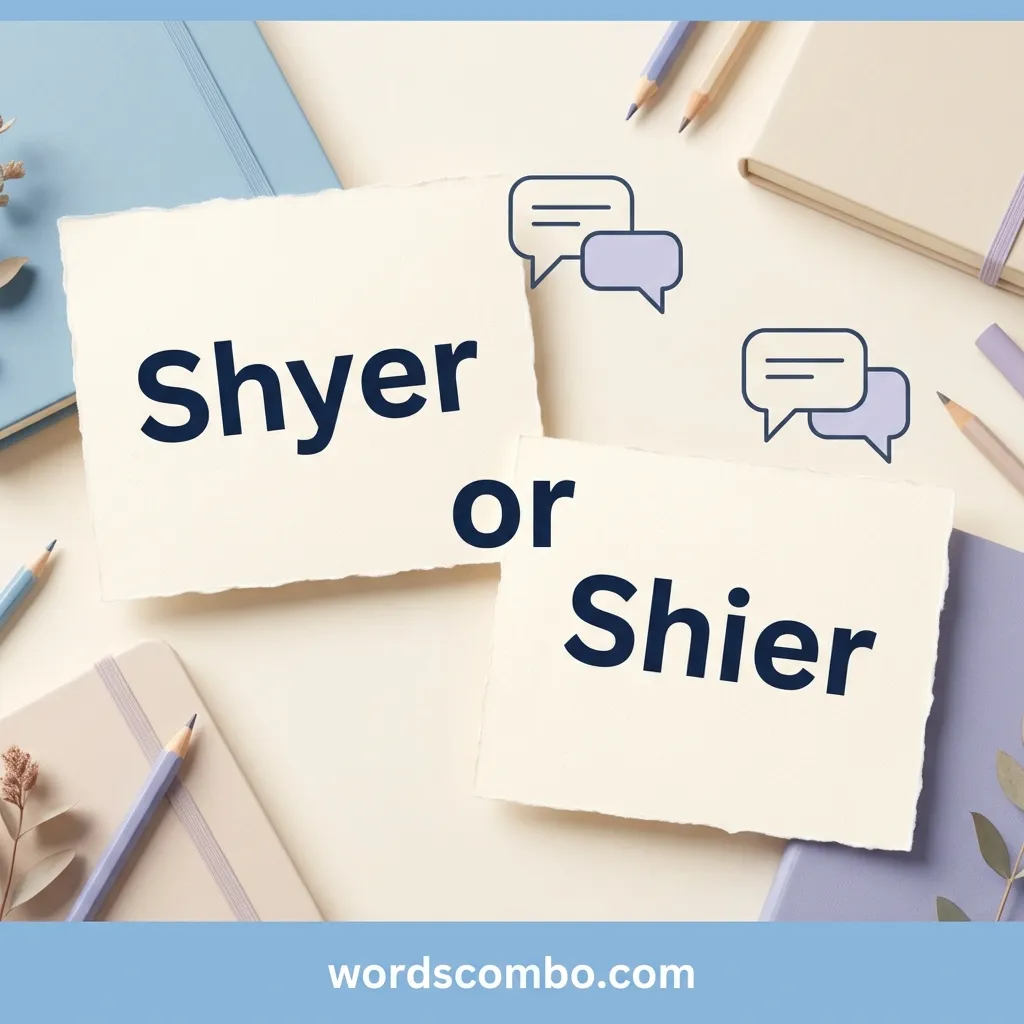
Shyer and shier both mean “more shy,” and both are correct, but shyer is often the clearer choice for everyday writing.
I caught this spelling once while editing a short email for a student. The sentence was simple: “Mia became ___ after moving to a new school.” The writer had typed shier, then stopped because the word looked almost like “sheer” or “pier.” A quick change to shyer made the sentence feel much more natural.
That tiny spelling choice causes a surprising amount of doubt. You already know shy, and you probably know that many adjectives ending in y change to i before -er, such as happy → happier. So why can we write shyer instead of changing the y?
The answer is that English has more than one accepted pattern here. Shyer and shier are both standard comparative forms of shy. They do not have different meanings. The real question is which form will look clearest to your reader.
This guide will make that choice easy. You will learn what each spelling means, why both exist, which one is more useful in everyday writing, and how to avoid the common mistakes that make this word feel harder than it really is.
Shyer or Shier: The Quick Answer
Shyer and shier are both correct comparative forms of shy.
The basic pattern is:
- shy = not confident around people or easily nervous
- shyer = more shy
- shier = more shy
- shyest = most shy
- shiest = most shy
For example:
Emma is shyer than her brother.
You can also write:
Emma is shier than her brother.
The meaning stays the same.
If you want the simplest choice for general writing, shyer is a strong option. It keeps the original word shy visible, so readers can understand the connection at once. Both forms are accepted in standard English.
Where Shyer and Shier Come From
The confusion starts with a familiar English spelling rule.
When an adjective ends in a consonant plus y, the y often changes to i before a suffix. For example:
- happy → happier
- busy → busier
- easy → easier
- pretty → prettier
That pattern makes shier look perfectly logical.
Yet shy behaves differently in common usage. Writers also keep the y and add -er, producing shyer.
So we have two accepted forms:
shy + er = shyer
and
shy → shi + er = shier
This is not a case where one spelling is a mistake and the other is secretly wrong. English has allowed both forms for a long time.
The word shy itself is very old. It has roots reaching back to Old English, where it was connected with ideas such as being timid or easily frightened. Over time, English developed several related forms, including the modern comparative spellings shyer and shier.
There is also a practical reason shyer feels easier to many readers. Shier can briefly look as if it should be pronounced like sheer or confused with another word. The spelling shyer makes the connection to shy obvious.
That does not make shier incorrect. It simply makes shyer a very useful choice when clarity matters.
Shyer vs. Shier: What Is the Difference?
There is no difference in meaning between shyer and shier when they are used as comparative adjectives.
Both mean that someone or something is more shy than another person or thing.
| Term | Meaning | When to Use | Region/Context |
| shyer | More shy | General and everyday writing | Widely understood |
| shier | More shy | Standard comparative form | Also accepted in standard English |
| more shy | More shy | When you want a very plain phrase | Conversational or emphatic writing |
| shyest | Most shy | Superlative form | Standard usage |
| shiest | Most shy | Superlative form | Also accepted |
Consider these examples:
Liam is shyer around strangers than his sister.
Liam is shier around strangers than his sister.
Both sentences say exactly the same thing.
You can also use more shy:
Liam is more shy around strangers than his sister.
That version is grammatical too, although the shorter comparative forms are often more natural when you simply need the standard comparison.
What Does Shyer Mean?
Shyer means more shy.
It describes a person, animal, or sometimes a thing that is less willing to interact, speak, approach others, or attract attention.
The new student was shyer than the other students.
Here, shyer compares the new student with the other students.
What Does Shier Mean?
Shier also means more shy.
The puppy became shier after hearing the loud noise.
Again, the word tells us that the puppy showed more fear or hesitation than before.
So if you write shier, you have not changed the meaning. You have simply chosen the other accepted spelling.
Which Spelling Should You Use?
For most readers, shyer is the easiest recommendation.
That is especially true when you are writing for a broad audience and want the word to be instantly clear.
For students
Use shyer if you are unsure.
It is easy to connect with the base adjective:
shy → shyer
That makes your sentence easy to understand and reduces the chance that a teacher or reader will pause over the spelling.
For professional writers
Shyer is a safe choice in emails, reports, blog posts, articles, and general business writing.
Example:
The candidate appeared shyer during the first interview.
There is no need to make the spelling more complicated than necessary.
For academic writing
Both shyer and shier are acceptable when used correctly.
Still, consistency matters. If you choose shyer, keep using that form throughout the document unless you are discussing spelling variation itself.
For American readers
Do not assume that shier is wrong in American English. It is an accepted form. Current dictionary evidence lists both shier and shyer as comparative forms.
For international readers
Shyer can be a useful neutral choice because the connection to shy is visually obvious.
If your audience is global, clarity is usually more valuable than trying to force a regional spelling preference.
Common Mistakes with Shyer or Shier
The word looks simple, but several mistakes appear again and again.
Mistake 1: Saying shier is wrong
Wrong idea:
“Shier is always incorrect.”
Better:
Shier is a correct comparative form of shy.
Both shier and shyer are accepted.
The problem is not the word shier. The problem is assuming that only one spelling can be correct.
Mistake 2: Writing shyier
Incorrect:
She became shyier after the move.
Correct:
She became shyer after the move.
or
She became shier after the move.
You do not add -ier directly to shy.
Mistake 3: Writing shyer
Incorrect:
He is shyer than his cousin.
Actually, this one is correct.
This is worth pointing out because many people see shyer and think the spelling must be wrong. It is not.
The correct form is:
shyer
with the full base word shy followed by -er.
Mistake 4: Using shier when you mean shyest
Incorrect:
She is the shier person in the group.
If you are comparing one person with the entire group, you normally need a superlative:
She is the shyest person in the group.
You can also use:
She is the shiest person in the group.
Remember:
Comparative: shyer / shier
Superlative: shyest / shiest
Mistake 5: Confusing shier with sheer
Incorrect idea:
Treating shier as if it were related to sheer.
These are different words.
Shier comes from shy and means more shy.
Sheer has completely different meanings, such as very steep, complete, or extremely thin.
Shyer or Shier in Real World Examples
Knowing a spelling rule is useful. Seeing the word in normal writing is even better.
In a professional email
Subject: Interview Feedback
Maya was a little shyer during the first part of the interview, but she became more confident as the conversation continued.
Here, shyer describes a change in confidence and social behavior.
In a news article
The younger player appeared shyer during the press conference but answered every question clearly.
The word works naturally in reporting because it describes behavior without sounding overly dramatic.
In a social media post
I was much shier in college than I am now. Funny how much can change in a few years.
Here, shier works well because the tone is personal and casual.
In a formal report
The child was noticeably shyer when interacting with unfamiliar adults.
This is a clear, professional use of the comparative adjective.
In everyday conversation
I was shyer when I was younger.
Or:
I was shier when I was younger.
Both work.
If the sentence feels awkward when you say it aloud, you can also write:
I was more shy when I was younger.
That is perfectly understandable and can sometimes sound more natural in conversation.
Shyer or Shier: Data, Trends & Usage
Searches for shyer or shier are mainly driven by informational intent. People are usually not looking to buy anything. They want a quick answer to a spelling or grammar question.
The strongest search needs tend to fall into a few groups:
- Which spelling is correct?
- Is shier a word?
- Is shyer grammatically correct?
- What is the comparative form of shy?
- Should I write shier or shyer?
- What is the difference between shyer and shier?
This tells us something useful about the word. Most people who search for it are already trying to write a sentence. They are often stuck at the exact moment when they need to choose between the two forms.
That means the best answer is not a long grammar lecture. It is a clear rule followed by examples.
Usage discussions also show why the question keeps appearing. Both forms are accepted, while shyer is often reported as the more familiar or more commonly seen form. There is no reliable reason to treat the two as different in meaning.
For modern writers, this matters because spelling advice should help you write with confidence, not make you afraid of acceptable variation.
Shyer or Shier: Comparison at a Glance
| Term/Variant | Meaning | Region/Context | Best Used When |
| Shyer | More shy | General English | You want the clearest everyday choice |
| Shier | More shy | Standard English | You prefer this accepted spelling |
| More shy | More shy | Conversational or emphatic | You want the meaning to be very obvious |
| Shyest | Most shy | General English | Comparing one person with a whole group |
| Shiest | Most shy | Standard English | Using the alternative superlative form |
The key point is simple: shyer and shier are not two different words with two different meanings.
They are two accepted spellings of the comparative form of shy.
If you need one spelling to use consistently, choose shyer. It is visually clear, easy to connect with shy, and widely understood.
FAQs About Shyer or Shier
Q: Is shyer or shier correct?
A: Both are correct. They are accepted comparative forms of shy and both mean “more shy.” If you want one simple choice, shyer is a good option.
Q: Is shier a real word?
A: Yes. Shier is a real and standard English word. It is the comparative form of shy, just like shyer.
Q: Is shyer grammatically correct?
A: Yes. Shyer is grammatically correct. You can write “She is shyer than her sister” without any problem.
Q: What is the comparative form of shy?
A: The comparative forms are shyer and shier. You can also say more shy when that phrasing fits your sentence better.
Q: Is shyer more common than shier?
A: Shyer is often the more familiar spelling in general writing, but usage varies. The important point is that shier is not an error.
Q: Can I use shier in formal writing?
A: Yes. Shier is acceptable in formal writing because it is a standard comparative form. If you want the most immediately recognizable spelling, shyer is a simple choice.
Q: What is the difference between shyer and shier?
A: There is no difference in meaning when they are used as comparative adjectives. Both mean more shy.
Q: Is it shier or more shy?
A: Both can be used. Shier is a standard comparative form, while more shy is another grammatical way to express the comparison. Choose the version that sounds clearest in your sentence.
Q: What is the superlative of shy?
A: The accepted superlative forms are shyest and shiest. For example, “Ella is the shyest student in the class.”
Final Thoughts on Shyer or Shier
The shyer or shier question looks harder than it really is.
The first thing to remember is that both spellings are correct. Neither one changes the basic meaning. Both describe someone or something that is more shy.
The second point is practical. If you are writing an email, school assignment, article, or report and you simply want the safest everyday choice, shyer is a clear option. It keeps the base word shy easy to see.
Finally, do not panic when you see shier. It is not automatically a spelling mistake. English allows both forms, and good writing is not about pretending that every word has only one possible spelling.
So your quick rule is:
shy → shyer or shier
And for the superlative:
shy → shyest or shiest
Now you can use the word without stopping every time your cursor reaches the y. Bookmark this guide so you never second-guess shyer or shier again.
Curious about similar spelling choices? Explore Hide or Hid: The Easy Grammar Guide

I started writing about English word differences after years of teaching students who kept making the same mistakes. My focus is on making spelling rules feel simple and easy to remember. At WordsCombo, I turn confusing word pairs into clear comparisons.








1 thought on “Shyer or Shier: The Easy Spelling Guide”