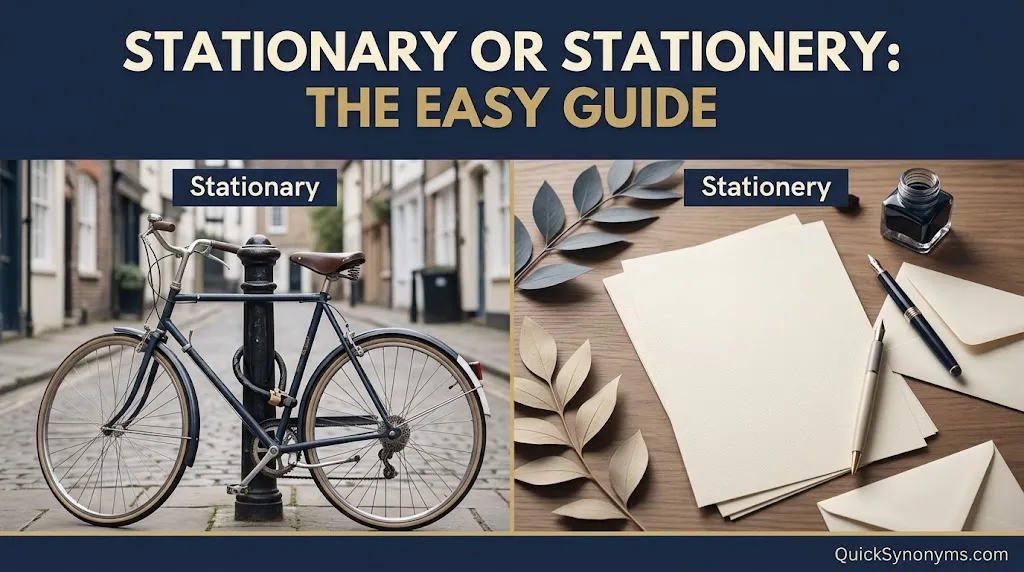
Stationary or stationery depends on the meaning: stationary means “not moving,” while stationery means writing materials such as paper, envelopes, and office supplies.
I caught this mix-up while checking a short business email before it went out. The sentence said, “Please order new stationary for the office.” It looked fine at first glance. Then I noticed the problem. The office needed paper, pens, and envelopes, so the word needed an e, not an a.
This is one of those spelling pairs that can make even careful writers pause. The two words sound the same in normal speech, but they do very different jobs on the page. One describes something that stays still. The other names things used for writing.
The good news is that you do not need a complicated grammar rule to remember the difference. Once you connect stationery with paper and stationary with staying in one place, the choice becomes much easier.
Let’s break down the difference with simple examples, common mistakes, and a quick memory trick you can use whenever you are unsure.
Stationary or Stationery: Quick Answer
Stationary is an adjective that means not moving or staying in one place.
- The car remained stationary at the traffic light.
- The machine must stay stationary during the test.
Stationery is a noun for writing materials, especially paper, envelopes, letterhead, and similar items.
- I bought new stationery for my office.
- The school asked students to bring basic stationery.
The easiest shortcut is this:
Stationery has an “e” for envelope.
If you mean paper or writing materials, choose stationery. If you mean something that is not moving, choose stationary.
The Background Behind Stationary and Stationery
These words look almost identical because they are historically related.
Stationary comes from an older word connected with a station or fixed position. Its meaning developed around the idea of something that stays in one place or does not move.
Stationery took a different path. It came from stationer, a term for a person who sold books and writing materials. Over time, stationery became the name for those writing goods. The word has been used in this sense since the 18th century.
That history explains why the spelling is so easy to confuse. The words share a similar sound and a related historical background, but their modern meanings are separate.
Think of them as two paths from the same old neighborhood:
- Stationary stayed connected to the idea of being fixed.
- Stationery became connected to paper and writing supplies.
Today, both are standard English words. The challenge is simply choosing the right one for your sentence.
Stationary or Stationery Explained: The Key Difference
The main difference is movement versus writing materials.
| Term | Meaning | When to Use | Region/Context |
| Stationary | Not moving or fixed in place | Describing people, vehicles, objects, or conditions that stay still | Standard English in the US and UK |
| Stationery | Writing materials such as paper and envelopes | Talking about paper goods, letterhead, cards, and office writing supplies | Standard English in the US and UK |
When to use stationary
Use stationary when something is still.
Example:
“The bus was stationary for ten minutes.”
The bus is not moving. That is why stationary is correct.
When to use stationery
Use stationery when you mean writing materials.
Example:
“She ordered personalized stationery for her business.”
The business ordered paper goods. Therefore, stationery is the correct spelling.
A simple test
Ask yourself:
Is it about movement?
Use stationary.
Is it about paper or writing supplies?
Use stationery.
That one question solves most cases.
Which Version Should You Use?
There is no single “better” spelling. The correct choice depends on what you mean.
For students
Use stationery when talking about notebooks, paper, pens, folders, and similar school supplies.
Example:
“I need to buy some stationery before school starts.”
For office workers
Use stationery for business writing materials.
Example:
“The company ordered new branded stationery.”
Use stationary when describing something that does not move.
Example:
“The camera remained stationary during the recording.”
For formal or academic writing
Use the word that matches your meaning. Both spellings are correct, but they are not interchangeable.
For global English
The distinction stays the same in both American and British English.
So you do not need to change the spelling because your reader is in the United States or the United Kingdom.
Common Mistakes with Stationary or Stationery
These errors are common because the two words sound alike.
| Mistake | Correction | Why |
| Please buy new stationary. | Please buy new stationery. | The sentence means writing supplies. |
| The car remained stationery. | The car remained stationary. | The car was not moving. |
| I ordered office stationary. | I ordered office stationery. | Office writing materials are stationery. |
| The train stayed stationery. | The train stayed stationary. | The train was not moving. |
| We designed wedding stationary. | We designed wedding stationery. | Invitations and paper goods are stationery. |
Why do these mistakes happen?
The biggest reason is simple: the words sound the same.
When you hear them, there is no useful sound clue. Your brain must rely on spelling and meaning.
That is why a quick memory trick helps.
Stationery = E for envelope.
If you can put an envelope next to the word, you probably need stationery.
Stationary or Stationery in Real World Examples
Knowing the rule is useful. Seeing it in everyday writing makes it easier to remember.
Professional email
Subject: New Office Stationery
Hi Sarah,
We need to order new stationery for the sales team. Please include letterhead and envelopes in the order.
Here, stationery means business writing materials.
News headline
Traffic remains stationary after the road closure
Here, stationary describes traffic that is not moving.
Social media post
Just received our new company stationery. The new letterhead looks great!
The post refers to printed business materials, so stationery is correct.
Formal report
The vehicle remained stationary while the safety inspection was completed.
The vehicle stayed in one position. Therefore, stationary is the right choice.
Stationary or Stationery: Data, Trends & Usage
This spelling pair has a strongly informational search intent. People usually search for it when they are writing an email, school assignment, report, business document, or social post and suddenly cannot remember which spelling is correct.
The topic is especially useful in contexts such as:
- School writing, where students discuss stationery and school supplies.
- Office communication, where stationery can mean business paper and letterhead.
- Business writing, especially when describing branded stationery.
- Formal documents, where stationary may describe a fixed object or condition.
- English-learning searches, where homophones are a common source of spelling mistakes.
There is no meaningful American-versus-British spelling split here. Both varieties use stationary for “not moving” and stationery for writing materials.
The reason this still matters is simple: spellcheck may not save you. Both words are valid English words. A spellchecker can accept the wrong one if it fits the sentence grammatically.
Stationary or Stationery: Comparison at a Glance
| Term/Variant | Meaning | Region/Context | Best Used When |
| Stationary | Not moving | American and British English | Something stays still |
| Stationery | Writing materials | American and British English | Talking about paper and writing goods |
| Stationer | A person or business selling stationery | General English | Referring to the seller |
| Stationery shop | A shop selling writing materials | Common everyday usage | Talking about where you buy stationery |
A useful memory pair is:
stationary = still
stationery = supplies
Once you learn that pair, the spelling becomes much easier.
FAQs About Stationary or Stationery
Q: What is the difference between stationary and stationery?
A: Stationary means not moving or staying in one place. Stationery means writing materials such as paper, envelopes, and letterhead.
Q: How do you use stationery correctly?
A: Use stationery when you mean writing or office materials. For example, “The company ordered new stationery for its offices.”
Q: Is stationery the same as stationary?
A: No. They sound alike, but their meanings differ. Stationery relates to writing materials, while stationary describes something that does not move.
Q: Is stationery correct in formal writing?
A: Yes. Stationery is completely standard in formal writing when you mean paper or other writing materials. It is common in business letters, invitations, and office documents.
Q: Which is correct, stationary or stationery for school supplies?
A: Stationery is correct. School stationery can include paper, notebooks, pens, pencils, envelopes, and similar writing supplies.
Q: Where does the word stationery come from?
A: Stationery comes from the older word stationer, which referred to a seller of books and writing materials. The modern spelling developed from that history.
Q: Can stationery mean pens and pencils?
A: Yes, especially in everyday usage. The word broadly refers to writing materials and can include items such as paper, pens, envelopes, notebooks, and related office supplies.
Final Thoughts on Stationary or Stationery
The difference between stationary and stationery is small in spelling but big in meaning.
Remember these three points:
- Stationary means not moving.
- Stationery means writing materials.
- Stationery has an “e” for envelope, which makes a useful memory trick.
If you are describing a parked car, a stopped train, or an object that stays in one place, choose stationary.
If you are talking about paper, envelopes, letterhead, or writing supplies, choose stationery.
Do not let the identical sound fool you. Look at the meaning of the sentence first, then choose the spelling.
Bookmark this guide so you never second-guess stationary or stationery again.
Curious about similar words? Explore Cheif or Chief: The Easy Spelling Guide.

I started writing about English word differences after years of teaching students who kept making the same mistakes. My focus is on making spelling rules feel simple and easy to remember. At WordsCombo, I turn confusing word pairs into clear comparisons.









1 thought on “Stationary or Stationery: The Easy Guide”