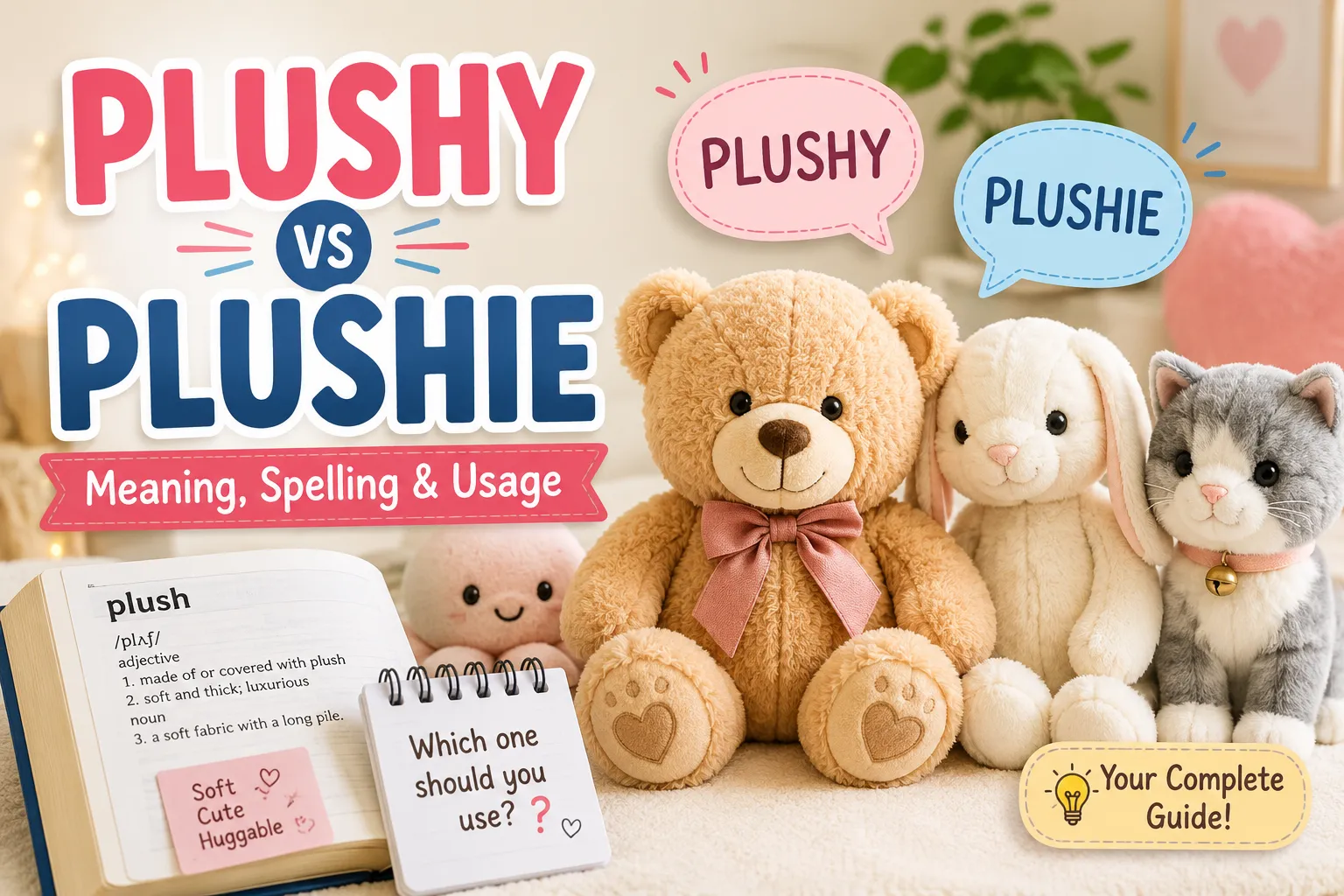
Plushy and plushie both refer to a soft, stuffed toy made from plush fabric. Plushie is the more common noun for the toy, while plushy often describes something that feels soft or plush.
Have you ever searched for a cute stuffed toy and wondered whether you should call it a plushy or a plushie?
I have seen this small spelling question confuse many new English learners. The two words look almost the same. They also sound similar. Yet, they do not always work in the same way.
When I first came across the term plushie, I noticed how often people used it in casual speech. Online shops, social media posts, gaming communities, and fan groups all use the word. At the same time, plushy appears in product names and everyday descriptions.
That can make the choice feel harder than it should be.
The good news is simple: both forms are used, but they have different common roles. One usually names the toy. The other can describe something soft, plush, or cushion like.
This guide breaks down the meaning, history, spelling, differences, examples, and common mistakes. By the end, you will know exactly which word fits your sentence.
Plushy
A plushie is a soft stuffed toy. It is usually made with plush fabric and filled with soft material.
For example:
- “My daughter sleeps with her favorite plushie.”
- “I bought a cat plushie at the store.”
The word plushy can also refer to something soft and plush.
For example:
- “This blanket feels very plushy.”
- “The sofa has a plushy texture.”
In casual English, people sometimes use plushy as another name for a stuffed toy. So you may see both forms online.
However, if you are talking about the toy itself, plushie is often the clearest choice.
The Origin and Background of Plushy and Plushie
The story starts with the word plush.
Plush is a soft fabric with a raised surface. It has been used for clothing, furniture, toys, and other items for many years.
The word plush comes from French peluche, meaning a soft or furry fabric.
Over time, English speakers began using plush in wider ways. It could describe not only fabric but also something soft, rich, or comfortable.
The word plushie developed as a cute, informal form connected with plush toys.
The ending ie often makes English words sound smaller, friendlier, or more affectionate. Think of words such as “doggie” or “birdie.”
That is why plushie has a warm and playful feeling.
Plushy, meanwhile, follows a different pattern. The ending y often turns a noun into an adjective.
For example:
- cloud → cloudy
- fluff → fluffy
- plush → plushy
This helps explain the main difference between the two words.
Plushie usually acts as a noun.
Plushy usually acts as an adjective.
But casual online English does not always follow strict grammar rules. That is why you may see plushy used as a noun too.
Plushy vs. Plushie: Key Differences
The easiest way to remember the difference is to ask one question:
Are you naming the toy or describing something?
If you are naming the stuffed toy, plushie is a natural choice.
If you are describing something as soft and plush, plushy works well.
| Term | Meaning | When to Use | Region/Context |
|---|---|---|---|
| Plushie | A soft stuffed toy | When naming the toy | Casual, online, fan, and everyday English |
| Plushy | Soft, plush, or plush like | When describing texture or comfort | Casual and descriptive English |
| Plush toy | A stuffed toy made with plush fabric | When you want a clear, standard term | General English |
| Stuffed animal | A soft toy shaped like an animal | When the toy represents an animal | Common in American English |
| Soft toy | A soft toy, often stuffed | When speaking generally | Common in British English and international English |
Example: Naming the Toy
“I bought a new plushie yesterday.”
Here, plushie is the name of the object.
Example: Describing Texture
“The toy has a plushy surface.”
Here, plushy describes the surface.
Example: Using a More Formal Term
“The company sells handmade plush toys.”
This sounds more neutral and professional.
Which Version Should You Use?
Your best choice depends on your audience.
For beginners and casual conversation
Use plushie when you mean the toy.
It is easy to understand and has a friendly tone.
“Look at my new plushie!”
For children and families
Plushie also works well. It sounds cute and warm.
“Which plushie do you want to take with you?”
For social media
Both words can work.
Plushie is especially natural when talking about a specific stuffed toy.
“My new bunny plushie is finally here!”
For product descriptions
Use plush toy when you want a clear and neutral phrase.
For example:
“This plush toy is made from soft fabric.”
You can still use plushie in a friendly product title or casual description.
For formal writing
Avoid plushie unless the subject itself is casual.
Use plush toy or stuffed toy instead.
The safest rule is simple:
Use “plushie” for the toy, “plushy” for a soft quality, and “plush toy” for formal or neutral writing.
Common Mistakes with Plushy and Plushie
1. Treating Plushy and Plushie as Exact Synonyms
Mistake:
“I love this plushy because it is my favorite stuffed toy.”
This is not always wrong, but it can sound less natural if you are using plushy as the noun.
Better:
“I love this plushie because it is my favorite stuffed toy.”
Why does this happen? Casual English often changes words over time. Online communities can also create their own common forms.
2. Using Plushie in Formal Writing
Mistake:
“The research examined children’s attachment to plushies.”
Better:
“The research examined children’s attachment to stuffed toys.”
The first sentence is understandable. The second sounds more formal.
3. Using Plushy When You Mean Soft
Mistake:
“I bought a plushy blanket.”
This can sound like plushy is being used as the name of an object.
Better:
“I bought a plush blanket.”
Or:
“The blanket feels plushy.”
4. Assuming One Spelling Is Always Correct
English has many informal words with more than one accepted form.
Plushie and plushy are good examples.
Context matters more than trying to find one universal spelling.
5. Confusing Plush With Plushie
Plush is the base word.
Plushie is usually the informal noun for a soft toy.
Plushy is generally descriptive.
So these sentences have different jobs:
“I bought a plushie.”
“The toy is very plushy.”
“It is made from plush fabric.”
Plushy and Plushie in Real World Examples
Seeing the words in context makes the difference much easier to remember.
Professional Email
“We are pleased to confirm that the custom plushie design has been approved.”
Here, plushie works because the email is discussing a specific product. A more formal company could also use “plush toy.”
News Headline
“Popular Character Plushies Sell Out Within Hours”
The word plushies works well in a headline aimed at a general audience.
Social Media Post
“I finally found the plushie I wanted! 🧸”
This is a natural casual use.
Formal Report
“The study examined children’s emotional attachment to plush toys.”
Here, plush toys is better than plushies because the report has a formal tone.
Product Description
“This soft plush toy is designed for gentle play and display.”
This wording is clear and professional.
Plushy: Data, Trends & Usage
The search intent behind plushy and plushie is mainly informational. People often want to know what the words mean, which spelling is correct, and whether the terms are interchangeable.
The topic also has a strong connection to online culture.
Plush toys are common in:
- children’s products
- collecting
- gaming communities
- anime and manga fandoms
- character merchandise
- social media
- gift shopping
- handmade crafts
The word plushie feels especially natural in online communities because it has a cute and personal tone.
You may also see related phrases such as plush toy, stuffed animal, soft toy, stuffie, and stuffed toy.
One useful insight is that language changes with the community using it. A word that starts as informal internet language can become familiar to millions of people.
That means plushie is worth understanding even if you prefer more traditional English.
Plushy vs. Plushie: Standalone Comparison
| Term/Variant | Meaning | Region/Context | Best Used When |
|---|---|---|---|
| Plushie | Soft stuffed toy | Casual and online English | Talking about the toy |
| Plushy | Soft or plush like | Casual descriptive English | Describing texture or feel |
| Plush toy | Soft stuffed toy | Neutral, global English | Formal or general writing |
| Stuffed animal | Stuffed toy shaped like an animal | Common in American English | Talking about animal toys |
| Soft toy | Soft stuffed toy | Common in British English | General or neutral writing |
| Stuffie | Cute informal term for a stuffed toy | Casual and online English | Friendly, playful conversation |
FAQ About Plushy and Plushie
Q: What does plushie mean?
A: Plushie means a soft stuffed toy. It is an informal and friendly word, often used for cute character toys, animals, and collectible toys.
Q: How do you use plushie correctly?
A: Use plushie as a noun when you mean a soft stuffed toy. For example, “I bought a new plushie.”
Q: Plushy vs. plushie: what is the difference?
A: Plushie usually names the toy. Plushy usually describes something that feels soft, thick, or plush.
Q: Is plushie acceptable in formal writing?
A: It is understandable, but it is informal. In formal writing, plush toy or stuffed toy is usually a better choice.
Q: Which is correct, plushy or plushie?
A: Both forms are used, but they often serve different purposes. Plushie is the clearer choice when you mean a stuffed toy.
Q: Where does plushie come from?
A: Plushie developed from the word plush, which refers to a soft fabric. The friendly ie ending gives the word a cute and informal feel.
Q: Can plushie be used for animal toys?
A: Yes. A stuffed bear, rabbit, cat, dog, or other character can be called a plushie. The word is not limited to one type of toy.
Q: Is “plushy” a real English word?
A: Yes. Plushy is used as a descriptive word for something soft or plush. In casual speech, some people also use it as a noun for a plush toy.
Q: Is plushie the same as stuffed animal?
A: Not exactly. A stuffed animal is usually shaped like an animal, while a plushie can be an animal, person, character, food, or other design.
Conclusion
The difference between plushy and plushie is small, but it becomes easy once you focus on context.
A plushie is usually the soft stuffed toy itself. It is a friendly, informal word that works well in everyday speech, social media, fandoms, and casual conversations.
Plushy is more often used as a description. It can tell you that something feels soft, thick, or plush.
For formal writing, plush toy or stuffed toy is the safest choice. These terms are clear and widely understood.
The key points are simple:
- Plushie = the toy.
- Plushy = soft or plush like.
- Plush toy = neutral and formal friendly.
- Stuffed animal = usually an animal shaped soft toy.
- Stuffie = another casual term.
You do not need to worry about the spelling every time. Think about what you are trying to say and who will read it.
Now you know exactly when to use plushy, plushie, and plush toy. Bookmark this guide so you never second guess the difference again.
Read more: Shining or Shinning: The Easy Spelling Guide

I started writing about English word differences after years of teaching students who kept making the same mistakes. My focus is on making spelling rules feel simple and easy to remember. At WordsCombo, I turn confusing word pairs into clear comparisons.