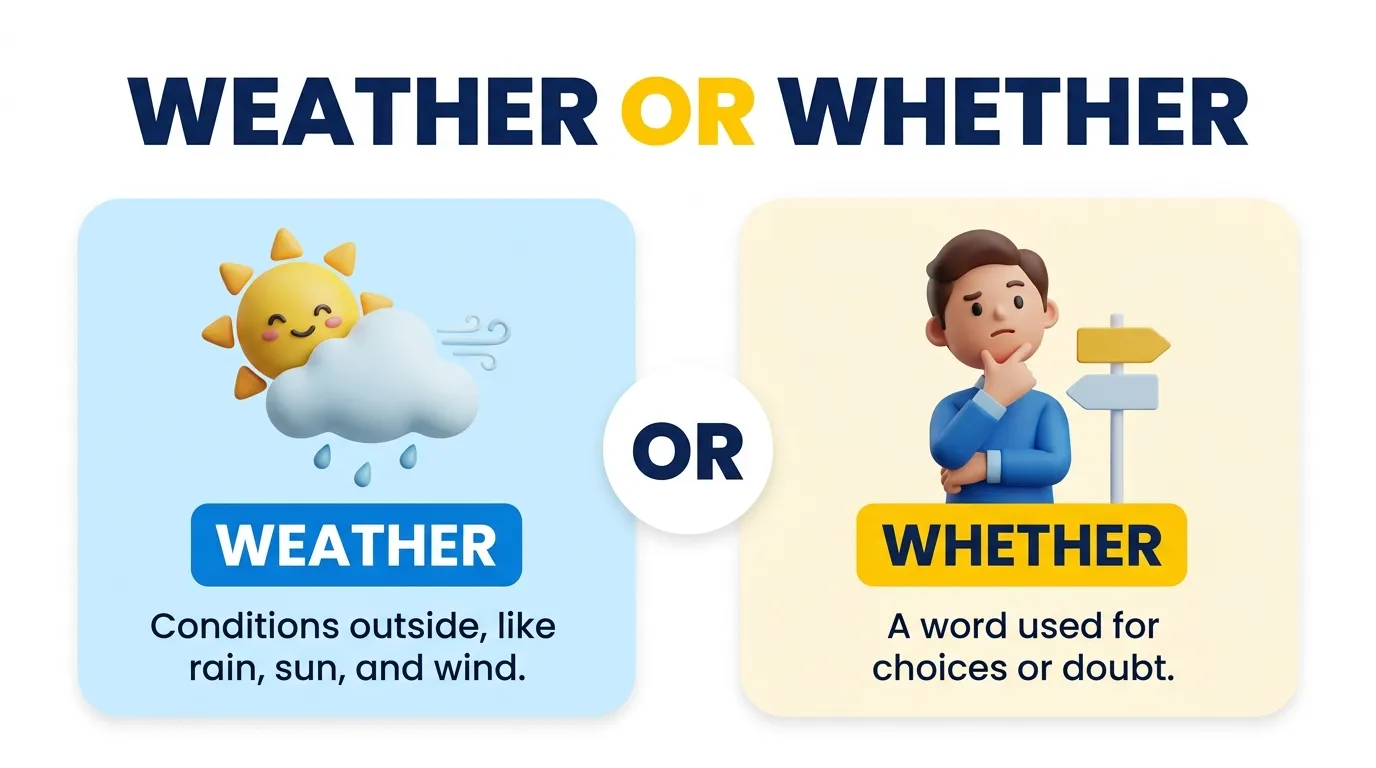
Weather means the conditions outside, like rain, sun, wind, or snow. Whether means if something will happen or if one choice is possible.
Picture this: you are writing an email to your boss, and a red line appears under the word “weather.” You stop and wonder if you picked the right word. The words weather or whether sound the same, but they have very different meanings.
The good news is that you can learn the difference with a few simple rules. Once you know what each word means, you can write clear emails, school papers, social posts, and work reports with more confidence.
Weather or Whether: The Quick Answer
Use weather when you talk about the sky and outdoor conditions. Use whether when you talk about a choice, a doubt, or two possible results.
For example:
- Weather: The weather is cold today.
- Whether: I do not know whether the shop is open.
- Weather: Bad weather may delay our flight.
- Whether: She must decide whether to stay or leave.
Easy trick: Weather is about the world outside. Whether is about what may or may not happen.
The Origin of Weather or Whether
The words weather and whether come from old forms of English. Over time, their spellings and meanings took different paths.
The word weather grew from an old English word linked to wind and the air around us. Today, it mainly means the state of the air outside, such as rain, heat, cold, or snow.
Meanwhile, whether came from an old English word used to talk about choices between two things. That meaning still guides how we use it today.
So, why do people mix them up? In many English accents, both words sound the same. Because your ears cannot always tell them apart, you must look at the meaning of the sentence.
Weather or Whether Explained: Key Differences
The easiest way to pick the right word is to look at what your sentence says.
Weather is a noun when it names outdoor conditions. It can also be a verb, as in “They weathered the storm,” which means they got through a hard time.
Whether is used to show doubt, choice, or two possible outcomes. For example, “I wonder whether he is home” shows that you do not know if he is there.
Here is a simple guide to the main differences.
| Term | Meaning | When to Use | Region/Context |
| Weather | Conditions outside | When you discuss rain, sun, wind, or snow | American and other forms of English |
| Whether | A choice or doubt | When you discuss options or possible results | American and other forms of English |
| Weathered | Got through a hard time | When you describe facing a tough event | Everyday and formal writing |
| Whether or not | No matter which result happens | When a result will not change your choice | Everyday and formal writing |
Both words are correct in American English. However, they are not used in the same way.
How to Remember the Difference
Try this easy test before you finish a sentence.
- If the sentence is about rain, heat, or wind, use weather.
- If the sentence is about a choice or doubt, use whether.
- If you can replace the word with “if,” whether may be the right choice.
For example, “I wonder whether we should leave” means “I wonder if we should leave.” However, “I wonder weather we should leave” is wrong because the sentence is not about the sky.
Which One Should You Use?
Your choice depends on what you want to say, not where you live.
- For students, use weather for topics about nature because it names outdoor conditions. Use whether when you write about choices or questions.
- For office workers, use whether when you ask if a task is ready or a meeting can take place. However, use weather when you explain a delay caused by rain or snow.
- For bloggers and news writers, use weather in forecasts and travel updates. Meanwhile, use whether when you report on choices, plans, or uncertain results.
- For everyday chats, use the word that fits your meaning. Either way, the same spelling rules apply in American English and British English.
When you are unsure, read the whole sentence and think about its meaning. If it is about the sky, choose weather. If it is about a choice, choose whether.
Common Mistakes with Weather or Whether
Because the two words sound alike, it is easy to pick the wrong spelling when you type fast. These common errors are easy to fix once you know what to look for.
Using weather for a choice
Wrong: I do not know weather he will come.
Right: I do not know whether he will come.
Why? The sentence shows doubt about his plans, so whether is the right word.
Using whether for outdoor conditions
Wrong: The whether is sunny today.
Right: The weather is sunny today.
Why? The sentence describes the sky, not a choice.
Misspelling “whether or not”
Wrong: Weather or not you agree, we will go.
Right: Whether or not you agree, we will go.
Why? This phrase means the choice will not change what happens. It has nothing to do with rain or sunshine.
Trusting spell-check too much
Wrong: Please tell me weather the file is ready.
Right: Please tell me whether the file is ready.
Why? Both words are spelled correctly on their own, so a basic spell-check tool may miss the error. Instead, check the meaning of the full sentence.
Mixing up whether and if
Less natural: We must decide if to leave now.
Better: We must decide whether to leave now.
Why? When you put “to” right after the word, whether is the usual choice. You can say “decide if we should leave,” but “decide whether to leave” is the clearer form.
Weather or Whether in Real-World Examples
Seeing these words in real situations can help you learn them faster. Notice how each one fits a different purpose.
In a professional email
EMAIL EXAMPLE
Subject: Meeting Plans
Hi Alex,
Please check the weather before you travel to the office. Also, let me know whether you can attend the meeting in person.
Thank you!
Here, weather refers to outdoor conditions, while whether asks about a possible choice.
In a news headline
NEWS EXAMPLE
Bad Weather May Delay Flights Across the City
The airline has not said whether all flights will run on time.
The headline uses weather because it describes the conditions outside. Meanwhile, whether introduces uncertainty about the flights.
In a social media post
SOCIAL POST EXAMPLE
Rain or shine, we are going on our hike! The weather may change, but we will go whether it is sunny or cloudy.
This post uses both words correctly. Weather describes the conditions, and whether shows that the plan stands either way.
In a formal document
FORMAL EXAMPLE
The team will review the weather report before travel. It will then decide whether the trip should go ahead.
In formal writing, both words are useful. However, the right choice still depends on meaning, not how formal the document sounds.
Weather or Whether: Data, Trends and Usage
People look up weather or whether when they want to spell a word correctly, fix a sentence, or improve their English. The topic fits a common search need: finding a quick answer to a word that sounds right but may look wrong on the page.
Three groups often need this help:
- Students and English learners who want to improve spelling and grammar.
- Office workers and job seekers who need clear emails and reports.
- Bloggers, editors, and content writers who want clean, easy-to-read text.
The search intent is mostly informational. People want to know which word is correct, see examples, and learn a simple rule they can use right away.
However, the words can be tricky even for strong writers. A spelling tool may accept both forms because both are real words. That is why context matters so much.
A useful tip is to learn common phrases, such as weather forecast, bad weather, whether or not, and whether to go. Once you know these patterns, you can spot many errors before you press send.
Weather or Whether: Comparison at a Glance
Use this table as a quick guide whenever you need to choose the right word.
| Term/Variant | Meaning | Region/Context | Best Used When |
| Weather | Conditions in the air outside | All major forms of English | Talking about rain, wind, sun, or temperature |
| Whether | A choice, doubt, or possible result | All major forms of English | Talking about options or uncertainty |
| Weather or not | Usually a spelling error for “whether or not” | Standard English writing | Replace with “whether or not” when showing a choice |
| Whether or not | No matter which of two outcomes is true | Formal and casual writing | Showing that a choice will not change the result |
| Weathered | Faced or survived a hard event | Everyday and formal writing | Describing how a person or group got through trouble |
The key point is simple: both weather and whether are correct words, but only one will fit the meaning you want.
Frequently Asked Questions About Weather or Whether
What is the difference between weather and whether?
Weather means the conditions outside, such as rain, wind, heat, or snow. Whether is used when you talk about a choice, doubt, or possible result. For example, “The weather is cold” and “I wonder whether it will snow” are both correct.
How do you use weather and whether in a sentence?
Use weather when you describe outdoor conditions, as in “The weather is warm today.” However, use whether to show doubt or a choice, as in “I cannot decide whether to stay.” The meaning of the sentence tells you which word to choose.
Is it weather or whether or not?
The correct phrase is whether or not when you mean that something will happen no matter which of two options is true. For example, “We will play whether or not it rains.” Use weather only when the sentence is about outdoor conditions.
Are weather and whether pronounced the same?
Yes, in many English accents, the two words sound the same. They are called homophones, which are words that sound alike but have different meanings or spellings. Because sound does not help much, check what the sentence means.
Which word is correct in formal writing, weather or whether?
Both words are correct in formal writing, but they have different jobs. Use weather for outdoor conditions and whether for choices or uncertainty. For example, a report may discuss the weather forecast and explain whether a meeting will go ahead.
Where do the words weather and whether come from?
Both words have roots in Old English, but their meanings developed in different ways. Weather became linked to the air and conditions around us, while whether became linked to choices between possibilities. Their similar sounds help explain why people mix them up today.
Should I use whether or if?
In many sentences, whether and if can both show doubt, as in “I do not know whether he is ready” and “I do not know if he is ready.” However, use whether before “to” when you talk about a choice, as in “I cannot decide whether to go.”
Final Thoughts on Weather or Whether
The difference between weather or whether is easy to learn once you focus on meaning. Weather is about the sky and outdoor conditions, while whether is about choices, doubts, and possible results. Both words are correct, but they cannot replace each other.
Remember these simple rules: check the weather before you go outside, and use whether when you talk about a choice. Also, watch for common phrases like “weather forecast” and “whether or not” because they can help you spot mistakes.
Now, before you send your next email or finish your next school paper, read the sentence once more. Choose the word that fits your meaning, and your writing will be clearer.
Curious about more confusing words? Read our guide to PPS or PSS.

I have a background in academic writing and spent several years as a proofreader for digital publications. Spotting differences between easily confused words became second nature to me. At WordsCombo, I share that knowledge so readers can write with confidence.