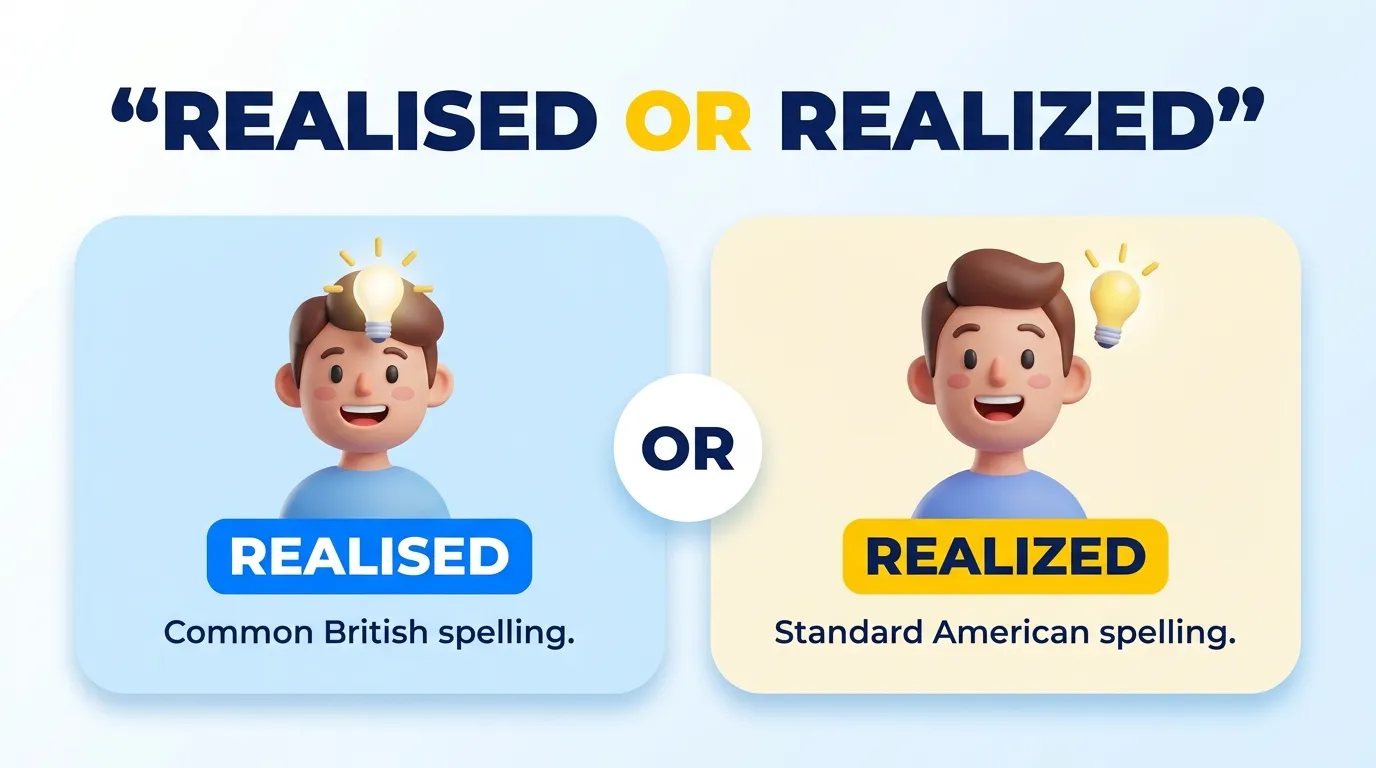
Realised and realized have the same meaning. Both are correct spellings of the past tense of realize. British English often uses realised, while American English usually uses realized.
When you finish an email and notice a red line under the word “realised,” you may wonder if you made a spelling mistake. The answer depends on which type of English you are using. Realised or realized is a common spelling choice because British and American English follow different rules. Both words mean that someone understood something or made something happen. However, choosing the right version for your reader can make your writing clearer and more consistent.
Realised or Realized: Quick Answer
Both realised and realized are correct. The main difference is regional spelling, not meaning.
- British English: I realised I had left my keys at home.
- American English: I realized I had left my keys at home.
In both examples, the person became aware of something they had not noticed before.
The Origin of Realised and Realized
The word realize comes from real, which relates to things that exist or are true. Over time, it came to mean understanding something clearly or making an idea real.
The two spellings developed through different writing traditions. British English often keeps the ending -ise, while American English commonly uses -ize.
However, British English can also accept some words ending in -ize, depending on the style guide. This is why you may see both spellings in English books, websites, and newspapers.
Realised or Realized Explained: Key Differences
The two spellings have the same meaning, grammar, and usual pronunciation. However, the preferred spelling can change based on the country or writing style.
Both forms can describe two main ideas:
- Becoming aware: I realized I had made a mistake.
- Achieving a goal: She realised her dream of becoming a doctor.
The table below shows how the spellings compare.
| Term | Meaning | When to Use | Region or Context |
|---|---|---|---|
| Realised | Became aware or achieved something | When following a style that uses -ise | Common in British English |
| Realized | Became aware or achieved something | When following American spelling | Standard in American English |
| Realise | Present form of the verb | When using British-style spelling | UK and other regions |
| Realize | Present form of the verb | When using American spelling | United States |
| Realisation | The act of understanding or achieving something | In British-style writing | Common in British English |
| Realization | The act of understanding or achieving something | In American-style writing | Standard in American English |
Does the Meaning Change?
No, the meaning stays the same. For example, “I realised the truth” and “I realized the truth” both say that someone understood what was true.
However, your choice can affect how consistent your writing looks. That is why it helps to pick one spelling style before you start writing.
Which One Should You Use?
The best choice depends on your reader and the type of English you need.
- For American readers, use realized because it follows standard American spelling.
- For British readers, use realised if you are following the common British -ise style.
- For school or college work, follow the spelling rules your teacher expects.
- For business emails, match the spelling style used by your company.
- For a website, choose the style that fits your target audience and keep it the same across your pages.
If you write for readers in Pakistan, you may see both forms because English writing can follow British or American conventions. However, British-style spelling is a common choice in Pakistani educational and formal settings.
Common Mistakes with Realised or Realized
These are some easy mistakes to avoid when choosing between the two spellings.
Using Both Spellings in One Document
Mistake: I realised my error, but later I realized my next mistake.
Correction: I realised my error, but later I realised my next mistake.
The second version follows one spelling style. Mixing forms can make an article or report look less polished.
Thinking One Spelling Is Always Wrong
Mistake: Realised is incorrect English.
Correction: Both realised and realized are accepted spellings.
The confusion happens because people learn different English rules at school. However, the correct choice depends on the spelling style you follow.
Changing the Spelling Without Changing the Grammar
Mistake: She realized to leave early.
Correction: She realized that she needed to leave early.
The issue here is grammar, not spelling. Both spellings use the same grammatical rules.
Using the Wrong Related Word
Mistake: I had a sudden realized.
Correction: I had a sudden realisation.
In American English, write “I had a sudden realization.” The noun describes the moment of understanding, while the verb describes the act of understanding.
Assuming the Word Only Means Understanding
Mistake: Realized can only mean that you understood something.
Correction: Realized can also mean that you achieved a goal or made an idea real.
For example, “He realized his dream of owning a shop” means that he achieved his dream.
Realised or Realized in Real-World Examples
These examples show how the word works in everyday writing.
Professional Email
Subject: Update on the Report
Hi Sarah,
I realised that one figure in the report was incorrect, so I have updated it. Please review the new version before the meeting.
Best regards,
James
For an American workplace, replace realised with realized to match American spelling.
News Headline
British-style headline: Local Team Realised Its Dream of Winning the Final
American-style headline: Local Team Realized Its Dream of Winning the Final
Both headlines describe the same achievement. However, news outlets usually follow a consistent house style.
Social Media Post
British-style: I just realised how far I have come this year!
American-style: I just realized how far I have come this year!
Either version works for a personal post. Choose the form that matches the English style you usually use.
Formal Document
British-style: The committee realised that the original plan needed changes.
American-style: The committee realized that the original plan needed changes.
Both sentences are suitable for formal writing. The key is to follow the spelling rules used throughout the document.
Realised or Realized: Usage Trends and Search Intent
People often search for realised or realized when they are writing an email, completing schoolwork, editing an article, or checking a spelling mistake.
The main reason for this search is simple: the words look different, but their meanings are the same.
Who Searches for This Spelling?
Several groups may need a quick answer:
- Students checking essays and homework.
- Writers editing blog posts and articles.
- Office workers preparing emails and reports.
- English learners comparing British and American spelling.
- Website owners writing for readers in different countries.
Why Does This Difference Matter?
English is used in many countries, and each region may prefer different spelling rules. As a result, a word that looks unusual to one reader may be normal to another.
For example, an American editor may change realised to realized throughout an article. Meanwhile, a British editor who follows an -ise style may make the opposite change.
The main search intent is informational. Most readers want a quick answer, a clear example, and advice on which spelling to choose. Therefore, the easiest way to avoid confusion is to learn the regional difference and use one style throughout your writing.
Realised or Realized: Comparison at a Glance
| Term or Variant | Meaning | Region or Context | Best Used When |
|---|---|---|---|
| Realised | Understood or became aware | British-style English | Writing with -ise spellings |
| Realized | Understood or became aware | American English | Writing for a US audience |
| Realised a dream | Achieved a dream | British-style English | Describing a goal achieved |
| Realized a dream | Achieved a dream | American English | Describing a goal achieved |
| Realisation | Understanding or achievement | British-style spelling | Using the noun form |
| Realization | Understanding or achievement | American spelling | Using the noun form |
Frequently Asked Questions About Realised or Realized
1. What is the correct spelling, realised or realized?
Both spellings are correct, but they follow different regional styles. Use realized for American English and realised for the common British -ise style.
2. What does realised mean in simple English?
Realised means that you understood something or became aware of a fact. For example, “I realised I had forgotten my bag” means you noticed that your bag was missing.
3. Is realised or realized correct in American English?
Realized is the standard American spelling. Therefore, use it in US schoolwork, business emails, and articles written in American English.
4. Is realised acceptable in formal writing?
Yes, realised is acceptable in formal writing when it matches the spelling style you follow. However, if your school, employer, or publisher requires American English, use realized instead.
5. What is the difference between realised and realized?
There is no difference in meaning or grammar. The main difference is spelling, with realised common in British-style English and realized standard in American English.
6. Where did the different spellings come from?
The spellings reflect different English writing traditions. British English commonly uses -ise endings, while American English generally uses -ize endings.
7. Should I write “I just realised” or “I just realized”?
Both sentences are correct. Use “I just realised” when following a British -ise style, or “I just realized” when following American spelling.
Conclusion: Realised or Realized?
The choice between realised or realized is simple once you know the difference. Both words have the same meaning, and neither is always better than the other. The spelling depends on the type of English you are using.
Remember these key points:
- Realised is common in British-style English.
- Realized is the standard American spelling.
- Both words can mean understanding something or achieving a goal.
- Consistent spelling makes your writing look clear and professional.
For everyday writing, choose the spelling that suits your readers. If you write for a US audience, use realized. For a British-style audience, realised is a safe choice. Keep learning these small spelling differences to write with more confidence.
Curious about similar spelling pairs? Read our guide to Baptised or Baptized.

I studied English literature and have spent years editing content for blogs and digital platforms. I noticed most people struggle with choosing between two similar words. At WordsCombo, I make that choice simple and clear.