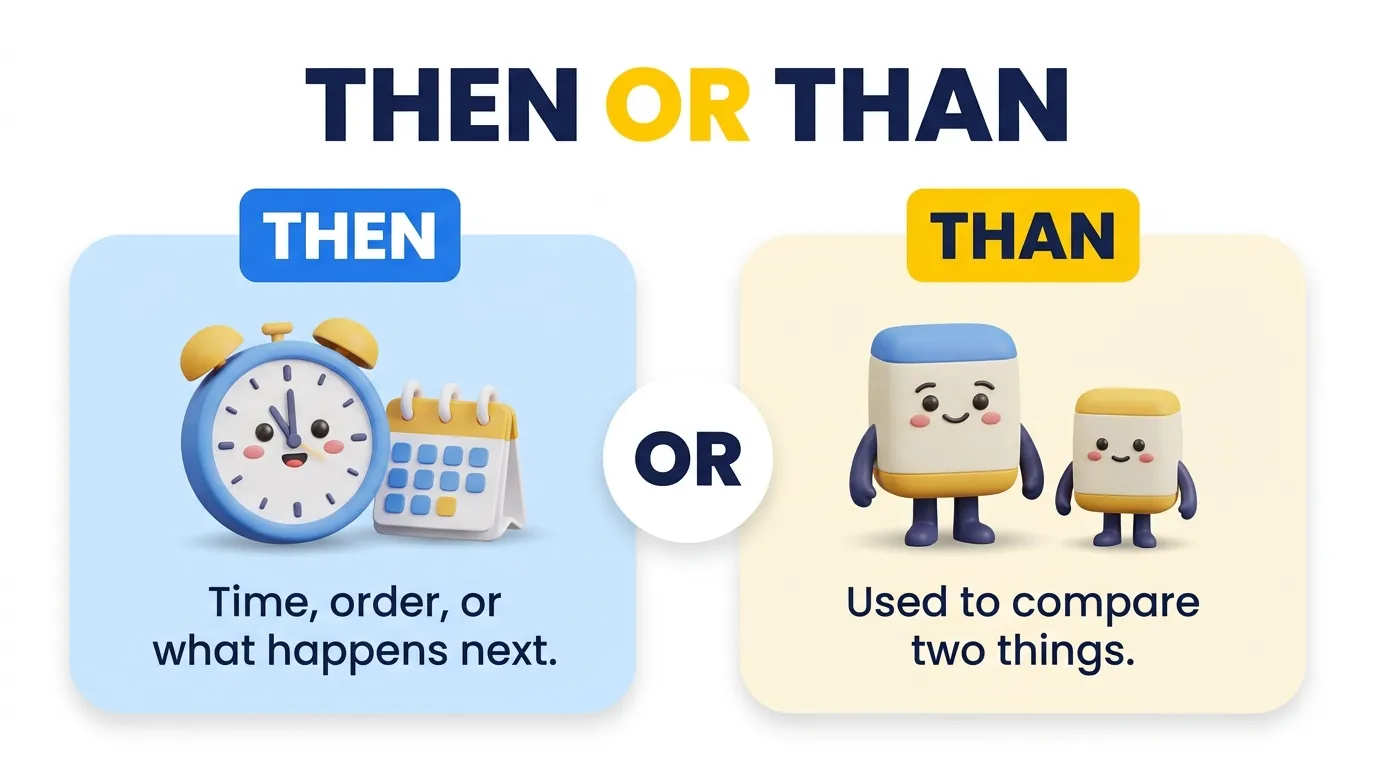
Then refers to time, order, or what happens next. Than is used to compare two people, things, or ideas.
You might type “I am taller then my brother” in an email, only to spot the red squiggly line before you send it. The words then or than look alike, but they have different jobs. The same mix-up can slip into work emails, school essays, and social posts. Luckily, one simple rule can help you choose the right word every time. Learn the key difference, see real examples, and avoid common mistakes with this easy guide.
Then or Than: Quick Answer
Use then when you talk about time, order, or what happens next. Use than when you compare two things.
- Then: We ate dinner, then watched a movie.
- Than: This movie is funnier than the last one.
Here is a simple rule to remember: Then has an E, like when. Than has an A, like compare. So, if you talk about time, choose then. However, if you compare things, choose than.
The Origin of Then or Than
The words then and than come from old forms of English. Long ago, their uses were more alike than they are today.
Over time, the words took on different jobs. Then became closely tied to time, order, and results. Than became the main word for making comparisons.
Their similar sounds still cause mix-ups. In fast speech, the difference can be hard to hear. As a result, many people type the wrong word without noticing.
Then or Than Explained: Key Differences
Although these words look almost the same, their meanings are different. The best choice depends on what you want to say.
When to use then
Use then to talk about time, order, or a result.
- Time: I lived in Texas back then.
- Order: First, wash your hands. Then, make lunch.
- Result: If it rains, then we will stay home.
- Past time: She was the team leader then.
For example, “Finish your work, then take a break” shows what happens next. The word then helps put the two actions in order.
When to use than
Use than when you compare people, things, amounts, or choices.
- People: Mia is taller than Ben.
- Things: This bag is cheaper than that one.
- Amounts: We need more than five chairs.
- Choices: I would rather walk than drive.
For instance, “This test is easier than the last one” compares two tests. The word than links the two sides of that comparison.
Then vs. Than: A Simple Comparison
| Term | Meaning | When to Use | Region/Context |
| Then | At that time or next | To show time, order, or a result | American and British English |
| Than | Used to compare | After words like better, faster, more, and less | American and British English |
Both words are correct in US English. However, they cannot replace each other because each word has a different meaning.
Which One Should You Use?
The right word depends on your sentence, not your location. Both words work the same way in American English and British English.
- For students: Use then to show the order of events, but use than to compare two things in an essay.
- For work emails: Choose then for the next task, while than works for comparing plans, prices, or results.
- For bloggers and writers: Use than when comparing products or ideas, and use then when telling a story.
- For formal writing: Check the meaning before you send or share your work, because both words are correct but serve different purposes.
- For everyday chats: Ask yourself if you mean “next” or “compared with.” That quick check often gives you the answer.
Try This Easy Memory Trick
Remember that then has an E, just like when. Both words relate to time.
Meanwhile, than has an A, which can remind you of making a comparison. For example, “A cat is smaller than a horse” compares two animals.
Common Mistakes with Then or Than
Even strong writers mix up these words when they type fast. Here are five mistakes to watch for.
Mistake: Writing “better then”
Wrong: This phone is better then my old one.
Right: This phone is better than my old one.
Why does this happen? The words sound alike, so it is easy to pick the wrong spelling. Since the sentence compares two phones, than is correct.
Mistake: Writing “first, than”
Wrong: First, add the eggs, than stir the mix.
Right: First, add the eggs, then stir the mix.
The sentence gives two actions in order. Therefore, then tells you what to do next.
Mistake: Writing “more then”
Wrong: The box weighs more then ten pounds.
Right: The box weighs more than ten pounds.
Here, the sentence compares the weight with a set amount. So, than is the right choice.
Mistake: Writing “rather then”
Wrong: I would rather read rather then watch TV.
Right: I would rather read rather than watch TV.
The phrase rather than shows a choice between two actions. Because the sentence compares those choices, than is needed.
Mistake: Trusting spell-check alone
A spell-check tool may accept both words because both are real English words. However, it may not know that the word is wrong for your meaning.
Before you finish, read the sentence again. Ask whether you mean time or comparison, and then check the spelling.
Then or Than in Real-World Examples
The best way to learn these words is to see how people use them in daily life. Here are examples from common types of writing.
Professional email
“Please review the report, then send your notes by Friday.”
This sentence shows the order of two tasks. First, review the report. After that, send your notes.
Business comparison
“Our new plan costs less than the old plan.”
The sentence compares two plans and their costs. Therefore, than is the correct word.
News headline
“Local Team Wins, Then Heads to the Finals”
The headline shows what happened first and what came next. As a result, then makes the order clear.
Social media post
“This recipe is easier than it looks!”
The post compares how easy the recipe is with how easy it seems. So, than fits the meaning.
Formal document
“The board reviewed the proposal and then approved it.”
This sentence lists two events in order. The review came first, and the approval came next.
School essay
“Reading every day is better than spending all your free time on a screen.”
This sentence compares two ways to spend time. Since it expresses a comparison, than is the correct choice.
Then or Than: Search Trends and Usage
People search for then or than when they want a quick answer to a common spelling and grammar problem. The search often happens while writing an email, finishing homework, editing a blog, or checking a work report.
The main search goal is clear: people want to know which word fits their sentence. They also want short rules, easy examples, and a way to avoid the same mistake later.
Here are the main groups who may look up this question:
- Students who want to improve grammar and spelling.
- English learners who need help with words that sound alike.
- Office workers who want clear, correct emails.
- Bloggers and content writers who want clean, easy-to-read posts.
- Teachers and editors who explain common writing errors.
A useful point is that both words pass many basic spell-checks. Therefore, learning the meaning is more helpful than relying on spelling tools alone.
The search also has a clear purpose. Most people want to solve a writing problem right away, rather than read a long lesson on grammar. That is why a short rule, followed by examples, is often the best way to learn.
Then or Than: Comparison at a Glance
| Term/Variant | Meaning | Region/Context | Best Used When |
| Then | Next or at that time | US and UK English | You describe time or order |
| Than | Used to compare | US and UK English | You compare people, things, or amounts |
| Rather than | One choice instead of another | Everyday and formal writing | You show a choice |
| More than | A greater amount or number | Everyday and formal writing | You compare amounts |
| Since then | From a past time until now | Everyday and formal writing | You describe a change over time |
Keep this table in mind when you write. If you are unsure, look at the words around then or than to help you decide.
FAQs About Then or Than
What is the difference between then and than?
Then refers to time, order, or a result, while than is used for comparisons. For example, “We ate, then left” shows order, but “We ate more than they did” makes a comparison.
How do you remember when to use then or than?
Remember that then has an E, like when, which relates to time. Meanwhile, than has an A, which can remind you of comparing things.
Is it better than or better then?
The correct phrase is better than because it compares two things. For example, “This book is better than the last one” is correct.
Is it more than or more then?
Use more than when you compare an amount or number. For example, “The class has more than 20 students” is correct because it compares the number with 20.
Is then or than correct in formal writing?
Both words are correct in formal writing, but they have different meanings. Use then for time or order, and use than for comparisons to keep your writing clear.
Why do people confuse then and than?
The words look and sound very similar, especially when people speak fast or type in a hurry. However, their meanings are different, so checking the sentence can help you choose the right one.
Should I write rather than or rather then?
The correct phrase is rather than because it shows a choice between two things or actions. For example, “I would rather walk than take the bus” is correct.
Final Thoughts on Then or Than
Choosing between then or than is easy once you know what each word means. Use then when you talk about time, order, or what happens next. However, choose than when you compare people, things, choices, or amounts.
Keep these simple examples in mind: “We ate, then left” and “We ate more than they did.” The first sentence shows order, while the second compares amounts. With practice, you will spot the difference faster.
Before sending an email, finishing an essay, or posting online, take a moment to check your words. Use then for time and than for comparison. Try this rule in your next sentence, and make clear writing a daily habit!
Curious about other tricky words? Read our guide to Opossum or Possum.

I have been working with English language content for over six years. I specialize in word comparisons and spelling differences that most people overlook. At WordsCombo, I help readers choose the right word every time.