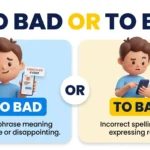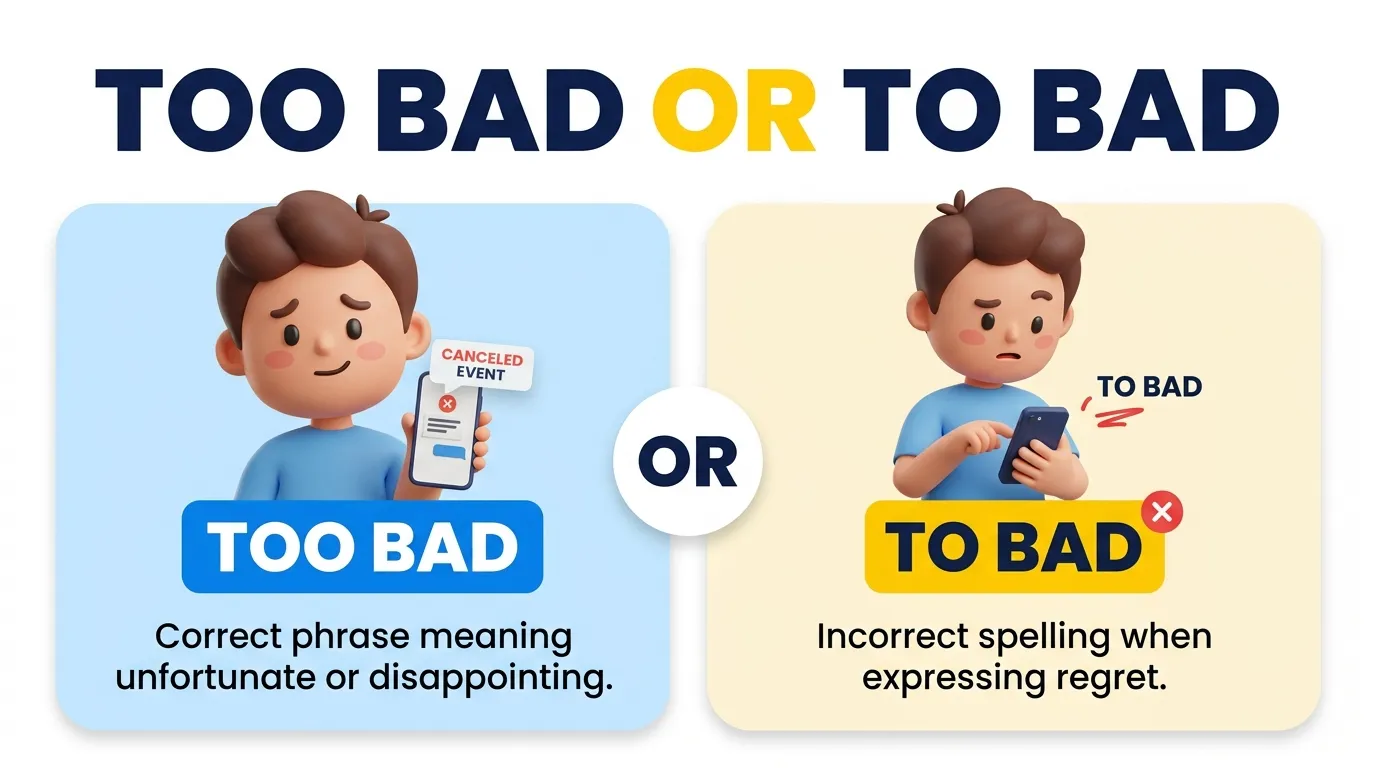
Too bad is the correct phrase when you mean something is sad, unfortunate, or not good enough. To bad is usually incorrect because to does not work as an adverb meaning “very” or “unfortunately.”
You are about to send a text, and your spell checker flags “to bad.” You pause because both words sound the same. This mix-up is common, but the fix is simple. Too bad or to bad depends on what you want to say. Use too bad for a sad result or something that is not good.
However, to has other jobs, such as showing direction or linking a verb to its next action. A few clear examples will help you choose the right phrase every time.
Too Bad or To Bad: Quick Answer
Too bad is the correct spelling when you mean that something is unfortunate, disappointing, or not good. The word too can mean “also” or “more than needed,” but in this phrase, it often shows regret.
For example:
- “Too bad you missed the game.” This means it is sad that you missed it.
- “The weather is too bad for a picnic.” This means the weather is not good enough.
By contrast, to bad is not the right choice for these meanings. Still, the words to and bad can appear next to each other in a sentence when the grammar calls for them.
The Origin of Too Bad and To Bad
The mix-up starts because to, too, and two sound alike in everyday speech. However, each word has a different meaning and job.
The word too comes from an older English word that meant “also” or “in addition.” Over time, it also came to mean “more than needed.” That is why we say “too hot,” “too late,” and “too bad.”
Meanwhile, to is often used to show direction, a goal, or an action. For example, you can walk to school or want to play. Since the two words sound the same, it is easy to type the wrong one.
Too Bad Explained: Key Differences
The main difference is the role each word plays in a sentence. Too adds meaning, while to often links words or shows direction.
Consider these examples:
- Too bad: “It is too bad that the shop is closed.” This shows regret.
- To: “I need to go to the shop.” This shows an action and a place.
- Too much: “The bag is too heavy.” This means the bag weighs more than needed.
- To be bad: “I do not want to be bad.” Here, to comes before the verb be, and bad describes a state or quality.
The table below makes the difference easier to remember.
| Term | Meaning | When to Use | Region/Context |
|---|---|---|---|
| Too bad | Unfortunate or disappointing | When sharing regret | American and British English |
| To | Shows direction or comes before a verb | “Go to work” or “to eat” | All standard English |
| Too | Also or more than needed | “Me too” or “too cold” | All standard English |
| Two | The number 2 | Counting people or things | All standard English |
Which One Should You Use?
The best choice depends on the message you want to send. In most cases, too bad is right when you express sadness or disappointment.
- For everyday chats: Use “Too bad!” when a friend shares sad news or misses an event.
- For schoolwork: Write “too bad” when the phrase means unfortunate or disappointing.
- For work emails: Use “too bad” in a friendly message, but choose “unfortunate” for a more formal tone.
- For formal writing: Use to only when the sentence needs it, such as “I need to leave.”
- For neutral sentences: Check the meaning before choosing to or too, since they have different jobs.
For example, “Too bad you cannot join us” is correct. However, “I want to bad” is not correct if you mean you want to do something bad. You would write “I want to do something bad” instead.
Common Mistakes with Too Bad or To Bad
Even strong writers can mix up words that sound alike. Here are common mistakes and easy ways to fix them.
– Mistake: “To bad you missed the party.”
Correction: “Too bad you missed the party.” Use too bad to show regret.
– Mistake: “The food is to spicy.”
Correction: “The food is too spicy.” Here, too means more spicy than wanted.
– Mistake: “I want too leave.”
Correction: “I want to leave.” Use to before the verb leave.
– Mistake: “I have too apples.”
Correction: “I have two apples.” Use two when you mean the number 2.
– Mistake: “That is to bad.”
Correction: “That is too bad.” The phrase expresses disappointment, so too is the right word.
These errors happen because the words sound alike. However, you can avoid them by checking the meaning of the full sentence rather than just the sound.
Too Bad in Real-World Examples
The phrase too bad appears in daily chats, work messages, online posts, and news writing. Its tone depends on the situation, so choose your words with care.
In a Professional Email
“It’s too bad we could not meet today, but I hope we can find another time next week.”
This sounds friendly and polite. For a more formal email, you could write, “It is unfortunate that we could not meet today.”
In a News Headline
“Too Bad for Fans as the Match Is Called Off”
This headline uses too bad to show that fans may feel disappointed. However, a news report may use a more neutral phrase, such as “Fans Disappointed After Match Cancellation.”
In a Social Media Post
“Too bad the concert sold out before I got my tickets!”
This is a natural way to share disappointment online. You could also write, “Too bad! Maybe next time.”
In a Formal Document
“It is too bad that the planned event cannot go ahead.”
The phrase is grammatically correct, but it may sound too casual in a formal report. Instead, write, “It is unfortunate that the planned event cannot go ahead.”
Too Bad: Data, Trends and Usage
People search for too bad or to bad because they want to check spelling, grammar, and everyday English use. The search usually has an informational goal: the reader wants a quick answer and examples that make the rule clear.
English learners, students, bloggers, and people writing emails may all face this problem. In fact, short phrases can cause more doubt than long words because sound alone does not show the correct spelling.
The key lesson is that too bad is a set phrase that expresses regret or disappointment. However, to remains correct in sentences such as “I need to go.” Learning the role of each word helps you write clearly in texts, schoolwork, and professional messages.
Too Bad vs To Bad: Comparison at a Glance
| Term/Variant | Meaning | Region/Context | Best Used When |
|---|---|---|---|
| Too bad | Sad, unfortunate, or disappointing | Standard English worldwide | You want to express regret |
| To bad | Usually an incorrect spelling of too bad | Common spelling error | Do not use it to express regret |
| Too | Also or more than needed | Standard English worldwide | You mean “also” or “excessively” |
| To | Direction, purpose, or a verb link | Standard English worldwide | You write “go to school” or “want to eat” |
| Two | The number 2 | Standard English worldwide | You count two people or things |
Frequently Asked Questions About Too Bad or To Bad
Is it too bad or to bad?
Too bad is correct when you mean something is unfortunate or disappointing. For example, “Too bad you missed the show” is correct, while “To bad you missed the show” is not.
What does too bad mean in a text?
In a text message, too bad often means “what a shame” or “that is unfortunate.” However, the tone can change with the situation, so it may sound kind, sad, or even sarcastic.
Is too bad one word or two words?
Too bad is written as two separate words. Use both words together when you express regret or say that something is unfortunate.
Is too bad acceptable in formal writing?
Yes, too bad is grammatically correct in formal writing, but it can sound casual. For a formal email or report, unfortunate or disappointing may be a better choice.
Why do people confuse to bad and too bad?
People confuse these phrases because to and too sound alike when spoken. However, too means “also” or “more than needed,” while to often shows direction or comes before a verb.
Is to bad ever correct in a sentence?
Yes, the two words can appear next to each other when they have separate jobs in a sentence. For example, “The day went from good to bad” is correct because to shows a change from one state to another.
How can I remember whether to use too bad or to bad?
Remember that too has an extra letter, and it can express an extra degree or a strong feeling. If you mean “what a shame,” use too bad. This simple trick works for everyday writing, texts, and emails.
Conclusion
The correct choice is too bad when you want to express regret, sadness, or disappointment. For example, “Too bad we missed the bus” is correct because the speaker feels sorry about what happened. However, to is right when you show direction or introduce an action, such as “I need to leave.”
Keep one simple rule in mind: if you mean “what a shame,” write too bad. Also, remember that to, too, and two have different meanings, even though they sound alike.
Now you can choose the right phrase with confidence. Save this guide and share it with a friend who wants to improve their English!
Curious about other confusing words? Explore our guide to Weather or Whether.

I have a background in academic writing and spent several years as a proofreader for digital publications. Spotting differences between easily confused words became second nature to me. At WordsCombo, I share that knowledge so readers can write with confidence.