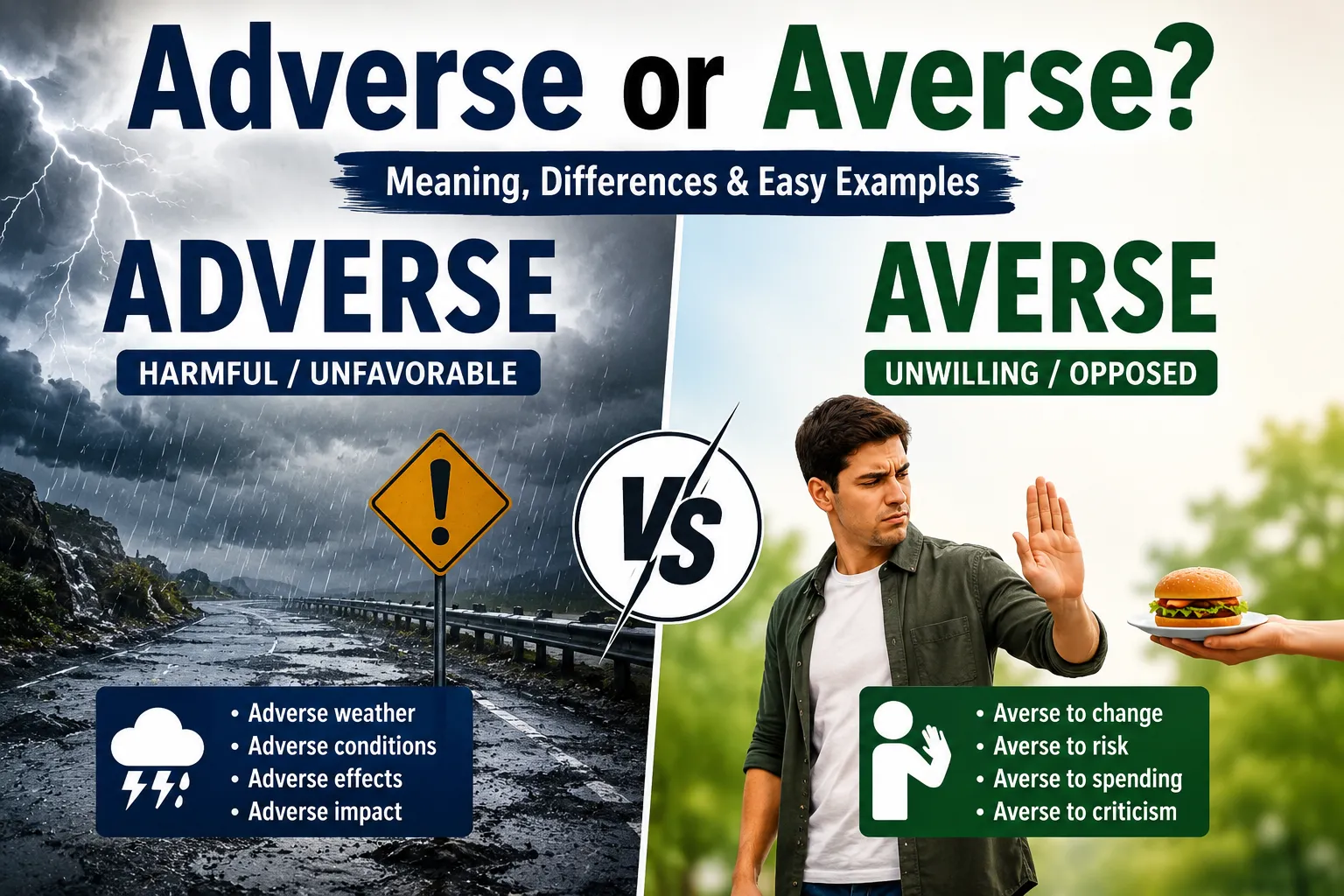
Adverse or averse depends on meaning: adverse describes something harmful or unfavorable, while averse means strongly unwilling or opposed to something.
Have you ever written a sentence like “I am adverse to change” and then wondered if it sounds right?
You are not alone. Adverse and averse look almost the same. They also sound similar. That makes them easy to mix up, even in formal writing.
The good news is that the difference is simple once you connect each word to its main idea.
Think of adverse as something that is bad for you. Think of averse as a person who is against something.
For example, bad weather can have an adverse effect on a flight. A person may be averse to flying because they dislike it.
That small difference can save you from many common grammar mistakes.
This guide explains adverse or averse in plain English. You will learn what each word means, where it comes from, how to use it, and how to remember the difference. You will also see examples from work, news, social media, and formal writing.
By the end, choosing the right word should feel much easier.
Adverse or Averse
The easiest way to remember the difference is this:
- Adverse = harmful, negative, or unfavorable.
- Averse = strongly against, unwilling, or disliking something.
Examples of adverse
The company faced adverse market conditions.
Here, adverse means unfavorable.
The medicine may cause adverse effects.
Here, adverse means harmful or unwanted.
Examples of averse
She is averse to taking risks.
She does not like or want to take risks.
Many people are averse to sudden change.
They strongly dislike or resist sudden change.
Quick memory trick:
Adverse = bad conditions.
Averse = bad feelings toward something.
The Origin and Background of Adverse or Averse
The words adverse and averse have a shared history.
Both come from Latin roots connected with the idea of turning away. Over time, the two words developed different meanings in English.
Adverse came to describe something that works against you. It often refers to conditions, results, effects, or situations.
For example:
The team worked through adverse conditions.
The conditions were difficult or unfavorable.
Averse, however, developed more strongly around personal feelings or attitudes. If you are averse to something, you do not want it or you strongly dislike it.
For example:
He is averse to borrowing money.
The sentence describes his attitude toward borrowing money.
This history helps explain why the words look alike. Their meanings are related, but their modern uses are different.
Adverse or Averse Explained: Key Differences
The biggest difference is what the word describes.
Adverse usually describes a thing, condition, situation, effect, or result.
Averse usually describes a person’s attitude or feeling toward something.
| Term | Meaning | When to Use | Region/Context |
|---|---|---|---|
| Adverse | Harmful or unfavorable | Conditions, effects, results, events | Standard English |
| Averse | Unwilling or strongly opposed | Personal attitudes or preferences | Standard English |
| Adversely | In a harmful or negative way | Explaining a negative effect | Formal and general writing |
| Aversion | A strong dislike | Naming the feeling itself | Standard English |
Use adverse for negative conditions
Common phrases include:
- adverse effects
- adverse conditions
- adverse weather
- adverse results
- adverse circumstances
- adverse impact
Example:
Heavy rain created adverse conditions for drivers.
The rain is not a person with an opinion. It creates difficult conditions. So adverse is correct.
Use averse for personal dislike or opposition
The common pattern is:
be averse to + noun/gerund
Examples:
I am averse to unnecessary spending.
She is averse to working late.
They are averse to taking financial risks.
Notice the word to after averse.
This is a useful pattern to remember.
Which Version Should You Use?
If you are a student, writer, employee, or English learner, use this simple rule.
- For students → use adverse for harmful or unfavorable things.
- For personal opinions → use averse when someone strongly dislikes or avoids something.
- For formal writing → use either word when its meaning fits. Neither is wrong or informal.
- For global English → follow the same distinction. Both words are standard in British and American English.
A simple test
Ask yourself:
“Is something harmful or unfavorable?”
Use adverse.
The storm caused adverse conditions.
Now ask:
“Is someone against or unwilling to do something?”
Use averse.
The driver was averse to taking the mountain road.
That test works in most everyday situations.
Common Mistakes with Adverse or Averse
These words are often confused because they look so similar.
| Mistake | Correction | Why? |
|---|---|---|
| I am adverse to change. | I am averse to change. | The sentence describes a personal attitude. |
| The drug caused averse effects. | The drug caused adverse effects. | The effects are harmful or unwanted. |
| The company faced averse conditions. | The company faced adverse conditions. | The conditions were unfavorable. |
| She is adverse to taking risks. | She is averse to taking risks. | She is unwilling to take risks. |
| The decision affected sales aversely. | The decision affected sales adversely. | The meaning is “in a harmful way.” |
Mistake 1: “Adverse to” for personal dislike
You may hear:
He is adverse to change.
In standard English, averse to is the better choice.
He is averse to change.
Mistake 2: “Averse effects”
This is another common mix up.
The medicine caused averse effects. ❌
Use:
The medicine caused adverse effects. ✅
The effects are harmful or unwanted. They are not feelings.
Mistake 3: Forgetting “to” after averse
Do not write:
She is averse change. ❌
Write:
She is averse to change. ✅
The structure is normally averse to + noun or ing form.
Adverse or Averse in Real World Examples
Seeing these words in real situations makes the difference easier to remember.
1. Professional Email
We may experience adverse effects if the project is delayed.
Here, adverse describes negative effects.
Another example:
I am averse to changing the agreed plan without more information.
Here, averse to describes a person’s attitude.
2. News Headline or Article
A news report might say:
Adverse Weather Delays Flights Across the Region
This means the weather is causing unfavorable or difficult conditions.
Another news style sentence could be:
Investors remain averse to high risk assets.
Here, averse to describes investors’ attitude toward risk.
3. Social Media Post
The hike was amazing, but the adverse weather made the final mile difficult.
The weather created a problem, so adverse is correct.
Or:
I’m averse to buying things I don’t really need.
The sentence describes a personal preference, so averse works.
4. Formal Report
The study found no significant adverse effects during the testing period.
This is a common formal use of adverse.
For a personal or organizational attitude, you could write:
The committee was averse to increasing costs without stronger evidence.
Again, averse to describes opposition.
Adverse or Averse: Data, Trends & Usage
People often search “adverse or averse” when they are checking a sentence before writing it. The search intent is mainly informational.
The topic matters because these words are common in several areas:
- Education: Students often confuse similar looking words.
- Business: “Adverse conditions” and “adverse effects” appear in reports.
- Health writing: “Adverse effects” is a common phrase.
- News: “Adverse weather” and “adverse conditions” are widely used.
- Everyday English: “Averse to” appears when people discuss choices and preferences.
One useful insight is that adverse appears in many fixed phrases. This makes it easier to learn through word groups rather than memorizing the definition alone.
For example, remember:
adverse effects
adverse weather
adverse conditions
Then remember:
averse to change
averse to risk
averse to spending
Learning these patterns can make correct usage almost automatic.
Standalone Comparison: Adverse vs. Averse
| Term/Variant | Meaning | Region/Context | Best Used When |
|---|---|---|---|
| Adverse | Harmful or unfavorable | British and American English | Describing negative conditions or effects |
| Averse | Strongly unwilling or opposed | British and American English | Describing a person’s attitude |
| Adversely | In a harmful or negative way | Formal and general English | Describing a negative impact |
| Aversion | Strong dislike | General English | Naming a strong dislike or avoidance |
Compare these two sentences
The storm had an adverse effect on travel.
The storm caused a negative result.
The traveler was averse to flying.
The traveler personally disliked or avoided flying.
The subject changes from a negative effect to a personal attitude.
That is the key.
A Simple Memory Trick for Adverse or Averse
Here is an easy trick you can use in an exam or while writing.
Adverse = Against your interests
Think:
Adverse weather → bad weather
Adverse effects → bad effects
Adverse conditions → bad conditions
Averse = A person avoids
Think:
Averse to risk → does not like risk
Averse to change → does not like change
Averse to spending → does not want to spend
If you remember “adverse = bad” and “averse = against”, you will usually choose correctly.
FAQs About Adverse or Averse
Q: What does adverse mean?
A: Adverse means harmful, unfavorable, or negative. It commonly describes conditions, effects, results, or circumstances.
Q: What does averse mean?
A: Averse means strongly unwilling, opposed, or unwilling to accept something. It usually describes a person’s attitude toward something.
Q: How do you use adverse correctly?
A: Use adverse when something creates a negative or harmful situation. For example, “The company faced adverse economic conditions.”
Q: How do you use averse correctly?
A: Use averse when someone dislikes or is unwilling to accept something. The usual pattern is averse to, as in “She is averse to taking risks.”
Q: Adverse vs. averse: what is the difference?
A: Adverse means harmful or unfavorable. Averse means strongly opposed or unwilling. A simple rule is adverse = bad conditions; averse = personal dislike.
Q: Is adverse acceptable in formal writing?
A: Yes. Adverse is common in formal writing, business reports, academic work, medical writing, and news articles. Phrases such as adverse effects and adverse conditions are standard.
Q: Which is correct: “adverse to” or “averse to”?
A: When you mean “strongly opposed to” or “unwilling to,” use averse to. For example, “He is averse to change.”
Q: Where do adverse and averse come from?
A: Both words have Latin roots linked to the idea of turning away. Their meanings later developed in different directions in English.
Q: Can I use averse in professional writing?
A: Yes. Averse is perfectly acceptable in professional writing when you are describing someone’s strong dislike or unwillingness. For example, “The client is averse to unnecessary risk.”
Conclusion
The difference between adverse or averse is much simpler than it first appears.
Remember these three points:
- Adverse means harmful, negative, or unfavorable.
- Averse means strongly unwilling or opposed.
- Averse is usually followed by to.
So, write:
adverse effects
because the effects are harmful.
Write:
adverse weather
because the weather is unfavorable.
But write:
averse to change
because someone does not like or want change.
You do not need to memorize long grammar rules. Focus on the meaning. If you are describing a bad condition or negative effect, choose adverse. If you are describing a person’s dislike or opposition, choose averse.
Once you learn these common patterns, the difference becomes much easier to spot.
Bookmark this guide so you never have to second guess “adverse or averse” again.
Read more: Appraise or Apprise: The Easy Way to Know

I have been working with English language content for over six years. I specialize in word comparisons and spelling differences that most people overlook. At WordsCombo, I help readers choose the right word every time.