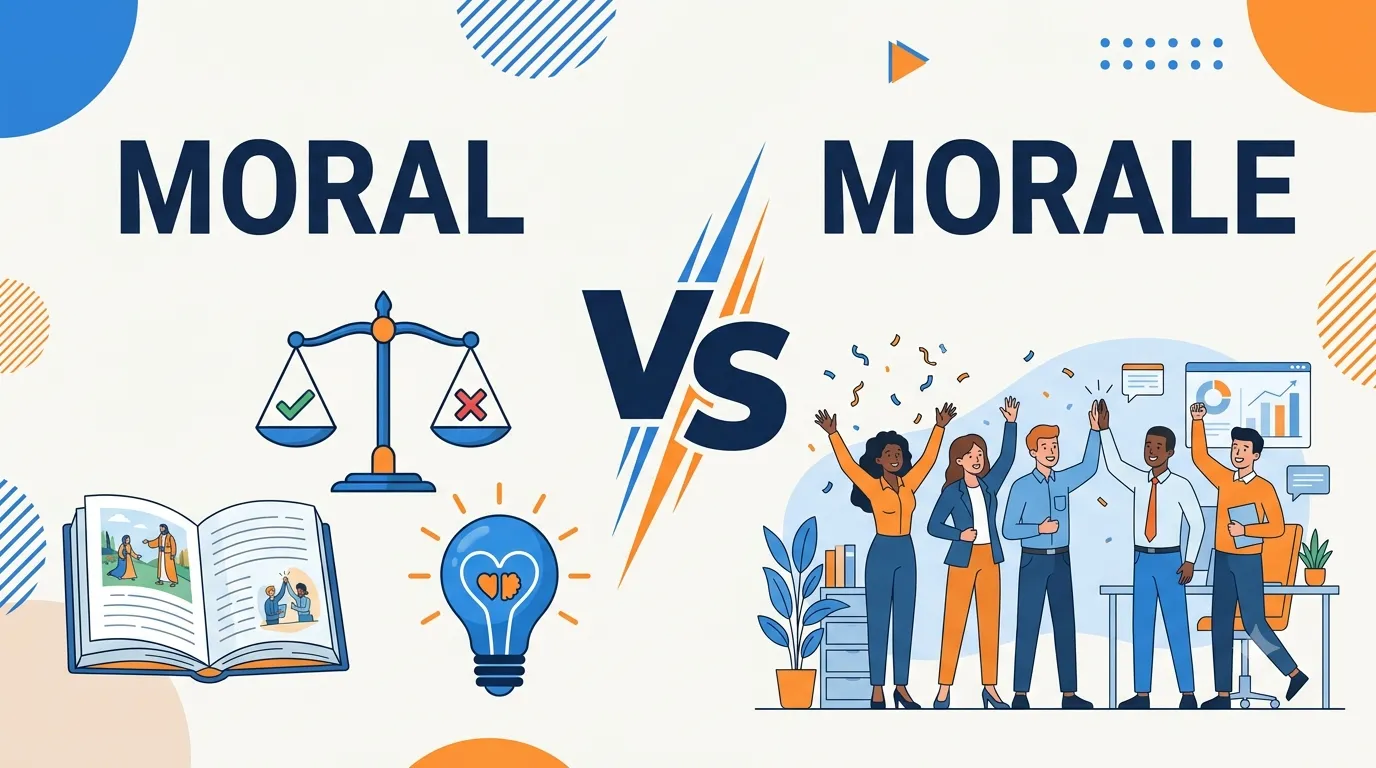
Moral usually means a lesson about right and wrong, while morale means the confidence, spirit, or motivation of a person or group. They sound alike, but they have very different meanings and should never be used interchangeably.
A few years ago, I was reviewing an article written by a new writer. One sentence caught my eye: “The team’s moral was high after winning the championship.” I smiled because I had made the same mistake when I first started teaching English. One missing letter completely changed the meaning of the sentence.
Many people confuse moral and morale because they sound almost the same. Spell check often misses the mistake because both words are correct English words. That makes the confusion even more common.
If you have ever paused while writing an email, school assignment, or work report and wondered which word to use, you are not alone.
This guide will make the difference easy to understand. You will learn what each word means, where it came from, when to use it, common mistakes to avoid, and plenty of real life examples. By the end, you will never mix up moral and morale again.
Moral or Morale: Quick Answer
The difference is simple.
- Moral = a lesson, principle, or belief about right and wrong.
- Morale = the confidence, enthusiasm, or spirit of a person or group.
Examples
- The moral of the story is to always tell the truth.
- Employee morale improved after everyone received a bonus.
A quick memory trick:
- Moral = Right and Wrong
- Morale = Team Spirit
The Origin and Background of Moral and Morale
Although these words look similar, they developed different meanings over time.
Moral
The word moral comes from the Latin word moralis, meaning “related to manners or character.”
Over hundreds of years, it became associated with:
- Ethics
- Right and wrong
- Life lessons
- Good behavior
That is why fairy tales often end with “The moral of the story…”
Morale
The word morale came into English through French.
Originally, it described the emotional condition of soldiers. Later, businesses, schools, sports teams, and other groups started using it to describe motivation and confidence.
Today, people commonly talk about:
- Employee morale
- Team morale
- School morale
- Military morale
Because both words share similar roots and almost identical pronunciation, many writers accidentally swap them.
Moral or Morale Explained: Key Differences
Here is the easiest way to remember them.
| Term | Meaning | When to Use | Region/Context |
|---|---|---|---|
| Moral | Right and wrong, lesson, ethics | Stories, education, ethics | Worldwide |
| Morale | Confidence, enthusiasm, motivation | Business, sports, military, workplace | Worldwide |
Example using moral
The moral of the story is to help others.
Example using morale
The manager worked hard to improve employee morale.
Notice how one talks about values, while the other talks about feelings.
Which Version Should You Use?
The answer depends on what you are talking about.
For students
Use moral when writing about:
- Stories
- Ethics
- Character
- Good choices
Example:
The moral of the fable teaches kindness.
For business professionals
Use morale when discussing:
- Employee happiness
- Team motivation
- Leadership
- Company culture
Example:
Better communication increased staff morale.
For teachers
Use moral when explaining life lessons.
Use morale when talking about classroom spirit.
For global English users
These meanings stay the same in:
- American English
- British English
- Canadian English
- Australian English
There is no regional spelling difference.
Common Mistakes with Moral and Morale
Many writers make the same errors.
| Mistake | Correct Version | Why It Happens |
|---|---|---|
| Team moral is high. | Team morale is high. | Confusing similar pronunciation |
| The morale of the story… | The moral of the story… | Similar spelling |
| Employee moral improved. | Employee morale improved. | Missing the extra “e” |
| Good morale values matter. | Good moral values matter. | Wrong meaning |
| Our company has strong morals. (when discussing motivation) | Our company has high morale. | Ethics and motivation are different ideas |
Easy memory trick
Think about the extra E in morale.
That E can remind you of:
- Employees
- Energy
- Enthusiasm
Those all relate to morale.
Moral or Morale in Real World Examples
Professional Email
Our recent wellness program has greatly improved employee morale across every department.
News Headline
Strong Leadership Helps Boost Worker Morale
Social Media Post
Nothing lifts team morale like celebrating small wins together.
Formal Report
The survey found that employee morale increased by 18% after flexible work policies were introduced.
Story Example
The moral of the story is that honesty always wins.
Classroom Example
The teacher asked students to explain the moral of the fairy tale.
Moral or Morale: Data, Trends & Usage
Both words receive steady search traffic because people often confuse them.
Search Intent
The main search intent is:
Informational
People want to know:
- Which spelling is correct
- What each word means
- When to use each one
- Real examples
Where is this topic popular?
Searches commonly come from:
- Students
- Teachers
- Content writers
- Bloggers
- HR professionals
- English learners
Why does this matter now?
Clear communication matters more than ever.
Whether you are writing an email, blog post, business report, or social media update, using the correct word helps you sound professional and prevents misunderstandings.
Comparison Table
| Term/Variant | Meaning | Region/Context | Best Used When |
|---|---|---|---|
| Moral | Ethics, lesson, right and wrong | Education, literature, philosophy | Talking about values or lessons |
| Morale | Confidence, motivation, team spirit | Business, military, sports, schools | Talking about emotions and motivation |
Frequently Asked Questions
Q: What does moral mean?
A: Moral refers to principles about right and wrong or the lesson learned from a story. It often relates to ethics, values, and good behavior.
Q: What does morale mean?
A: Morale describes the confidence, enthusiasm, and motivation of a person or group. It is commonly used in workplaces, sports teams, schools, and the military.
Q: How do you use moral correctly?
A: Use moral when discussing ethics, values, or the lesson of a story. Example: The moral of the story is to be honest.
Q: Moral vs morale: what’s the difference?
A: Moral is about right and wrong. Morale is about confidence and motivation. One deals with ethics, while the other describes emotional spirit.
Q: Is morale acceptable in formal writing?
A: Yes. Morale is widely used in professional reports, business communication, academic writing, and news articles when discussing motivation or team spirit.
Q: Which version is correct: moral or morale?
A: Both are correct words. The right choice depends on your meaning. Use moral for ethics and morale for confidence or motivation.
Q: Where do moral and morale come from?
A: Moral comes from the Latin word moralis. Morale entered English through French and originally referred to the spirit of soldiers before expanding to workplaces, schools, and teams.
Q: Can morale be used in business writing?
A: Absolutely. Business leaders often discuss employee morale because motivated workers are usually more productive, engaged, and satisfied.
Conclusion
The difference between moral and morale is small in spelling but big in meaning.
Remember these key points:
- Moral relates to ethics, values, and life lessons.
- Morale refers to confidence, motivation, and team spirit.
- Both words are correct, but they belong in different situations.
- A simple memory trick can help: Moral = Right and Wrong. Morale = Employee Energy.
Once you know the distinction, choosing the right word becomes easy. Your writing will be clearer, more professional, and easier for others to understand.
Now you know exactly how to use moral and morale. Bookmark this guide so you never second guess these words again, and share it with someone who still mixes them up.

I have been working with English language content for over six years. I specialize in word comparisons and spelling differences that most people overlook. At WordsCombo, I help readers choose the right word every time.