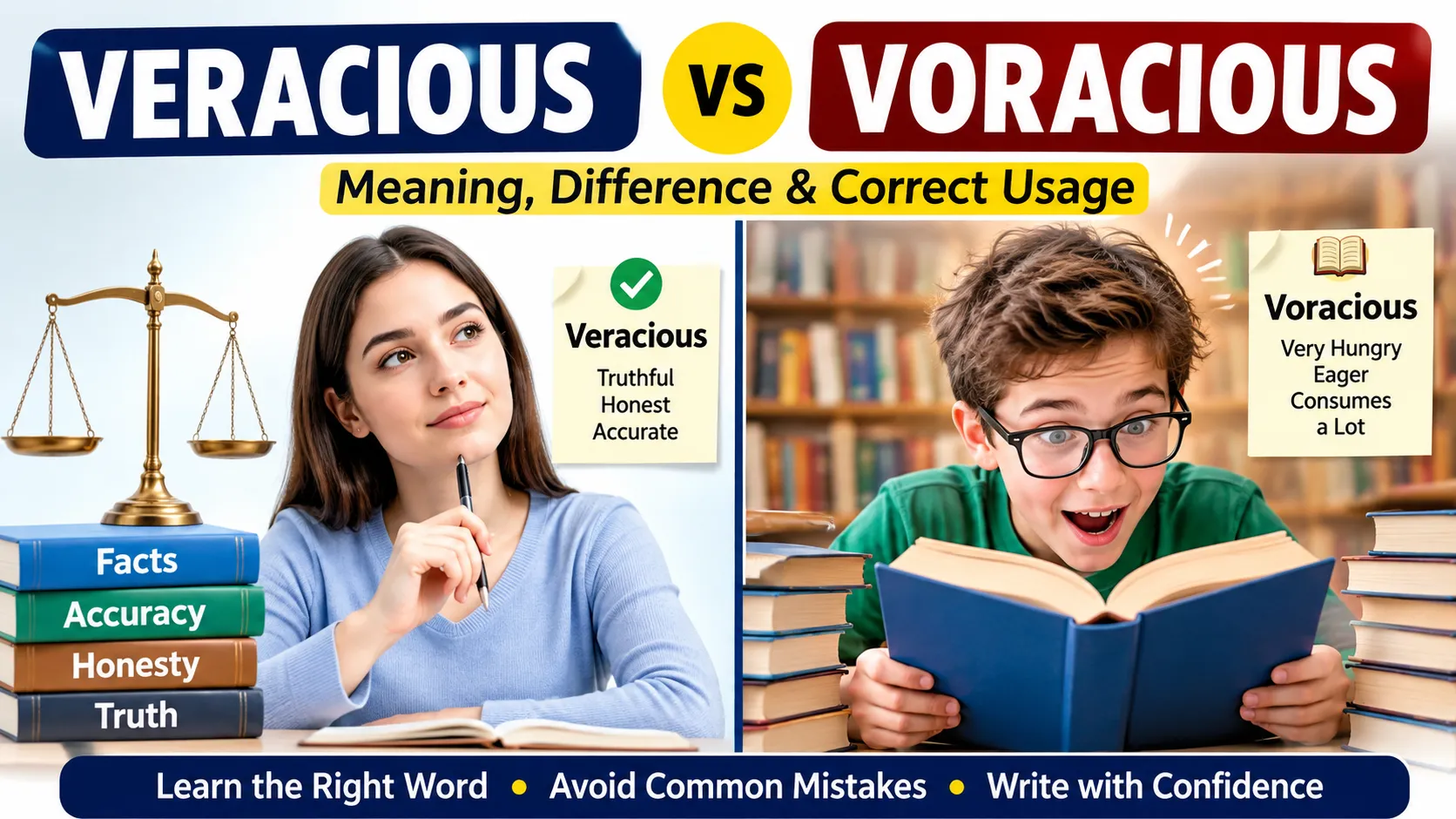
Veracious means truthful or honest, while voracious means having a very strong appetite or consuming something eagerly. They sound similar, but their meanings are very different.
Have you ever written a word that looked right, only to stop and wonder, “Wait, is that actually the word I mean?”
I have seen this happen often when helping students improve their English. Veracious and voracious are a perfect example. They look almost alike. They also sound similar when spoken quickly. Yet they describe two completely different ideas.
One word is about truth. The other is about strong hunger or desire.
That small spelling difference can change your whole sentence. Calling someone a “veracious reader” does not mean they read books very quickly or in large amounts. In fact, it may confuse your reader. The correct word in that case is usually voracious.
This guide will make the difference simple. You will learn what each word means, where the words come from, how to use them, and which common mistakes to avoid.
By the end, you should be able to choose the right word without stopping to guess.
Veracious or Voracious
Veracious means truthful, honest, or telling the truth.
Voracious means very hungry, eager to consume, or wanting a lot of something.
Here are two simple examples:
- The witness gave a veracious account of the event.
- She is a voracious reader who finishes several books each month.
Think of the difference this way:
Veracious = truth
Voracious = appetite
The two words share a similar sound, but they are not synonyms.
What does “veracious” mean?
If a person or statement is veracious, it is truthful or accurate.
For example:
The journalist wanted a veracious account of what happened.
The word is fairly formal. In everyday English, truthful, honest, or accurate may sound more natural.
What does “voracious” mean?
If someone is voracious, they have a huge appetite or a strong desire for something.
For example:
He has a voracious appetite.
You can also use it beyond food:
Maya is a voracious reader.
Here, she does not eat books. She reads them eagerly and in large amounts.
The Origin and Background of Veracious and Voracious
The confusion between these words makes more sense when you look at their history.
Where does “veracious” come from?
Veracious comes from the Latin word verax, meaning truthful or speaking the truth. It is related to the Latin word verus, meaning true.
You can connect it with words such as:
- veracity — truthfulness
- verify — to establish that something is true
- veritable — real or true
This gives you a useful memory trick:
Veracious → veracity → truth
Where does “voracious” come from?
Voracious comes from the Latin vorare, meaning to devour or swallow greedily.
That history fits the modern meaning very well.
Someone with a voracious appetite wants to eat a lot. Someone with a voracious curiosity wants to learn a lot.
So remember:
Voracious → devour → consume eagerly
That one connection can help you keep the words apart.
Veracious vs. Voracious: Key Differences
The easiest way to understand the difference is to focus on the idea behind each word.
| Term | Meaning | When to Use | Region/Context |
|---|---|---|---|
| Veracious | Truthful or honest | Talking about truth or accuracy | Formal English |
| Voracious | Very hungry or eager to consume | Talking about appetite, reading, learning, or desire | Common in general English |
| Veracity | Truthfulness | Talking about whether something is true | Formal English |
| Voraciously | With great eagerness or appetite | Describing how someone consumes something | General English |
Example: veracious
The researcher provided a veracious description of the findings.
The focus is truth.
Example: voracious
The student was a voracious reader.
The focus is quantity and eagerness.
Another easy comparison
The witness was veracious.
The witness told the truth.
The reader was voracious.
The reader consumed books eagerly.
One letter can point you toward a completely different meaning.
Which Version Should You Use?
The right choice depends on what you are trying to say.
If you mean “truthful”
Use veracious.
However, in simple everyday writing, truthful or honest may be clearer.
For example:
The statement was truthful.
This is more natural for most readers than:
The statement was veracious.
If you mean “very eager or consuming a lot”
Use voracious.
It works well with words such as:
- voracious appetite
- voracious reader
- voracious learner
- voracious consumer
- voracious curiosity
For beginners
If you are learning English, remember this simple rule:
Truth = veracious
Big appetite or strong desire = voracious
That is enough for most situations.
For formal writing
Veracious can be used in formal writing, but do not choose it just because it sounds sophisticated.
Clear writing is usually better than complex writing.
If truthful says exactly what you mean, it may be the better choice.
Common Mistakes with Veracious and Voracious
These words are easy to mix up. Here are five common mistakes.
1. Mistake: “He is a veracious reader.”
Correction:
He is a voracious reader.
Why? A voracious reader reads a lot and reads eagerly.
2. Mistake: “The report was voracious.”
Correction:
The report was veracious.
Why? If you mean the report was truthful, veracious is the correct word.
That said, accurate may sound more natural.
3. Mistake: Using “voracious” only for food
Some learners think voracious always means “very hungry.”
That is only part of the meaning.
You can say:
She has a voracious appetite for knowledge.
Here, the person wants to learn a great deal.
4. Mistake: Treating the words as synonyms
They are not synonyms.
- Veracious relates to truth.
- Voracious relates to appetite or eagerness.
5. Mistake: Choosing the word by sound
The words sound alike enough to cause trouble.
Do not rely on pronunciation alone. Think about the meaning first.
Ask yourself:
“Am I talking about truth or appetite?”
That question usually solves the problem.
Veracious or Voracious in Real World Examples
Seeing the words in context makes the difference easier to remember.
1. Professional email
Thank you for your report. We appreciate your veracious account of the incident and the clear details you provided.
In a normal business email, truthful or accurate may be more natural. Still, veracious is grammatically possible.
2. News article
The investigation focused on whether the witness gave a veracious account.
Here, the topic is the truth of the witness’s statement.
3. Social media post
I have become a voracious reader this year. My book list keeps growing!
Here, voracious means reading eagerly and often.
4. Formal report
The committee examined the veracity of the claims before publishing its findings.
Notice that veracity is often more natural than veracious when discussing whether a claim is true.
5. Education
She is a voracious learner who always asks for extra reading.
The word describes a strong desire to learn.
Veracious or Voracious: Data, Trends & Usage
This topic has a clear informational search intent. People who search for “veracious or voracious” usually want to solve a spelling, meaning, or word choice problem.
The confusion is natural. Both words:
- begin with ver / vor
- contain similar sounds
- are adjectives
- can appear in formal English
- are less common than simpler words such as “truthful” and “hungry”
The most useful insight is that voracious has a much wider everyday range.
You can be voracious about food, books, information, learning, or even opportunities.
Veracious is much narrower. It mainly relates to truthfulness.
That makes context a powerful clue.
If you see reader, appetite, or learner, think voracious.
If you see truth, statement, account, or claim, think veracious.
Veracious vs. Voracious: Standalone Comparison Table
| Term/Variant | Meaning | Region/Context | Best Used When |
|---|---|---|---|
| Veracious | Truthful; honest | Formal English | Describing a truthful person or statement |
| Voracious | Very hungry; eager to consume | General English | Describing strong appetite or desire |
| Veracity | Truthfulness | Formal English | Discussing whether a claim is true |
| Voraciously | With great eagerness | General English | Describing eager consumption |
| Truthful | Telling the truth | Everyday English | Simple, clear writing |
| Hungry | Wanting food | Everyday English | Normal physical hunger |
| Eager | Very interested or excited | Everyday English | Strong interest or desire |
A Simple Memory Trick
Here is the fastest way to remember the difference.
VERACIOUS = VERACITY = TRUTH
Think of veracity.
If something has veracity, it has truth.
VORACIOUS = DEVOUR
Think of a person who wants to devour food, books, or information.
So:
Veracious = tells the truth.
Voracious = wants a lot.
This is more useful than trying to memorize a long dictionary definition.
FAQ: Veracious or Voracious
Q: What does veracious mean?
A: Veracious means truthful, honest, or accurate. It is usually used in formal English and often describes a person, statement, or account.
Q: What does voracious mean?
A: Voracious means having a very strong appetite or desire. It can describe food, reading, learning, curiosity, and other forms of eager consumption.
Q: How do you use veracious correctly?
A: Use veracious when you want to describe something as truthful. For example: “The witness gave a veracious account.” In everyday writing, “truthful” or “accurate” may be simpler.
Q: What is the difference between veracious and voracious?
A: Veracious is about truth. Voracious is about strong appetite or eagerness. A veracious person tells the truth; a voracious reader reads a lot.
Q: Is veracious acceptable in formal writing?
A: Yes. Veracious is a valid English word and can work in formal writing. However, it is less common than “truthful” or “accurate,” so use it only when it fits your tone.
Q: Which is correct: veracious reader or voracious reader?
A: Voracious reader is correct when you mean someone who reads a lot and reads eagerly. “Veracious reader” would suggest a reader who is truthful, which is not the usual meaning.
Q: Where do veracious and voracious come from?
A: Veracious comes from Latin roots connected with truth. Voracious comes from a Latin verb meaning “to devour.” Their different origins match their different meanings.
Q: Can voracious be used outside the context of food?
A: Yes. This is very common. You can say voracious reader, voracious learner, or voracious curiosity to describe someone who wants to consume a lot of information or experience.
Conclusion
Veracious and voracious may look almost identical, but their meanings are far apart.
The key difference is simple:
- Veracious = truthful
- Voracious = very hungry or eager to consume
- Veracity = truthfulness
- Voracious reader = someone who reads eagerly and often
When you are unsure, stop and ask one question: “Am I talking about truth or appetite?”
If the answer is truth, choose veracious. If the answer is strong hunger, desire, or consumption, choose voracious.
For everyday writing, remember that simpler words are often better. You can use truthful, accurate, hungry, or eager when they express your meaning more clearly.
The most useful phrase to remember is “voracious reader.” It is a common example and a great way to lock the spelling into your memory.
Now you know exactly when to use veracious and voracious. Bookmark this guide so you never second guess these two words again.
Read more: Complacent or Complaisant: The Easy Difference

I have been working with English language content for over six years. I specialize in word comparisons and spelling differences that most people overlook. At WordsCombo, I help readers choose the right word every time.