Appraise or apprise? Use appraise when you mean “evaluate or judge the value of something.” Use apprise when you mean “inform or tell someone about something.”
Have you ever typed a sentence, stopped, and wondered, “Is it appraise or apprise?”
You are not alone. These two words look almost the same. They also sound similar when spoken quickly. Yet their meanings are very different.
I have seen this mix up many times in student essays, business emails, reports, and everyday writing. The mistake often happens because both words begin with app and contain the same basic sounds.
Here is the good news: you do not need to memorize a long grammar rule.
Think about the action you want to describe. Are you judging the value or quality of something? Then use appraise. Are you giving someone information? Then use apprise.
For example, a real estate expert may appraise a house. A manager may apprise an employee of a change.
This guide will make the difference clear. You will learn the meanings, origins, common mistakes, correct usage, and easy memory tricks. By the end, choosing the right word should feel simple.
Appraise or Apprise
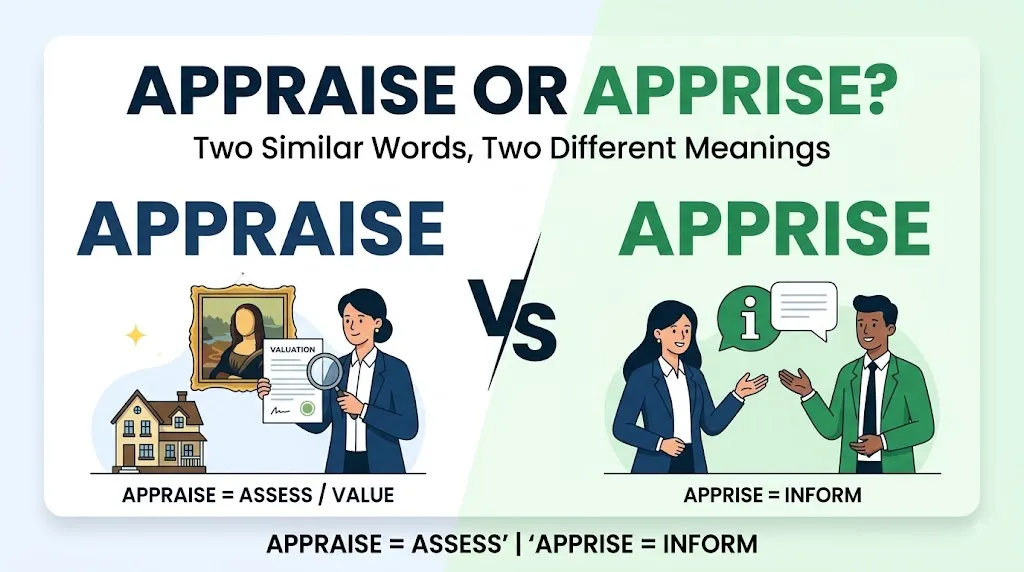
The difference is simple:
- Appraise = to evaluate, assess, or estimate the value of something.
- Apprise = to inform or tell someone about something.
Example 1: Appraise
The expert will appraise the painting before it is sold.
Here, the expert is judging the painting’s value.
Example 2: Apprise
Please apprise me of any changes to the schedule.
Here, the person wants to be informed.
Easy memory trick
Think:
Appraise = assess
Apprise = inform
If you can replace the word with evaluate, choose appraise.
If you can replace it with inform, choose apprise.
The Origin and Background of Appraise or Apprise
The confusion between appraise and apprise has a long history.
Both words came into English through French. Their histories are related, which helps explain why they look so similar today.
Appraise developed from words connected with setting or judging a value. Its modern meaning is linked to assessing worth, quality, or condition.
For example:
The bank asked an expert to appraise the property.
The expert estimates what the property is worth.
Apprise, on the other hand, comes from a French verb related to learning or informing. Its modern use means to inform someone about something.
For example:
We will apprise the team of the new policy.
The team receives information.
So, while the words look like close twins, their jobs are different.
One is about evaluation.
The other is about information.
Appraise or Apprise Explained: Key Differences
The fastest way to understand these words is to compare them side by side.
| Term | Meaning | When to Use | Region/Context |
|---|---|---|---|
| Appraise | Evaluate or estimate value | When judging quality, worth, or performance | General English; common in business and property |
| Apprise | Inform or notify | When giving someone information | Formal English; common in business and official writing |
| Appraisal | An evaluation or valuation | When referring to the act or result of appraising | Business, property, jobs |
| Apprised | Informed or notified | When someone has received information | Formal writing |
Appraise in a sentence
The jeweler will appraise the diamond.
The jeweler is estimating its value.
You can also say:
The manager will appraise her performance.
Here, appraise means evaluate.
Apprise in a sentence
Please apprise me of the latest developments.
This means:
Please inform me about the latest developments.
Notice the common pattern:
apprise someone of something
For example:
The lawyer apprised us of the new deadline.
This structure is especially useful in formal writing.
Which Version Should You Use?
Choosing between appraise and apprise depends on what you mean.
For students
Use appraise when you are talking about evaluating something.
The teacher asked students to appraise the author’s argument.
Use apprise when the sentence is about informing someone.
The teacher apprised the students of the schedule change.
For business writers
Both words can be useful.
Use appraise for:
- Employee performance
- Property value
- Financial assets
- Quality
- Risk
- Results
Use apprise for:
- Updates
- Policy changes
- New information
- Decisions
- Deadlines
- Important developments
For global or neutral English
Appraise is usually more familiar to general readers.
Apprise is correct, but it sounds more formal. In casual writing, inform, tell, or update may sound more natural.
For example:
Please inform me about the changes.
This is simpler than:
Please apprise me of the changes.
Both are correct. The first is more common in everyday English.
Common Mistakes With Appraise or Apprise
These words are easy to confuse. Here are five common errors.
| Mistake | Correction | Why? |
|---|---|---|
| The agent will apprise the house. | The agent will appraise the house. | A house is being valued. |
| Please appraise me of the news. | Please apprise me of the news. | The person needs information. |
| The bank will apprise the property. | The bank will appraise the property. | The property needs an evaluation. |
| We were appraised of the decision. | We were apprised of the decision. | We were informed. |
| The manager will apprise employee performance. | The manager will appraise employee performance. | Performance is being evaluated. |
Mistake 1: Using “appraise” for information
Wrong:
Please appraise me of the meeting time.
Correct:
Please apprise me of the meeting time.
Even better for everyday English:
Please inform me of the meeting time.
Mistake 2: Using “apprise” for value
Wrong:
The expert will apprise the antique.
Correct:
The expert will appraise the antique.
The expert is estimating its value.
Mistake 3: Forgetting “of” after apprise
A common formal structure is:
apprise someone of something
Correct:
She apprised me of the changes.
Not:
She apprised me the changes.
This small word makes a big difference.
Appraise or Apprise in Real World Examples
Seeing the words in context makes the difference easier to remember.
1. Professional email
Please apprise me of any changes to the project timeline.
Here, the writer wants information.
A simpler version would be:
Please inform me of any changes to the project timeline.
2. News article
An independent expert was asked to appraise the value of the historic building.
The expert is estimating the building’s value.
3. Social media post
We are excited to apprise our customers of our new store hours.
This means the company is informing customers.
For a casual social post, however, tell or let you know may sound more natural:
We are excited to let you know about our new store hours!
4. Formal report
The committee conducted an independent appraisal of the project’s financial risks.
Here, appraisal means an evaluation.
Another example:
The director was apprised of the latest findings.
The director was informed.
Appraise or Apprise: Data, Trends and Usage
People often search for “appraise or apprise” because these words are classic vocabulary traps.
The search intent is mainly informational. Readers usually want to know which word is correct in a sentence.
The confusion is especially common among:
- Students
- English learners
- Job applicants
- Business writers
- Professionals writing formal emails
- People preparing reports or exams
There is also an important usage trend to understand.
Appraise appears in many practical settings. Property, finance, performance reviews, antiques, and risk assessment all use the word naturally.
Apprise is less common in everyday conversation. It appears more often in formal or professional writing.
That matters because a word can be correct but unnatural for the situation.
If you are writing a friendly email, “inform” or “update” may be better than “apprise.”
If you are writing a formal report, apprise may fit well.
The best writer does not only ask, “Is this word correct?”
They also ask:
“Does this word sound natural for my reader?”
Standalone Comparison: Appraise vs. Apprise
| Term/Variant | Meaning | Region/Context | Best Used When |
|---|---|---|---|
| Appraise | Evaluate or estimate value | General English | Judging worth, quality, or performance |
| Apprise | Inform or notify | Formal English | Giving someone information |
| Appraisal | Evaluation or valuation | Business and professional English | Describing an assessment |
| Apprised | Informed | Formal English | Saying someone received information |
| Inform | Give information | Everyday and formal English | General communication |
| Assess | Judge or evaluate | Academic and professional English | Measuring quality, risk, or performance |
A Simple Memory Trick for Appraise or Apprise
Here is the trick worth remembering:
Appraise = Price
Both words contain a similar “price” idea.
When you appraise something, you may estimate its price or value.
The expert appraised the watch at $2,000.
Apprise = Information
Think of apprise as giving someone information.
Please apprise me of the situation.
So remember:
Appraise → value
Apprise → information
If you remember just those two ideas, you will avoid most mistakes.
FAQ: Appraise or Apprise
Q: What does appraise mean?
A: Appraise means to evaluate, assess, or estimate the value of something. You can appraise a house, painting, employee performance, or financial asset.
Q: What does apprise mean?
A: Apprise means to inform or tell someone about something. It is often used in the formal structure “apprise someone of something.”
Q: How do you use appraise correctly?
A: Use appraise when something is being evaluated. For example: “The expert will appraise the antique.”
Q: What is the difference between appraise and apprise?
A: Appraise means evaluate or estimate value. Apprise means inform someone. A property can be appraised, while a person can be apprised of a change.
Q: Is apprise acceptable in formal writing?
A: Yes. Apprise is a correct formal English word. However, inform or update may sound more natural in everyday communication.
Q: Which is correct: appraise or apprise?
A: Both are correct words. The correct choice depends on your meaning. Choose appraise for evaluation and apprise for information.
Q: Where does appraise come from?
A: Appraise entered English through French and developed around the idea of setting or judging value. Its modern meaning still centers on evaluation.
Q: Can I use apprise in a business email?
A: Yes. For example: “Please apprise me of any changes.” It is correct, though “Please inform me” or “Please keep me updated” may sound more natural in a casual business email.
Conclusion
The difference between appraise or apprise becomes easy once you focus on the action.
Appraise means evaluate or estimate value. You might appraise a house, painting, employee, or business asset.
Apprise means inform someone. You might apprise a manager of a problem or apprise a team of a new deadline.
There is one simple rule to remember:
Appraise = assess. Apprise = inform.
Also remember that apprise is more formal. In casual English, words such as tell, inform, and update often sound more natural.
The next time these two words look almost identical on your screen, stop and ask one question:
Am I judging something, or am I informing someone?
If you are judging, choose appraise. If you are informing, choose apprise.
Bookmark this guide so you never have to second guess appraise or apprise again.
Read more: Imply or Infer: The Easy Rule You Won’t Forget

I have been working with English language content for over six years. I specialize in word comparisons and spelling differences that most people overlook. At WordsCombo, I help readers choose the right word every time.