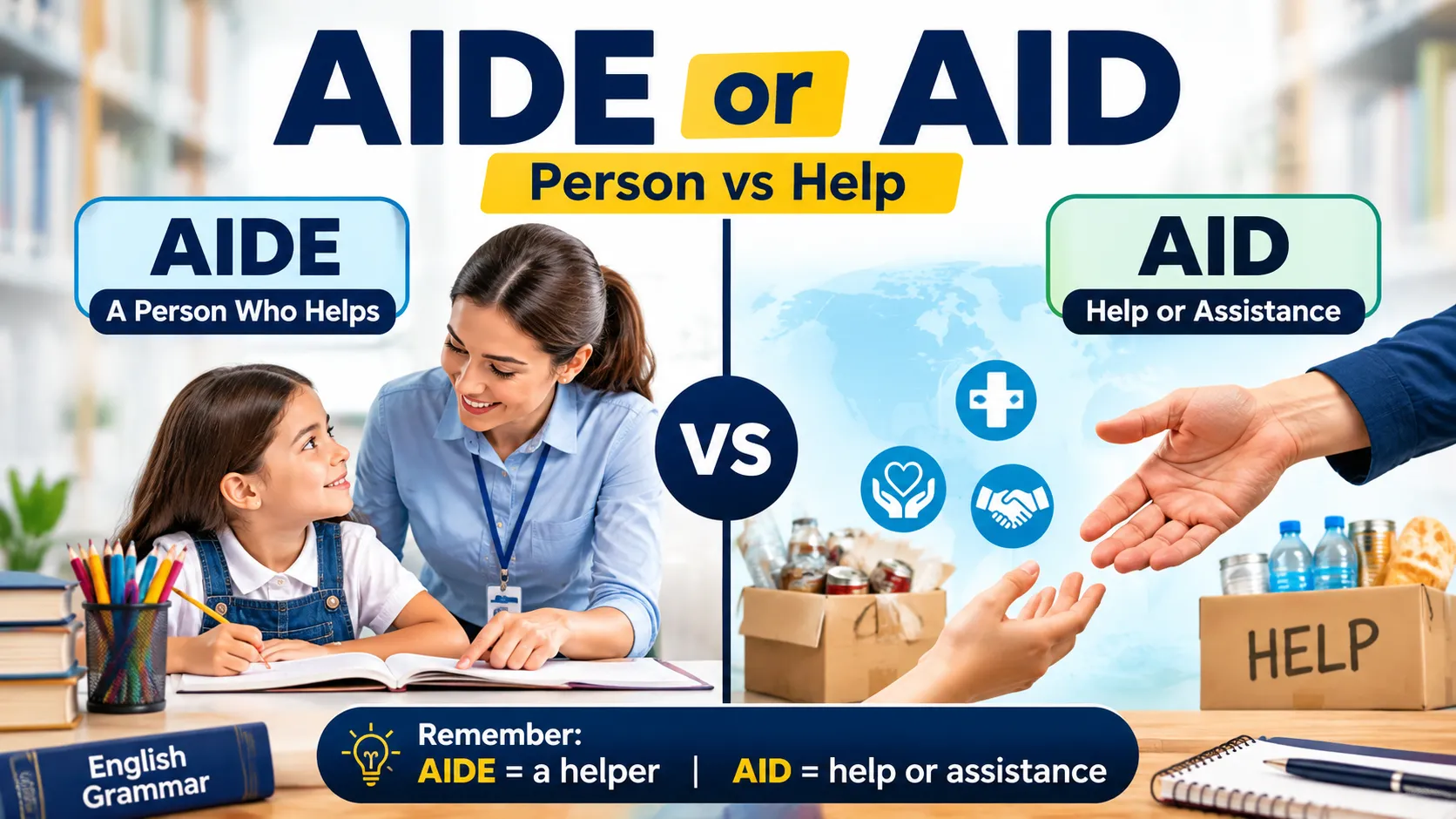
Aide means a person who helps someone, while aid means help, assistance, or something used to provide help. Choose aide for a helper and aid for help itself.
Have you ever typed a sentence like “The nurse was a great aid” and then stopped to wonder if aide would be better?
You are not alone. These two words sound almost the same, but they do different jobs in a sentence. One usually refers to a person. The other refers to help or assistance.
I have seen this mix up many times while helping students improve their English. The mistake is easy to make because aide and aid share the same sound. Their meanings, however, are not the same.
The good news is that you do not need a complex grammar rule to remember the difference.
Think about one simple question: Are you talking about a person who helps, or the help itself?
That small test can help you choose the right word in seconds. In this guide, you will learn the meanings, origins, differences, common mistakes, and real world uses of aide and aid.
Let’s make the difference simple.
Aide or Aid
Aide is a person who helps someone.
The teacher’s aide helped the students with their work.
Aid means help, assistance, or support. It can also be a verb meaning “to help.”
The medicine may aid recovery.
The charity provided food and medical aid.
The easiest rule
- Aide = a helper
- Aid = help
Here is another easy way to remember it:
An aide is a person. Aid is assistance.
A simple example
Imagine a hospital.
A nurse’s aide is a person who helps nurses and patients.
A medical aid is help given to a patient.
The words sound alike, but they have different meanings.
The Origin and Background of Aide and Aid
The confusion between these words is understandable. They are closely related in history.
Aid comes from an Old French word related to helping or assistance. It entered English many centuries ago.
Aide also comes from French. In English, it developed as a word for a person who provides assistance.
So, both words are connected to the idea of help.
That shared history explains why they look and sound so similar.
Over time, English gave them different roles.
- Aid became the general word for help or assistance.
- Aide became a noun for a person who helps another person.
This difference is especially useful in modern English.
For example:
The government sent emergency aid.
Here, aid means assistance.
But:
The politician’s aide answered the phone.
Here, aide means a person who works as a helper or assistant.
The spelling gives you a useful clue. The extra e in aide can remind you of a person or employee.
Aide or Aid Explained: Key Differences and Variations
The biggest difference is simple:
| Term | Meaning | When to Use | Region/Context |
|---|---|---|---|
| aide | A person who helps | When referring to a helper or assistant | General English |
| aid | Help or assistance | When talking about support or help | General English |
| aid | To help | When used as a verb | General English |
| aids | Helps or supports | Verb form or plural noun in some contexts | General English |
| aided | Helped | Past tense of “aid” | General English |
When to use “aide”
Use aide when the word refers to a person.
Examples:
The teacher’s aide prepared the classroom.
The senator’s aide spoke to reporters.
A nurse’s aide helped move the patient.
You can often replace aide with assistant.
If “assistant” makes sense, aide may be the word you need.
When to use “aid”
Use aid when you mean help or assistance.
Examples:
The country received financial aid.
The first aid kit provided useful medical aid.
This tool can aid your learning.
Notice that aid can work as both a noun and a verb.
As a noun:
We need more aid.
As a verb:
This guide can aid your study.
A quick substitution test
Try replacing the word.
If you can use assistant, choose aide.
If you can use help, choose aid.
For example:
The doctor’s aide called the patient.
“Doctor’s assistant” works. So aide is correct.
The doctor gave the patient financial aid.
“Financial help” works. So aid is correct.
Which Version Should You Use?
For most learners, the best choice depends on what you are describing.
For students
Use aide when you mean a person who assists a teacher or student.
The classroom aide helped the children.
Use aid when you mean help.
The study guide will aid your preparation.
For professional writing
Both words are correct.
Choose aide for a person:
The manager’s aide arranged the meeting.
Choose aid for assistance:
The company offered financial aid.
For global or neutral English
Aid is much more common because it has several uses.
You may see it in phrases such as:
- financial aid
- medical aid
- emergency aid
- legal aid
- foreign aid
- first aid
- hearing aid
- visual aid
Use aide when the context clearly involves a person.
A safe rule is:
Person = aide. Help = aid.
Common Mistakes With Aide and Aid
These words often cause small but noticeable errors. Here are the most common ones.
1. Mistake: Using “aid” for a person
Wrong:
The teacher’s aid helped the class.
Correct:
The teacher’s aide helped the class.
Why? The sentence describes a person.
2. Mistake: Using “aide” for help
Wrong:
The country received financial aide.
Correct:
The country received financial aid.
Why? Financial aid means financial help.
3. Mistake: Confusing “aid” with “aided”
Wrong:
The program aid thousands of families last year.
Correct:
The program aided thousands of families last year.
Why? Aided is the past tense of the verb aid.
4. Mistake: Thinking “aide” is always formal
Some learners think aide is only used in politics.
That is not true.
You can use it for many types of assistants:
classroom aide
teacher’s aide
nurse’s aide
congressional aide
political aide
5. Mistake: Choosing by sound
This is probably the biggest problem.
Aide and aid are normally pronounced the same way.
That means you cannot rely on pronunciation.
Instead, ask:
Is this a person or help?
That question solves most cases.
Aide or Aid in Real World Examples
Seeing the words in real situations makes the difference easier to remember.
1. Professional email
Subject: Meeting Support
Sarah, the project manager’s aide, will join the meeting and help with the notes.
Here, aide means a person.
Another example:
We are pleased to provide financial aid to eligible students.
Here, aid means financial assistance.
2. News headline
Government Announces New Aid for Flood Victims
Here, aid means assistance.
A different headline could say:
Senator’s Aide Speaks to Reporters
Here, aide means a person who works for the senator.
3. Social media post
Our classroom aide did an amazing job helping students today!
The word refers to a person.
Another post might say:
Many families still need emergency aid after the storm.
Here, aid means help.
4. Formal document
The organization will provide emergency aid to affected communities.
The organization is providing assistance.
Compare that with:
The director’s aide will contact the applicants.
The aide is a person.
Aide or Aid: Data, Trends, and Usage
The search intent behind “aide or aid” is mainly informational. People usually search the phrase when they are writing, studying English, checking spelling, or proofreading a sentence.
The question often appears in situations where the words sound right but the spelling feels uncertain.
The most common contexts include:
- school and education
- workplace writing
- government and politics
- healthcare
- news writing
- formal documents
- English grammar and vocabulary study
One reason this topic remains useful is that English contains many words that sound alike but have different meanings. These are called homophones.
Other common examples include:
- there / their / they’re
- to / too / two
- hear / here
- your / you’re
Aide and aid fit the same pattern.
The key insight is that pronunciation does not always tell you which spelling to use. Meaning and sentence role matter more.
Standalone Aide vs. Aid Comparison Table
| Term/Variant | Meaning | Region/Context | Best Used When |
|---|---|---|---|
| Aide | A person who helps | General English | You mean an assistant |
| Aid | Help or assistance | General English | You mean support |
| Aid | To help | General English | You need a verb |
| Aided | Helped | General English | Talking about past help |
| Aiding | Helping | General English | Talking about ongoing help |
| Aids | Helps/supports | General English | Present tense verb or plural noun |
Compare these sentences
The teacher’s aide opened the door.
The aide is a person.
The new system will aid teachers.
The system will help teachers.
The school received financial aid.
The school received assistance.
Once you see the pattern, the choice becomes much easier.
A Simple Memory Trick
Here is a quick trick you can use when writing.
AIDE = ASSISTANT
Both words describe a person.
teacher’s aide = teacher’s assistant
AID = ASSISTANCE
Both words describe help.
financial aid = financial assistance
You can also remember this short line:
An aide gives aid.
That sentence shows the difference perfectly.
A person can be an aide.
That person can provide aid.
FAQ: Aide or Aid
Q: What does aide mean?
A: Aide means a person who helps or assists another person. For example, a teacher’s aide helps a teacher in a classroom.
Q: What does aid mean?
A: Aid means help or assistance. It can also be a verb meaning “to help.” For example, “The program will aid students.”
Q: How do you use aide correctly?
A: Use aide when you are talking about a person who provides assistance. “The senator’s aide called me” is correct.
Q: What is the difference between aide and aid?
A: Aide is usually a person. Aid is help, assistance, or the act of helping. They sound alike but have different meanings.
Q: Is aide acceptable in formal writing?
A: Yes. Aide is a standard English word and is common in formal writing. You may see it in education, healthcare, government, and business.
Q: Which is correct: teacher’s aid or teacher’s aide?
A: Teacher’s aide is correct when you mean a person who assists a teacher. “Teacher’s aid” would mean help given to a teacher.
Q: Where does aide come from?
A: Aide comes from French and is related to the idea of helping. English uses it mainly for a person who provides assistance.
Q: Can aid be used as a verb?
A: Yes. Aid can mean “to help.” For example, “Exercise may aid recovery.” The past tense is aided.
Q: Can aide be used for any kind of helper?
A: It is used for many types of assistants, especially in roles such as education, healthcare, politics, and government. The exact job depends on the context.
Conclusion
The difference between aide and aid is small but easy to master.
Remember these three points:
- Aide = a person who helps.
- Aid = help or assistance.
- Aid can also be a verb meaning “to help.”
If you are unsure, use the simple substitution test.
Can you replace the word with assistant? Use aide.
Can you replace it with help or assistance? Use aid.
For example, a teacher’s aide is a person. Financial aid is assistance. A study tool can aid your learning.
You do not need to memorize a long grammar rule. Just focus on the meaning of the word in the sentence.
Now you know exactly how to use aide and aid. Try the rule in your next piece of writing, and bookmark this guide so you never have to second guess these two words again.
Read more: Farthest or Furthest: The Easy Guide to Correct Usage

I started writing about English word differences after years of teaching students who kept making the same mistakes. My focus is on making spelling rules feel simple and easy to remember. At WordsCombo, I turn confusing word pairs into clear comparisons.