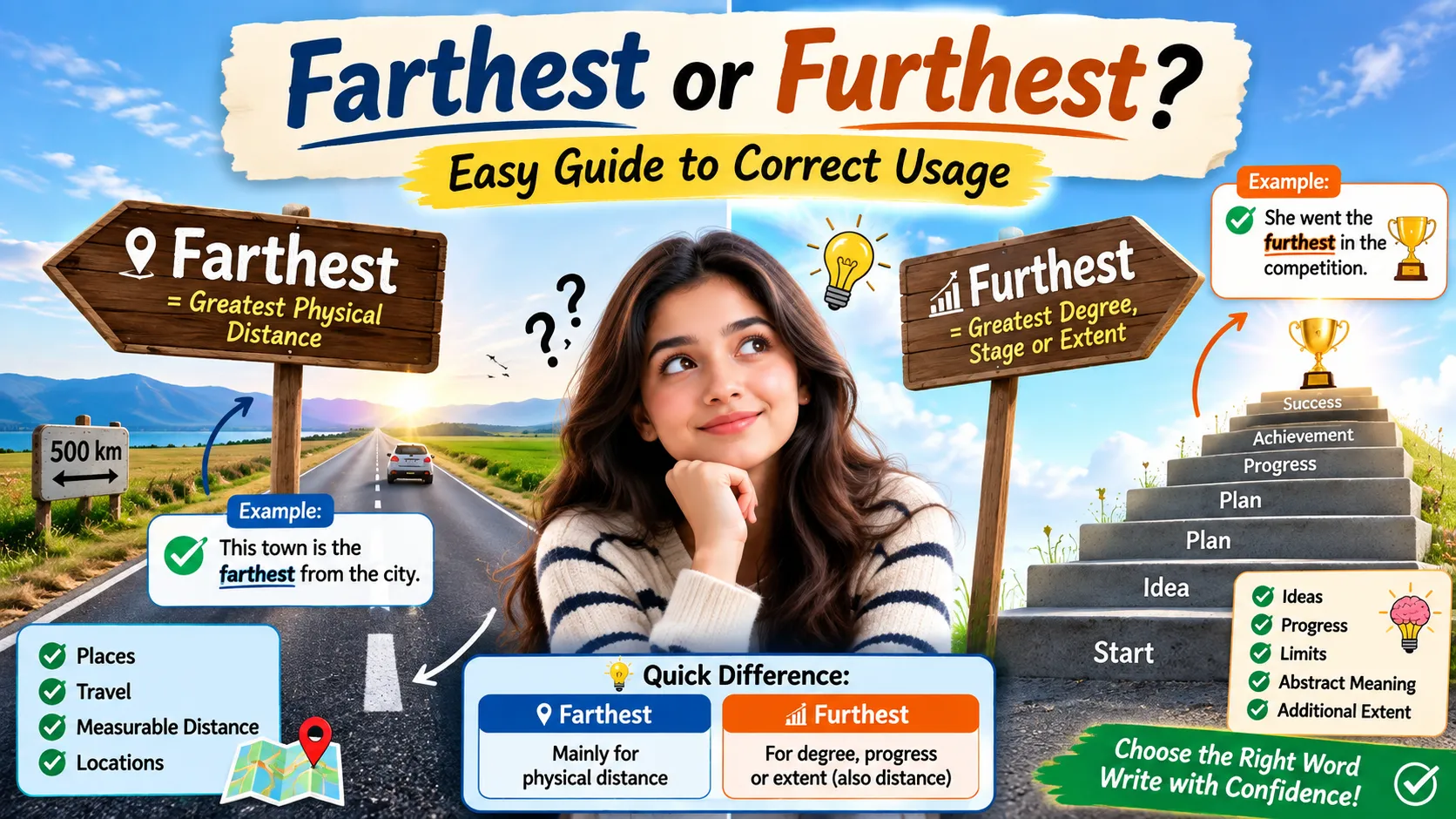
Farthest usually refers to the greatest physical distance, while furthest can refer to physical distance or the greatest degree, point, or extent. In modern English, both can be correct in some contexts.
Have you ever stopped while writing a sentence and wondered, “Should I use farthest or furthest?”
You are not alone. This is one of those small English choices that can make even confident writers pause.
The problem is simple: both words are forms of far, and both can talk about distance. Yet their usual uses are not quite the same. To make things more confusing, British and American English do not always follow the same pattern.
A useful rule is easy to remember. Farthest is often the safer choice when you mean actual physical distance. Furthest is often preferred when you mean a limit, degree, stage, or figurative distance.
For example, you might say, “Which runner went the farthest?” But you could say, “We need to take this discussion further.”
The good news is that you do not need to memorize a long list of grammar rules. Once you understand the main difference, choosing the right word becomes much easier.
Let’s break it down with simple rules, examples, common mistakes, and practical advice.
Farthest or Furthest
Farthest and furthest are both superlative forms of far.
- Far → farther → farthest
- Far → further → furthest
Traditionally, farthest is linked more closely with physical distance.
The blue house is the farthest from the school.
Here, we are talking about a measurable distance.
Furthest often works for an abstract idea, degree, or stage.
That was the furthest point in our discussion.
There is no physical journey here. The word describes the greatest stage or extent of the discussion.
However, there is an important detail: furthest can also describe physical distance, especially in British English and in many modern uses.
Which town is furthest from London?
So the difference is a use preference, not always a strict grammar rule.
A quick memory trick
Think:
Farthest = physical distance
Furthest = degree, stage, or extent
This rule will help you in most everyday writing.
The Origin and Background of Farthest and Furthest
Both words come from the adjective far.
The word far has been part of English for a very long time. It describes something at a great distance.
English later developed different forms to compare distance:
- Far — a long distance
- Farther / further — a greater distance or degree
- Farthest / furthest — the greatest distance or degree
The two forms became closely connected over time. That is one reason English speakers sometimes use them in overlapping ways.
The traditional distinction became clearer in modern grammar guides:
Farther was often used for measurable physical distance.
Further was often used for additional or figurative meaning.
For example:
The shop is farther down the road.
But:
We need further information.
The same pattern can appear with the superlative forms:
The village is the farthest point on the map.
This is the furthest we can go with the current plan.
Still, real world English is flexible. Native speakers do not always follow the traditional split. Further is also very common for physical distance.
That means you should focus on meaning and context instead of treating the distinction as an absolute law.
Farthest vs. Furthest Explained: Key Differences
The easiest way to understand the difference is to look at what kind of “distance” you mean.
| Term | Meaning | When to Use | Region/Context |
|---|---|---|---|
| Farthest | Greatest physical distance | Places, travel, measurable distance | Common in American English |
| Furthest | Greatest degree, stage, or extent | Ideas, progress, limits, abstract concepts | Common in British and international English |
| Furthest | Greatest physical distance | Physical distance when style allows it | Especially common in British English |
| Farthest | Greatest degree or extent | Less common in modern general use | Possible, but often replaced by furthest |
Example 1: Physical distance
Which planet is the farthest from the Sun?
The word refers to physical distance.
Example 2: Progress
She went the furthest in the competition.
Here, the meaning is about progress or achievement.
Example 3: A limit
That is the furthest I am willing to go.
The speaker is describing a limit, not a physical location.
Example 4: Physical distance with furthest
The hotel is the furthest from the airport.
This sentence is acceptable, especially in British English.
So, while farthest is a strong choice for physical distance, furthest is not automatically wrong.
Which Version Should You Use?
Your best choice depends on your meaning and your audience.
For beginners and students
Use farthest for clear physical distance.
This is the farthest point we can reach by car.
Use furthest for ideas, limits, progress, and abstract meanings.
This is the furthest we have progressed.
This simple rule is easy to learn and works well in most school writing.
For American English
Farthest is often the clearer choice for physical distance.
Alaska is one of the farthest states from Florida.
For abstract meanings, furthest is usually natural.
That is the furthest we can go.
For British English
You will often see furthest used for both physical and abstract distance.
Which station is furthest from here?
So if you are writing for a British audience, do not assume that furthest must be abstract.
For global or neutral English
If you want a simple, widely understood style, use:
- farthest for physical distance
- furthest for abstract distance, progress, or degree
This distinction is clear and rarely causes confusion.
Common Mistakes with Farthest or Furthest
Small differences can create big doubts. Here are the mistakes writers make most often.
1. Using farther when you mean a limit
Mistake:
That is the farther we can go.
Correction:
That is the furthest we can go.
Why? The sentence describes a limit or extent. Furthest is the natural choice.
2. Assuming furthest is always wrong for physical distance
Mistake:
“Furthest” cannot describe physical distance.
Correction:
The village is the furthest from the city.
This is acceptable. Furthest is widely used for physical distance, especially in British English.
3. Using farthest for every abstract meaning
Mistake:
We need to take the project farthest.
Better:
We need to take the project furthest.
The idea is progress or development, not physical travel.
4. Confusing further and farther
Mistake:
I need farther information.
Better:
I need further information.
Further information is a standard phrase. Here, further means additional.
5. Treating the rule as absolute
Some grammar lessons say:
Farther = physical
Further = figurative
That is a useful starting rule, but it is not the whole story.
Modern English often uses further for physical distance too. Your audience and style guide can affect the best choice.
Farthest or Furthest in Real World Examples
Seeing these words in normal situations makes the difference easier to remember.
Professional email
We have taken the project as far as we can at this stage. Please send any further details before Friday.
Here, further means additional.
News headline
Local Team Travels Farthest in Tournament History
Here, farthest works because the headline focuses on how far the team traveled or progressed in a measurable sense.
Another headline might say:
Talks Reach Their Furthest Point Yet
Here, furthest refers to the stage of negotiations.
Social media post
We finally reached the farthest point of our hike!
This sounds natural because the post describes physical travel.
For an abstract idea:
This is the furthest I have ever pushed myself.
Here, the meaning is personal effort and achievement.
Formal document or report
The northern site is the farthest location from the main office.
For a physical location, farthest is clear and precise.
You could also write:
The project has reached its furthest stage of development.
This describes progress rather than physical distance.
Farthest vs. Furthest: Data, Trends and Usage
The most useful trend is not simply “one word is right and the other is wrong.”
English usage shows that further and furthest have developed wider meanings over time. They are especially common when talking about progress, limits, discussion, development, and additional information.
The physical distance distinction remains useful, though.
If you are writing for an international audience, farthest can make physical distance especially clear:
The cabin is the farthest building from the entrance.
For abstract meanings, furthest usually sounds more natural:
We pushed the idea to its furthest limit.
This matters for students, business writers, and content creators because clear wording reduces hesitation.
The search intent behind “farthest or furthest” is mainly informational. People are usually not looking for a product or service. They want a quick grammar answer, followed by examples that help them avoid mistakes.
That is why the best approach is simple: learn the main rule, then understand the exceptions.
Farthest vs. Furthest: Standalone Comparison
| Term/Variant | Meaning | Region/Context | Best Used When |
|---|---|---|---|
| Farthest | Greatest distance | General English | Physical distance |
| Furthest | Greatest extent or degree | General English | Abstract ideas and limits |
| Furthest | Greatest distance | Common in British English | Physical or abstract distance |
| Farther | Greater distance | General English | Physical comparison |
| Further | Greater or additional | General English | Abstract comparison or additional information |
A useful pair to remember is:
farthest → physical distance
furthest → degree, progress, or extent
But keep in mind that furthest can also describe physical distance.
FAQs About Farthest or Furthest
Q: What does farthest mean?
A: Farthest means the greatest distance away. It is most often used for physical distance, such as the farthest city, house, or point.
Q: What does furthest mean?
A: Furthest means the greatest degree, stage, or extent. It can also refer to physical distance, especially in British English.
Q: Is farthest or furthest correct?
A: Both can be correct. Use farthest when you want to clearly describe physical distance. Use furthest for abstract ideas, limits, stages, and degrees.
Q: What is the difference between farthest and furthest?
A: The traditional difference is that farthest refers to physical distance, while furthest refers to abstract distance or extent. However, furthest is also commonly used for physical distance.
Q: Is furthest acceptable in formal writing?
A: Yes. Furthest is fully acceptable in formal writing. Use it when the meaning involves degree, progress, extent, or a limit. It can also describe physical distance when that usage fits your audience or style.
Q: Which is correct: the farthest point or the furthest point?
A: The farthest point is a clear choice when you mean physical distance. The furthest point is also used, especially in British English.
Q: Where do farthest and furthest come from?
A: Both words developed from the adjective far. English formed different comparative and superlative forms, including farther/farthest and further/furthest.
Q: Can I use furthest for physical distance?
A: Yes. You can say, “Which shop is the furthest away?” This is especially common in British English. If you want to make physical distance very clear, farthest is a safe choice.
Q: Is “further information” correct?
A: Yes. Further information is a standard phrase. Here, further means additional, not physically farther away.
Conclusion
The choice between farthest and furthest is easier than it first appears.
Remember these three points:
- Farthest is a strong choice for the greatest physical distance.
- Furthest is a strong choice for degree, progress, limits, and abstract distance.
- Furthest can also describe physical distance, especially in British English.
So, if you are a student and want one simple rule, start with farthest for physical distance and furthest for abstract meaning.
Then remember that real English is flexible. You may see furthest used for physical distance, and that does not automatically make the sentence wrong.
The goal is not to fear small grammar choices. The goal is to understand what your words mean and choose the form that makes your meaning clear.
Bookmark this guide so you never have to second guess “farthest or furthest” again.
Read more: Towards or Toward: The Easy Guide to Correct Usage

I started writing about English word differences after years of teaching students who kept making the same mistakes. My focus is on making spelling rules feel simple and easy to remember. At WordsCombo, I turn confusing word pairs into clear comparisons.