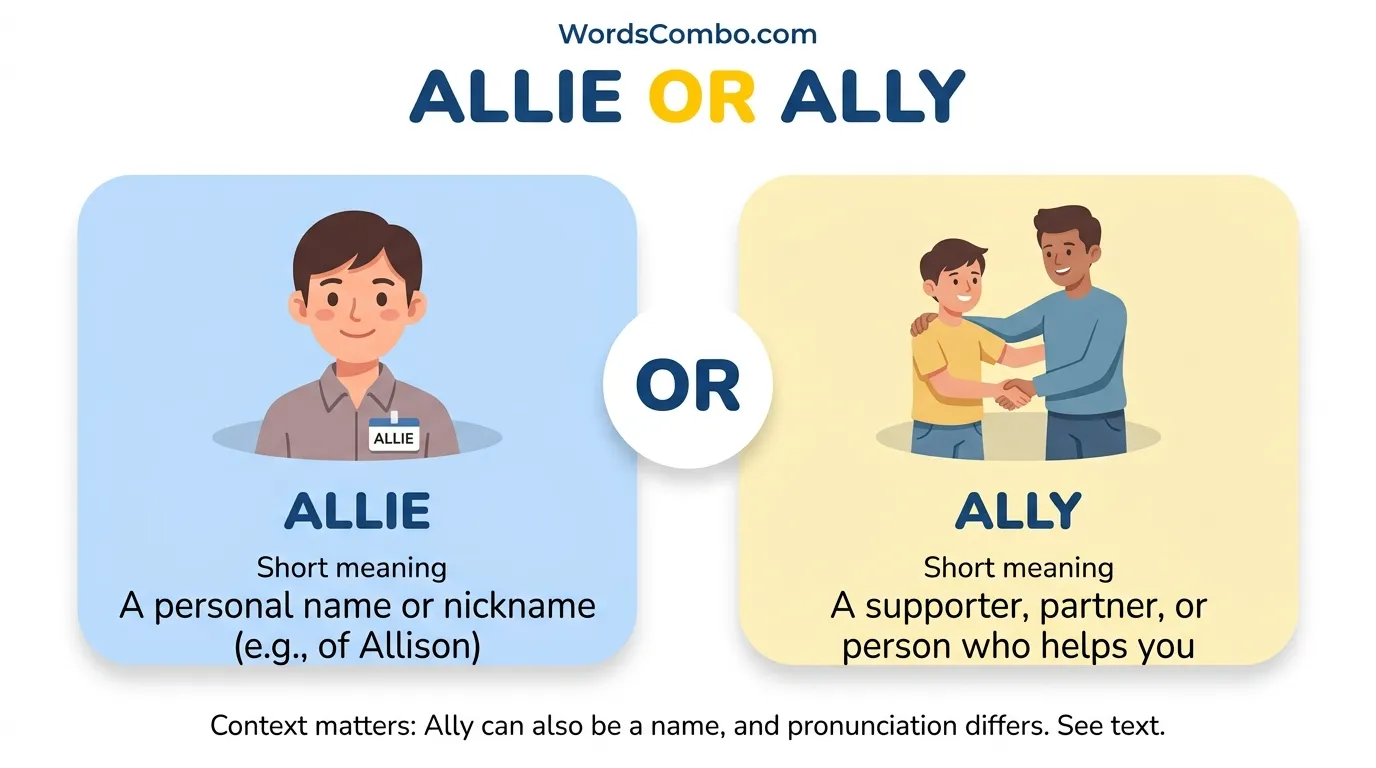
Ally is the correct English word for a supporter, partner, or person who helps you. Allie is usually a personal name or nickname. However, Ally can also be a person’s name, so context matters.
You are writing an email and want to say that someone supports your team. Should you write allie or ally? The correct word is ally when you mean a supporter or partner. Allie is usually a person’s name. Although they look and sound close, they have different uses. Also, ally can be a noun or a verb, while Allie is normally a proper name. Once you know this simple difference, choosing the right spelling becomes much easier.
Allie or Ally: What Is the Difference?
The main difference is simple:
- Ally means a person, group, or country that supports or works with another.
- Allie is usually a person’s name or nickname.
- Ally can also be used as a personal name.
- Allie is not the standard spelling of the common English word meaning a supporter.
For example:
She became a trusted ally at work.
Here, ally means someone who supports her.
Now compare it with:
Allie joined us for lunch.
Here, Allie is a person’s name.
So, if you mean supporter, partner, or helper, use ally.
If you mean a person whose name is Allie, use Allie.
What Does Ally Mean?
Ally is a noun that means a person, group, or country that supports another person or group.
For example:
- She is a close ally of the team.
- We found an ally who supported our plan.
- The two countries became allies.
- He has been a strong ally at work.
The word can also describe someone who works with you toward a shared goal.
An ally does not always have to be a close friend. For instance, a coworker may become your ally during a workplace problem. Likewise, two countries can be allies because they agree to support each other.
Ally as a Verb
Ally can also be a verb. It means to join or work with another person or group.
For example:
- The two groups allied to solve the problem.
- Several countries allied against a common threat.
- The company allied with a local organization.
The noun and verb forms are related, but the sentence tells you how ally is being used.
What Does Allie Mean?
Allie is usually a personal name or nickname.
It can be used as a nickname for names such as Alison, Allison, or Alexandra. However, some people are simply given the name Allie.
For example:
- Allie sent me an email.
- I met Allie at school.
- Allie works with our team.
- We invited Allie to the meeting.
Because Allie is a name, it normally begins with a capital letter.
Remember, you should always use the spelling a person uses for their own name. If someone’s name is Allie, do not change it to Ally.
Ally as a Name
There is one more point that can cause confusion.
Ally can also be a person’s name.
For example:
Ally called me after work.
Here, Ally is a name, not the word meaning a supporter.
So, you cannot decide the meaning only from the spelling. You also need to look at the sentence.
Compare these:
Ally is coming to dinner.
Here, Ally is a person’s name.
She is my strongest ally.
Here, ally means a supporter.
Capitalization and context help you understand the difference.
How Do You Pronounce Ally and Allie?
The pronunciation can also cause confusion.
When ally means a supporter, it is usually pronounced like AL-eye.
Allie, when used as a name, is usually pronounced like AL-ee.
For example:
- ally = a supporter
- Allie = a person’s name
The names Ally and Allie can sound like AL-ee, depending on the person and the name they use.
Therefore, listen to the full sentence and check the spelling when possible.
Ally vs Allie Comparison Table
| Term | Meaning | Region/Context | Best Used When |
| ally | A supporter or partner | General English | Talking about support or cooperation |
| allies | More than one supporter or partner | General English | Talking about two or more allies |
| Allie | A personal name or nickname | Personal names | Referring to someone named Allie |
| Ally | A personal name or nickname | Personal names | Referring to someone named Ally |
Common Mistakes With Allie and Ally
Mistake 1: Using Allie for a Supporter
Incorrect:
She is a strong allie.
Correct:
She is a strong ally.
When you mean a supporter or partner, the correct spelling is ally.
Mistake 2: Changing Someone’s Name
Suppose someone’s name is Allie.
Incorrect:
Dear Ally, thank you for your help.
Correct:
Dear Allie, thank you for your help.
A person’s name should be spelled the way that person spells it.
Mistake 3: Thinking Ally Is Only a Common Noun
Ally can also be a personal name.
For example:
Ally sent the report this morning.
Here, Ally is a person’s name.
However:
She is an important ally.
Here, ally is a common noun.
Mistake 4: Confusing Ally With Alliance
These words are related, but they are not the same.
An ally is a person, group, or country that supports another.
An alliance is a relationship or agreement between people or groups who agree to work together.
For example:
The two countries formed an alliance.
Each country became an ally of the other.
Allie or Ally in Everyday Writing
The right choice depends on what you want to say.
In an Email
If you are talking about a coworker named Allie:
Hi Allie,
Thanks for sending the report.
If you mean a supportive coworker:
She has been a valuable ally during the project.
At School
You might write:
My friend became an ally during the group project.
But if the student’s name is Allie:
Allie helped me finish the project.
At Work
You could say:
Our manager became an important ally during the discussion.
But:
Allie will lead the meeting tomorrow.
In Conversation
You might hear:
I need an ally who understands the problem.
Or:
Allie is waiting outside.
The meaning becomes clear from the context.
Is Allie a Misspelling of Ally?
Usually, no.
If you mean a supporter or partner, allie is not the standard spelling. The correct word is ally.
However, Allie is a valid personal name.
For example:
She is a trusted ally.
But:
Allie is my sister.
So, the letters -ie do not make a normal spelling variant of ally. They usually show that you are dealing with a personal name.
Is Ally American or British English?
Ally is used in both American and British English.
It is not a case of one spelling being American and the other being British.
Instead, the difference is mainly about meaning and name use.
Use ally when you mean a supporter or partner. Use Allie when that is the person’s name.
FAQs About Allie or Ally
Is ally the correct spelling for a supporter?
Yes. Ally is the standard English spelling when you mean a person, group, or country that supports another.
For example, you can say, “She is a strong ally.”
Is Allie a correct word?
Allie is normally a personal name or nickname. It is correct when it is someone’s name, but it is not the standard spelling of the common noun ally.
Is Allie a nickname for Ally?
It can be, depending on the person. Names can have different spellings, so you should use the spelling that the person chooses.
Are ally and Allie pronounced the same?
They can sound different when ally is used as a common noun. The noun ally is commonly pronounced like “AL-eye,” while the name Allie is commonly pronounced like “AL-ee.”
Should I write ally or Allie in formal writing?
Use ally when you mean a supporter or partner. Use Allie only when you are writing someone’s name and that is their correct spelling.
Is ally a noun or a verb?
Ally can be both a noun and a verb. As a noun, it means a supporter or partner. As a verb, it means to join or work with another person or group.
Conclusion
When choosing between allie or ally, focus on the meaning first. Use ally when you mean a supporter, partner, or person who works with you. Use Allie when you are writing a person’s name. Also, remember that Ally can itself be a personal name, so context matters.
The easiest rule is simple: ally means a supporter, while Allie is usually a name. Check the sentence before choosing the spelling, and always respect the spelling of someone’s name. With this small difference in mind, you can avoid a common writing mistake in emails, school work, professional writing, and everyday English.
Curious about another confusing word: Opossum or Possum.

I started writing about English word differences after years of teaching students who kept making the same mistakes. My focus is on making spelling rules feel simple and easy to remember. At WordsCombo, I turn confusing word pairs into clear comparisons.