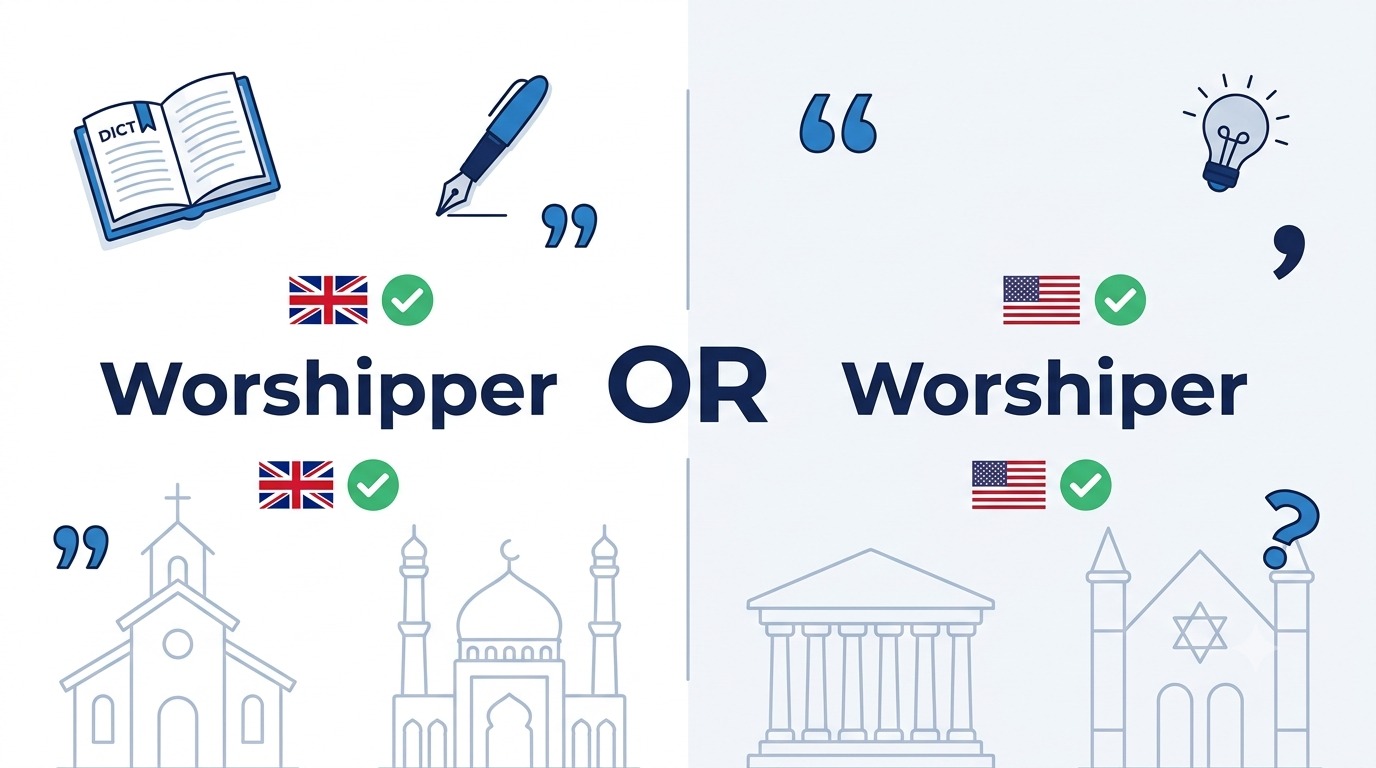
Both worshipper and worshiper are correct. Worshipper is the preferred British English spelling, while worshiper is the standard American English spelling. They have the same meaning and can usually be used interchangeably based on your audience.
The first time I wrote worshipper, my spell checker underlined it in red. I changed it to worshiper, only to discover that another website preferred the original spelling. That made me stop and wonder: Which one is actually correct?
If you’ve had the same question, you’re not alone.
English is full of spelling differences between British and American English. Words like traveller/traveler, counsellor/counselor, and worshipper/worshiper often leave writers second-guessing themselves.
The good news is that this confusion has a simple answer.
In this guide, you’ll learn the difference between worshipper and worshiper, why both spellings exist, when to use each one, and how to avoid common mistakes. By the end, you’ll know exactly which spelling fits your audience and your writing.
Worshipper or Worshiper: Quick Answer
Both spellings refer to a person who worships a god, deity, or someone or something they deeply admire.
- Worshipper → Preferred in British English
- Worshiper → Preferred in American English
Examples
- Thousands of worshippers gathered at the cathedral for Easter Sunday. (British English)
- Every worshiper was welcomed into the church. (American English)
The meaning never changes. Only the spelling does.
The Origin and Background of Worshipper or Worshiper
The word worship comes from the Old English word weorthscipe, meaning honor, respect, or worthiness.
Later, English added the ending -er to create a noun for someone who performs the action.
The spelling difference appeared because British and American English developed different spelling conventions.
In British English, when adding -er to verbs ending with a stressed consonant after a short vowel, the final consonant is often doubled.
Examples include:
- travel → traveller
- counsel → counsellor
- worship → worshipper
American English often simplifies these spellings.
Examples:
- traveler
- counselor
- worshiper
That is why both spellings are accepted today.
Worshipper or Worshiper Explained
Although the spellings differ, their meanings are exactly the same.
| Term | Meaning | When to Use | Region |
|---|---|---|---|
| Worshipper | A person who worships | British publications, UK schools, Commonwealth countries | British English |
| Worshiper | A person who worships | American publications, US schools, businesses | American English |
Example Sentences
British English:
- The worshippers entered the temple quietly.
- Hundreds of worshippers attended the evening prayer.
American English:
- The worshipers gathered before sunrise.
- Every worshiper received a welcome booklet.
Notice that only the spelling changes.
Which Version Should You Use?
The best choice depends on your audience.
If you write for British readers
Use worshipper.
This matches British dictionaries, newspapers, and schools.
If you write for American readers
Use worshiper.
Most American style guides prefer this spelling.
If you have a global audience
Choose one spelling and use it consistently throughout your article or document.
Consistency looks professional.
Quick Recommendation
- UK: Worshipper ✅
- USA: Worshiper ✅
- International websites: Either is correct, but stay consistent.
Common Mistakes with Worshipper or Worshiper
Here are mistakes many writers make.
| Mistake | Correct |
|---|---|
| Mixing both spellings in one article | Pick one spelling and use it throughout |
| Thinking one spelling is wrong | Both are correct |
| Using British spelling in American copy without reason | Match your audience |
| Assuming the meanings differ | They mean exactly the same |
| Ignoring style guides | Follow your publication’s preferred English |
Why These Mistakes Happen
Many online tools default to American English. Others follow British English. This can make your spelling appear incorrect even when it isn’t.
Worshipper or Worshiper in Real-World Examples
Professional Email
We expect every worshipper to follow the venue’s safety guidelines during the event.
(British English)
News Headline
Every worshiper returned safely after the annual religious gathering.
(American English)
Social Media Post
Wishing every worshipper a peaceful and joyful day of prayer.
Formal Report
The survey recorded the attendance of each worshiper during the weekend services.
Worshipper or Worshiper: Data, Trends & Usage
Search interest in worshipper or worshiper usually comes from people who:
- Write essays
- Learn English
- Edit academic papers
- Create religious content
- Work with international audiences
Search Intent
Primary Intent: Informational
People want to know:
- Which spelling is correct
- Whether both words are acceptable
- Which version fits British or American English
Regions Where Interest Is Highest
- United Kingdom
- United States
- Canada
- Australia
- India
- Pakistan
- English learners worldwide
Why This Matters Today
Many people use AI writing tools, spell checkers, and grammar software. Knowing regional spelling differences helps you create content that looks natural and professional for your readers.
Worshipper vs Worshiper Comparison Table
| Term | Meaning | Region/Context | Best Used When |
|---|---|---|---|
| Worshipper | A person who worships | British English | Writing for UK or Commonwealth audiences |
| Worshiper | A person who worships | American English | Writing for US audiences |
Frequently Asked Questions
Q: What does worshipper or worshiper mean?
Both words mean someone who worships a deity, religious figure, or something they deeply admire. The meaning is identical.
Q: Is worshipper correct?
Yes. Worshipper is the standard spelling in British English.
Q: Is worshiper correct?
Yes. Worshiper is the preferred American English spelling.
Q: Which spelling should I use in formal writing?
Use the spelling that matches your audience or your organization’s style guide. Both are accepted in formal writing.
Q: Why does British English use worshipper with two P’s?
British English often doubles the final consonant before adding a suffix after a stressed syllable, resulting in worshipper.
Q: Can I mix worshipper and worshiper in one article?
No. Choose one spelling and use it consistently throughout your writing.
Q: Is there any difference in pronunciation?
No. Both words are pronounced the same way. Only the spelling changes.
Conclusion
Choosing between worshipper and worshiper is much easier once you know the rule. Both spellings are correct, and they carry exactly the same meaning. The only real difference is the variety of English you are using.
If you’re writing for a British audience, worshipper is the better choice. If your readers are mainly in the United States, use worshiper. For international content, either spelling works well as long as you stay consistent from beginning to end.
Small spelling differences like this can make your writing feel more polished and trustworthy. Paying attention to your audience helps your message look natural and professional.
Now you know exactly how to use worshipper or worshiper with confidence. Bookmark this guide so you never second-guess the spelling again, and share it with anyone who has been confused by these two words.

I started writing about English word differences after years of teaching students who kept making the same mistakes. My focus is on making spelling rules feel simple and easy to remember. At WordsCombo, I turn confusing word pairs into clear comparisons.