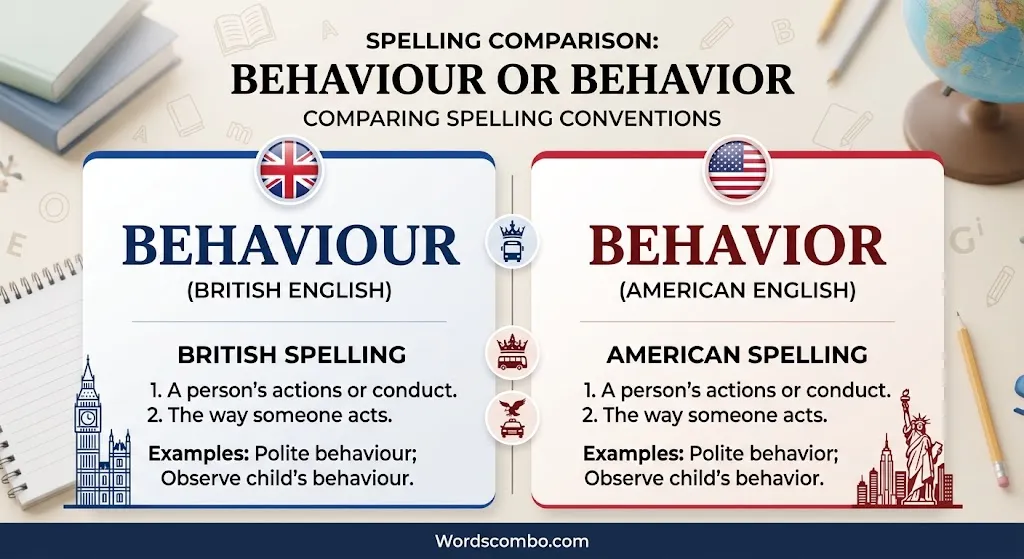
Behaviour and behavior are both correct. Behaviour is the standard British English spelling, while behavior is the standard American English spelling. They have the same meaning and are used in the same contexts.
If you are writing for a British English audience, use behaviour. If you are following American English, use behavior. The difference is spelling, not meaning, grammar, or pronunciation.
The choice between behaviour or behavior can be confusing because both spellings appear in dictionaries, books, websites, academic writing, and everyday communication. Neither form is a general spelling mistake. The correct choice depends on which variety of English you are using.
In British English, the word keeps the -our ending as behaviour. American English removes the u and uses behavior. The same pattern appears in words such as colour/color, favour/favor, and honour/honor.
Why the Confusion Happens
The confusion comes from the differences between British and American spelling conventions.
British English commonly retains -our endings in words that have historically been written that way. American English often uses -or instead. As a result, British writers normally use behaviour, while American writers use behavior.
This does not mean that one spelling is better than the other. Both belong to established forms of English. The important thing is to choose the spelling that matches your intended variety of English and use it consistently.
For example:
- British English: The student’s behaviour was excellent.
- American English: The student’s behavior was excellent.
The meaning remains exactly the same.
Meanings of Behaviour and Behavior
What does behaviour mean?
Behaviour is the British English spelling of a noun meaning the way a person, animal, group, or other thing acts or responds.
It can describe someone’s actions in everyday situations, their conduct toward others, or the way something operates under particular conditions.
Examples include:
- children’s behaviour at school
- professional behaviour at work
- unusual animal behaviour
- human behaviour
- changes in consumer behaviour
What does behavior mean?
Behavior has exactly the same meaning as behaviour, but it is the standard American English spelling.
It can describe how a person acts, how an animal responds, or how something functions.
For example:
- The child’s behavior changed after the move.
- Scientists study animal behavior.
- His behavior during the meeting was professional.
- The machine’s behavior changed under pressure.
Dictionaries treat behavior as the American form of behaviour, confirming that the distinction is regional rather than a difference in meaning.
Correct Usage Examples
Using behaviour in British English
- The teacher praised the student’s behaviour during the lesson.
- Her calm behaviour helped everyone feel comfortable.
- The researchers studied animal behaviour in its natural environment.
- His rude behaviour caused problems at work.
Using behavior in American English
- The teacher praised the student’s behavior during the lesson.
- Her calm behavior helped everyone feel comfortable.
- The researchers studied animal behavior in its natural environment.
- His rude behavior caused problems at work.
Notice that the sentence structure and meaning do not change. Only the spelling of the noun changes.
Behaviour vs Behavior at a Glance
| Word | Status/Context | Why | Example |
| Behaviour | British English | Standard British spelling | Her behaviour was polite. |
| Behavior | American English | Standard American spelling | Her behavior was polite. |
Both forms are valid. If your document follows British spelling, use behaviour throughout. If it follows American spelling, use behavior throughout.
Behaviour or Behavior: Which One Should You Use?
The best choice depends on your audience and the style of English you are following.
Use behaviour when writing in British English. This is the usual form in British publications and is also used in other varieties that generally follow British spelling conventions.
Use behavior when writing in American English. It is the normal American form and should be preferred when your audience, school, employer, publication, or style guide uses American English.
The key is consistency. Avoid switching between behaviour and behavior randomly within the same piece of writing.
For example, if an article consistently uses British spellings such as colour, favour, and organise, behaviour fits naturally with that style. If it uses color, favor, and organize, behavior is the appropriate choice.
Related Forms: Behavioural or Behavioral
The same regional difference appears in related forms of the word.
British English uses:
- behaviour
- behavioural
- behaviourally
American English uses:
- behavior
- behavioral
- behaviorally
For example:
- British: The study examines behavioural changes in children.
- American: The study examines behavioral changes in children.
The pattern remains consistent because the difference comes from the British -our and American -or spelling conventions.
Memory Trick
Think of the U in behaviour as a reminder of UK English.
UK → behaviour
US → behavior
The letters make the choice easy to remember: UK has the U, US drops the U.
This is not a rule for every British and American spelling difference, but it works perfectly for behaviour/behavior.
Similar Word Pairs to Watch For
Colour or Color
Colour is the British spelling, while color is the American spelling. Both refer to the visual property produced by light.
Favour or Favor
Favour is the British form, while favor is the American form. Both can mean an act of kindness, approval, or support.
Honour or Honor
British English uses honour, while American English uses honor. Both words have the same meaning.
Labour or Labor
Labour is the British spelling, while labor is the American spelling. The words can refer to work or, in specific contexts, the process of childbirth.
Humour or Humor
British English generally uses humour, while American English uses humor. Both describe the quality of being amusing or the ability to appreciate comedy.
These pairs follow the same broad spelling distinction as behaviour vs behavior.
Mini FAQ
Is behaviour or behavior correct?
Both are correct. Behaviour is the standard British English spelling, while behavior is the standard American English spelling.
Is behaviour British or American?
Behaviour is British English. American English uses behavior instead.
Is behavior a misspelling of behaviour?
No. Behavior is not a misspelling when American English is being used. It is the standard American spelling of the word.
Does behaviour mean something different from behavior?
No. They have the same meaning. Both refer to the way someone or something acts or responds.
Should I use behaviour or behavior in formal writing?
Use the spelling required by the variety of English used by your audience or organization. British English calls for behaviour, while American English uses behavior. Consistency is more important than choosing one form universally.
Conclusion
Behaviour or behavior is a British-versus-American spelling difference, not a difference in meaning. Use behaviour for British English and behavior for American English, and keep your spelling consistent throughout your writing.
If you are comparing other regional spellings, see our guides to Counselling or Counseling and Afterward or Afterwards for more examples.

I studied English literature and have spent years editing content for blogs and digital platforms. I noticed most people struggle with choosing between two similar words. At WordsCombo, I make that choice simple and clear.






1 thought on “Behaviour or Behavior: British vs American Spelling”