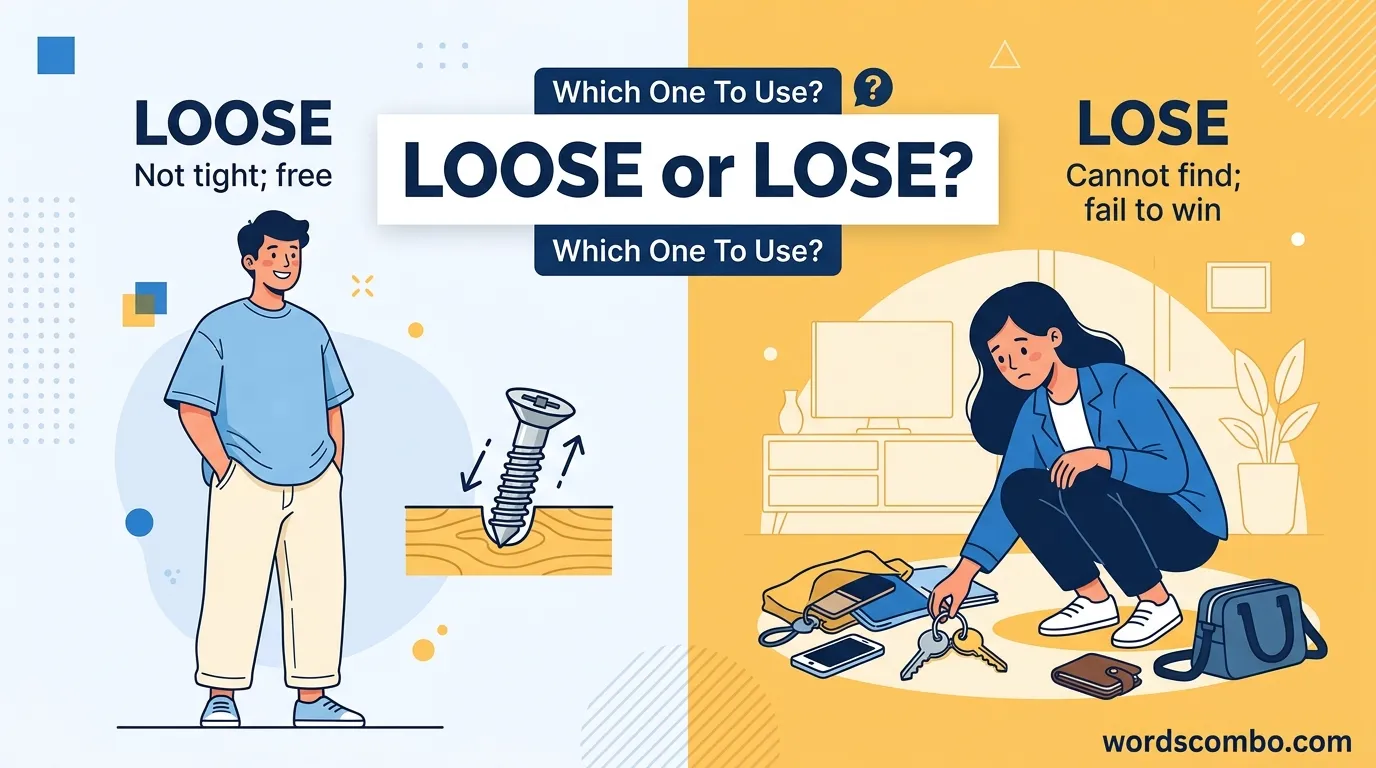
Loose means not tight, fixed, or controlled, while lose means to misplace something, fail to win, or no longer have something.
I remember catching this mistake while editing a short work email. The sentence said, “I don’t want to loose this client.” I knew what the writer meant, but that extra o changed the word completely. The funny part was that the rest of the email was polished and professional. One tiny spelling mistake stood out.
That is why loose or lose causes so much trouble. The words look almost identical, and they sound close when spoken quickly. Yet they do very different jobs in a sentence.
You lose your keys. Your keys can become loose.
You lose weight. Your clothes may become loose.
Once you see that pattern, the difference becomes much easier. This guide will show you the meanings, pronunciation, grammar, common mistakes, real-world examples, and a simple memory trick that can help you choose the right word in seconds.
Loose or Lose: The Quick Answer
Loose usually describes something that is not tight, not firmly attached, or free.
- My shoes are loose.
- The screw is loose.
- The dog got loose.
Lose is usually a verb. It means to misplace, fail to win, or stop having something.
- I might lose my keys.
- We could lose the game.
- She wants to lose weight.
The fastest rule is simple:
Loose = extra space or freedom. Lose = loss or failure.
The Story Behind Loose and Lose
The two words look almost like twins, but they developed along different paths in English.
Loose has long been connected with ideas such as being free, unfastened, or not tightly held. That meaning still appears in everyday phrases such as loose clothing, loose change, and break loose.
Lose developed around the idea of being deprived of something, failing to keep something, or suffering a loss. That is why we use it with things such as money, games, time, opportunities, possessions, and weight.
Their similar spelling creates the real trap.
The extra o in loose makes it look like it should be the natural choice for words such as “loose weight” or “loose the game.” But that is incorrect.
Think about the meaning before you think about the spelling.
If something is not tight, choose loose.
If something is gone, missed, misplaced, or not won, choose lose.
Loose vs Lose: The Key Difference
Here is the simplest way to separate them:
| Term | Meaning | When to Use | Region/Context |
|---|---|---|---|
| Loose | Not tight, fixed, or restrained | Clothing, objects, animals, rules, or physical conditions | Standard English |
| Lose | Misplace, fail, or stop having something | Games, possessions, weight, money, time, or opportunities | Standard English |
When to use “loose”
Use loose when you are describing a condition.
For example:
- The shirt is loose.
- The tooth feels loose.
- One wheel became loose.
- The dog is loose in the yard.
- She prefers loose clothing.
Here, you are describing something that is not tight or securely controlled.
When to use “lose”
Use lose when you are talking about an action or result.
For example:
- Don’t lose your phone.
- We might lose the match.
- I need to lose weight.
- He could lose his job.
- Don’t lose hope.
Here, something is being missed, misplaced, reduced, or no longer kept.
A useful two-word test
Try this pair:
Loose shoes
The shoes are not tight.
Lose shoes
This does not make sense if you mean shoe fit.
Now try:
Lose your shoes
You cannot find them or no longer have them.
Loose your shoes
Usually incorrect in everyday writing.
That tiny shift in meaning is the whole secret.
Which One Should You Use?
The answer does not depend on whether you are writing for the United States, the United Kingdom, or a global audience.
Both loose and lose are standard English words. The correct choice depends on what you mean.
For students
Use loose for descriptions such as clothing, objects, or physical conditions.
Use lose for actions such as losing a game, losing focus, or losing an item.
For professional writers
Be especially careful with lose in phrases such as:
- lose money
- lose customers
- lose time
- lose focus
- lose credibility
- lose an opportunity
A spelling mistake here can make otherwise polished writing look careless.
For casual writing
The same rule applies.
Text messages and social posts may be informal, but loose and lose still have different meanings.
For global English
Do not treat this as an American-versus-British spelling issue.
The distinction stays the same:
Loose = not tight or free
Lose = misplace, fail, or no longer have
Common Mistakes with Loose or Lose
These mistakes are easy to make because one extra letter changes the meaning.
| Mistake | Correction | Why |
|---|---|---|
| I don’t want to loose my job. | I don’t want to lose my job. | You mean you do not want your job to be gone. |
| I want to loose weight. | I want to lose weight. | Weight is something you want to reduce. |
| My shoes are too lose. | My shoes are too loose. | The shoes do not fit tightly. |
| We might loose the game. | We might lose the game. | The team may fail to win. |
| The screw is lose. | The screw is loose. | The screw is not firmly attached. |
Mistake 1: “Loose weight”
This is probably the mistake people remember most.
❌ I need to loose weight.
✅ I need to lose weight.
You are talking about reducing something you have. That requires lose.
Mistake 2: “Loose the game”
❌ Our team could loose the game.
✅ Our team could lose the game.
A game can be lost. It cannot be “loosed” in this meaning.
Mistake 3: “Lose clothing”
❌ She bought a lose dress.
✅ She bought a loose dress.
The dress is not tight, so loose is correct.
Mistake 4: “Loose my keys”
❌ I always loose my keys.
✅ I always lose my keys.
You are talking about misplacing the keys.
Mistake 5: “The handle is lose”
❌ The handle is lose.
✅ The handle is loose.
The handle is not securely attached, so loose fits the meaning.
Loose or Lose in Real World Examples
Seeing these words in normal situations makes the difference much easier to remember.
In a professional email
Please check the cabinet before the meeting. One of the handles is loose, and we do not want it to lose its grip completely.
Here, loose describes the handle. Lose describes something no longer being held securely.
In a news headline
Local Team Could Lose Key Match Tonight
The headline uses lose because the team may fail to win.
In a social media post
Finally found my loose bracelet after thinking I had lost it!
Notice the difference between the two words.
The bracelet is loose because it is not tight.
The person thought they had lost it because they could not find it.
In a formal report
The company may lose revenue if the loose connection is not repaired.
The company could suffer a loss, so we use lose.
The connection is not secure, so we use loose.
In everyday conversation
My jeans are too loose, but I don’t want to lose them.
That sentence gives you the whole rule in one line.
Loose or Lose: Data, Trends & Usage
Loose or lose is mainly an informational search. People usually type the phrase when they are unsure which spelling belongs in a sentence.
The confusion appears across several common situations:
- Health: lose weight
- Sports: lose a game
- Work: lose a client
- School: lose points
- Shopping: loose clothing
- Home repairs: loose screws
- Daily life: lose keys
- Social media: loose vs lose spelling questions
The United States is an important audience for this topic because the words appear often in everyday American English. But the same confusion affects English users in many other regions.
The most useful insight is that this is not really a spelling problem. It is a meaning problem.
When you decide what the sentence means first, the spelling becomes much easier.
Loose or Lose: Comparison at a Glance
| Term/Variant | Meaning | Region/Context | Best Used When |
|---|---|---|---|
| Loose | Not tight, secure, or restrained | Standard English | Describing fit, movement, freedom, or attachment |
| Lose | Misplace, fail, or stop having something | Standard English | Describing loss, failure, or something no longer kept |
| Loose as a verb | Release or set free | Less common, literary or formal contexts | When something is deliberately released |
| Lose as a verb | Fail to keep, find, win, or retain | Very common everyday use | Talking about games, objects, money, time, weight, or opportunities |
One more point matters here: loose can occasionally work as a verb, but that use is uncommon in everyday English.
For most writing, you will use loose as a description and lose as an action.
FAQs About Loose or Lose
What is the difference between loose and lose?
Loose usually means not tight, not secure, or free. Lose usually means to misplace something, fail to win, or stop having something.
Is it lose weight or loose weight?
The correct phrase is lose weight. You use lose because you are talking about reducing the amount of weight you have.
Is it loose clothing or lose clothing?
The correct phrase is loose clothing. The word loose describes clothing that does not fit tightly.
How do you remember loose vs lose?
A simple trick is to connect the extra o in loose with extra room. If something has extra room and is not tight, use loose. If you are talking about loss or failure, use lose.
Is loose acceptable in formal writing?
Yes. Loose is completely standard in formal writing when it has the correct meaning. You can write about loose connections, loose rules, loose clothing, or other things that are not tightly fixed.
Is lose always a verb?
In normal everyday English, lose is used as a verb. You can lose your keys, lose a game, lose money, lose weight, lose focus, or lose an opportunity.
Can loose be used as a verb?
Yes, but this use is uncommon in modern everyday writing. Loose can mean to release or set something free. In most ordinary sentences, however, you are much more likely to see it as an adjective.
Is loose or lose the correct spelling in American English?
Both spellings are correct, but they have different meanings. American English uses loose for something that is not tight or restrained and lose for misplacing, failing, or no longer having something.
Why do people confuse loose and lose?
The words look very similar, and their pronunciation is close enough to cause mistakes when people speak quickly or type without checking. The extra o also makes the wrong spelling feel tempting in words such as “lose weight.”
Final Thoughts on Loose or Lose
The difference between loose and lose is small in spelling but big in meaning.
Remember these three rules:
- Loose means not tight, secure, or restrained.
- Lose means to misplace, fail, or no longer have something.
- Lose weight is correct, while loose clothing is correct.
If you are unsure, stop looking at the letters for a moment. Look at the meaning.
Are you describing something with extra room or freedom? Choose loose.
Are you talking about something being missed, lost, reduced, or not won? Choose lose.
That simple check can save you from one of the most common word-choice mistakes in English. Once the difference clicks, you will start spotting the correct word almost automatically.
Bookmark this guide so you never second guess loose or lose again.
Curious about similar word choices? Explore Loosing or Losing.

I have been working with English language content for over six years. I specialize in word comparisons and spelling differences that most people overlook. At WordsCombo, I help readers choose the right word every time.




2 thoughts on “Loose or Lose: The Easy Rule You’ll Never Forget”