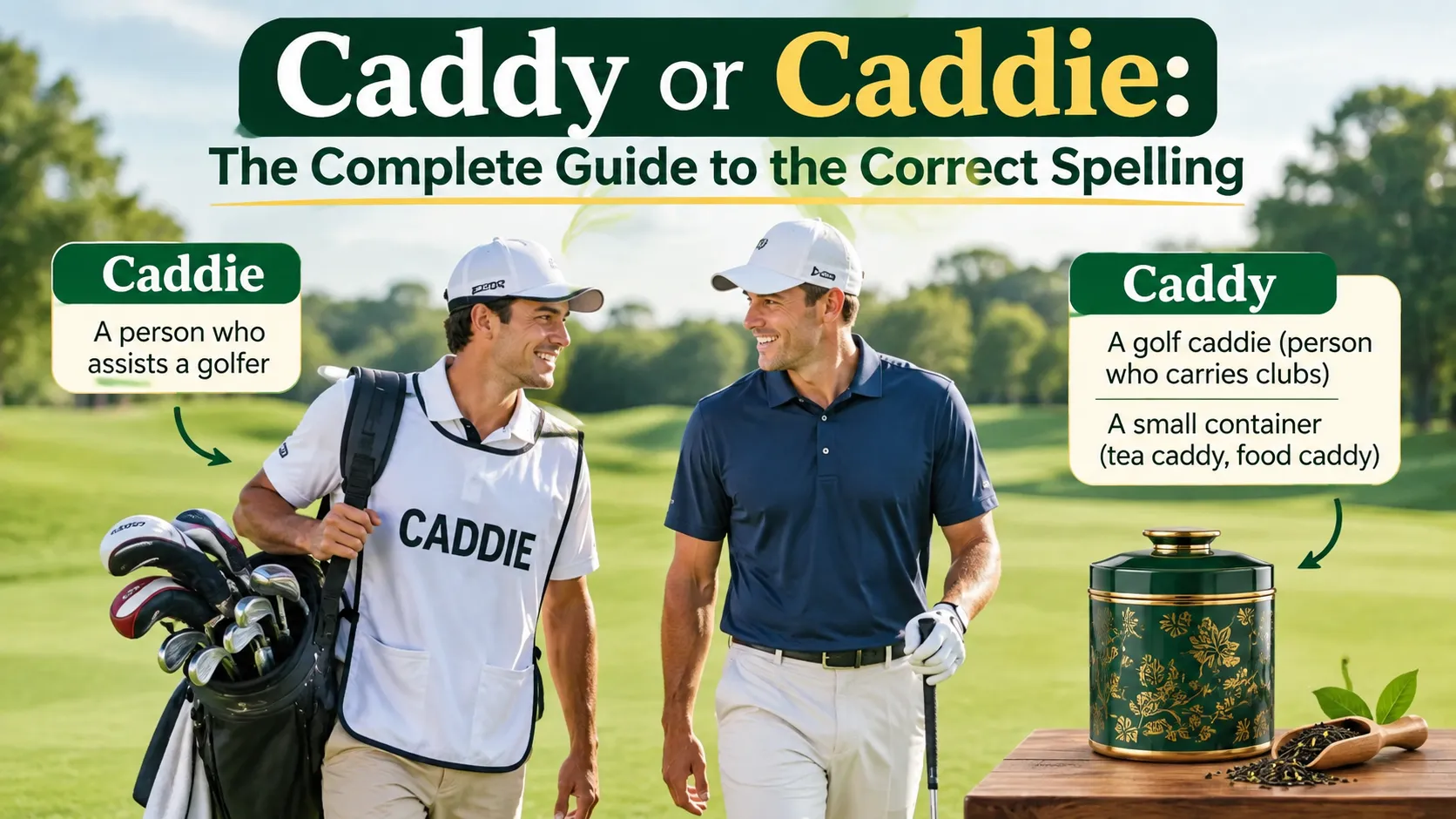
Caddy or caddie both refer to a person who carries a golfer’s clubs and helps during a round. Caddie is the standard spelling for the golf role, while caddy is also widely used and has other meanings.
Have you ever typed caddy and wondered if you should have written caddie instead?
I have seen this small spelling choice cause a surprising amount of confusion. It often happens when someone writes about golf, edits a sports article, or checks a word before sending an email. The problem is simple: both words are real English words, but they do not always mean the same thing.
That makes this more than a spelling question.
If you are talking about the person who carries a golfer’s clubs, gives advice, and helps a player read the course, caddie is the safest choice. Yet caddy is also used for that golf meaning, especially in some contexts and varieties of English.
There is another twist. Caddy can also mean a small container used to hold or store things. So choosing the wrong spelling can change the meaning of your sentence.
This guide makes the difference easy to remember. You will learn where both words came from, when to use each one, common mistakes, real examples, and a simple rule you can use every time.
Caddy or Caddie
For golf, the traditional and most widely recommended spelling for the person helping a player is caddie.
For example:
- The golfer thanked his caddie after the final hole.
- Her caddie helped her choose the right club.
Caddy can also be used for a golf caddie. It is not simply a misspelling. However, caddy has a separate meaning too: a small container or holder.
For example:
- She keeps tea in a metal caddy.
- The golfer hired a caddie for the tournament.
A quick memory trick is this:
Golf helper = caddie. Container = caddy.
That rule will keep you right in most writing.
The Origin and Background of Caddy or Caddie
The history of caddie is linked to golf and Scotland.
The word is related to the Scots word caddie, which referred to a young person who did various jobs or carried messages. Over time, the word became strongly connected with golf.
A golf caddie was a person who carried a player’s clubs and offered practical help on the course.
The spelling later appeared in several forms, including caddy. English spelling has never been perfectly fixed, so variations often develop over time.
This explains why you may see both forms in books, newspapers, websites, and everyday speech.
The two spellings are also easy to confuse because they sound almost identical.
There is an important difference, though. Caddy developed another common meaning in English. It can describe a container used to store items such as tea, food, tools, or other small objects.
So the modern words have overlapping meanings but are not always interchangeable.
Why does the spelling vary?
English often keeps spelling variations that became established in different places or periods.
You can see similar patterns in words such as:
- theater / theatre
- color / colour
- center / centre
With caddy and caddie, context matters more than it does with many spelling variants because caddy has its own dictionary meaning.
Caddy or Caddie Explained: Key Differences
The easiest way to understand the two words is to look at what they usually mean.
| Term | Meaning | When to Use | Region/Context |
|---|---|---|---|
| Caddie | A person who assists a golfer | Golf writing and formal references | Common in golf |
| Caddy | A golf caddie; also a small container | Golf or storage context | Widely used in English |
| Golf caddie | A person who carries clubs and helps a golfer | When maximum clarity is needed | International English |
| Tea caddy | A container for tea | Storage and household writing | General English |
Example: caddie
The professional golfer spoke with her caddie before hitting the shot.
Here, caddie clearly means the person helping the golfer.
Example: caddy
The golfer hired a local caddy for the weekend.
Here, caddy means the same golf worker.
But look at this sentence:
The tea caddy was made of wood.
Now caddy means a container. Caddie would be wrong here.
Which Version Should You Use?
The best choice depends on your audience and your meaning.
For beginners and students
Use caddie when you mean the person who helps a golfer.
It is the clearest choice for school work and basic English writing.
Example:
The golfer’s caddie carried the clubs.
For professional or formal writing
Use caddie when referring to the golf role.
This spelling is especially useful in sports writing because it removes possible confusion with the container meaning of caddy.
For American English
You may see both caddie and caddy in golf related writing.
If you are writing for a broad audience, caddie is a strong neutral choice.
For British English
Caddie is also a standard spelling for the golf meaning.
However, caddy remains a valid word when referring to a container.
For global English
Choose caddie for the golf worker.
It is the easiest option when your readers may come from different countries.
Simple recommendation: If you mean a person who helps a golfer, write caddie.
Common Mistakes With Caddy or Caddie
Small spelling errors can change the meaning of a sentence. Here are five common mistakes.
| Mistake | Correction | Why |
|---|---|---|
| The golfer thanked his caddy. | The golfer thanked his caddie. | Caddie is the clearest golf spelling. |
| She put the tea in a caddie. | She put the tea in a caddy. | A tea container is a caddy. |
| The caddie held the tea. | The caddy held the tea. | The sentence refers to a container. |
| The golf caddy gave advice. | The golf caddie gave advice. | Caddie avoids ambiguity. |
| He became a tea caddie. | He became a tea caddy. | A tea caddy is a container, not a person. |
Mistake 1: Thinking “caddy” is always wrong
It is not.
Caddy is a real word. It can refer to a golf caddie or a container.
Mistake 2: Using “caddie” for every meaning
That is also incorrect.
If you mean a tea container, use caddy.
Mistake 3: Assuming the two spellings are always interchangeable
In golf, they can overlap. In other contexts, they cannot.
Always check what the sentence means.
Mistake 4: Adding an unnecessary explanation
You do not need to write:
The golf caddie, which is the person who carries golf clubs, helped him.
If the context is clear, simply write:
His caddie helped him.
Simple writing is usually stronger.
Mistake 5: Relying only on pronunciation
The two words sound very similar.
That means listening is not enough. Look at the meaning before choosing the spelling.
Caddy or Caddie in Real World Examples
Seeing the words in context makes the difference much easier to remember.
1. Professional email
Subject: Golf Tournament Schedule
Hi James,
Please confirm whether each player will have a caddie during Saturday’s round.
Thanks,
Sarah
Here, caddie means a person who assists a golfer.
2. News article
Local golfer credits his caddie after major win
The word caddie is natural in a golf news story.
3. Social media post
Huge thanks to my caddie for helping me stay calm on the final hole!
Again, the word refers to the golf helper.
4. Formal document
Each competitor may be accompanied by one caddie during the round.
This wording is clear and professional.
5. Household context
The new tea caddy keeps the leaves dry and fresh.
Here, caddy means a container.
Notice how context solves the problem.
Caddy or Caddie: Data, Trends and Usage
The main search intent behind caddy or caddie is informational.
People usually search the phrase because they want to know:
- Which spelling is correct?
- Is caddy a misspelling of caddie?
- What does caddie mean?
- What is the difference between caddy and caddie?
- Is caddy used in golf?
- What is a tea caddy?
The topic matters because English contains many words that have more than one accepted spelling or meaning.
For golf fans, sports writers, students, editors, and English learners, a small spelling choice can affect clarity.
The safest broad use pattern is simple:
Use “caddie” for the golf helper. Use “caddy” for a container.
That distinction works well for readers in many English speaking regions.
Caddy vs. Caddie: Standalone Comparison
| Term/Variant | Meaning | Region/Context | Best Used When |
|---|---|---|---|
| Caddie | Person who assists a golfer | Golf, general English | You mean the golf helper |
| Caddy | Person who assists a golfer | Golf, especially informal use | You are using the accepted golf variant |
| Caddy | Small storage container | General English | You mean a tea, food, or storage container |
| Golf caddie | Golf assistant | International and formal contexts | You want maximum clarity |
| Tea caddy | Tea storage container | Household and food contexts | You mean a tea container |
If you remember only one line, remember this:
A caddie helps a golfer. A caddy can hold your tea.
Frequently Asked Questions
Q: What does caddy or caddie mean?
A: In golf, caddie and caddy can mean a person who carries a golfer’s clubs and helps during a round. Caddy also means a small container used for storing things.
Q: How do you use caddie correctly?
A: Use caddie when you mean a person who assists a golfer. For example: The golfer asked her caddie for advice.
Q: Caddy vs. caddie: what’s the difference?
A: For golf, both spellings can refer to the same role. However, caddy also has the separate meaning of a container, while caddie is strongly linked to the golf role.
Q: Is caddie acceptable in formal writing?
A: Yes. Caddie is a standard word and is a good choice in formal writing about golf. It is often the clearest spelling when you mean the golf assistant.
Q: Which version is correct: caddy or caddie?
A: Both can be correct, depending on the meaning and context. For a golf assistant, caddie is the safest choice. For a container, use caddy.
Q: Where does the word caddie come from?
A: Caddie is connected to Scots usage and developed from a word for a young person or messenger who did various jobs. It later became closely associated with golf.
Q: Can caddy be used for a golf assistant?
A: Yes. Caddy is used for the golf role and is not automatically a spelling error. Still, caddie is the safer choice when you want clear, standard golf terminology.
Q: What is a tea caddy?
A: A tea caddy is a container used to store tea. In this meaning, caddy is the correct spelling.
Conclusion
The caddy or caddie question looks small, but the answer is useful.
If you mean the person who carries golf clubs and helps a player during a round, caddie is the best general choice. Caddy can also describe that golf role, so seeing it in golf writing does not automatically mean the writer made a mistake.
The bigger difference appears outside golf. Caddy can mean a container, such as a tea caddy. That meaning makes the spelling worth checking.
Here are the three rules to remember:
- Caddie = a person who helps a golfer.
- Caddy = a golf assistant in some usage.
- Caddy = a container, such as a tea caddy.
When you are unsure, choose caddie for the golf worker. It is clear, familiar, and easy for an international audience to understand.
Now you know exactly when to use caddy or caddie. Bookmark this guide so you never have to second guess the spelling again.
Raed more: Racquet or Racket: The Easy Guide to Correct Use

I started writing about English word differences after years of teaching students who kept making the same mistakes. My focus is on making spelling rules feel simple and easy to remember. At WordsCombo, I turn confusing word pairs into clear comparisons.