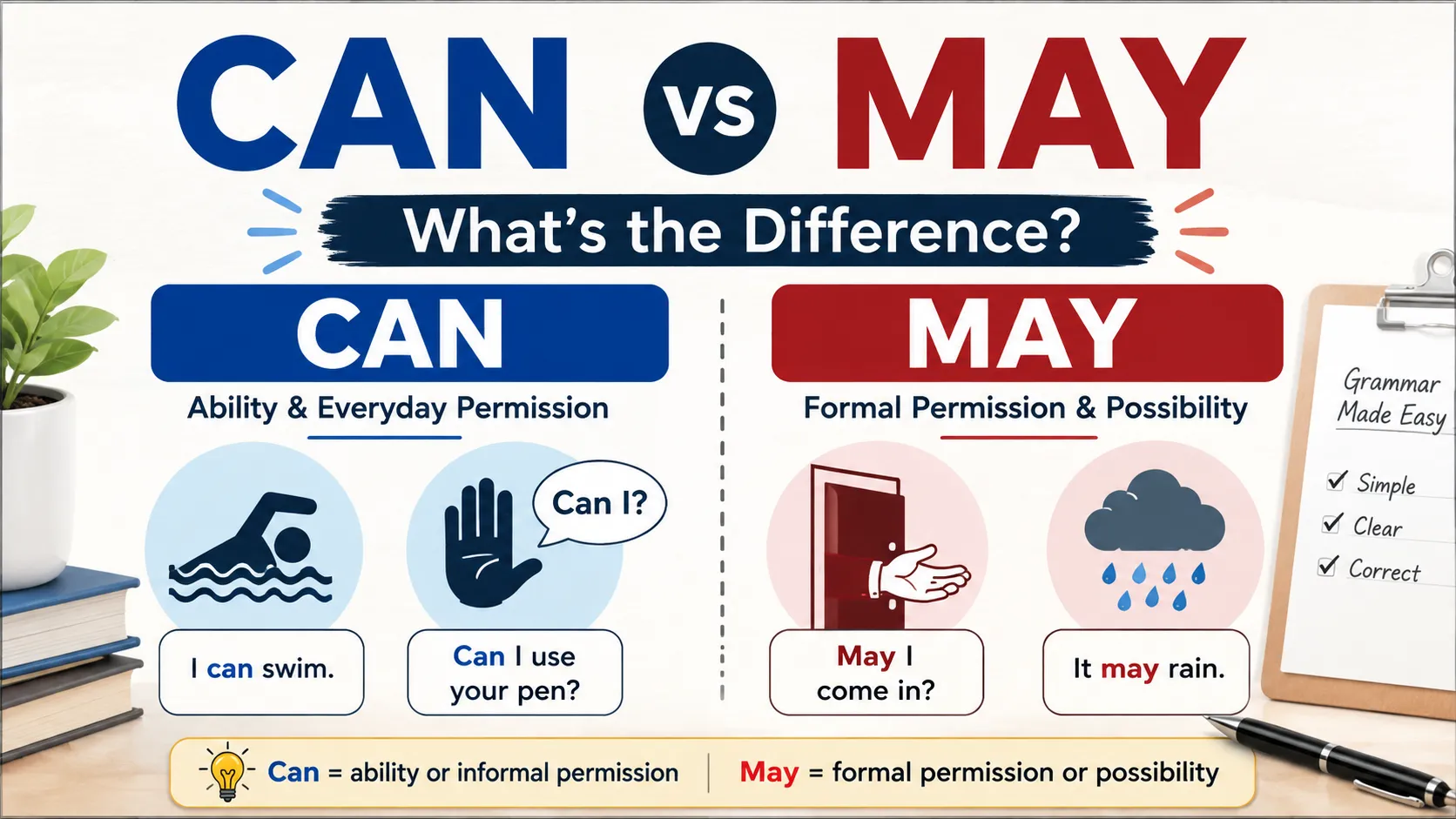
Use can for ability and common permission. Use may for formal permission and possibility.
Have you ever stopped while writing a sentence and wondered, “Should I use can or may?”
You are not alone. This is one of those small English questions that can make even a simple sentence feel difficult.
A student may write, “May I go outside?” Then a friend asks, “Can I go outside?” Both sound natural. So, which one is correct?
The answer depends on what you mean and how formal the situation is.
For years, one of the easiest ways to teach this difference has been to connect each word with a clear idea. Think of can as the word of ability. Think of may as the word of permission or possibility.
That simple rule works well, but there is more to it. Modern English has also changed how people use these words. In everyday speech, can is very common when asking for permission.
This guide will help you understand the difference, avoid common mistakes, and choose the right word with confidence.
Can or May
Can and may can both be used when asking for permission, but they do not always have the same meaning or tone.
- Can = ability or informal permission
- May = formal permission or possibility
Example 1: Ability
Can you swim?
Here, can means that someone has the ability to swim.
You could not replace it with may.
❌ May you swim?
✅ Can you swim?
Example 2: Permission
Can I use your phone?
This is common in everyday English.
May I use your phone?
This is also correct. It sounds more formal and polite.
So, both can work for permission. The main difference is tone and context.
The Origin and Background of Can or May
The difference between can and may comes from their long history in English.
Can is linked to an old English verb meaning to know or be able to. Over time, its meaning became strongly connected with ability.
That is why we say:
I can drive.
She can speak French.
They can solve the problem.
May has a different history. It comes from an old word connected with having power, ability, or permission.
Over time, may became strongly linked with permission and possibility.
For example:
You may leave now.
This means you have permission to leave.
We also use may for possibility:
It may rain tonight.
Here, may does not mean permission. It means that rain is possible.
This history helps explain why the two words sometimes overlap. English changes over time. Words can gain new uses while keeping older meanings.
That is why modern English allows can for permission in many everyday situations.
Can or May Explained: Key Differences
The easiest way to understand these words is to look at their main uses.
| Term | Meaning | When to Use | Region/Context |
|---|---|---|---|
| Can | Ability | When someone has the skill or power to do something | General English |
| Can | Permission | Informal requests for permission | Everyday conversation |
| May | Permission | Polite or formal permission | Formal and polite English |
| May | Possibility | Something might happen | General English |
| Might | Possibility | A less certain possibility | General English |
1. Can for ability
Use can when you mean that someone is able to do something.
I can drive.
Sarah can play the piano.
Can you lift this box?
The question “Can you…?” often asks about ability.
2. Can for informal permission
In modern English, can is widely used to ask for permission.
Can I sit here?
Can we leave early?
Can I borrow your pen?
These sentences are normal in everyday speech.
3. May for formal permission
Use may when you want your language to sound more formal or respectful.
May I come in?
May I ask a question?
May we begin the meeting?
You may hear this style in classrooms, offices, official settings, and polite requests.
4. May for possibility
This is another major use of may.
It may snow tomorrow.
She may be late.
We may visit Lahore next week.
Here, may means possibly.
You cannot normally use can with this meaning.
❌ It can rain tomorrow.
✅ It may rain tomorrow.
However, can can describe general possibility:
It can get very hot here in summer.
That means hot weather is possible in general.
Which Version Should You Use?
The best choice depends on your audience and purpose.
For beginners and everyday conversation
Use can when asking for permission.
Can I use your laptop?
It sounds natural and friendly.
For formal writing
Use may when you want to show formal permission.
Employees may request leave through the online system.
This sounds suitable for a workplace policy.
For polite requests
May I…? is a safe choice.
May I speak with the manager?
It sounds respectful without being too complicated.
For ability
Use can.
I can speak English.
Do not use may when you mean ability.
For possibility
Use may when something is possible.
The package may arrive tomorrow.
A useful rule is:
Can = ability or everyday permission.
May = formal permission or possibility.
Common Mistakes With Can or May
These two words are easy to mix up. Here are some common mistakes.
| Mistake | Correction | Why? |
|---|---|---|
| ❌ May you drive a car? | ✅ Can you drive a car? | Can shows ability. |
| ❌ Can it rain tomorrow? | ✅ May it rain tomorrow? | May shows possibility. |
| ❌ I may swim very well. | ✅ I can swim very well. | Swimming ability needs can. |
| ❌ May I borrow your pen? | ✅ May I borrow your pen? | This sentence is already correct. |
| ❌ You can leave now. | ✅ You may leave now. | May sounds more formal when giving permission. |
Mistake 1: Using may for ability
❌ I may speak Spanish.
This usually sounds like perhaps I speak Spanish.
If you mean you have the skill, say:
✅ I can speak Spanish.
Mistake 2: Thinking can is always wrong for permission
Some traditional grammar lessons teach that only may should be used for permission.
Modern English is more flexible.
Can I open the window?
This is completely normal in everyday English.
Mistake 3: Using can for every type of possibility
Compare these:
It can be dangerous.
This means something is sometimes dangerous or has the potential to be dangerous.
It may be dangerous.
This means it is possible that it is dangerous in this particular case.
The context changes the meaning.
Mistake 4: Making formal writing too casual
Can employees enter this room?
This is not necessarily wrong. But a rule may sound more formal as:
Employees may enter this room.
The second sentence clearly sounds like an official permission or rule.
Can or May in Real World Examples
Knowing grammar rules is useful. Seeing the words in real situations is even better.
1. Professional email
May I request an extension for the project deadline?
This sounds polite and professional.
For a friendly coworker, you could also write:
Can I get an extension on the project deadline?
Both can work. The first is more formal.
2. News article
The company may announce the new policy next week.
Here, may shows possibility.
The writer does not know for sure that the announcement will happen.
3. Social media post
Can I get your opinion on this?
This is natural and casual.
Social media usually favors conversational English, so can often feels more natural.
4. Formal document
Visitors may enter the building after 9 a.m.
This is a rule.
May clearly communicates permission in a formal context.
5. Classroom
A student might ask:
May I leave the classroom?
This is polite and traditional.
But in everyday conversation, a student might simply say:
Can I leave the classroom?
Both forms are understood.
Can or May: Data, Trends and Usage
The search intent behind “can or may” is mainly informational. People are usually not looking for a product or service. They want a quick grammar answer.
The confusion is common because English has two layers.
First, there are traditional grammar rules. These often teach may = permission and can = ability.
Second, there is modern everyday English. In everyday speech, can is widely used to ask for permission.
This creates a common situation:
Traditional rule: May I go?
Modern everyday English: Can I go?
Both can be correct.
The important point is context.
If you are talking with a friend, Can I…? is natural.
If you are writing a formal policy, may is often better.
This matters because good English is not only about grammar. It is also about tone, purpose, and audience.
Can or May: Standalone Comparison Table
| Term/Variant | Meaning | Region/Context | Best Used When |
|---|---|---|---|
| Can | Ability | All major English varieties | Talking about skills or ability |
| Can | Permission | Everyday English | Asking friends, family, or coworkers |
| May | Permission | Formal English | Making polite or official requests |
| May | Possibility | General English | Saying something is possible |
| Might | Possibility | General English | Expressing a weaker possibility |
There is no need to avoid can simply because you learned an older grammar rule.
Instead, ask yourself one question:
What do I mean here?
If you mean ability, choose can.
If you mean formal permission, choose may.
If you mean possibility, may is often the better choice.
FAQ: Can or May
Q: What does can mean?
A: Can mainly means that someone has the ability to do something. It can also be used to ask for permission in everyday English.
Q: What does may mean?
A: May can show permission or possibility. It is often more formal than can when asking for permission.
Q: Can I use can to ask for permission?
A: Yes. Can I…? is common and natural in modern English. It is especially common in casual conversation.
Q: Can or may — which is more formal?
A: May is generally more formal when asking for or giving permission. For example, “May I enter?” sounds more formal than “Can I enter?”
Q: Is can or may correct for ability?
A: Use can for ability. Say “I can swim,” not “I may swim,” when you mean that you have the ability to swim.
Q: Is may used for possibility?
A: Yes. May often means that something is possible. For example, “She may arrive late” means there is a possibility that she will arrive late.
Q: Where do can and may come from?
A: Both words have roots in Old English. Can developed from a word linked to knowing or being able, while may developed from a word linked to having power or permission.
Q: Can I use may in formal writing?
A: Yes. May is often a good choice for formal writing, especially when talking about rules, permission, or possibility.
Q: Is “May I?” more polite than “Can I?”
A: Usually, yes. May I…? has a more formal and polite tone. However, Can I…? is also polite in many everyday situations.
Conclusion
The difference between can and may becomes much easier when you focus on meaning.
Use can when you talk about ability:
I can drive.
Use can for informal permission:
Can I borrow your book?
Use may for formal permission:
May I enter the room?
And use may for possibility:
It may rain later.
The old rule that says “can is only for ability and may is only for permission” is too simple for modern English. Real English depends on context, tone, and audience.
For everyday conversation, can is usually the natural choice when asking for permission. For formal situations, may is often the safer choice.
Once you learn these four patterns, you will rarely need to stop and guess again.
Bookmark this guide so you never second guess can or may again.
Read more: Your or You’re: The Complete Guide to Using Them Correctly

I have been writing about English spelling and word usage for the past five years. My goal is to give readers a clear answer without overwhelming them with complicated rules. At WordsCombo, I focus on making everyday English easier for everyone.