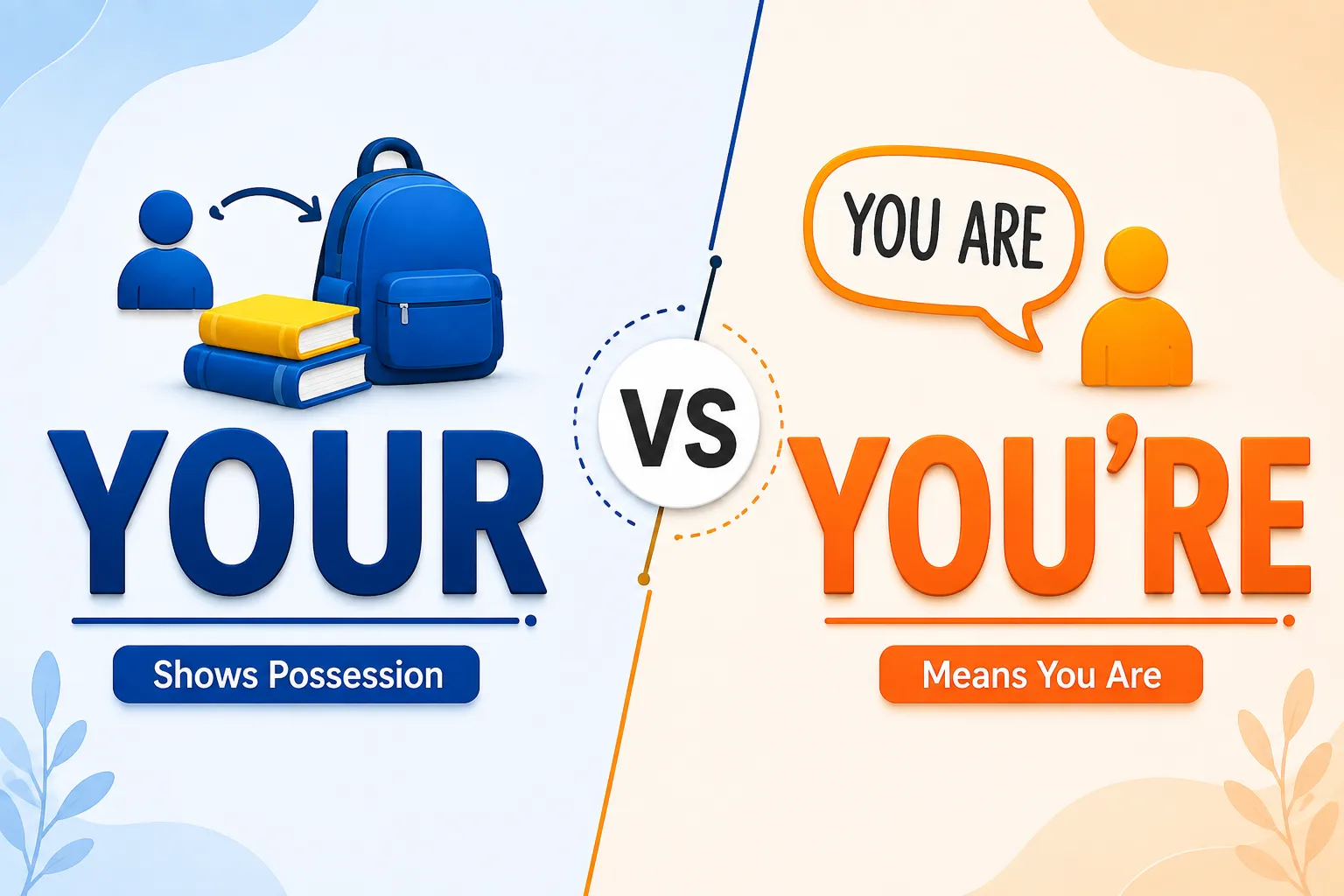
Your shows ownership, while you’re is short for you are. If you can replace it with you are, use you’re; otherwise, use your.
I still remember grading a stack of student papers early in my teaching career. One mistake appeared again and again. Students wrote “your welcome” instead of “you’re welcome.” Even strong writers made this error. It wasn’t because they did not know English. They were simply writing fast and mixing up two words that sound exactly the same.
If you have ever paused before typing your or you’re, you are not alone. Millions of people search this question every year. It is one of the most common grammar mistakes in English. It appears in emails, school work, social media posts, and even business messages.
The good news is that this mistake is easy to fix once you know one simple rule. You do not need to memorize long grammar lessons. A quick test can help you choose the right word every time.
By the end of this guide, you will understand the difference between your and you’re, know when to use each one, avoid common mistakes, and write with more confidence.
Your or You’re
Many people confuse your and you’re because they sound the same. These words are called homophones. They have the same pronunciation but different meanings and spellings.
Here is the simple rule:
- Your = shows that something belongs to someone.
- You’re = means you are.
Example 1
✅ Your backpack is on the table.
The backpack belongs to you.
Example 2
✅ You’re very kind.
This means:
✅ You are very kind.
Quick Memory Trick
Whenever you write you’re, replace it with you are.
If the sentence still makes sense, you’re is correct.
If it does not, choose your instead.
For example:
❌ You’re phone is ringing.
Replace it:
❌ You are phone is ringing.
That sounds wrong.
Correct sentence:
✅ Your phone is ringing.
The Origin and Background of Your or You’re
Understanding where these words come from makes them easier to remember.
Where Did Your Come From?
The word your comes from Old English. It has been used for hundreds of years to show ownership.
Its job has always been simple. It tells readers that something belongs to another person.
Examples:
- your book
- your family
- your ideas
- your homework
Nothing has changed about its meaning.
Where Did You’re Come From?
The word you’re is much newer.
It is a contraction.
A contraction joins two words together.
In this case:
you + are = you’re
The apostrophe replaces the missing letter a from are.
Examples:
- You’re happy.
- You’re late.
- You’re amazing.
- You’re learning fast.
Why Do People Mix Them Up?
There are three main reasons.
1. They sound exactly alike.
English has many homophones.
You hear the same sound, but each word has a different meaning.
2. People type quickly.
Phones and computers encourage fast writing.
Small grammar mistakes happen easily.
3. Spell check often misses the error.
Both your and you’re are real English words.
Since both are spelled correctly, many spelling tools cannot tell you that you used the wrong one.
That is why proofreading is still important.
Your or You’re Explained: Key Differences
Although these words sound identical, they have completely different jobs in a sentence.
Your
Your is a possessive determiner.
It tells readers that something belongs to someone.
Examples:
- Your shoes are outside.
- Your dog is sleeping.
- I like your idea.
- Your project looks great.
Notice that your is always followed by a noun or something acting like one.
You’re
You’re is a contraction.
It simply means:
You are
Examples:
- You’re my best friend.
- You’re doing well.
- You’re ready.
- You’re welcome.
A quick replacement with you are will confirm whether it is correct.
Side-by-Side Comparison
| Term | Meaning | When to Use | Region/Context |
|---|---|---|---|
| Your | Shows ownership | Before a noun that belongs to someone | Used worldwide in all English varieties |
| You’re | Short for you are | When you mean you are | Used worldwide in spoken and written English |
More Examples
| Sentence | Correct? | Why? |
|---|---|---|
| Your car is clean. | ✅ | The car belongs to you. |
| You’re very smart. | ✅ | Means you are very smart. |
| Your amazing. | ❌ | Ownership does not fit. Use you’re. |
| You’re backpack is heavy. | ❌ | Means “you are backpack.” Use your. |
Easy Test
Ask yourself one question:
Can I replace this word with “you are”?
If yes, write you’re.
If no, write your.
Examples:
- You’re doing great. ✔
- Your homework is finished. ✔
- You’re my teacher. ✔
- Your opinion matters. ✔
This simple habit can prevent almost every mistake.
Which Version Should You Use?
The right choice depends on what you want to say. The rule is simple once you know the job of each word.
For Students
Use your when you talk about something that belongs to someone.
Examples:
- Your notebook is on the desk.
- Please finish your homework.
Use you’re when you mean you are.
Examples:
- You’re doing a great job.
- You’re ready for the test.
For Professionals
Clear writing builds trust. A small grammar mistake can make an email or report look careless.
Use your for ownership.
- Thank you for your feedback.
- Please send your report by Friday.
Use you’re when describing the reader.
- You’re invited to the meeting.
- You’re responsible for the final review.
For Social Media Users
People often type quickly online. That is why your and you’re are mixed up so often.
Before you post, take one second to check:
Can I replace it with “you are”?
If yes, use you’re.
If no, use your.
For Global English
Whether you write American English, British English, Canadian English, or Australian English, the rule never changes.
- Your always shows ownership.
- You’re always means you are.
Best Recommendation
If you are unsure:
- Replace the word with you are.
- If the sentence still makes sense, choose you’re.
- If it does not, choose your.
This quick test works almost every time.
Common Mistakes with Your or You’re
Many people make the same mistakes because the words sound alike. Here are the most common errors and how to fix them.
| Mistake | Correct | Why |
|---|---|---|
| Your welcome. | You’re welcome. | It means you are welcome. |
| You’re car is new. | Your car is new. | The car belongs to you. |
| I like you’re idea. | I like your idea. | The idea belongs to you. |
| Your amazing! | You’re amazing! | It means you are amazing. |
| Is this you’re book? | Is this your book? | The book belongs to you. |
Why These Mistakes Happen
- The words sound exactly the same.
- Fast typing causes slips.
- Spell check often cannot detect the mistake.
- Many people rely on pronunciation instead of grammar.
How to Avoid Them
- Slow down before sending important messages.
- Use the “you are” test.
- Read your sentence aloud.
- Proofread emails and school assignments.
- Practice with short sentences every day.
A few seconds of checking can prevent embarrassing mistakes.
Your or You’re in Real World Examples
Seeing these words in everyday writing makes the rule much easier to remember.
Professional Email
Hello Sarah,
Thank you for your report. You’re doing excellent work, and your attention to detail is appreciated.
Best regards,
James
Notice:
- your report → ownership
- you’re doing → you are doing
- your attention → ownership
News Headline
You’re Not Alone: Experts Share Ways to Improve Your Writing
The headline uses both words correctly.
- You’re = you are
- Your writing = writing belongs to you
Social Media Post
You’re going to love this new café! Don’t forget your camera.
Again:
- You’re = you are
- Your camera = the camera belongs to you
Formal Report
Employees should update their records before confirming your account information. If you’re unsure about any details, contact Human Resources.
Professional writing follows the same grammar rule.
Everyday Conversation
Friend: You’re early today!
You: Yes. I forgot your umbrella yesterday, so I came back.
Both words fit naturally because each has a different purpose.
Your or You’re: Data, Trends & Usage
Confusion between your and you’re remains one of the most searched grammar topics online.
Who Searches for This Topic?
Many different groups look up this question, including:
- Students
- English learners
- Teachers
- Bloggers
- Business professionals
- Job seekers
- Content writers
Search Intent
The main search intent is informational.
People want to know:
- Which word is correct.
- How to remember the difference.
- When to use each word.
- How to avoid grammar mistakes.
Where Is It Most Common?
The topic is popular in countries where English is widely spoken or studied, including:
- United States
- United Kingdom
- Canada
- Australia
- India
- Pakistan
- Philippines
Why Does This Matter Today?
People write more than ever before.
Emails, text messages, online classes, social media, blogs, and remote work all depend on clear writing. A small grammar mistake can change how others see your message.
Using your and you’re correctly helps you sound more confident, professional, and trustworthy.
Standalone Comparison Table
| Term/Variant | Meaning | Region/Context | Best Used When |
|---|---|---|---|
| Your | Shows ownership or possession | All English-speaking regions | Something belongs to someone |
| You’re | Contraction of you are | All English-speaking regions | You mean you are |
| You are | Full form of you’re | Formal writing, emphasis, or clarity | Avoiding contractions or adding emphasis |
Frequently Asked Questions (FAQs)
Q: What does your mean?
A: Your is a possessive word. It shows that something belongs to you or another person. For example, “Your bag is on the chair.”
Q: What does you’re mean?
A: You’re is a contraction of you are. It combines two words into one. For example, “You’re very kind.” means “You are very kind.”
Q: How do you use your and you’re correctly?
A: Use your to show ownership. Use you’re when you mean you are. If you can replace the word with you are and the sentence still makes sense, you’re is correct.
Q: Your vs. you’re: what’s the difference?
A: Your shows possession, while you’re means you are. Even though they sound the same, they have different meanings and different grammar roles.
Q: Is you’re acceptable in formal writing?
A: Yes, you’re is acceptable in many forms of formal writing, including emails and reports. However, some academic papers, legal documents, and official reports prefer the full form you are for a more formal style.
Q: Which version is correct: your or you’re?
A: Both are correct, but they are used in different situations. Choose your for ownership and you’re when you mean you are. The context of the sentence decides which one is right.
Q: Can your and you’re be used in professional emails?
A: Absolutely. Using them correctly makes your writing look polished and professional. Taking a few seconds to check your grammar can leave a better impression on colleagues, clients, and employers.
Conclusion
Mixing up your and you’re is one of the most common grammar mistakes in English. The good news is that it is also one of the easiest to fix.
Remember these key points:
- Your shows ownership.
- You’re means you are.
- Use the simple “you are” test whenever you feel unsure.
- Proofread important emails, assignments, and social media posts before you send or publish them.
With a little practice, choosing the correct word will become second nature. You will write more clearly, avoid common mistakes, and communicate with greater confidence.
The next time you pause before typing your or you’re, you will know exactly which one belongs in your sentence.
Bookmark this guide so you never second-guess your or you’re again. If you found it helpful, share it with a friend, classmate, or coworker who might need a quick grammar refresher.
Read more: There, Their, or They’re: Easy Guide with Examples

I have been writing about English spelling and word usage for the past five years. My goal is to give readers a clear answer without overwhelming them with complicated rules. At WordsCombo, I focus on making everyday English easier for everyone.