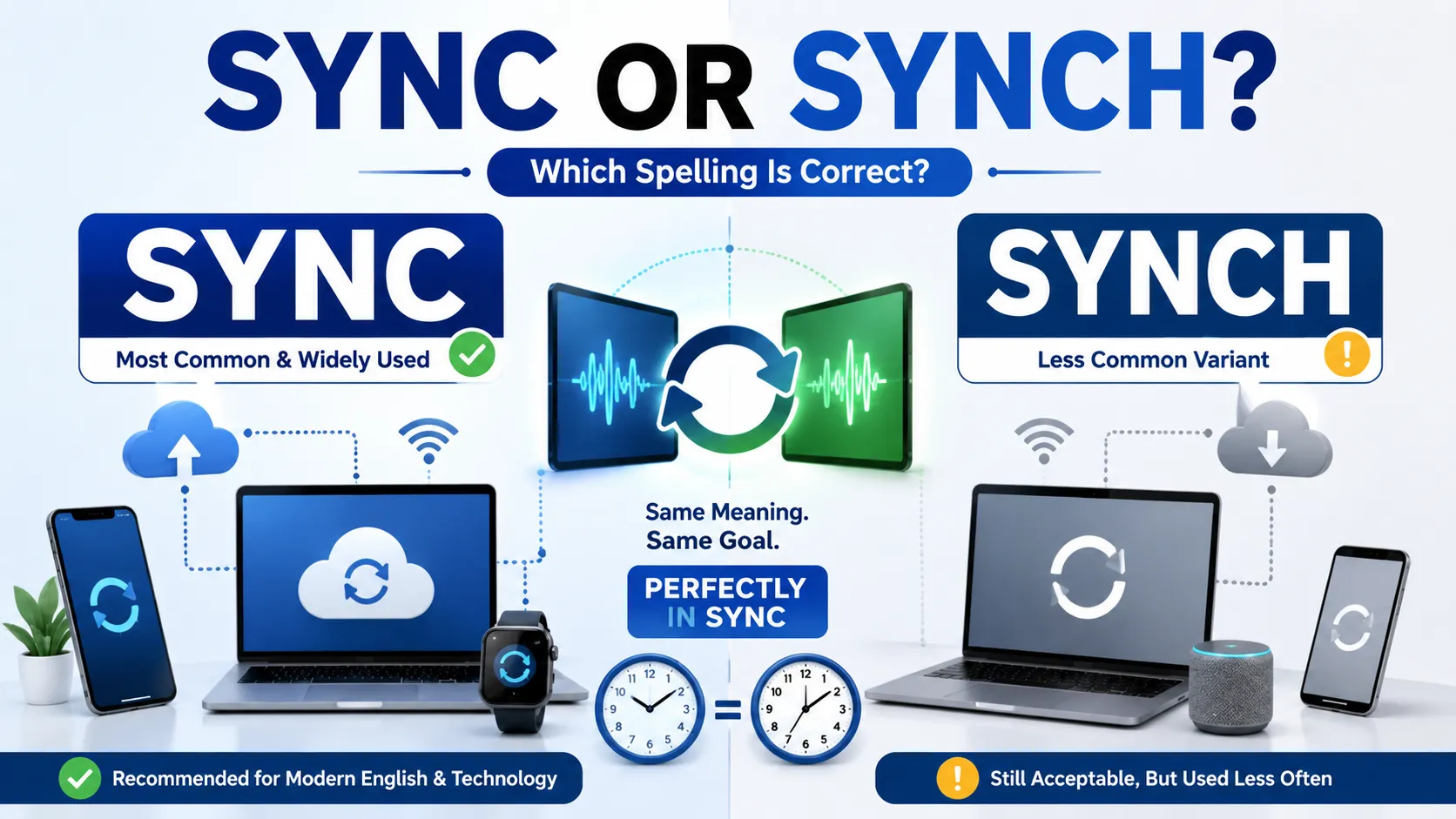
Sync and synch both mean to make things happen at the same time or to match. Sync is the more common and widely preferred spelling, especially in modern English and technology.
Have you ever typed a sentence and stopped at one tiny word: sync or synch?
I have seen this question many times while reviewing everyday English, emails, website copy, and technical writing. The confusion is easy to understand. Both spellings appear in dictionaries, apps, music, films, and professional writing.
The good news is simple. You usually do not need to overthink it.
Sync is the spelling you will see most often. It is short, clean, and widely used in modern English. You will see it in phrases such as sync your phone, keep files in sync, and audio sync.
Synch is also a real spelling. It is often used as a variant, especially when people want the word to look closer to the sound of the original word synchronization.
So, which one should you choose?
This guide breaks down the meaning, history, differences, examples, common mistakes, and best use of sync or synch. By the end, you should know exactly which spelling fits your sentence.
Sync or Synch
Sync and synch have the same basic meaning: to make two or more things happen together or match in time.
For most writing, sync is the safest choice.
Examples
- “Please sync your phone before the meeting.”
- “The audio and video are out of sync.”
- “The two dancers moved in sync.”
You may also see:
- “The audio and video are out of synch.”
- “The actors were perfectly synched.”
However, sync is much more common in modern technology and everyday English.
If you are unsure, choose sync.
The Origin and Background of Sync or Synch
The word comes from synchronization, which comes from the Greek word synchronos. It combines ideas linked to same and time.
Over time, English speakers shortened synchronization to sync.
This follows a common pattern in English. Long words often become shorter in everyday speech and writing.
For example:
- application → app
- advertisement → ad
- telephone → phone
- synchronization → sync
The spelling synch also developed as a shortened form. The extra h helps some readers see the connection between the spelling and the pronunciation.
That explains why both forms exist.
The difference is not really about meaning. It is mostly about spelling, style, and usage frequency.
Today, sync has a strong connection with technology. You may use it when talking about phones, cloud storage, calendars, music, video, software, or online accounts.
Sync or Synch Explained: What Is the Difference?
The biggest difference is simple:
Sync is the standard modern choice for most situations. Synch is an accepted variant but is less common.
| Term | Meaning | When to Use | Region/Context |
|---|---|---|---|
| sync | Match or happen at the same time | General writing and speech | Widely used |
| synch | Same basic meaning as sync | When following a source’s preferred style | Less common |
| synchronize | Make things happen together | Formal or technical writing | Widely used |
| synchronization | The act or process of matching things | Formal and technical writing | Widely used |
Example: Sync
“I need to sync my contacts.”
This sounds natural and modern.
Example: Synch
“The music was slightly out of synch with the video.”
This is understandable and acceptable, but out of sync is more common.
Example: Synchronize
“The system will synchronize your files automatically.”
This sounds more formal.
Example: Synchronization
“The software uses automatic synchronization.”
This is common in technical documents.
Which Version Should You Use?
For most readers, the answer is easy: use sync.
Here is a practical guide.
For beginners and students
Use sync.
It is short, familiar, and easy to understand.
“Make sure your files are in sync.”
For professional emails
Use sync unless your company style guide says otherwise.
“Can we sync before the client call?”
This sounds natural in modern workplace English.
For technical writing
Use sync for a short, user-friendly style.
Use synchronize or synchronization when you need a more formal technical term.
“Click Sync to update your files.”
But:
“The system performs automatic data synchronization.”
For global or neutral English
Sync is usually the best choice.
It is widely recognized across technology, business, media, and everyday communication.
For formal academic writing
Consider the full words synchronize or synchronization.
For example:
“The devices were synchronized before testing began.”
That can sound more polished than using the informal abbreviation.
Common Mistakes With Sync or Synch
Even though the spelling seems simple, a few mistakes appear often.
| Mistake | Correction | Why? |
|---|---|---|
| “Please synch your phone.” | “Please sync your phone.” | Sync is the more common modern form. |
| “The files are out of synch.” | “The files are out of sync.” | Sync is the usual spelling. |
| “I will synchronization my account.” | “I will synchronize my account.” | Synchronization is a noun. |
| “The devices are sync.” | “The devices are in sync.” | The phrase needs the correct form. |
| “We need to synk the data.” | “We need to sync the data.” | Synk is not the standard spelling. |
Mistake 1: Using “synch” everywhere
Synch is not necessarily wrong. But it can look less familiar to many readers.
Better: Use sync when you want the safest general choice.
Mistake 2: Confusing “sync” with “synchronize”
These words are related, but they do different jobs.
“Please sync the files.”
Here, sync is a verb.
“Automatic synchronization is enabled.”
Here, synchronization is a noun.
Mistake 3: Forgetting “in” or “out of”
English commonly uses the phrases:
- in sync
- out of sync
For example:
“The team’s actions were in sync.”
Not:
“The team’s actions were in sync together.”
The phrase already expresses the idea of matching.
Sync or Synch in Real World Examples
The best way to understand a word is to see it in natural situations.
1. Professional Email
“Hi Sarah,
Can we sync tomorrow morning to discuss the project? I have a few updates to share.”
Here, sync means talk or meet briefly to make sure everyone has the same information.
This use is very common in modern workplaces.
2. News Headline
“New Software Helps Devices Stay in Sync”
Here, sync refers to devices working together or keeping information updated.
It is short and easy to understand.
3. Social Media Post
“Finally got all my photos in sync across my devices. So much easier!”
This is a natural casual use of the word.
4. Formal Report
“The two systems were synchronized before the final test.”
Notice the change.
A formal report may prefer synchronized instead of the shorter sync.
5. Entertainment and Media
“The subtitles are out of sync with the dialogue.”
This is another common use.
It means the words on screen do not match the timing of the spoken words.
Sync or Synch: Data, Trends & Usage
The search intent behind “sync or synch” is mainly informational.
People usually search the phrase because they want to know:
- Which spelling is correct?
- Is synch a real word?
- Should I write sync or synch?
- Is one spelling more formal?
- How should I use the word in a sentence?
Modern technology has made sync especially common.
Phones, computers, cloud storage, calendars, browsers, apps, music services, and online accounts all use the idea of synchronization.
You may see phrases such as:
- sync settings
- sync contacts
- sync data
- sync files
- sync devices
- cloud sync
- audio sync
- calendar sync
- in sync
- out of sync
This matters because language follows real-world use. As technology became part of daily life, sync became a familiar word for millions of users.
The practical lesson is simple: if you are writing for a broad audience, sync is usually the clearest choice.
Sync or Synch: Standalone Comparison
| Term/Variant | Meaning | Region/Context | Best Used When |
|---|---|---|---|
| Sync | Match or coordinate | General English | Most everyday and digital writing |
| Synch | Match or coordinate | Variant spelling | When a style or source uses it |
| Synchronize | Make things occur together | Formal/general | Formal sentences and instructions |
| Synchronization | The process of matching | Technical/formal | Reports, manuals, and academic writing |
There is no major difference in meaning between sync and synch.
The main difference is frequency and style.
Think of sync as your default choice.
FAQ: Sync or Synch
Q: What does sync mean?
A: Sync means to make two or more things match or happen at the same time. It can also mean to update information so that different devices or systems have the same data.
Q: How do you use sync correctly?
A: Use sync as a verb when you mean “make things match.” For example: “Please sync your phone.” It can also be a noun, as in “Let’s have a quick sync.”
Q: Sync vs synch — what is the difference?
A: Both words have the same basic meaning. Sync is much more common, especially in modern English and technology, while synch is a less common variant.
Q: Is sync acceptable in formal writing?
A: Yes, but context matters. In very formal or academic writing, synchronize or synchronization may sound more appropriate than sync.
Q: Which version is correct — sync or synch?
A: Both spellings are used, but sync is the safest and most widely recognized choice. If you are unsure, use sync.
Q: Where does sync come from?
A: Sync is a shortened form of synchronize or synchronization. These words ultimately trace back to Greek roots connected with the idea of happening at the same time.
Q: Can sync be used in professional communication?
A: Yes. It is very common in workplace English. For example, “Can we sync tomorrow?” is a natural way to ask for a short meeting or discussion.
Q: Is “in sync” correct English?
A: Yes. In sync means that people, things, or systems are working together or matching. For example, “The two teams are in sync.”
Conclusion
If you remember only one thing, remember this: use sync when you need the safest, simplest, and most widely understood spelling.
Sync and synch share the same basic meaning. Both relate to things happening together or matching. However, sync is far more common in modern everyday English, workplace communication, and technology.
Use sync for sentences like:
“Please sync your phone.”
“The files are out of sync.”
“Let’s sync before the meeting.”
For formal documents, you can choose synchronize or synchronization when the full form fits better.
The key is not to worry about the choice too much. If your goal is clear, natural English, sync is an excellent default.
Now you know exactly when to use sync or synch. Bookmark this guide so you never have to second-guess the spelling again.
Read more: Scrapped or Scraped? Learn the Difference with Easy Examples

I started writing about English word differences after years of teaching students who kept making the same mistakes. My focus is on making spelling rules feel simple and easy to remember. At WordsCombo, I turn confusing word pairs into clear comparisons.