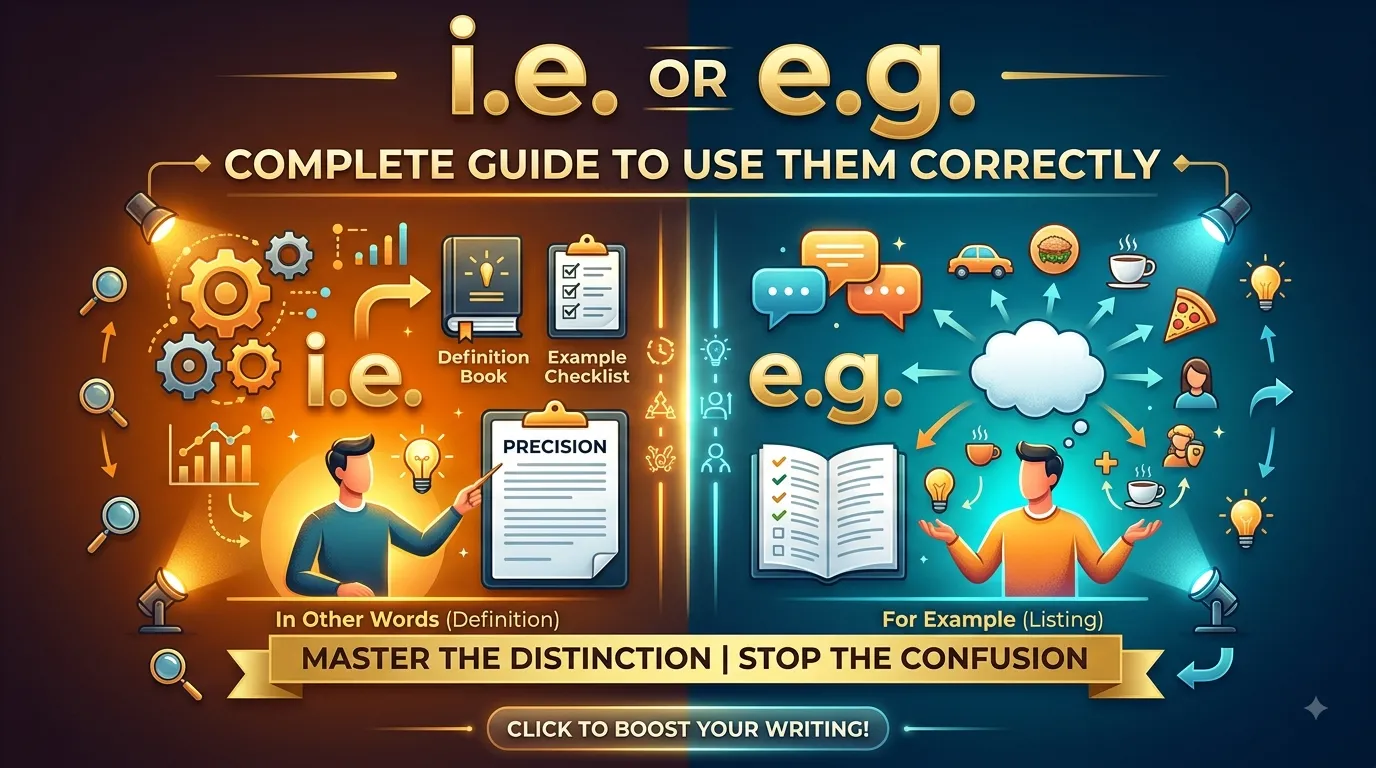
i.e. or e.g. are Latin abbreviations used in English writing. i.e. means “that is” and explains something more clearly, while e.g. means “for example” and introduces examples.
I still remember reviewing a business report where a writer used i.e. before listing several examples. The sentence looked professional at first glance, but the meaning was completely wrong. It was a small mistake that changed the message.
Many English learners, students, and even experienced writers confuse i.e. or e.g. because both abbreviations come from Latin and often appear inside parentheses. They look similar, they are short, and they are frequently used in the same types of sentences.
The problem is not remembering the letters. The real challenge is understanding the purpose behind each abbreviation.
i.e. helps you explain or restate something. e.g. helps you give examples without naming every possibility.
In this guide, you will learn the exact difference between i.e. or e.g., their history, correct usage, common mistakes, examples, and simple tricks to remember which one to choose.
i.e. or e.g. : Quick Answer
The difference between i.e. and e.g. is simple:
- i.e. means “in other words” or “that is.” It introduces a clarification or a specific explanation.
- e.g. means “for example.” It introduces one or more examples from a larger group.
Simple examples:
Using i.e.:
I will visit the largest city in Japan, i.e., Tokyo.
Here, Tokyo is the exact city being discussed.
Using e.g.:
I enjoy Asian cuisines, e.g., Japanese, Thai, and Korean food.
Here, Japanese, Thai, and Korean food are only examples.
A quick memory trick:
i.e. = in explanation
e.g. = example given
The Origin / Background of i.e. or e.g.
The abbreviations i.e. and e.g. come from Latin, the language once used widely in science, education, and official documents.
Meaning of i.e.
i.e. comes from the Latin phrase id est, which means “that is” or “it is.”
English writers use it when they want to explain something in a different way or provide a more exact meaning.
Example:
The meeting will happen in the capital city, i.e., London.
London is not one possible option. It is the exact location.
Meaning of e.g.
e.g. comes from the Latin phrase exempli gratia, meaning “for the sake of example.”
It is used when you want to provide examples but do not want to list everything.
Example:
Many programming languages are popular today, e.g., Python, JavaScript, and Java.
These are examples, not the complete list.
Why do people confuse them?
The confusion happens because both abbreviations:
- Are written with small letters
- Usually appear inside sentences
- Often include commas
- Come from Latin
- Are common in academic and professional writing
However, their jobs are different.
i.e. or e.g. Explained : Key Differences and Variations
Understanding the purpose behind each abbreviation makes correct usage much easier.
| Term | Meaning | When to Use | Region/Context |
|---|---|---|---|
| i.e. | That is; in other words | When explaining a specific meaning | Academic, professional, formal writing |
| e.g. | For example | When giving examples | General, academic, business writing |
When to use i.e.
Use i.e. when you want to define, clarify, or narrow down an idea.
Example:
The project requires a technical expert, i.e., someone with software development experience.
The second part explains exactly what “technical expert” means.
When to use e.g.
Use e.g. when you want to mention some examples.
Example:
You can improve your writing skills through different methods, e.g., reading books, practicing daily, and writing journals.
The examples do not represent every possible method.
Which Version Should You Use?
Choosing between i.e. or e.g. depends on your purpose.
For students and academic writers
Use i.e. when defining a concept.
Example:
Renewable energy, i.e., energy from natural sources, is becoming more common.
Use e.g. when adding examples.
Example:
Renewable energy sources include many options, e.g., solar, wind, and hydro power.
For business professionals
Use both carefully in:
- Reports
- Presentations
- Emails
- Research documents
However, avoid overusing Latin abbreviations when a simple phrase works better.
Instead of:
We need better marketing channels, e.g., social media.
You can write:
We need better marketing channels, such as social media.
For general online writing
Clear language is usually better.
Many readers understand:
- “for example”
- “that is”
- “such as”
more easily than abbreviations.
For global audiences, writing the full words can improve readability.
Common Mistakes with i.e. or e.g.
Many writers make small errors with these abbreviations. Here are the most common ones.
| Mistake | Correction | Why It Happens |
|---|---|---|
| Using i.e. before examples | Use e.g. instead | People confuse explanation with examples |
| Using e.g. when giving one exact answer | Use i.e. instead | The writer wants to clarify a meaning |
| Forgetting commas | Add commas after abbreviations | Style rules are ignored |
| Using both together | Choose one based on meaning | Both look similar |
| Overusing abbreviations | Use simple words when possible | Writers try to sound formal |
Mistake 1: Wrong use of i.e.
Wrong:
I like outdoor activities, i.e., hiking and swimming.
Correct:
I like outdoor activities, e.g., hiking and swimming.
Why?
Hiking and swimming are examples, not the complete meaning of outdoor activities.
Mistake 2: Wrong use of e.g.
Wrong:
My favorite fruit is tropical fruit, e.g., mango.
Correct:
My favorite tropical fruit is mango, i.e., the fruit I eat most often.
Why?
The sentence needs clarification, not examples.
i.e. or e.g. in Real-World Examples
Professional email
We need documents from your company, i.e., the registration certificate and tax information.
Here, the writer explains exactly which documents are needed.
News article
Several countries, e.g., Canada, Germany, and Australia, have introduced new environmental policies.
The writer gives examples of countries.
Social media post
Small habits can improve productivity, e.g., planning your day, avoiding distractions, and setting goals.
The examples show possible habits.
Formal report
The company follows strict quality standards, i.e., every product must pass safety testing before delivery.
The abbreviation introduces a clear explanation.
i.e. or e.g. : Data, Trends & Usage
The search interest around i.e. or e.g. remains high because these abbreviations are common problems for English learners and professional writers.
People often search for:
- Difference between i.e. and e.g.
- When to use i.e.
- When to use e.g.
- i.e. vs e.g. examples
- Correct grammar usage
The topic mainly attracts:
- Students
- ESL learners
- Content writers
- Researchers
- Business professionals
The reason this topic matters today is simple: clear communication is more valuable than ever. A small abbreviation mistake can affect the meaning of an email, report, article, or academic paper.
Standalone Comparison Table: i.e. vs e.g.
| Term/Variant | Meaning | Region/Context | Best Used When |
|---|---|---|---|
| i.e. | That is / in other words | Formal English writing worldwide | Explaining one exact meaning |
| e.g. | For example | Formal and informal writing worldwide | Providing examples |
| That is | Full English replacement for i.e. | Everyday communication | You want maximum clarity |
| For example | Full English replacement for e.g. | General writing | You want readers to understand easily |
FAQ Section
Q: What does i.e. or e.g. mean?
A: i.e. means “that is” and is used to explain something more clearly. e.g. means “for example” and introduces examples from a larger group.
Q: How do you use i.e. correctly?
A: Use i.e. when you are giving the exact meaning of something. It should introduce a clarification, not a list of examples.
Q: i.e. vs e.g. : what is the difference?
A: The main difference is purpose. i.e. explains a specific idea, while e.g. provides examples that represent a wider category.
Q: Is i.e. or e.g. acceptable in formal writing?
A: Yes, both are acceptable in academic and professional writing. However, some style guides prefer using the full phrases “that is” and “for example” for better readability.
Q: Which version is correct : i.e. or e.g.?
A: Both are correct, but they are used in different situations. Choose i.e. for explanations and e.g. for examples.
Q: Where do i.e. and e.g. come from?
A: Both abbreviations come from Latin. i.e. comes from id est, while e.g. comes from exempli gratia.
Q: Can i.e. or e.g. be used in online content?
A: Yes, they can be used in blogs, articles, and websites. Still, using simple words like “for example” may make content easier for a wider audience.
Conclusion
Understanding i.e. or e.g. is a small skill that creates a big improvement in your writing. These two abbreviations may look similar, but they have completely different purposes.
Remember these three simple rules:
- i.e. = explain the exact meaning
- e.g. = give examples
- Use full phrases when your audience may not know these abbreviations
Good writing is not about using complicated words. It is about making your message clear and easy to understand.
Whether you are writing an email, academic paper, blog post, or business report, choosing the correct abbreviation helps your readers follow your ideas without confusion.
Now you know exactly how to use i.e. or e.g. save this guide and use it whenever you are unsure.
Read more: Me or I: Complete Guide to Using Them Correctly

I have been writing about English spelling and word usage for the past five years. My goal is to give readers a clear answer without overwhelming them with complicated rules. At WordsCombo, I focus on making everyday English easier for everyone.