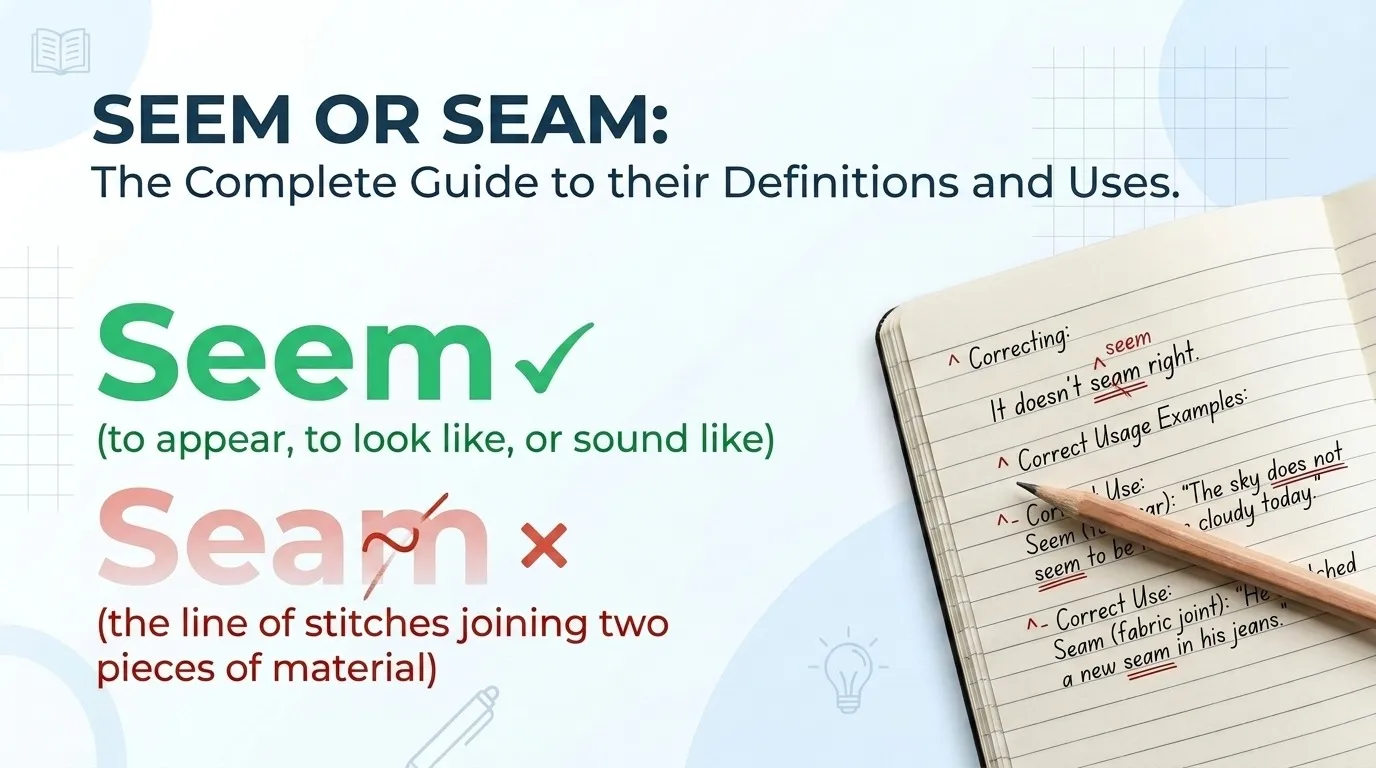
Seem means to appear or give an impression, while seam is the line where two pieces of material are joined together. They sound the same but have very different meanings.
A few years ago, I was editing a student’s essay when I found this sentence: “You seam very confident.” It made me smile because I had seen the same mistake many times before. Even experienced writers mix up seem and seam because they sound exactly alike.
If you have ever paused while typing and wondered which word is correct, you are not alone. English is full of words that sound the same but mean different things. These are called homophones, and they often cause confusion.
The good news is that this mistake is easy to fix once you know the difference. After reading this guide, you will understand what each word means, when to use it, and how to remember the correct spelling forever. Along the way, you’ll also see real examples, common mistakes, and practical tips you can use every day.
Let’s clear up the confusion once and for all.
Seem or Seam: Quick Answer
The words seem and seam sound the same but have different meanings.
- Seem means to appear, look, or give an impression.
- Seam means a stitched line joining two pieces of fabric or another material.
Examples
- You seem happy today.
- The shirt has a torn seam.
- It seems like rain is coming.
- The tailor repaired the seam on my jacket.
Remember:
If you’re talking about appearance, use “seem.” If you’re talking about sewing, use “seam.”
The Origin and Background of Seem or Seam
Although these words sound identical today, they came from different origins.
Seem
The word seem comes from Old Norse sœma, meaning to appear suitable or fitting. Over time, its meaning changed to “appear” or “look like.”
Seam
The word seam comes from Old English sēam, meaning a stitched joint or a line where materials meet.
Because English pronunciation changed over hundreds of years, both words eventually sounded the same. That is why many writers still confuse them today.
Seem or Seam Explained Key Differences
Although they are pronounced the same, their meanings are completely different.
| Term | Meaning | When to Use | Region/Context |
| Seem | To appear or give an impression | Opinions, feelings, observations | Worldwide English |
| Seam | A stitched line joining materials | Sewing, clothing, engineering, sports | Worldwide English |
Use “Seem” When
- Giving an opinion
- Describing appearances
- Making observations
- Talking about possibilities
Examples:
- You seem tired.
- This movie seems interesting.
- It seems impossible.
Use “Seam” When
- Talking about clothing
- Sewing fabric
- Sports equipment
- Any joined edge
Examples:
- The dress has a loose seam.
- The baseball’s seam helps pitchers throw different pitches.
- Check every seam before buying the backpack.
Which Version Should You Use?
The answer depends entirely on what you mean.
For Students
Use seem when writing essays, reports, or answering questions about opinions or appearances.
Example:
The results seem accurate.
For Tailors, Designers, or Crafters
Use seam when discussing clothing, stitching, or fabric.
Example:
Strengthen the shoulder seam.
For Business Professionals
Most workplace writing uses seem.
Example:
The proposal seems reasonable.
For Global English
Both American and British English use the same spellings.
- Seem = appearance
- Seam = stitched line
There is no regional difference.
Common Mistakes with Seem or Seam
These errors happen often because both words sound identical.
| Mistake | Correct Version | Why |
| You seam happy. | You seem happy. | Talking about appearance. |
| The shirt seem is ripped. | The shirt seam is ripped. | Talking about fabric. |
| It seams impossible. | It seems impossible. | Verb meaning “appears.” |
| Fix the seem. | Fix the seam. | Sewing term. |
| She seams nervous. | She seems nervous. | Describing appearance. |
Easy Memory Trick
Think:
- Seem = See
- If you can see an impression, use seem.
- Seam = Sewing
- Both words begin with S.
Seem or Seam in Real World Examples
Professional Email
The updated proposal seems ready for approval.
News Headline
Experts Say Inflation Seems to Be Slowing
Social Media Post
This sunset seems unreal! 🌅
Formal Report
The collected data seems consistent across all samples.
Clothing Label
Reinforced shoulder seam improves durability.
Tailor’s Note
Please repair the side seam before delivery.
Seem or Seam Data, Trends & Usage
People search for seem or seam because they hear the words spoken but are unsure which spelling fits their sentence.
Most Common Search Intent
Informational
Users want to know:
- Which spelling is correct
- What each word means
- How to avoid mistakes
- Real examples
Who Searches Most?
- Students
- English learners
- Bloggers
- Copywriters
- Teachers
- Professionals
Regions
Interest is highest in:
- United States
- United Kingdom
- Canada
- Australia
- India
Why It Matters Today
Grammar checkers catch many spelling mistakes, but they often miss homophones because both words are correctly spelled. Knowing the difference yourself helps you write with confidence.
Comparison Table
| Term/Variant | Meaning | Region/Context | Best Used When |
| Seem | To appear | Everyday English | Giving an impression |
| Seems | Appears | Everyday English | Third person singular sentences |
| Seam | Stitched joint | Sewing, clothing, sports | Talking about fabric or joined edges |
| Seams | Multiple stitched joints | Clothing and construction | Referring to more than one seam |
Frequently Asked Questions
Q: What does “seem” mean?
A: Seem means to appear or give an impression. It does not always mean something is true, only that it looks that way.
Q: What does “seam” mean?
A: A seam is the line where two pieces of material are stitched or joined together. It is commonly used when talking about clothing, bags, shoes, and sports equipment.
Q: How do I use “seem” correctly?
A: Use seem whenever you describe how something appears.
Example:
You seem excited.
Q: Is “seam” ever used to describe people?
A: No. Seam refers to physical joins in materials. When describing people or feelings, use seem.
Q: Which is correct: “You seem happy” or “You seam happy”?
A: You seem happy is correct because you are describing someone’s appearance or impression.
Q: Is “seem” acceptable in formal writing?
A: Yes. It is widely used in essays, reports, academic writing, business communication, and professional documents.
Q: Can “seam” be used outside sewing?
A: Yes. It is also used in engineering, geology, mining, construction, and sports. For example, a baseball has raised seams, and coal forms in seams underground.
Conclusion
The difference between seem and seam is simple once you know what each word represents. Seem is about appearance, opinion, or impression. Seam is about something physical that joins two pieces together, especially fabric.
Whenever you’re writing, pause for one second and ask yourself a simple question: Am I talking about how something appears, or am I talking about stitching? That quick check will help you choose the correct word almost every time.
Learning small differences like this makes your writing clearer and more professional. It also helps you avoid common mistakes that spell checkers sometimes miss because both words are spelled correctly.
Now you know exactly how to use seem and seam with confidence. Bookmark this guide so you never second guess these words again, and share it with anyone who has ever mixed them up.
Read more: Parents or Parent’s: The Complete Guide to Correct Usage

I have been writing about English spelling and word usage for the past five years. My goal is to give readers a clear answer without overwhelming them with complicated rules. At WordsCombo, I focus on making everyday English easier for everyone.